CV check
How to improve your CV for the Swiss market — the full pass
Updated:
In short
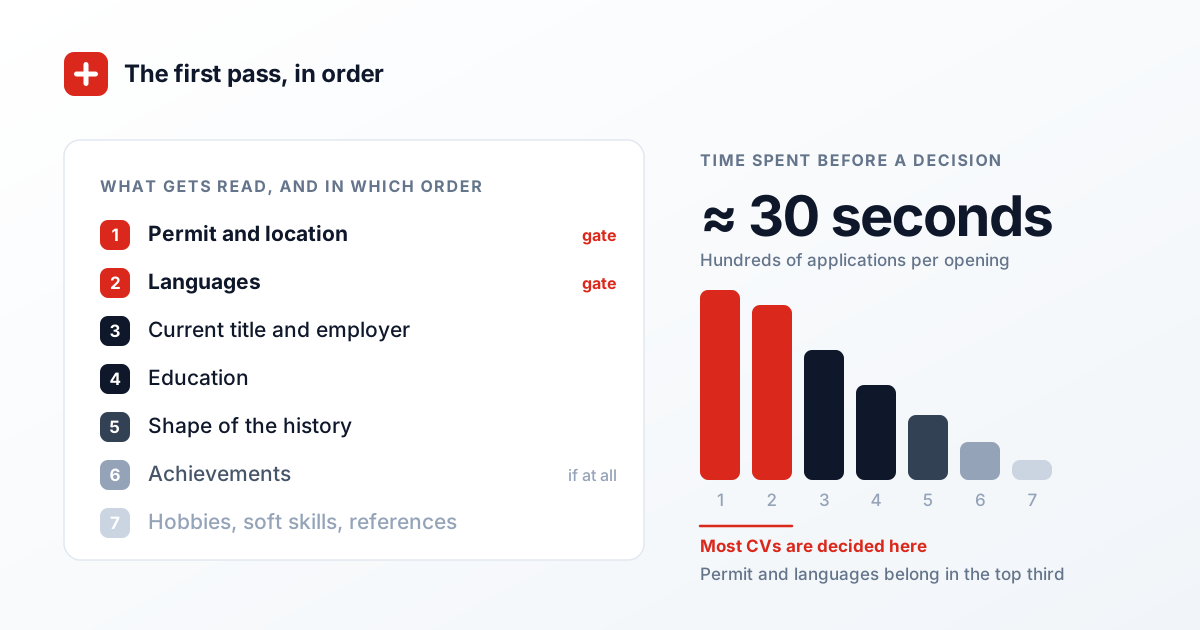
The pass has an order, and it does not start with the layout. First decide which part of the market this document is written for: among open Swiss adverts that state a language requirement, English at working level on its own covers 20.3 per cent of them. German at working level covers 38.9 per cent, and German plus English covers 74.3 per cent. Only then do you build the top of page one around the two gates — permit and language — and only last do you rewrite the experience section.
This is the base pass, the one you do once: an evening, your documents on the table, no particular advert in front of you. Tailoring to a specific posting is a second, much shorter job of about twenty minutes, and it assumes the seven steps below are already done. Mixing the two is why people rewrite the same document fifty times and never end up with a version the next application can build on.
If you are arriving from outside Switzerland, the most useful thing to know early is that this is a dossier, not a resume. arbeit.swiss, the federal employment portal, lists the cover letter, the CV and your work references, diplomas and certificates as the usual components, and asks that the references be complete, in chronological order with the most recent first, and collected in a single PDF. Arbeitszeugnis — the written reference a Swiss employer issues when you leave — has no equivalent in most countries and is expected here.
The order below puts the expensive things first. A beautifully written experience section does not save a CV whose top third leaves your permit status open, and no wording opens an advert that requires a language at working level you do not have. What you control is whether what you bring is visible in the seconds where the sorting happens.
Open adverts on SwissJobs.app excluding apprenticeships, internships and trainee schemes, counted on 5 September 2026. Only adverts that state a language requirement are included; a profile covers an advert when it meets every language demanded, at the level demanded.
- Two thirds of open adverts state a language requirement at all. Among those, 65.9 per cent ask for German, 46.2 per cent for English, 22.2 per cent for French and 3.6 per cent for Italian, and 30.8 per cent ask for more than one.
- English at working level on its own covers 20.3 per cent of the adverts that state a requirement — 29.3 per cent in French-speaking Switzerland, 17.8 per cent in the German-speaking cantons, 16.9 per cent in Ticino. An advert written in English is not the same thing as an English-language workplace.
- Adding German at conversational level to working English takes you from 20.3 to 28.8 per cent. Adding German at working level takes you to 74.3. The level, not the number of languages, is where the market opens.
- The advert almost never tells you what to send: a permit or residence status is mentioned in under one per cent of open adverts, a complete set of application documents in a fraction of a per cent. The default set still applies — you are expected to know it.
- arbeit.swiss caps the CV at three pages, asks for reverse chronological order and lists eight usual contents, from the title to references. References themselves go in as a note that they are available on request.
- The German version of that federal page hedges the photo as "gegebenenfalls" — where applicable. The French, Italian and English versions of the same page list it without the hedge. The convention is real; the requirement is not.
1. Check which part of the market is open to you before you edit anything
Start with the arithmetic, not the wording. Among open adverts that state a language requirement, working English alone fully covers 20.3 per cent. Working German alone covers 38.9 per cent, and the two together 74.3 per cent. Add French and you reach 93.5 per cent. These are not opinions about the Swiss market; they are what the adverts themselves ask for.
The distribution across the country matters more than a national average if you are choosing where to look. English alone covers 38.9 per cent of Geneva adverts and 30.1 per cent of Zurich adverts, but only 5.9 per cent in Bern and 7.4 per cent in St. Gallen. Ticino sits at 16.9 per cent. A search that ignores this reads as bad luck and is really a filter you set yourself.
The single largest gain is not another language, it is a level. German at conversational level alone covers 6.5 per cent of these adverts; German at working level covers 38.9 per cent. If you are already learning, that is the step worth finishing before you decide the market is closed. About a third of adverts state no language requirement at all — that is silence, not an open door, and the language the advert is written in is the best hint available.
2. Build the top of page one as an answer to the two gates
The first pass over a CV sorts rather than evaluates, and it sorts on two questions: can this person start, and does the language fit? Both belong in the top third of page one. So the personal block carries your name, the job title as the market writes it, your city and canton, your permit status, your contact details — and, if you want a specific arrangement, the workload in per cent and your earliest start date.
The permit line is where most is lost silently. The advert will not prompt you: a permit, residence status or nationality is mentioned in under one per cent of open adverts. Leaving it out does not get you rejected, it makes you an open question, and open questions are skipped rather than resolved during a first screen. One line closes it — where you live, which permit you hold, and whether an employer would need to sponsor anything.
On the photo, read the source rather than the advice columns. arbeit.swiss lists "personal details, including photograph" in its English version, "avec photo vous mettant en valeur" in French and "inclusa la vostra fotografia" in Italian, while the German version says "gegebenenfalls" — where applicable. So a photo is conventional and nowhere required. If you are coming from the UK, Ireland or the US, this is the reverse of the habit you bring, and omitting it here carries no advantage.
3. Write the language block in levels, and split it by skill
The language block is the second gate and belongs near the top, not at the end after your interests. One line per language, the level from the Common European Framework, then the certificate and its year if you hold one. Your first language goes first and is called your mother tongue. Drop the bars, stars and percentages: they claim a precision nobody can check and say less than two characters would.
The framework is finer than most CVs use. The Europass self-assessment grid grades five separate skills — listening, reading, spoken interaction, spoken production and writing — across six levels. That is why a split entry such as "German: B2 written, C1 spoken" is the intended form rather than an oddity. It is also more useful to a Swiss recruiter, because the job may be spoken German with English documentation, or the exact opposite.
Then compare your block with what the market asks for: German in 65.9 per cent of the adverts that state a requirement, English in 46.2, French in 22.2, Italian in 3.6, and more than one language in 30.8 per cent. An honest second line is worth more here than a flattering first one. The level gets tested in the first ten minutes of the interview, usually by switching languages mid-conversation.
4. Turn every role from responsibilities into results
Only now comes the part most people start with. The structure is set: reverse chronological, most recent first, no more than three pages in total. A role opens with a header line — title, employer, place, dates, and the workload in per cent if it was not full time — and carries two to four lines underneath. Those lines are the real work of the pass.
The difference that counts in a Swiss first screen is between a responsibility and a result. "Responsible for the marketing budget" describes a job description, not you. "Ran a CHF 400k budget, cut cost per new customer by a fifth" describes what happened while you were there. Take one number per role that you can defend in an interview — volume, time, money, headcount — and delete the lines where no number comes to mind.
Close gaps with a line rather than with silence. The federal page is explicit about it in three of its four language versions: the CV should not contain any gaps, "évitez les lacunes dans votre parcours", "senza lacune nella cronologia". Six months for a relocation, a course, family or a sabbatical is unremarkable when it is named, and gets filled in with the least generous assumption when it is not.
5. Write qualifications the way this market writes them
The education block is short and it is read closely, because Switzerland has a dedicated route into almost every occupation. Write the qualification as it is called here — EFZ for a federal apprenticeship certificate, eidgenössischer Fachausweis, HF, or the Bachelor or Master with its institution — plus place and year of completion. Vocational qualifications are not a lesser version of a degree in this market; for a large share of occupations they are the standard route.
For a foreign qualification, write the original title with the country and the institution. Only put a Swiss equivalent beside it if you actually hold a recognition decision; without one, the equation is a claim that shows up in the interview. For regulated occupations, recognition is a question of admission rather than of wording, and it is worth resolving before you apply rather than after.
Continuing education belongs in the same block, but only where it contributes to the role you are applying for. One course from this year says more about your direction than a list reaching back a decade. The diplomas and certificates themselves do not go in the CV — they belong in the dossier file, which is the next step.
6. Assemble the dossier without waiting for an advert to ask
The second half of the pass is filing, and it is the half most often skipped. arbeit.swiss asks that all work references are complete, in chronological order with the most recent first, and that all documents are collected into one PDF — the same for diplomas and certificates. References themselves appear in the CV only as a note that they can be provided on request; the list of names is handed over at the interview.
The official advice is to look at the advert to see which documents are required — that is what the cantonal careers portal tells you to do. In practice that advice rarely helps: complete application documents are mentioned in a fraction of a per cent of open adverts, work references or referees in under one per cent. That does not mean they are not expected. It means the default set applies and nobody is going to write it down for you.
Before you send, run the short checklist from the same federal page: spelling and formatting errors, completeness of the documents, correct and unambiguous file names. Send PDFs, from a serious email address containing your first and last name. A file called "Surname_Firstname_Application.pdf" is not cosmetics — it is the first work sample that arrives, and the only one that acts before anything is read.
7. Check it against a real advert, then measure honestly
The base pass is finished when you hold it against a real posting. Take an advert you would actually apply to and check in this order: does your language line cover what it asks for, and at which level? Is the permit and location line in the top third? Do the words the advert uses for the work appear in your first three result lines? Fonts and spacing come after all of that, not before.
What you cannot measure at this point is the effect. Reply rates are a slow signal: ten applications before and ten after tell you almost nothing, because two runs of ten differ that much by chance alone. Measure what is measurable the same day instead — whether the four checks above are a yes, and whether you can now adapt the document to a new advert in twenty minutes rather than rewriting it.
If you would rather not do that comparison by hand, it is exactly what the CV check is built for: you give it the CV and the posting and get back the points where the two diverge. It does not replace the pass; it tests it. And the step after that is not another tool, it is the twenty minutes per advert that this base version now makes possible.
What people report
Public posts by recruiters working in Switzerland raise one point that general CV advice almost never mentions: in technical, scientific and finance-adjacent fields, transcripts or final grades are expected alongside the diploma. Not having them to hand delays exactly the stage that otherwise moves quickly.
Public LinkedIn post by a recruiter working in the Swiss market on the complete Swiss application file, September 2025, from our existing collection; published as the pattern, not as a quotation.
The same posts recommend giving language ability in split form — for example German at B2 written and C1 spoken — rather than one level per language. That matches how the Common European Framework is built, since it assesses the skills separately in the first place.
The same post plus recurring guidance in German- and English-language LinkedIn posts on Swiss application documents, reviewed in September 2026, checked against the self-assessment grid on the Europass page for the framework.
All market figures were counted on 5 September 2026 from the adverts open on SwissJobs.app at that moment. Apprenticeships, internships and trainee schemes are excluded, because their requirements follow a different logic. The language statements come from the field recorded per advert holding the languages demanded and their level; each advert is counted once, at the highest level demanded per language. Around two thirds of adverts carry such a requirement, and every coverage share refers only to those adverts. A profile "covers" an advert when it meets every language demanded there at least at the level demanded; a language demanded at mother-tongue level counts as not covered, so the figures are conservative rather than generous. Language regions are assigned from the place named in the advert, which resolves for just under nine in ten adverts. The statements about what an advert asks you to supply come from the short summary of the advert text, available for just over nine in ten adverts; summaries drop detail, so those shares are lower bounds. Structure, page limit, the eight usual contents, the ordering of work references and the pre-send checklist come from the "Bewerbungstipps" page on arbeit.swiss (SECO) in its German, French, Italian and English versions; the advice to check the advert for the documents required comes from the cantonal careers portal berufsberatung.ch and orientation.ch; the levels and the self-assessment grid from the Europass page on the Common European Framework. All were read on 5 September 2026.
Check how your CV fits a job — and the Swiss market
Free checker: languages, work permit, skills and more — scored against a specific posting.
ATS CV checker: against a specific advert, freeSources
- arbeit.swiss (SECO), English — Tips on applying for jobs: the application file, the CV, work references and the pre-send checklist
- travail.swiss (SECO), French version of the same page — "avec photo vous mettant en valeur", "Évitez les lacunes dans votre parcours"
- berufsberatung.ch careers portal — "Sich bewerben": check the advert for the documents required (German; French twin at orientation.ch)
- Europass — Common European Framework of Reference: self-assessment grids across five skills
What our job index says about the Swiss market
Computed live from our own index, not quoted from a study. Shares only, as of today.
Language the advert is written in
- Deutsch
- 60%
- English
- 23%
- Français
- 13%
- Italiano
- 3%
Of adverts that state a language requirement, the share asking for
- Deutsch
- 70%
- English
- 43%
- Français
- 21%
- Italiano
- 3%
19% posted in the last 7 days · Largest markets: Zürich 18% · Bern 10% · Genève 5% · Basel 5%