How do I mention my permit in a cover letter?
Updated:
In short
One sentence, placed where your start date is, stating the consequence rather than the permit letter: "I am an EU national, so the residence permit is issued by the commune against a signed contract — I can start on 1 November." The category itself belongs in the personal details of your CV. The letter says only what it means for the employer: whether they have to do anything, and when you are available. If you already hold a valid permit, the letter says nothing at all about it.
The competent cantonal migration or labour market authority and the State Secretariat for Migration are the binding sources. Permit questions turn on individual circumstances. This is editorial guidance, not legal or immigration advice.
That split has a reason. A CV is read to place you; a letter is read to prepare a decision. A permit category places you. A date, a responsible party and an effort estimate are what a decision runs on. So the letter should answer the only two questions a Swiss employer silently asks: is there work here for me, and from when are you actually available?
For nationals of EU and EFTA states the first answer is almost always no. The residence permit is at the same time the work permit, and the cantonal authorities issue it once an employment contract exists — nothing has to happen before an offer. For everyone else the answer is a firm yes: the employer, not the applicant, files the application with the canton.
Whichever side you are on, the second answer is the one that earns its space. Give a date or a range, give the reason for it in half a sentence, then stop and go back to the job.
Median age of currently open vacancies, counted from their publication date, across those adverts whose language can be determined. The measure describes how long adverts stay open, not how long a hire takes. As at 23 August 2026.
- One sentence, in the availability paragraph — not in the opening line and not in the closing one.
- State the consequence, not the category: who applies, how long it takes, when you can start.
- Holding a valid EU/EFTA permit already? Leave the sentence out. The line in your CV has covered it.
- Non-EU/EFTA: name the six-to-eight-week window yourself, and say plainly that the application is filed by the employer with the canton.
- No scans, no permit number, no authority addresses in the letter. The document itself is checked later, in the original.
- No apology. A procedure is a date in a calendar, not a defect — and a reason to name a precise one.
EU and EFTA nationals: the permit follows the contract
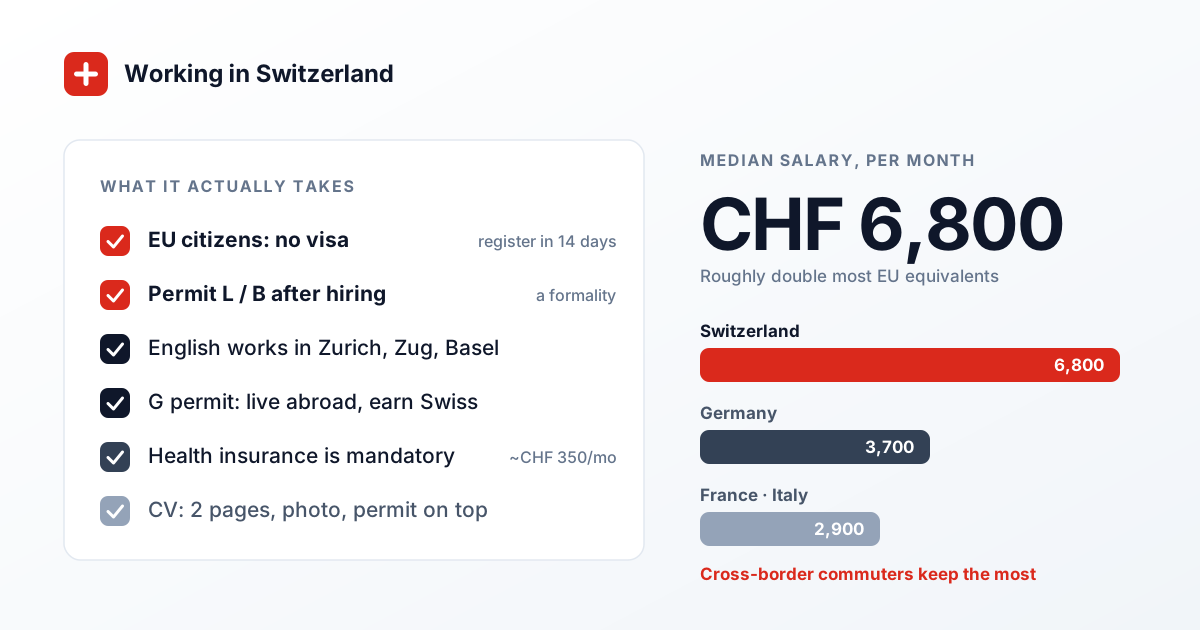
For citizens of EU and EFTA states the residence permit is the work permit. The State Secretariat for Migration describes the sequence plainly: it is issued on presentation of a written declaration of employment or an employer confirmation — an employment contract stating duration and workload, for instance. For a job lasting three months or more you register with your commune of residence within 14 days of arrival and before you take up the post. A contract of up to 364 days gets a short-stay permit; a contract of a year or more, or an open-ended one, gets a residence permit. The steps can be completed after you arrive.
For the letter that means there is nothing to resolve, only something to schedule. "As an Irish citizen I register with the commune once the contract is signed, so a start in early November is realistic" answers the question completely and costs two lines.
If you are already working in Switzerland on such a permit, you have even less to write. The EU/EFTA residence permit carries the right to change job and occupation, the short-stay permit carries it too, and both are valid across the whole country; regulated professions and public offices involving the exercise of official authority — the military, the police, the judiciary — are the exceptions. Moving canton is a change of address, not a new permit. Explaining your permit in that situation answers a question nobody asked.
Third-country nationals: the sentence does not save the work, it saves the surprise
If you hold a passport from outside the EU and EFTA, the position is different and sugar-coating helps nobody. The SEM says it without hedging: a job offer in Switzerland is not enough. The employer has to respect the precedence of domestic and EU/EFTA workers, demonstrate that your personal and professional qualifications are met and that pay and working conditions match local, occupational and sector norms — and a unit of the relevant quota has to be available. The employer files the application with the cantonal migration or labour market authority; the SEM then has to give its approval.
On timing the SEM publishes a figure from its own practice: as a rule, expect six to eight weeks once a complete file has been submitted, longer in complex cases, where circumstances are unusual, or where a business is applying for the first time. That last clause is exactly why you should be the one to name the number. A company doing this for the first time hears "a few weeks" and pictures a few days.
Two situations soften the picture, and both belong in the letter when they apply. Anyone who has completed a degree or further qualification at a Swiss university may stay six months to look for a suitable job, and may be admitted in derogation from the domestic-priority rule where the work is of high scientific or economic interest. And spouses and children of someone holding a residence permit are entitled to work and may take up employment without a further permit procedure. Both are sentences that can prevent a rejection when they sit in the letter — and cannot when they surface on the third phone call.
One situation is harder than it sounds. If you are in Switzerland on a short-stay permit and want to change employer, the rules are narrower: a change is normally approved only within the same sector and the same occupation. Saying so cleanly in the letter saves both sides an application round.
Who is actually reading this letter
In our running analysis of the Swiss vacancies we index, almost half of all employers have exactly one advert open; together they account for barely seven per cent of the adverts. At the other end, fewer than two per cent of employers account for more than a third of everything posted. So your letter lands either with a hiring team that has done this many times, or with someone advertising the only vacancy their company will fill this year.
That second group matters more than it looks for a permit question. Among adverts whose language can be determined, 45.3 per cent of those from single-advert employers are written in English. Among the largest employers — those with more than fifty open adverts — the share is 15.2 per cent. The internationally facing part of the Swiss market is disproportionately made of small firms: companies that recruit abroad without ever having built a routine for permits.
The practical consequence is not to write more, but to write more precisely. A large employer with an established process needs your status and nothing else. A firm hiring its first foreign employee needs the half-sentence "the application is filed by the employer with the cantonal authority" more than it needs anything else in your letter — because it answers the unspoken question of whether an unknown amount of work is about to appear.
The timetable you do not have to apologise for
Applicants routinely overestimate how much six to eight weeks disturbs a hiring process. The adverts themselves suggest otherwise: the vacancy you are looking at has been open for a median of about three weeks, and more than a third of open adverts have been up for longer than six. Among adverts written in English — that is, precisely where international applications are expected — the median age is 43 days, against 19 days for adverts written in German.
The measure describes how long adverts stay open, not how long a hire takes. But that is the timeline your letter is read against. Writing "I would expect six to eight weeks to the start date and can supply every document immediately" places you alongside the employer's own calendar instead of asking them to forgive yours.
In practice: date before explanation. "Available from 1 December, earlier if the application goes in promptly" is information. "I am flexible once the formalities are settled" is not. If you have a notice period and a permit procedure at the same time, add them up once and give the result, not the components.
The sentences that cost people this letter
"I would need visa sponsorship" is the most common, and it imports a system Switzerland does not have. Nobody sponsors here. The employer submits an application, and it is decided against federal and cantonal criteria — the wage on offer, the priority rule, the quota, your qualifications. The word sets an expectation the procedure will not meet, and it makes a small employer imagine an obligation they have never heard of.
"I require a visa" is the second, and it is usually imprecise. What matters for the hire is the permit; an entry visa is a later and separate step that follows a positive decision. Mixing them up reads as if you had never looked at the procedure — and leaves the employer without the one thing they wanted, which is a date.
"The permit is a formality" is the most expensive of the three. For EU/EFTA nationals it is roughly true, for third-country nationals it is wrong, and in both cases it will be read by somebody who knows better or will check. Write what actually applies instead: which authority, who applies, what the expected wait is. A checkable sentence persuades a Swiss reader far more than a reassuring one.
And a placement error worth naming: the permit in the opening sentence. The opening belongs to the job. Your permit is a condition on your availability — so it goes where availability goes, and nowhere else.
Market figures come from our running analysis of the Swiss job adverts we index, as at 23 August 2026. Employers were grouped by a normalised company name; spelling variants and national subsidiaries can remain separate, so the employer count errs high rather than low. Language shares refer to the roughly three quarters of adverts whose language can be determined. The age of an advert is the time since its publication date, computed across the adverts currently open; it measures how long adverts stay open, not how long a vacancy takes to fill. We publish shares and ratios, never absolute index sizes. The statements on permits, procedure, deadlines and mobility were read on 23 August 2026 on the pages of the State Secretariat for Migration; they do not replace information from the competent cantonal authority.
Sources
Related questions
What our job index says about the Swiss market
Computed live from our own index, not quoted from a study. Shares only, as of today.
Language the advert is written in
- Deutsch
- 60%
- English
- 23%
- Français
- 13%
- Italiano
- 3%
Of adverts that state a language requirement, the share asking for
- Deutsch
- 70%
- English
- 43%
- Français
- 21%
- Italiano
- 3%
19% posted in the last 7 days · Largest markets: Zürich 18% · Bern 10% · Genève 5% · Basel 5%