Which language should my cover letter be in?
Updated:
The advert decides, not your fluency and not the company's head office — and in Switzerland the answer moves sharply with the city, the occupation and even the way the employer spells the place of work. This page collects the language questions around the cover letter. The formal rules come from SECO's own application guidance in all four language versions; the market figures come from the adverts on SwissJobs.app.
How do I write a cover letter in English for Switzerland?
In short
Write in the language of the advert, then keep the Swiss form. Of the adverts on SwissJobs.app whose language can be determined, 27.2 percent are written in English — 50.9 percent in Geneva, 50.2 in Zug, 34.9 in the city of Zurich, 7.2 in Bern and 0.7 in Chur. SECO's own English page lists what the letter has to contain: your postal address, the company's postal address, date, subject heading, opening salutation, closing greeting and signature. That is a business letter, not the three-paragraph American cover letter, and it stays that way in English.
The difference matters because most English-language templates are written for a different market. They open with a first name, drop the address block, skip the subject line and spend a paragraph on enthusiasm. A Swiss recruiter opening that file is missing the two elements they use to file it: the dated header and the subject line carrying the exact job title. Nothing about writing in English requires you to give those up.
The second half of the job is what the English advert does not tell you. English-language adverts here are written to an international template: 38.8 percent state no employment type at all, against 2.0 percent of German-language ones, and only 9.1 percent put a workload percentage in the title, against 29.1 percent. Availability, notice period, permit status and your level in the local language are therefore yours to raise — in the letter, in plain sentences, near the end.
Measured on the adverts live on SwissJobs.app on 23 August 2026 whose text language can be determined. Locations are grouped by the spelling the employer used, so «Zurich» and «Zürich» are counted separately; the comparison is between two spellings of the same place, not between two places.
- Keep the header. A Swiss letter in English still carries your postal address, the employer's postal address and the date — SECO lists all three. Most English-language templates delete them, which is the fastest way to make a well-written letter look like it was sent to fifty companies.
- Address a person if the advert names one: «Dear Ms Bernasconi». «Dear Sir or Madam» is the fallback for when it does not, exactly as «Sehr geehrte Damen und Herren» is in German. «To Whom It May Concern» belongs to certificates, not applications.
- «Kind regards» is the safe sign-off. It matches «Freundliche Grüsse», the closing used in the official Swiss letter templates, and it is what the closing greeting and signature line in SECO's list is asking for.
- Use SECO's vocabulary for the documents themselves: «application file», «work references», «references can be provided on request». These are the federal service's own English terms, which means a Swiss HR department will recognise them without translating back.
- Say the percentage. «I am available at 80 to 100 percent from 1 November» answers two questions that 38.8 percent of English-language adverts leave open by stating no employment type at all.
- Give your German or French a level and a context, not an adjective — 32.5 percent of English adverts in German-speaking cities want German, and 60.5 percent of those want it at professional level.
- Applying for an internship? Expect English: 46.5 percent of adverts with «Praktikum», «stage», «intern» or «trainee» in the title are written in English, a higher share than software at 40.1 percent.
What SECO's own English says the letter contains
There is no need to guess at the Swiss format, because the federal employment service publishes it in English. arbeit.swiss calls the document a «cover letter/motivation letter», describes it as your personal business card, and lists six formal elements: your postal address, the company's postal address, date, subject heading, opening salutation, closing greeting and signature. The German version of the same page lists the identical six, in the same order. The form is not a German-language convention that dissolves when you switch language — it is the Swiss convention, stated by the authority in both languages.
The same page names the rest of the dossier in English, which saves you from inventing translations. The whole application is an «application file». Your Arbeitszeugnisse are «work references»; they have to be complete, ordered with the most recent first, and combined into a single PDF along with diplomas and certificates. Referees are not listed in the file: the CV notes that «references can be provided on request», and a separate sheet can be handed over at the interview. Everything goes out as PDF files, sent from an address that contains your own name.
One element deserves separate attention because English templates have no equivalent: the subject heading. The federal careers portal berufsberatung.ch requires the job title «as in the advert», set in bold. In English that rule is unchanged — copy the title character for character, including a workload range like «80–100%» or a gender marker like «(m/f/d)» if the employer put them there. Rewriting «Senior Frontend Engineer (80–100%)» into a smoother «Application for a Front-End Developer position» detaches your letter from the vacancy it belongs to.
Where an English letter is expected — and where it is a misread
English is not evenly spread across this labour market, and the variation is far larger than most applicants assume. By occupation — counted from keywords in the job title — 65.3 percent of marketing and communications adverts are written in English, 49.6 percent in finance and banking, 46.5 percent of internships and traineeships, 40.1 percent in software, 39.5 percent in engineering and 32.8 percent in HR. At the other end: 20.4 percent in hospitality, 3.7 percent in nursing and healthcare, 1.7 percent in retail and 1.1 percent in construction. An English letter for a retail role in Aargau is not ambitious; it reads as an application sent without reading the advert.
Geography moves the number as much as occupation does. Baar 53.6 percent, Geneva 50.9, Zug 50.2, Lugano 36.5, the city of Zurich 34.9, Lausanne 30.7, Basel 27.2 — then St. Gallen 10.0, Lucerne 7.8, Bern 7.2, Winterthur 6.7, Aarau 1.2 and Chur 0.7. Note that Zurich and Geneva are not the top of that list. The small tax-and-headquarters towns are, because the employers based there run in English internally and advertise the way they work.
The most reliable single signal costs nothing to check: how the employer spells the place of work. Adverts that write the location as «Zurich», without the umlaut, are in English 95.9 percent of the time; those that write «Zürich» only 34.9 percent. «Geneva» runs at 90.4 percent against 50.9 for «Genève». One character in the location field tells you which language the house runs on. Use it per advert rather than per company: among employers with at least three adverts, 26.8 percent post in more than one language, so the firm that published an English role last month may want German for this one.
The sentence most English letters are missing
Applicants who write in English tend to treat the language question as settled once they see an English advert. The adverts disagree. Of English-language adverts that state any language requirement — 99 percent of them do — 69.9 percent ask for English alone, 24.2 percent also want German, 9.5 percent French and 1.2 percent Italian. Restrict that to German-speaking cities and the German share rises to 32.5 percent. Of those adverts, 60.5 percent want German at a professional level, 32.7 percent conversationally and 5.9 percent as a native speaker.
So roughly one English advert in three east of the Sarine expects German somewhere in the job, and the letter is where that gets settled — or quietly left open until the first call. State a level and a use: «German B2, used daily for internal meetings and supplier calls» carries information that «good German» does not. If your level is below what the advert asks, say so and put what you are doing next to it — the course you are in, the exam date booked, the hours a week. In Romandie the same logic runs on French: of English-language adverts there, 22 percent ask for French and 12.2 percent for German.
The mirror image is worth knowing too, because it stops a common overcorrection: 18.5 percent of German-language adverts require English, and 22.8 percent of French-language ones do. A German advert that demands English is not an invitation to answer in English. It is an invitation to prove your English inside a German letter — a project run in English, a cross-border team, a certificate level.
Availability, notice period and permit — the Swiss content of an English letter
Three facts belong in your closing paragraph, and none of them appear in a standard English-language cover letter. The first is your workload. Swiss roles are advertised as a percentage, and English adverts are the ones that leave it out: 9.1 percent name a percentage in the title against 29.1 percent of German ones, and 38.8 percent state no employment type whatsoever. A line as plain as «I am available at 80 to 100 percent» resolves it.
The second is when you could start, expressed through your notice period rather than a wish. «My notice period is two months, so I could start on 1 November» is a sentence a Swiss hiring manager can plan against; «available immediately» from someone currently employed only raises a question. The third is your right to work, if it is not obvious from the rest of the file — which permit you hold, or that you are covered by free movement. None of this is padding; it is the material an English-language advert declined to specify.
Part-time deserves its own note. Only 1.7 percent of English-language adverts are advertised as part-time, against 7.7 percent of German-language and 4.6 percent of French-language ones. That gap is not proof that English-speaking employers refuse part-time work; it is proof that they do not advertise it. If you want a reduced workload, the letter is the only point in the process where the subject comes up at all, so propose a percentage and give one line of reasoning for it.
British or American spelling?
Switzerland has no settled answer, and it is more honest to show the evidence than to invent a rule. The Confederation writes British English: the English application page on arbeit.swiss uses «organise», «labour», «programme» and «centre», and none of the American variants of those words. Employer-written job titles, by contrast, split almost evenly between «-ise» and «-ize» forms — there is no dominant house style to copy.
The workable rule is consistency plus mirroring. Pick one variety and hold it across the whole letter, and follow whatever spelling the advert itself uses for the role and the team. Mixed forms in one document — «organization» in the second paragraph, «specialised» in the third — are the only thing in this area a reader actually notices. Proper nouns never get converted: company names, the location line in the address block and the official name of your qualification stay exactly as their owners write them.
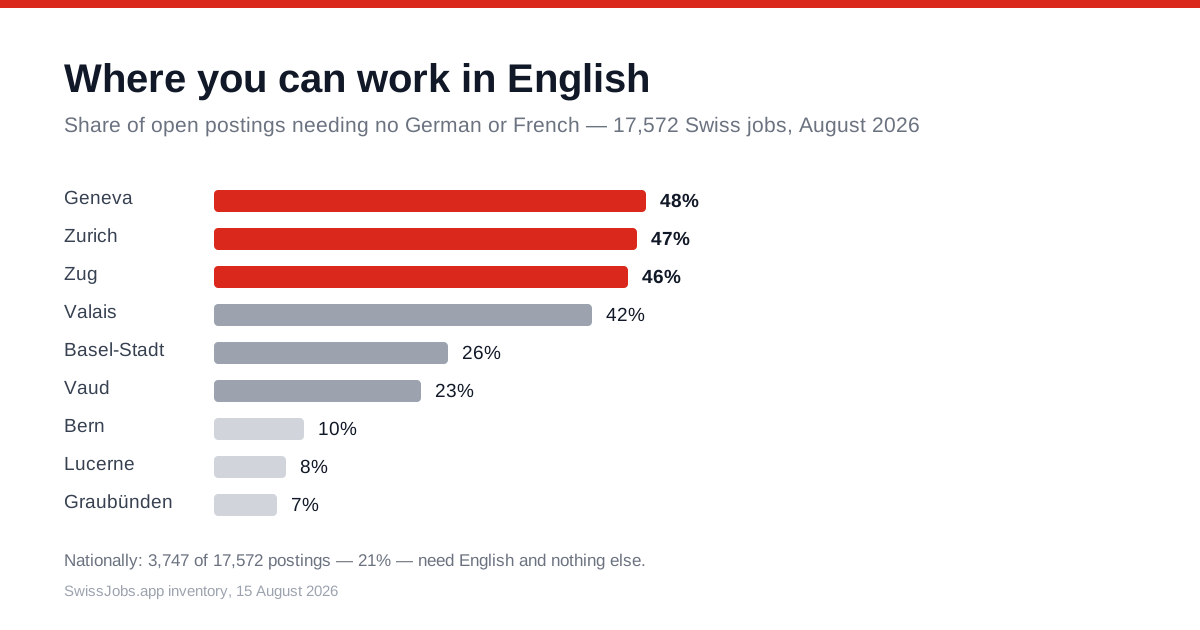
Market figures come from the adverts live on SwissJobs.app on 23 August 2026 and are always shares, never absolute inventory sizes. «Written in English» refers to the language of the advert text; the base is the adverts whose language can be determined, roughly three quarters of the live set. The graphic at the top answers a different question and therefore carries different numbers: it shows, per canton, the share of adverts that get by with English alone — no additional national language — as measured on 15 August 2026. Language requirements are taken from the requirements named in the advert; 99 percent of English-language adverts name at least one. Occupation groups are formed from keywords in the job title, and groups with fewer than eighty adverts are omitted. Locations are the workplaces as the employer spelled them. The formal elements of the letter and the English names for the parts of the dossier are quoted from arbeit.swiss (SECO) in its English and German versions and from berufsberatung.ch (SDBB), all retrieved on 23 August 2026.
How do I write a cover letter in French?
In short
Check first whether you need one. Among adverts on SwissJobs.app located in French-speaking Switzerland whose language can be determined, 54.7 percent are written in French and 37.6 percent in English. The split follows the occupation, not the map: 95.7 percent French in construction and 93.4 in care, against 24.2 percent in marketing and 29.3 in engineering. Write in the language of the advert you are answering. When that is French, the letter keeps the Swiss skeleton — arbeit.swiss lists the same six formal elements in its French version as in its English one.
Writing the letter in French is less about vocabulary than about three fixed positions that English-language templates simply do not have. The date line names the place first and takes an article: «Genève, le 23 août 2026». The salutation is «Madame, Monsieur,» with a comma, or «Madame Vaucher,» when the advert names someone. The closing is «Meilleures salutations». All three appear exactly in that form in the official model letter published by orientation.ch, the Swiss career-guidance service. An English speaker who gets those three right has already placed the letter in the right country.
What remains is the content no advert ever asks for. French-language adverts state a workload in the title less often than German ones — 18.5 percent against 29.1 — and only 4.6 percent are flagged as part-time. What they do state more often is the contract type: 2.9 percent name CDI or CDD in the title, which German-language titles almost never do. So the letter has to carry your taux d'activité, your earliest start date, your permit status and your language levels with a scale attached, because nothing in the advert will have asked for them.
Measured on adverts active on SwissJobs.app on 23 August 2026 with a workplace in French-speaking Switzerland and a text language that can be determined unambiguously. Fields are built from keywords in the job title; fields with fewer than forty Romandie adverts are omitted. The remainder is mostly written in English.
- «I am writing to apply for the position advertised on your website» → «Je vous adresse ma candidature au poste de Business Analyst, 80–100%, publié sur votre site». Name the post as the advert names it, and say where you saw it.
- «Dear Sir or Madam» → «Madame, Monsieur,» — comma included, on its own line. With a name: «Madame Vaucher,». Both forms come straight from the official model letter; «Cher Monsieur» belongs to correspondence, not to applications.
- «Zurich, 23 August 2026» → «Genève, le 23 août 2026». The «le» is not optional, the month is lower case, and the place comes first.
- «Kind regards» → «Meilleures salutations», the closing used by the official Swiss model. The long formula «Je vous prie d'agréer, Madame, Monsieur, mes salutations distinguées» is correct but not expected here.
- «Federal VET diploma» → «CFC». Never translate the abbreviation: it appears in 8.0 percent of French-language job titles, exactly as EFZ appears in 8.9 percent of German-language ones, and it is the same certificate.
- «I am flexible» → a number: «Disponible à 80–100% dès le 1er novembre». Only 18.5 percent of French-language titles state a workload themselves, so the letter is usually the first place it appears.
- «Good German» → level plus situation: «Allemand B2, utilisé quotidiennement». More than a quarter of French-language adverts with language requirements ask for German, most of them at conversational level.
- Attachments: the official model lists them at the end and allows the collective form «Dossier de candidature» when space is short. arbeit.swiss asks for PDF files sent from an address containing your first and last name.
Do you need French for this job at all?
The most expensive assumption an international applicant makes about Romandie is that the market runs in French. Measured across adverts with a French-speaking-Switzerland location and a determinable text language, 54.7 percent are French, 37.6 percent English, 5.1 percent German and 2.6 percent Italian. Nearly four in ten adverts in French-speaking Switzerland are written in English by the employer itself — in Geneva the share reaches 60.1 percent.
Which four in ten depends almost entirely on the field. Inside Romandie, counted by keywords in the job title, the share written in French runs 95.7 percent in construction and the trades, 93.4 in care and health, 90.0 in hospitality, 80.7 in retail and 77.6 in office administration. It falls to 47.9 percent in finance — where English takes 50.0 — 33.3 in software, 29.3 in engineering, 27.5 in pharma and life sciences and 24.2 in marketing, where 72.7 percent of adverts are in English. Internships sit in the middle at 52.8 percent French against 44.4 English.
City-level numbers sharpen it further. In Geneva 37.5 percent of adverts are French and 60.1 percent English; in Lausanne 65.5 against 32.4; in Fribourg, both spellings taken together, 58.5 against 20.4; in La Chaux-de-Fonds 92.9 percent are French, in Yverdon-les-Bains 95.2, in Morges 89.3. One spelling tells you more than any of these averages: adverts giving the workplace as «Fribourg» are 70.7 percent French, while adverts spelling the same city «Freiburg» are 0 percent French — they are 40.9 percent German and 59.1 percent English. How the employer writes the place name is the employer's working language, visible in one word.
The reverse case is rarer than most people expect. Of German-language adverts that state any language requirement, only 8.5 percent ask for French; of English-language adverts, 9.5 percent. If the advert is not in French, a French letter is very unlikely to be the thing that helps.
The Swiss letter, in French
arbeit.swiss, the SECO job-seeker portal, calls the letter «votre carte de visite» and lists what it must contain: adresse de l'expéditeur, adresse du destinataire, date, objet, civilité, salutations et signature. The English version of the same page lists the same six items — your postal address, the company's postal address, date, subject heading, opening salutation, closing greeting and signature. The structure does not change with the language, which means you are not learning a new document, only filling a familiar one in French.
One habit from English-language applications does have to go: the letter has a postal header even when it travels by e-mail or upload. Your address block sits at the top, the employer's address beneath it, and only then the date line. American and British templates start straight at «Dear Hiring Manager», and a French letter built on one of those looks incomplete to a Swiss reader before a word has been read.
The subject line — the objet — is where French letters are most conventional and where you should invent least. The official model writes it as «Candidature pour la place d'apprentissage de …» and instructs the writer to insert the occupation exactly as it appears in the advert, in bold. For an ordinary vacancy the same line reads «Candidature au poste de Business Analyst, 80–100%». Copy the designation verbatim, but leave the employer's gender marker out of your own sentence: 22.8 percent of French-language titles carry «(H/F)» or «(F/H)», another 4.1 percent use a mid-dot inside the word and 1.7 percent write «(tous genres)». That is the employer's house style for its advert, not your job title.
Five things a non-native French letter gets wrong
Accents come first, because they are the most visible and the least excusable. Among French-language job titles on SwissJobs.app, 60.2 percent contain at least one accented character, against 0.2 percent of German-language titles. A letter that writes «references», «experience» and «ingenieur» because the keyboard was never set up announces itself in the first line. On Swiss keyboards é, è and à are direct keys and the circumflexes come from a dead key; ç is one keystroke further. Setting this up takes ten minutes and is not a language skill.
Second, the verb the letter is built on. English cover letters open with «I am writing to apply for…», and translating it produces «J'écris pour postuler», which nobody writes. The idiomatic opening is «Je vous adresse ma candidature au poste de …» or «Je souhaite poser ma candidature pour le poste de …». The Swiss French verb for applying to a job is «postuler», and the noun you will meet in Romandie job pages is «postulation».
Third, false friends in qualifications. A Swiss federal apprenticeship certificate is a CFC in French and an EFZ in German — 8.0 percent of French-language titles carry the abbreviation, and 8.9 percent of German-language ones carry the German equivalent. It is the same qualification, and neither abbreviation is ever translated. The same applies to «certificat de travail» for the work certificate a Swiss dossier is expected to carry — arbeit.swiss asks for all of them, without exception — and to «taux d'activité» for the workload percentage.
Fourth, register. French has no equivalent of an English letter's flexible warmth: the vouvoiement is the only register a job application uses, in every canton and every industry. And fifth, length. arbeit.swiss caps the CV at three pages and says nothing at all about the letter — no Swiss authority prescribes a length. The working convention is a single A4 page, and since the postal header and the six formal elements already take a share of it, that leaves room for roughly four paragraphs. A French letter running to two pages reads as a translation of something written for a different market.
French does not mean without German
Of French-language adverts that state a language requirement — 95.1 percent of them do — 28.2 percent also ask for German and 22.8 percent for English. Among the ones located in Romandie, 25.9 percent ask for German. The level matters more than the fact: of the French-language adverts asking for German, 56.7 percent want conversational German, 33.0 percent professional, 5.5 percent native and 4.8 percent basic. For most of them a demonstrable middle level is enough, provided you name it. «Allemand B2, utilisé quotidiennement en réunion» is information; «bonnes connaissances» is not.
Employers advertising in more than one language are the norm here, not the exception: 33.4 percent of employers with at least three adverts publish in more than one language, and 16.5 percent publish in both German and French. Coop's adverts are 92.6 percent German and 7.3 percent French; the federal railways SBB CFF FFS run 84.8 to 12.7; the bilingual hospital in Biel/Bienne is close to even at 53.0 German to 47.0 French; the canton of Fribourg's administration reverses it at 87.6 percent French to 8.8 percent German.
This is why the language has to come from the single advert. Of French-language adverts, 49.1 percent come from employers who also advertise in German, and 18.4 percent come from employers whose adverts are mostly German. Reading the language off the company website rather than off the vacancy gets it wrong in nearly one case in five — and applying in French to a German advert from a company you know to be «French» is exactly that mistake.
What to put in, and how long you have
Permit status belongs in the letter for anyone not holding a Swiss or EU/EFTA passport, and it belongs there as a fact rather than an apology: «Titulaire d'un permis B, disponible dès le 1er novembre». Geneva and Vaud employ a large cross-border workforce and are used to the question; what they are not used to is guessing.
State a taux d'activité even when the advert did not ask. Only 18.5 percent of French-language titles name a percentage, so a letter that says «Disponible à 80–100%» is answering a question that would otherwise surface only at interview. If the advert says CDD, say what your availability looks like beyond the fixed term — that is the question the reader is holding while reading.
You usually have more time than in the German-speaking market: the median French-language advert on SwissJobs.app is 31 days old, against 19 days for German-language ones. Use the difference for a proofreading pass by a first-language French speaker. Machine translation now handles the three fixed positions above reliably, but it does not catch the register drift that makes a letter read as translated — a sentence that is grammatical, idiomatic in English, and slightly wrong in French.
One last case: 6.5 percent of French-language adverts are located in a German-speaking city, Biel/Bienne and Bern above all. Those are genuinely bilingual workplaces, where a French letter is correct and the interview may open in German. Answer in the language of the advert, and give both levels in the letter.
Market figures come from adverts active on SwissJobs.app on 23 August 2026 and are shares throughout, never stock sizes. «Written in French» refers to the text language of the advert; the base is those adverts whose language can be determined unambiguously, about three quarters of them. «Romandie» here means the workplace named in the advert, in the employer's own spelling — which is why «Fribourg» and «Freiburg» are counted separately, and why that separation is itself a finding. Language requirements and their levels are taken from the requirements stated in the advert; 95.1 percent of French-language adverts state at least one. Figures on titles, contract types and accented characters refer to the job title, that is, to text written by the employer. The formal specification of the letter is quoted from arbeit.swiss (SECO) in its French and English versions and from orientation.ch (SDBB), all retrieved on 23 August 2026. The orientation.ch model letter is written for apprenticeship applications; its formal requirements — date line, subject, salutation, closing — apply to job application letters generally, its content suggestions do not.
Sources
- arbeit.swiss (SECO) — Tips on applying for jobs: «cover letter/motivation letter», the six formal elements, application file, work references, references on request, send as PDF
- arbeit.swiss (SECO) — Bewerbungstipps: the same six elements in the German version, for comparison
- berufsberatung.ch (SDBB) — Bewerbungsbrief schreiben: subject line «as in the advert» and in bold, named salutation before the impersonal one, «Freundliche Grüsse» with a digital signature
- arbeit.swiss (SECO) — Conseils pour vos candidatures: the six formal elements of the lettre de motivation, PDF submission, references on request
- arbeit.swiss (SECO) — Tips on applying for jobs: the same six elements in English
- orientation.ch (SDBB) — Écrire une lettre de motivation: date line «Cornaux, le 16 mars 2026», subject carrying the occupation as advertised, «Madame, Monsieur,», «Meilleures salutations»
Related questions
What our job index says about the Swiss market
Computed live from our own index, not quoted from a study. Shares only, as of today.
Language the advert is written in
- Deutsch
- 60%
- English
- 23%
- Français
- 13%
- Italiano
- 3%
Of adverts that state a language requirement, the share asking for
- Deutsch
- 70%
- English
- 43%
- Français
- 21%
- Italiano
- 3%
19% posted in the last 7 days · Largest markets: Zürich 18% · Bern 10% · Genève 5% · Basel 5%