What language level do I need for a job in Switzerland?
Updated:
In short
Two out of three language requirements in Swiss job adverts ask for professional command: what adverts call fluent, very good or business fluent, roughly C1. About a quarter accept good knowledge, B1 to B2. Fewer than four in a hundred ask for native level. And at least a third of adverts name no language at all, because they are written in the one they expect you to use.
The reputation that Switzerland wants you trilingual and accent-free does not survive the numbers. Only 3 % of adverts name three languages, and 45 % name exactly one. The trilingual picture comes from a small but highly visible slice of the market: international corporate roles in Zurich and Geneva, federal administration, and customer-facing work that spans several language regions.
These numbers are based on looking at every single ad we publish, not on a survey or just a few examples. We read each ad twice: once for the language it's written in, and once for the languages and levels it calls for. The two answers don't match up as often as you might think, and that's where we get most of the helpful tips on this page.
Share of all language requirements stated in job adverts published on SwissJobs.app, one per language per advert, 27 September 2026. Professional covers C1, fluent, very good and business fluent. Good knowledge covers B1 and B2, a choice between two languages, and a requirement read from the region when the advert states none.
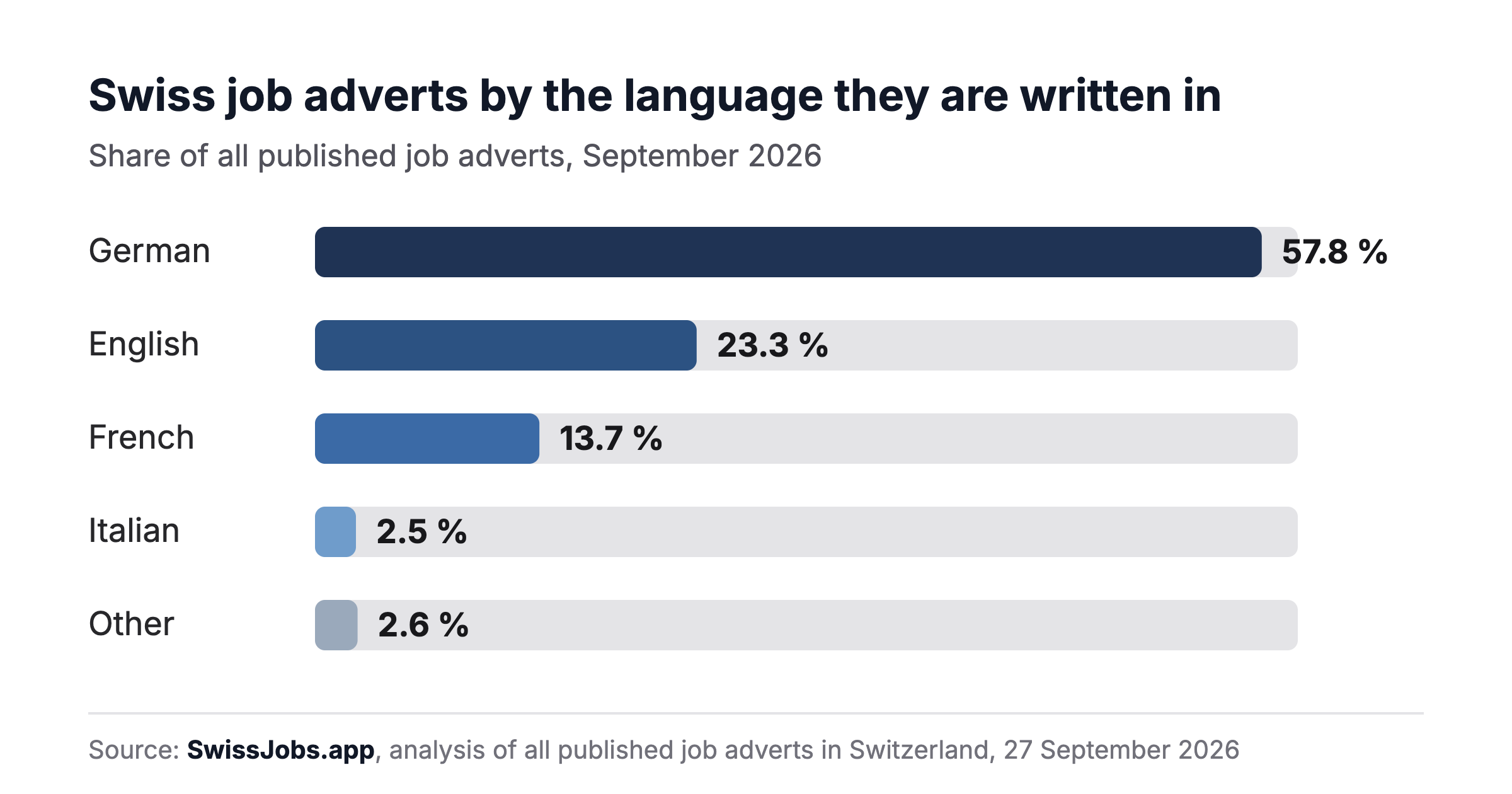
- Adverts are written in German (58 %), English (23 %), French (14 %) and Italian (2.5 %). English is the second language of the Swiss job market without being a national language.
- At least a third of job ads don't mention any language skills needed. In these cases, the language the ad is written in is what's required.
- 45 % of adverts name exactly one language, 18 % name two, and 3 % name three.
- German is required in 46 % of all adverts, English in 29 %, French in 14 % and Italian in 2 %.
- 11 % of adverts ask for English and no national language. Of the adverts written in English, almost three in four ask for no German, French or Italian.
- Native level is rare in every language, but not equally rare: 3 % of German and English requirements, 7 % of French and 12 % of Italian.
Language levels and what they mean at work
| Level | At work | Typically asked for |
|---|---|---|
| A1–A2 | everyday phrases, no work conversations | roles with English as the fixed working language |
| B1 | familiar matters in your own field, with effort | simpler roles with little client contact |
| B2 | follow meetings and contribute | what adverts call good knowledge |
| C1 | negotiate, present, write | the most common requirement: fluent, very good, business fluent |
| C2 / native | every nuance, in writing too | law, editorial, communications |
| Swiss German | understanding helps everywhere, speaking rarely required | almost never requested as a level |
The levels are the Council of Europe CEFR scale — not Swiss law, but the convention adverts are written in. That is exactly why a CV should state them this way rather than as "good" or "fluent". What an employer actually needs is in the advert; the right-hand column is orientation, not a rule.
What "good knowledge" in an advert actually means
Swiss adverts rarely state language requirements as a CEFR level. They write "very good German", "business fluent English", "French an advantage", or "confident written and spoken German". That is not arbitrary. It is a settled convention, and it translates fairly reliably.
The words sort into two tiers. "Good knowledge" means B1 to B2: you follow a meeting, write a routine email, and handle your own field with some effort. "Very good", "fluent", "business fluent" and "confident written and spoken" mean C1: you run the meeting, and your emails leave the building without anyone fixing them. Two in three requirements sit in the second tier.
"An advantage", "desirable" or "a plus" is not a requirement but a tie-breaker, and no figure on this page counts it as one. It decides between two otherwise equal applications and does not exclude you. Anyone who skips an application because of an "an advantage" line is skipping one nobody would have rejected.
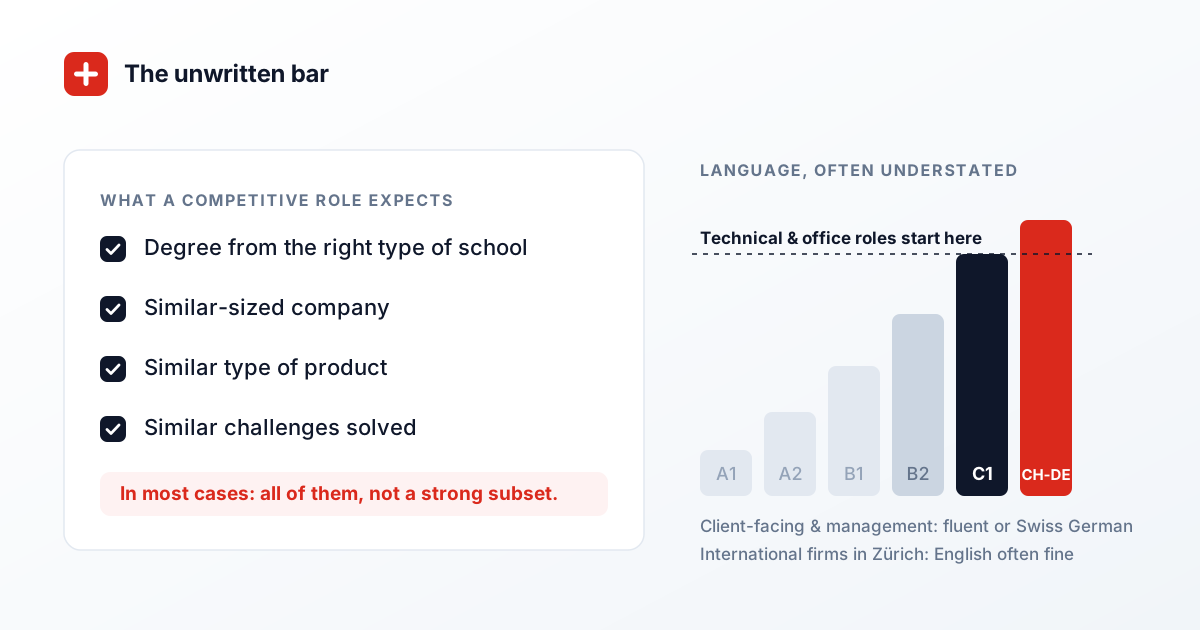
The practical conclusion: aim for C1 in the language of the region you apply in. That covers the large majority of requirements, and the remaining distance to native level is the longest stretch and the one asked for least often.
The language of the advert is the first requirement
Nearly six out of ten job ads in Switzerland are in German, while just under a quarter are in English. Around one in seven are in French, and one in forty are in Italian. The order matches the language regions, with one notable exception: English, which isn't a national language, comes in as the second most common language for job listings.
The requirements themselves are narrower than the three-language reputation. At least a third of adverts state no language requirement at all, 45 % name exactly one language, 18 % name two, and only 3 % name three.
An ad without a language line does not welcome every language. It presumes you can read and work in the language it is in, so a German ad that doesn't mention German still assumes you know German. Consider the language of the ad as a must, even if the text never states it.
For English speakers, the situation is better than the chart shows. Almost seventy-five percent of ads written in English don't require any German, French, or Italian. If you are strong in one language and only understand a second language, most job ads are still available to you: begin with the ads written in the language you know well.
Zurich and Geneva are two different labour markets
The national averages hide the biggest difference. In the city of Zurich, 53 % of adverts require German and 19 % get by with English and no national language. In Geneva, German barely features at 5 %; French is required in 45 %, and 24 % are English only.
The language adverts are written in differs even more: half of all Geneva adverts are written in English, against 39 % in Zurich. Zurich has more than three times as many adverts, so in absolute terms it still offers the most English-only roles, while Geneva offers the best odds per advert. Lausanne is less English than its neighbour, at 16 % English only.
The reverse holds as well. German carries just as far outside Zurich: 59 % of adverts in Bern and in Basel require it, and Bern is the least English of the large cities, at 4 % English only. If you have solid German, widen your search radius rather than narrowing it to Zurich.
What to actually write on your CV
Write CEFR levels, not adjectives. "German C1, English B2, French A2" is readable in two seconds. "German fluent, English good" is not, because "good" means something different to everyone, and a reader in doubt estimates downwards.
Be honest in your self-assessment but not modest. People who systematically rate themselves one level low filter themselves out of processes they would have passed. Overstating, on the other hand, shows up within the first minute of the interview and costs more credibility than the extra level ever bought.
A certificate is rarely mandatory in Switzerland, but it ends an argument before it starts. If you have one — Goethe, telc, DELF, Cambridge — name it with the level and the year. If you do not, leave the field out rather than explaining it; a justification on a CV draws attention to a gap nobody would otherwise have noticed.
And split the levels when they diverge. Many applicants speak considerably better than they write. "German: spoken C1, written B2" is a credible, precise statement — and it tells the reader in advance why the interview will go better than the cover letter did.
If your level is not there yet
About a quarter of requirements accept good knowledge, B1 to B2, rather than professional command. That is the realistic entry block, and it covers occupations where the work itself carries the language: trades, logistics, production, hospitality, parts of care work and cleaning. There, being understood is the requirement, not eloquence.
The second realistic route is the role where your technical language is English and the team's everyday language is something else. That describes large parts of IT, research, pharma and finance. Starting in English is normal there, and the German arrives alongside the work over the first two years.
What helps in both cases: do not hide the language line on your CV — attach a course in progress to it. "German B1, intensive B2 course in progress, exam planned" is a statement about direction, and direction is exactly what someone reads when deciding whether the onboarding is worth it.
What people report
A recurring point in posts about Swiss applications: language skills belong on the CV as CEFR levels, not as "good" or "fluent". That specific correction is repeatedly described as the difference between an application that reads as local and one that reads as imported.
Recurring pattern across German- and English-language LinkedIn posts on Swiss application documents, reviewed August 2026.
Newcomers name the same three barriers in the same order again and again: paperwork, local work experience, language. What stands out is that language almost never appears alone — it is described as one of three conditions, not the decisive one.
First-hand accounts from new arrivals in LinkedIn posts about job hunting in Switzerland, reviewed August 2026.
A frequent observation is that a German CV and a Swiss CV are written in the same language but are not the same document. The language line is one of the points where the difference becomes visible immediately.
Recurring theme in LinkedIn posts on the difference between German and Swiss application documents, reviewed August 2026.
Figures from every job advert published on SwissJobs.app, read on 27 September 2026, apprenticeships included. Each advert is read for the language it is written in and for the languages and levels it requires; a language described as an advantage is not counted. We publish shares, not absolute inventory figures.
Write a custom CV for every job you apply to
Most people send the same CV everywhere. The editor rewrites yours against the posting — Swiss format, the right language, in about a minute.
CV maker & resume builder: for a specific advertSources
Related questions
What our job index says about the Swiss market
Computed live from our own index, not quoted from a study. Shares only, as of today.
Language the advert is written in
- Deutsch
- 60%
- English
- 23%
- Français
- 13%
- Italiano
- 3%
Of adverts that state a language requirement, the share asking for
- Deutsch
- 70%
- English
- 43%
- Français
- 21%
- Italiano
- 3%
19% posted in the last 7 days · Largest markets: Zürich 18% · Bern 10% · Genève 5% · Basel 5%