Swiss CV template and format: free, built for your occupation
The Swiss CV format differs from the British and American one in ways that a generic template will not tell you about. Here you choose your occupation: over 170 free templates in the Swiss format, each with example text and the requirements that occupation's adverts name most often. Download as Word or PDF.
In short: a Swiss CV is two pages, reverse-chronological, with a photo at the top right. It opens with personal details including nationality and, without a Swiss passport, the permit (B, C, G or L). Then come a short profile, experience with the workload in percent, education, languages with a CEFR level from A1 to C2, and IT skills. Reference letters (Arbeitszeugnisse) go in the application file, not the CV, and an English CV is fine when the advert is in English.
With your own details
Paste the text or upload your current CV. The editor puts it into the Swiss layout, with photo, permit, language levels and workload. You do not need to sign up.
Most searched
All occupations A–Z
Account Manager Resume
Accountant Resume
Accounting Resume
Additional Apprenticeship (EFZ) Resume
Administrative Assistant Resume
Administrative Assistant Resume
AI Engineer Resume
All-Rounder Resume
Application Manager Resume
Apprentice Resume
Assistant Resume
Automation Engineer Resume
Automation Technician EFZ Resume
Automotive Technician Resume
Baker Resume
Bricklayer / Mason Resume
Building Services Planner Resume
Business Analyst Resume
Butcher Resume
Career Changer Resume
Caretaker Resume
Cashier Resume
Chauffeur Resume
Chef Resume
Chef de Partie Resume
Civil Engineer Resume
Civil Engineer Resume
Cleaner Resume
Client Advisor Resume
Client Engineer Resume
Cloud Engineer Resume
CNC Machinist Resume
Commercial Clerk Resume
Commercial Employee Resume
Compliance Officer Resume
Consultant Resume
Content Manager Resume
Controller Resume
Conversational Designer Resume
Cyber Security Resume
Data Analyst Resume
Data Engineer Resume
Data Scientist Resume
Delivery Driver Resume
Deputy Store Manager Resume
Design Engineer Resume
Development Engineer Resume
DevOps Engineer Resume
Digital Marketing Manager Resume
Director Resume
Draughtsperson Resume
Electrical Planner Resume
Embedded Engineer Resume
Engineer Resume
Engineering Resume
Enterprise Architect Resume
Executive Resume
Fashion Advisor Resume
Fashion Advisor Resume
Fiduciary Resume
Fiduciary Account Manager Resume
Field Service Technician Resume
Finance Resume
Finance Manager Resume
Financial Accountant Resume
Fitter Resume
Forward Resume
Franchise Partner Resume
Frontend Engineer Resume
Group Controller Resume
Growth Manager Resume
Head Chef Resume
Healthcare Assistant Resume
Healthcare Assistant (FaGe/ASSC) Resume
Healthcare Assistant EFZ Resume
Healthtech Resume
Hospitality Resume
Human Resources Resume
Information and Documentation Specialist Resume
Insurance Advisor Resume
Insurance Claims Handler Resume
Interior Consultant Resume
Java Developer Resume
Lawyer Resume
Logistics Resume
Machine Operator Resume
Machine Operator Resume
Maintenance Mechanic Resume
Maintenance Technician Resume
Managing Director Resume
Marketing Manager Resume
Marketing Manager Resume
Mechanic Resume
Mechanical Engineer Resume
Medical Practice Assistant Resume
Metrology Technician Resume
Network Electrician Resume
Network Engineer Resume
Nursing Assistant Resume
Operations Manager Resume
Optician Resume
Optometrist Resume
Order Picker Resume
Payroll Specialist Resume
Penetration Tester Resume
Physiotherapist Resume
Platform Engineer Resume
Plumber Resume
Plumber Resume
Police Officer Cadet Resume
Polymechanic Resume
Process Engineer Resume
Product Designer Resume
Product Engineer Resume
Product Manager Resume
Production Planner Resume
Project Engineer Resume
Property Manager Resume
Psychotherapist Resume
Quality Engineer Resume
Quality Manager Resume
Quick Service Restaurant Specialist Resume
Quick-Service Restaurant Manager Resume
Quick-Service Restaurant Practitioner (EBA) Resume
R Engineer Resume
Real Estate Accountant Resume
Real Estate Agent Resume
Regulatory Affairs Manager Resume
Relationship Manager Resume
Research Associate Resume
Resident Physician Resume
Restaurant Server Resume
Restaurant Service Staff Resume
Retail Resume
Retail Store Manager Resume
Sales Assistant Resume
Sales Assistant (Vendeur) Resume
Sales Engineer Resume
Sales Manager Resume
Scientist Resume
Secretary Resume
Security Engineer Resume
Security Officer Resume
Senior Physician Resume
Shunter Resume
Site Manager Resume
Site Manager Resume
Social Worker Resume
Software Developer Resume
Solution Architect Resume
Store Manager Resume
Strategic Buyer Resume
System Administrator Resume
Talent Acquisition & Talent Management Specialist Resume
Team Leader Resume
Team Member Resume
Waiter / Waitress Resume
Waiter/Waitress Resume
Warehouse Clerk Resume
Wine Taster Resume
Six of the templates as images
The same Swiss layout in six colours, fonts and layouts. Click one to open it in the editor, then download it as Word or PDF.
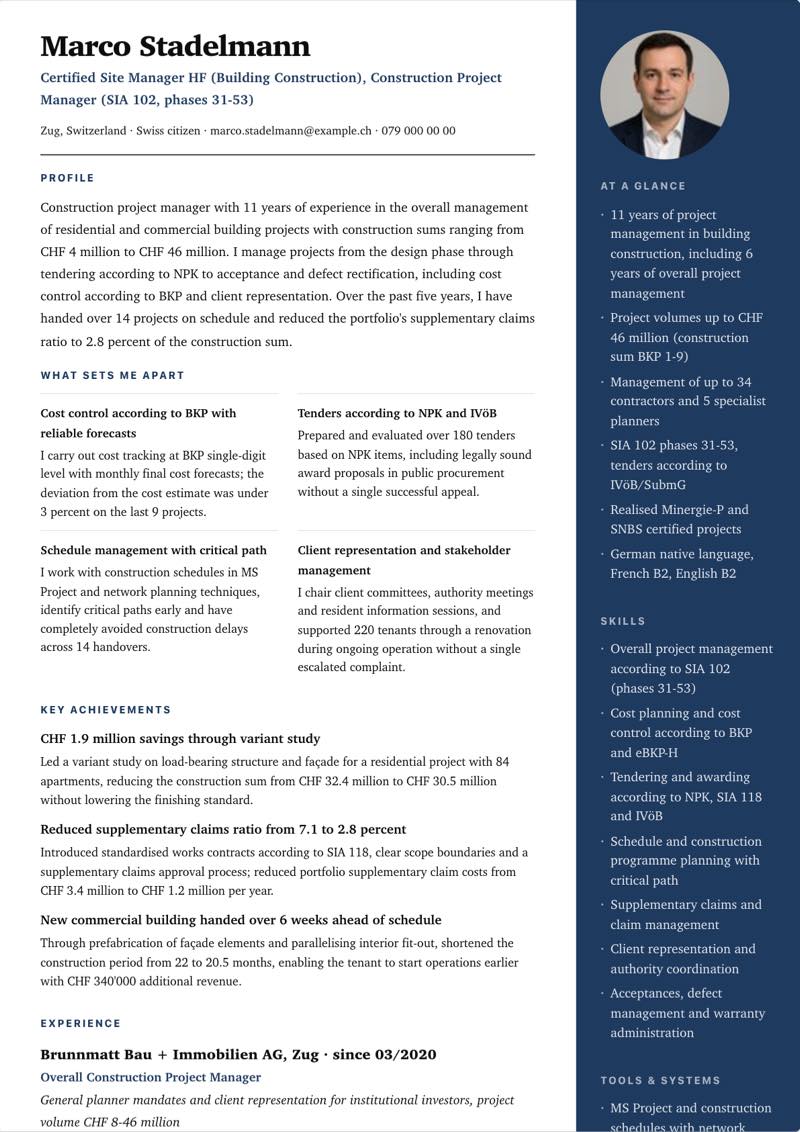
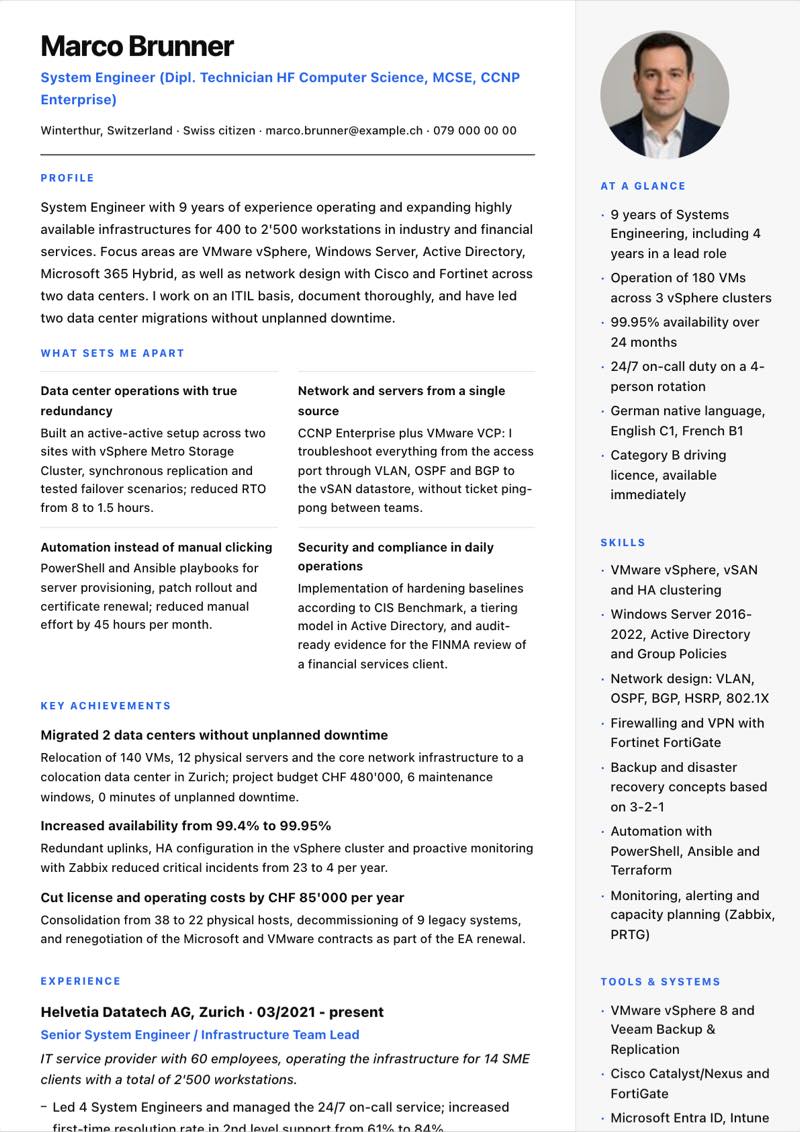
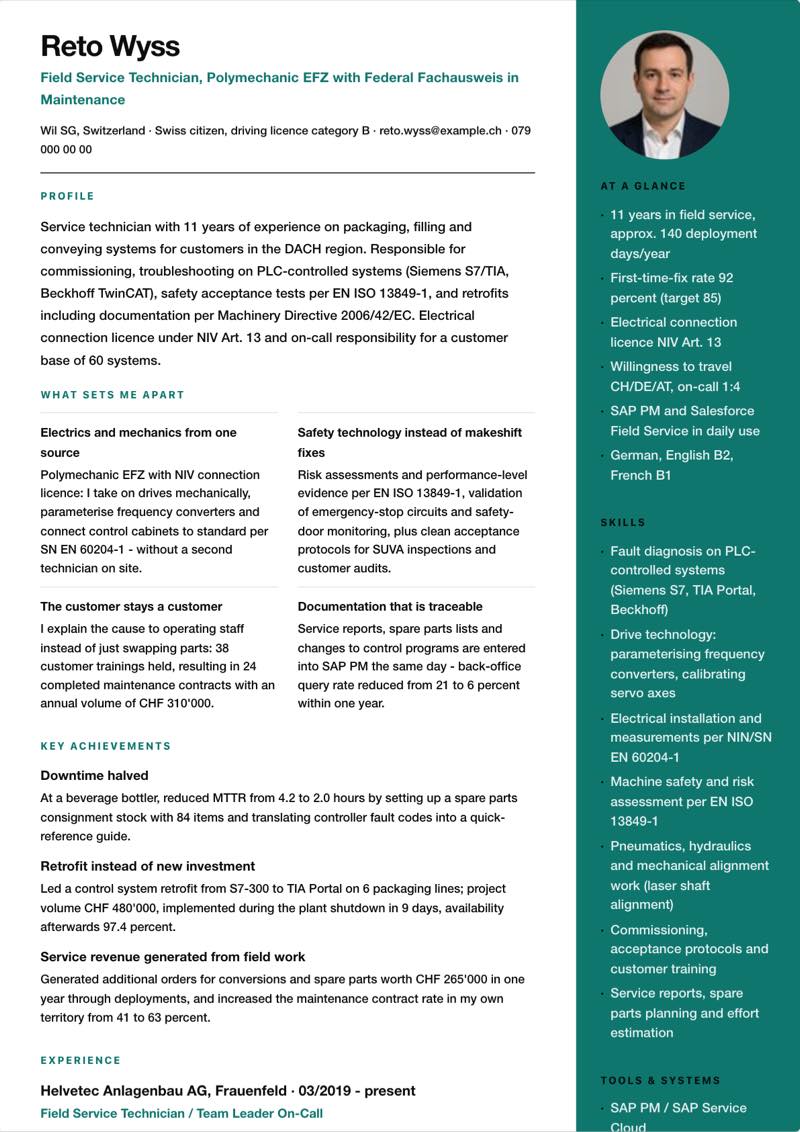
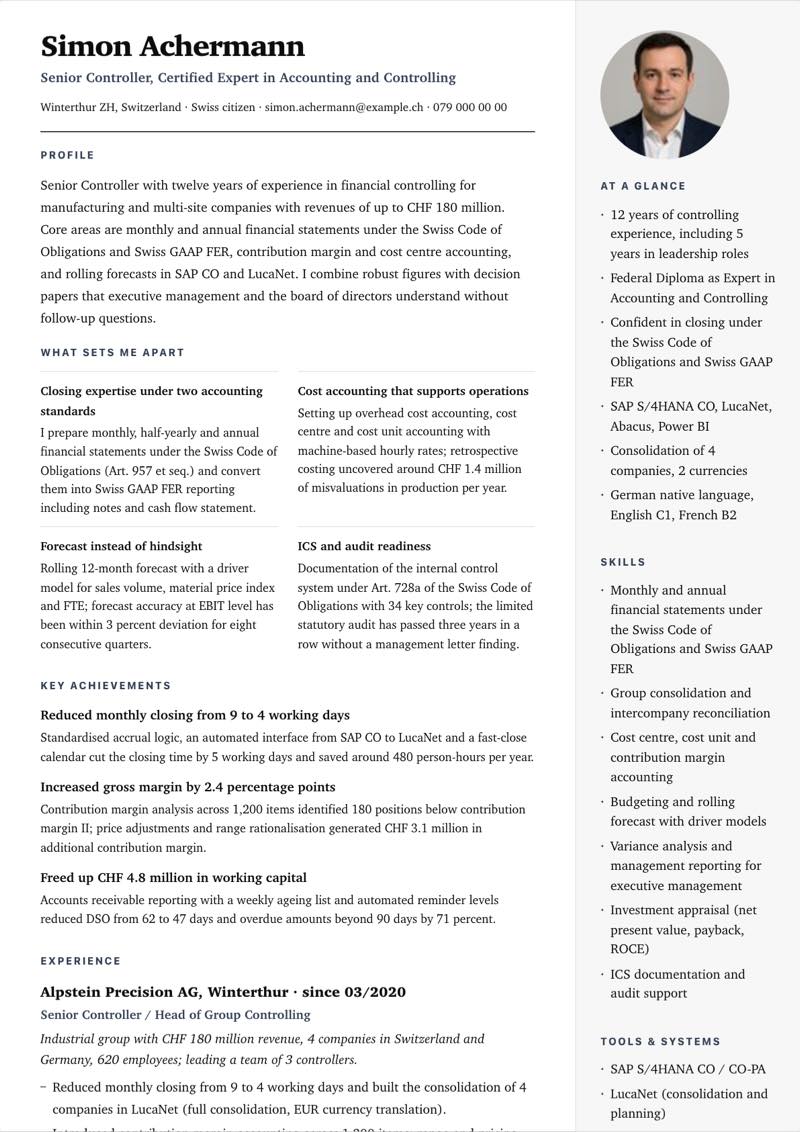
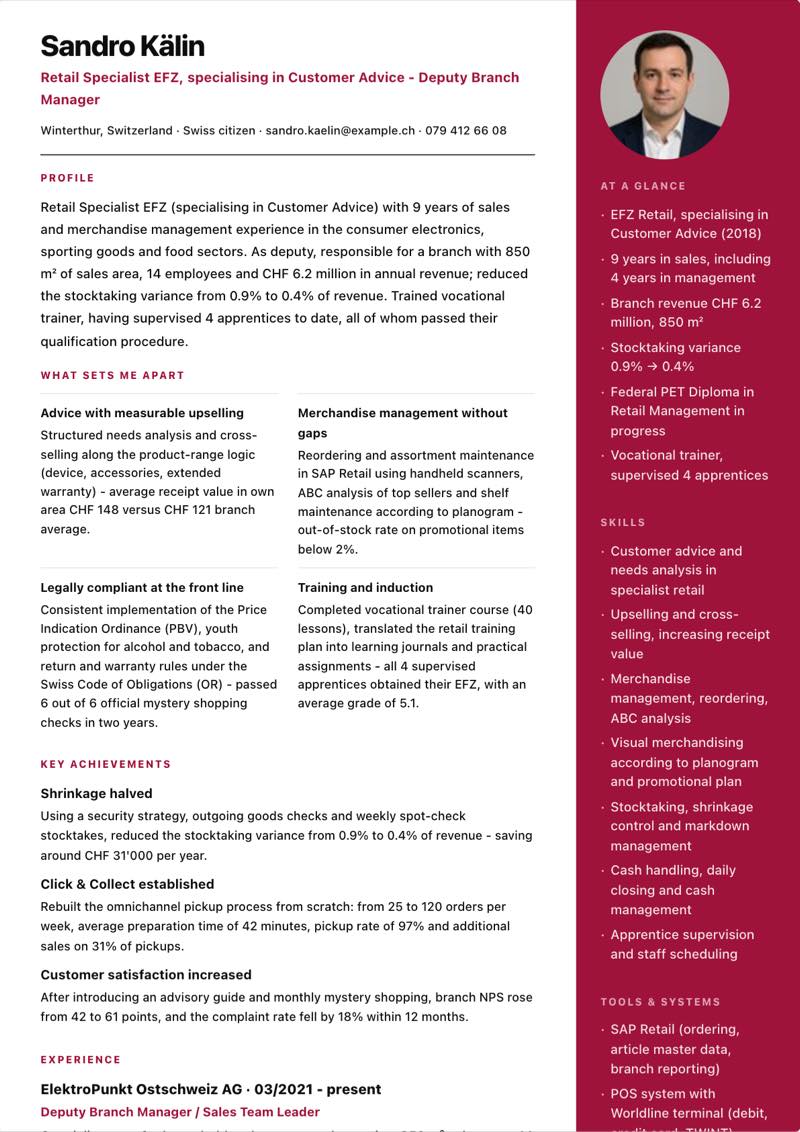
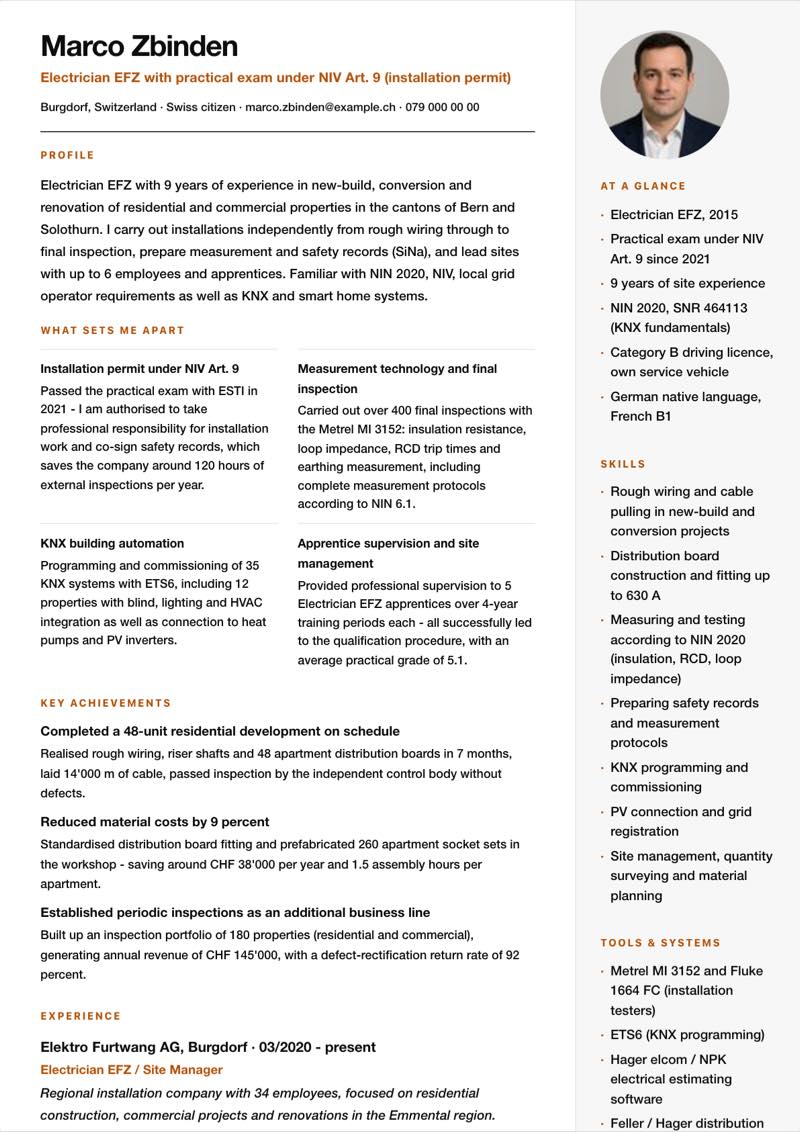
Swiss CV format: what goes where, section by section
Swiss recruiters look for this specific order, starting at the top and going down. Each template on this page sticks to that layout. You won't find a date or a signature at the bottom.
Personal details and photo
Name, address, phone, email, date of birth and nationality. Without a Swiss passport, add one line on your permit, such as "Settlement permit C". The photo sits at the top right: a plain portrait against a neutral background.
Short profile
Write three or four lines about your professional self, your top skills, and the job you want. If you have a long work history or are switching fields, this section is the most important one.
Professional experience
Reverse-chronological, current role first. For each role: dates (MM.YYYY), job title, company, location and the workload in percent if it was not 100%. Below it, two to four bullet points, results rather than duties.
Education and training
List every qualification along with its Swiss name if applicable (EFZ, HF, university of applied sciences, university), plus the school, place and year. Include courses and certificates with the year. A foreign degree keeps its original title, with level, duration and country in brackets.
Languages
Each language with its level on the Common European Framework of Reference, from A1 to C2, and your mother tongue named as such. "Fluent" without a level leaves the reader guessing.
IT and specialist skills
Named software and systems rather than "MS Office": SAP, Salesforce, Excel with pivot tables, AutoCAD, a till system. Add a driving licence if the role needs one.
References
Two referees with job title, company and phone number, once you have asked them, or "References available on request". Reference letters and diplomas go into the application file as separate PDFs.
The Swiss CV template to copy: the standard layout as plain text
Paste the text directly into Word or another document. Follow the Swiss standard format: two pages, reverse-chronological order, photo in the top right corner, and permit details on the first page. Substitute the text inside the square brackets.
PERSONAL DETAILS
[First name Last name] · [Street No., Postcode Town] · [Phone] · [Email]
Born [DD.MM.YYYY] · [Nationality] · [Permit B, C, G or L — only without a Swiss passport]
[Photo: top right, professional, about 3.5 × 4.5 cm]

PROFILE
[Three or four lines: your field, your strongest skill, the role you are looking for]

PROFESSIONAL EXPERIENCE  (most recent first)
[MM.YYYY – present]   [Job title], [Company], [Town]  ([workload in %])
· [Duty or result with a number: "Built the team from 4 to 11 people"]
· [second point — what you were responsible for, not what the company does]
[MM.YYYY – MM.YYYY]   [Job title], [Company], [Town]  ([workload in %])
· [one to three points per role, older roles shorter]

EDUCATION AND TRAINING
[YYYY – YYYY]   [Qualification, e.g. EFZ Commercial Employee or BSc Business], [School], [Town]
[YYYY]   [Course or certificate]

LANGUAGES  (CEFR level)
English: [mother tongue / C2] · German: [B1] · French: [A2]

IT AND SPECIALIST SKILLS
[specific rather than "MS Office": e.g. SAP FI, Excel with pivot tables, Salesforce]

REFERENCES
Available on request  [or: name, job title, company, phone — ask them first]
As of 3 November 2026. If you would rather type than copy: the editor builds the same layout, free for your first CV, export without a watermark, no sign-up needed.
Swiss CV vs German CV template: the differences that cost interviews
| Switzerland | Germany | |
|---|---|---|
| Photo | usual and expected, top right | increasingly left out (anti-discrimination law, AGG) |
| Residence permit | on page 1, if you are not a Swiss national | not applicable |
| Workload | in percent, for each job ("80%") | unusual |
| Languages | level on the European framework (B2, C1) | often described freely ("fluent") |
| Length | two pages are normal | one to two pages |
| References | "available on request" is standard, and used | less often actively requested |
| Date and signature | not usual, left out | traditionally place, date and signature; often left out today |
Arriving in Switzerland with a German CV template doesn't seem out of place, but it does come across as unprepared. The top four rows are precisely the features that international CV generators lack.
The detailed guide covering the same topic breaks it down line by line: the specific details Swiss adverts ask for, the amount of detail the experience block needs, and whether an EFZ, an HF or a degree counts for more. Guide: the lines Swiss job adverts ask for on a CV →
What Swiss adverts actually insist on — counted, not guessed
Before picking a template, it is worth knowing what the other side asks for. On 5 September 2026 we counted all 22,859 open Swiss job adverts in our index: 23.1 per cent state the workload in the title alone — and 58 per cent of those give it as a range, such as “80–100 %”. 20.6 per cent of all adverts require at least two languages, and where a level is named it is almost always a Common European Framework one (B2, C1). A template with no dedicated line for workload and language level forces you to bury, in running text, the two things a Swiss recruiter looks for first.
That is the standard every template on this page is built to: its own fields for photo, residence permit, language levels and workload — the four places where an American or British template quietly fails in the Swiss market.
What a Swiss CV template has to contain
A template from the US or the UK is not wrong in Switzerland, it is incomplete. Two fields are almost always missing, and each answers a question that otherwise gets asked in the interview — or stops one from happening.
The workload percentage, on any role that was not 100%. An 80% position is entirely normal here and says nothing about commitment, but if the figure is missing, reduced hours look like a gap. Permit status, if you do not hold a Swiss passport: "C permit" or "EU/EFTA citizen, free movement of persons" is one line and saves both sides a round of questions.
Then the blocks any usable template carries: contact details with a photo at the top, a short profile, experience in reverse-chronological order with dates and location, education, languages with levels, IT skills. Two pages. Reference letters belong in the application file, not in the CV.
Moving to Switzerland? How to rewrite your CV into the Swiss format, step by step
Living as an expat in Zurich, Geneva or Basel with a UK, US or other international CV means you do not need to start from scratch. Six changes transform it into a Swiss CV, in this order.
1. Layout: two pages, one column, reverse-chronological, standard headings. Drop the American one-page limit and any skills-first functional layout. 2. Photo: add a plain, professional portrait at the top right. 3. Permit: one line under your nationality, such as "Permit B", "Permit C", "Cross-border permit G" or, before you have one, "EU/EFTA citizen, free movement of persons".
4. Languages: one line per language with its CEFR level, "English C2, German B1, French A2", instead of "fluent" or skill bars. 5. Workload: the percentage on any part-time role, such as "80%". 6. Foreign qualifications and employers: keep the original degree title with level, duration and country in brackets, and add half a sentence on what each foreign employer does and how big it is.
You can make these changes by hand with the template on this page, or upload your current CV with "Start with my own CV". The editor rebuilds it in this layout, and you correct the result directly in the document.
Can you apply in Switzerland with an English CV? The best CV format for Switzerland in English
Yes, provided the job ad is in English, which is typical at international firms and within the tech, research, and finance sectors. The guideline is straightforward: draft your CV in the same language as the job ad. A German ad gets a German CV, a French one gets a French CV, and an English one gets an English CV.
The best CV format for Switzerland in English is still the Swiss one, not the American resume: two pages, a photo, your permit, CEFR language levels and the workload for each role. Call it a CV, not a resume, and keep Swiss qualification names such as EFZ or HF with a short English explanation in brackets.
If you speak German, French or Italian at B1 or above, put it on the English CV too. One Swiss advert in five asks for at least two languages (see the count above), and a local language can tip the balance between two otherwise equal candidates.
How do you show language levels on a Swiss CV?
With the level on the Common European Framework of Reference (CEFR): A1 and A2 for basic users, B1 and B2 for independent users, C1 and C2 for proficient users. Swiss adverts name exactly these levels, such as "German C1, French B2", and the person reading your CV compares line with line.
Put each language on its own line, with a certificate in brackets if you have one: "German B2 (Goethe-Zertifikat B2)". Bars, stars and percentages leave the reader guessing, and applicant tracking systems do not read them. If you understand Swiss German, that is worth its own line, because it can make the difference in customer-facing roles.
Which permit goes on a Swiss CV? B, C, G and L explained
If you do not hold a Swiss passport, list your residence status in the personal details, right below your nationality. This is the first question an employer asks when seeing a CV from abroad, and if there is no answer, the CV is more likely to be set aside than pursued.
B is the residence permit, C the settlement permit, G the cross-border commuter permit for people who live abroad and work in Switzerland, and L the short-term residence permit. Write it the way it appears on your card, for example "Residence permit B, valid until 03.2028" or "Cross-border permit G".
No permit yet? Then write what applies. "EU/EFTA citizen, free movement of persons" tells an employer you can start without a lengthy permit procedure. With a nationality outside the EU/EFTA, the employer has to apply for the permit; state your nationality openly anyway, so the question does not first come up in the interview.
Reference letters and referees: what goes on the CV and what goes in the application file
Swiss reference letters (Arbeitszeugnisse, certificats de travail) do not go on the CV. They go into the application file as separate documents after the cover letter and CV. In Switzerland every employee can ask any employer for one (Art. 330a of the Code of Obligations), and recruiters read them closely because they contain the former employer's assessment.
Send the diplomas listed in the ad along with letters from your last two or three jobs. An interim reference works if you still have a job. A short letter from a past boss or a confirmation of employment works just as well if you come from a country without written references.
On the CV itself, the last block is "References": two people with job title, company and phone number, or "available on request". Ask them first, because Swiss employers really do call.
Showing hands-on skills, certifications and customer-facing experience
For trades, certifications and licences get their own block under education, each with a year: the Swiss EFZ or a foreign equivalent, safety training, a welding certificate, a forklift licence. Under each role, name the projects by type and size, "sanitary installation for a 24-unit residential block", and what you were responsible for, "supervised a team of 4 fitters". A site supervisor role then reads as more than a job title.
For customer service, the two blocks Swiss recruiters check first are languages and systems. Languages with levels, "French C2, English C1, German B1", and systems by name, "Salesforce Service Cloud, Zendesk, SAP SD". Then one result per role that you can back up in the interview: tickets handled per day, a satisfaction score, a first-contact resolution rate.
With a photo or without?
With. Switzerland is one of the few markets where the application photo has remained the convention — unlike the UK and the US, where it is actively discouraged. A CV without one stands out here, and it reads as though somebody took a template from another market and never adapted it.
So every template here has a place for it, at the top. A plain head-and-shoulders portrait, neutral background, dressed one notch more formally than the target role's daily norm. The exception: if you are applying to the Swiss arm of an American or British group, their portal may not accept a photo. When in doubt, include it.
CV template in Word or PDF?
Edit in whatever you like, send as PDF. That is the whole rule, and it has a practical reason: a Word document looks different on somebody else's computer — different fonts, shifted margins, reflowed lines. A PDF looks the same everywhere, including inside an application portal.
Name the file so a recruiter can find it again: "Surname_Firstname_CV.pdf", not "CV_final_v3_new.pdf". In an inbox holding forty applications the filename is the first thing anyone sees.
If the advert explicitly asks for Word — which happens with recruitment agencies, because they add their own cover sheet — send Word. The instruction in the advert beats any rule of thumb.
Will the template get through an applicant tracking system?
At larger Swiss employers the application usually passes through a system; at SMEs often not. What matters is less the fear of the software than the format: a single-column structure, real text rather than graphics, standard headings such as "Professional experience" and "Education", and a PDF file.
That is exactly how these templates are built. No two-column layout whose right column gets read into the middle of the left one, nothing that exists only inside an image, no invented section names. It costs nothing in readability for humans and saves you wondering whether your application arrived at all.
Downloading the template — and what comes after
Every template can be filled in directly in the browser and downloaded as a PDF. No software, no missing fonts. You pick your occupation, replace the example text with your own, and download the finished document. If you would rather work on your own computer, "Download" under each card gives you the template as Word or PDF straight away, no account needed.
That order is deliberate. A downloaded Word file looks different on another machine, loses its formatting when opened elsewhere, and tends to become "CV copy (2).docx". Filling in the browser and downloading a PDF gives you exactly the document the recipient will see.
The download is free and carries no watermark. In the editor, the first download works without an account. A free account keeps your CV saved and includes one download a day, for the next application you want to tailor rather than starting from the blank template again.
CV or resume — which one does Switzerland want?
A CV. The word “resume” is barely used here, and the document Switzerland expects is closer to the British CV than the American resume: two pages rather than one, reverse-chronological, with a photo, and no objective statement at the top.
The one-page rule that dominates American advice is actively wrong in Switzerland. A single page reads as thin, particularly past five years of experience. Two pages is the expectation, and the second page is where the earlier career gets summarised into short lines rather than dropped.
The other American convention to leave behind is the skills-first functional layout. Swiss recruiters read chronologically and look for gaps; a functional CV that hides dates reads as though it is hiding something, whether or not it is.
Free CV builder — with no catch
Every template is free. Not free-until-download, no watermark on the finished document, no trial that turns into a subscription. You fill it in, you download the PDF, you pay nothing.
You only have to open a free account to store the CV for your next application, the one you will want to adjust for a specific job ad instead of going back to the blank template. It comes with one download a day. No credit card, no trial period that switches to a subscription.
Which template suits a long career?
Templates are usually built for a career of five to ten years: equal blocks, every role given the same amount of space. At twenty or thirty years that breaks — either the CV runs to four pages, or everything is cut back so far that the roles that matter occupy the same space as a summer job from 1998.
The answer is not a different template but an uneven distribution within the same one. The last ten to fifteen years get the full block, with duties and results. Everything before that becomes a single entry — "1996–2008: various field sales roles, construction supply sector". The template stays two pages and the eye lands where it should.
Two additions that do more for a long career than any styling: a short profile at the top saying in three lines where you want to go next — without it the reader works through thirty years and guesses. And at least one recent item: a course, a certification, a system newly introduced at work. That is the reservation an experienced CV is working against, and only recent evidence answers it.
Using the template with a foreign degree or an international career
A Swiss template has fields an international CV often does not use — and the reverse. Three places decide whether it reads clearly.
The qualification: enter the original title, because it is the official one, with the placement in brackets after it — level, duration, country. A literal translation frequently produces a name that does not exist in the Swiss system, which generates a follow-up question instead of an answer.
The employers: the field next to the company name should carry half a sentence of context — sector, rough size. A name nobody here recognises is, without that, a blank in the document.
The personal details: one line on your residence permit, if you hold one. It is the first question an employer asks of a CV from abroad, and answering it in the template costs a line and prevents a rejection for the wrong reason.
A template is the start, not the result
The biggest mistake with a template is filling it in and sending it. The second biggest is sending the same filled-in template to everyone. A recruiter spots both in seconds, because the template is written neutrally and your application therefore sounds like nobody in particular.
Tailoring takes ten minutes: take the advert, highlight the three requirements described at greatest length, and make sure each one appears in a line of your experience with a number, a duration or an outcome attached. "Responsible for accounts receivable" is a job description; "cut days-sales-outstanding from 52 to 34" is evidence.
That is why every occupation page also shows what that occupation's adverts ask for most often. It is the order to sort your evidence in — and the part a pure design template cannot give you.
See what a Swiss recruiter checks first
Upload your CV and get a score against a specific job ad in about 30 seconds — language levels, work permit, photo, how your achievements are phrased.
ATS CV checker, freeSwiss CV: frequently asked questions
- What is the Swiss CV format?
- Two pages, reverse-chronological, with a photo at the top. Contact details, a short profile, experience with dates and location, education, languages with levels, IT skills. Two things a UK or US template omits: the workload percentage on any role that was not 100%, and permit status if you are not a Swiss national.
- Is the Swiss CV template free?
- Yes. You can download every template from this page as Word or PDF with no account and no watermark. In the editor, the first download works without signing up; a free account keeps the CV saved and includes one download a day.
- Can I download the CV template?
- Yes, in two ways: as the template with its example text, straight from each card, as Word or PDF, or as a PDF once you have filled it in with your own details in the browser. PDF is the right choice for sending, because it looks the same for the recipient as it does for you.
- Is there a Word version of the template?
- Yes. Under each template, "Download" offers three formats: Word, a second Word file for Apple Pages, and PDF. Send the PDF all the same, because a Word document reflows on someone else's computer and a PDF looks the same everywhere.
- Which CV template is right for me?
- The one for your occupation. The structure is the same Swiss standard across all of them — what differs is the example text and which requirements are highlighted, and those are not the same for a registered nurse as for a project manager. Search for your occupation above; if it is not there, take the nearest one.
- How many pages should the CV be?
- Two. One page reads as thin in Switzerland, three never gets finished. Two pages hold twenty years of experience if the last ten take about two thirds of the space and everything before that compresses into short lines.
- What does a Swiss CV need that others do not?
- Two things. The workload percentage on any role that was not 100% — part-time is normal here and without the figure it looks like a gap. And permit status, if you do not hold a Swiss passport. Each is one line and each answers a question that would otherwise come up in the interview.
- Is it a CV or a resume in Switzerland?
- A CV. Switzerland follows the British convention rather than the American one: two pages rather than one, reverse-chronological, with a photo, and no objective statement. The one-page rule from US advice is wrong here — a single page reads as thin.
- Can I let ChatGPT fill in the template?
- As a draft, yes. The finished text should not go in unchanged though: a language model does not know your numbers, systems or team sizes and substitutes sentences that fit anyone in the same profession. Check each line for whether it applies only to you — what survives is shorter and stronger.
- Which template works at over 50?
- The same one as anyone else — what matters is how you fill it. The last ten to fifteen years get the full space, everything before becomes one summarising line. That keeps the CV to two pages without shrinking the roles that matter to the size of the old ones.
- Where do I put a foreign degree in the template?
- In the education block, with the original title as the label and the placement in brackets: level, standard duration, country. If a recognition procedure is running, put that on the same line, with a date.
- Which permit do I put on a Swiss CV?
- The one you hold, as it appears on your card: B (residence permit), C (settlement permit), G (cross-border commuter permit) or L (short-term permit), on one line under your nationality. Without a permit but with an EU/EFTA passport, write "EU/EFTA citizen, free movement of persons".
- Should I fill the template with duties or achievements?
- Both, but not in equal measure. The duty explains the responsibility, the result shows what came of it. A template filled only with duties reproduces a job description instead of the person who held the job.
- What is the best CV format for Switzerland in English?
- The Swiss layout, drafted in English: two pages, reverse-chronological order, a photo in the top right, your permit listed below your nationality, languages including CEFR levels and the workload for any part-time job. Avoid the American one-page resume. Write in English if the advert is in English, and include any German, French or Italian you speak.
- How do I convert my CV to the Swiss format?
- Make six changes: two pages in one column, a professional photo, a permit line, CEFR levels for each language, the workload percentage on part-time roles, and context for foreign degrees and employers. Or upload your current CV with "Start with my own CV" and the editor rebuilds it in the Swiss layout. No sign-up needed.
- How do I list language levels on a Swiss CV?
- One line per language with its CEFR level: "English mother tongue, German B2, French A2". A certificate goes in brackets after it. Bars and stars leave the reader guessing and are not read by applicant tracking systems.
- Do reference letters go on a Swiss CV?
- No, into the application file. Attach the reference letters from your last two or three jobs as separate PDFs, with the diplomas the advert asks for. The CV itself carries only a "References" block with two referees or "available on request".
- Does a Swiss CV need a signature?
- No. Putting a place, date and signature at the end is a German habit, not a Swiss one. That space works better for an extra line of experience.