Swiss CV template: the lines the adverts actually ask for
A template is worth something only if the rows on it are the rows a Swiss employer looks for. Most of the ones you can download are a layout decision — a column here, a skills bar there — and they say nothing about which lines carry weight in this country.
So I built one from the other side. I went through the Swiss job adverts on our own search and counted what they put in writing: which requirements recur, which qualifications get named, which language the advert itself is written in.
Two results changed how I would lay the document out. Almost every advert I could read names a language, usually with a level attached — and the standard international template puts languages near the bottom, under hobbies. And Swiss adverts name a vocational qualification far more often than a university degree, which is the opposite of what a template imported from the US assumes.
Here is the document row by row, with the number behind each row.
Short version
- What has to be on a Swiss CV?
- Seven blocks: contact details (photo optional but conventional), a three-line profile, work experience in reverse-chronological order with month-and-year dates, education, languages with levels, skills, and a line on references. Two pages is normal here.
- Where do languages go on a Swiss CV?
- In the top third, not at the bottom. Among the adverts whose text I could read, 98% name at least one language, and most attach a level to it. It is the single most consistently stated requirement in the Swiss market.
- Does an apprenticeship belong on a Swiss CV next to a degree?
- It belongs above it, if it is the qualification for the job. Swiss adverts name a vocational qualification — EFZ, CFC, HF, a Weiterbildung — on 19% of the adverts I could read, against 7% naming an academic degree. Write it in the Swiss form and do not translate it.
- Which language should I write my CV in?
- The language the advert is written in. Of the adverts where the language is identifiable, 56% are in German, 27% in English, 13% in French and 2% in Italian. If the advert is in German, an English CV starts the reading with a question.
- Should I put my work permit on my CV?
- Yes, one line under your contact details — B, C, EU/EFTA, or the date from which you can start. A permit requirement appears in well under one percent of the adverts I could read, because employers assume it rather than write it down. The person screening still wonders.
- Is a photo still expected on a Swiss CV?
- It is convention rather than rule, and still the safe play for most roles. Adverts effectively never ask for one, so nobody rejects you for leaving it off — but the Swiss dossier a recruiter is used to seeing has one.
Working on your CV right now? ATS CV checker: free, against a real Swiss job ad
See what a Swiss recruiter checks first
Upload your CV and get a score against a specific job ad in about 30 seconds — language levels, work permit, photo, how your achievements are phrased.
ATS CV checker, freeWhat actually goes on a Swiss CV?
Seven blocks — contact details, a short profile, experience in reverse-chronological order, education, languages with levels, skills, references — and the order carries more weight than the design does.
The blocks are not controversial. What separates a Swiss CV from a downloaded template is which of them gets the top of page one — and the adverts answer that, because the recruiter reading your CV has one open next to it.
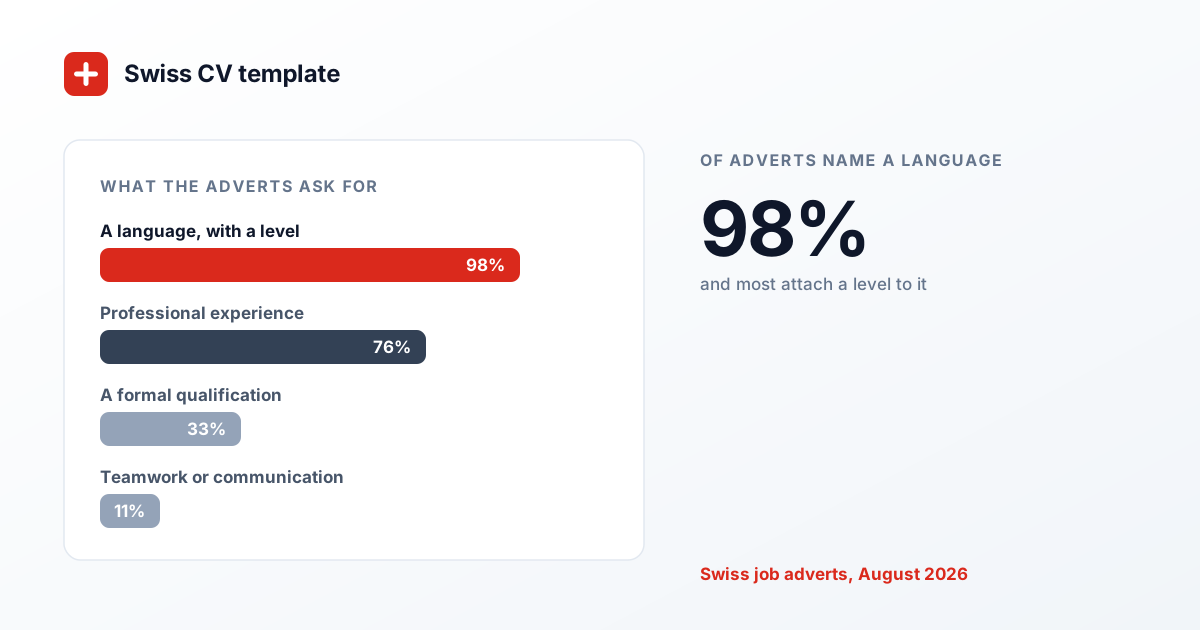
Counted across the adverts whose text I can read, a language requirement shows up on 98% of them. Professional experience is named on 76%. A formal qualification of some kind on 33%. Teamwork and communication, the two soft skills every template gives its own box, on 11%. A driving licence on 2%.
Read that as an ordering rule, not a scoring rule. What is named on almost every advert should be visible without scrolling: your last two jobs, your languages with levels, where you are and what permit you hold. What is named on one advert in ten can wait for page two, and the skills bar rating your Photoshop out of five can go entirely.
Share of adverts naming each requirement, counted across the Swiss job adverts on SwissJobs.app whose text states requirements, August 2026
Write a custom CV for every job you apply to
Most people send the same CV everywhere. The AI editor rewrites yours per application — Swiss format, the right language, in about a minute.
CV maker & resume builder: tailor it to this jobHow much detail does the experience block need?
Enough to show what you actually delivered: three quarters of adverts ask for experience and fewer than one in ten put a number of years on it, so dates and outcomes beat a claim of seniority.
This gap surprised me. Experience is the second most stated requirement in the market, and yet 8% of adverts name a specific number of years. The rest ask for experience in a role, in a sector, with a system — and that is a different question from how long you have been at it.
Which means “10+ years of experience in marketing” answers almost nobody. Write the roles instead, newest first, month and year on each, employer and location on the same line. Two or three bullets per role, and each bullet says what changed: a number, a system introduced, a team taken over.
Keep the last two positions detailed and compress everything older into single lines. The Swiss first read is short and it is spent at the top of the experience block. Put the months in, and where there is a gap, name it in three words — travel, further training, caring responsibilities. An unexplained eighteen months reads worse than any of those.
Share of Swiss job adverts on SwissJobs.app whose text states requirements, August 2026
See what a Swiss recruiter checks first
Upload your CV and get a score against a specific job ad in about 30 seconds — language levels, work permit, photo, how your achievements are phrased.
ATS CV checker, freeWhich education line matters — an EFZ, an HF or a degree?
In Switzerland the vocational line usually matters more: adverts name an EFZ, a CFC, an HF or a Weiterbildung on 19% of the adverts I could read, against 7% naming an academic degree.
This is where imported templates do the most damage. They assume education means university, so they give the degree a headline and squeeze anything vocational into a footnote. In the Swiss market that inverts the actual demand — the apprenticeship route is the mainstream qualification here, and the adverts say so.
So write the Swiss qualification in its Swiss form. Kaufmann/Kauffrau EFZ, not "commercial diploma". Dipl. Techniker HF, not "higher technical certificate". A recruiter recognises the first instantly and has to guess at the second, and a guess in a thirty-second read is a loss. Same for a Berufsmatura, a Fachausweis, an eidgenössisches Diplom.
Two thirds of adverts name no qualification at all, which is the part people misread as an opening. It usually means the requirement is obvious from the trade rather than absent — nobody spells out that the nursing post needs the nursing qualification. Where you hold a foreign qualification, add one short line saying what it corresponds to, and if it has been formally recognised, say so there.
Share of Swiss job adverts on SwissJobs.app whose text states requirements, August 2026
Which language do you write the CV in?
The one the advert is written in — German for over half of the adverts where the language is identifiable, English for a quarter, French for one in eight.
There is no national answer to this, only a per-application one. Two employers on the same street in Zurich will advertise in different languages, and the advert is the only evidence you need: write in the language it used. If it is bilingual, use the language of the first paragraph.
That has a cost worth being honest about: it means keeping the dossier in two languages rather than translating once and hoping. And the translation people get wrong is not the prose but the titles — job titles, qualifications and school names should keep their original form with a short gloss, because an employer who cannot match your title to their advert cannot shortlist you.
Inside the CV, the language block is a separate discipline: state a level for every language and use the CEFR scale, because that is what a Swiss reader expects to see. Which levels are actually asked for, and what “good German” means when an advert says it, I went through in a separate piece on what Swiss adverts mean by language level.
Share of Swiss job adverts on SwissJobs.app where the language of the advert is identifiable, August 2026
Do the Pensum and the permit lines belong on it?
Both, one line each: nine in ten adverts that state a contract type are full-time, so a target below 100% has to be said out loud, and the permit line answers a question the advert almost never asks.
Pensum is the Swiss word for the workload you are hired at, written as a percentage, and it belongs in your profile line rather than at the end. Among adverts that state a contract type, 91% are full-time and 6% part-time, with temporary work, internships and fixed contracts around one percent each. If you want 80%, the market will not offer it unprompted.
The permit line is the stranger one. A permit or right-to-work requirement appears in well under one percent of the adverts I could read — employers assume it rather than write it down. That silence is not indifference. It is the single fastest way an application from abroad gets set aside, because the reader cannot tell whether hiring you means paperwork, and guessing is more expensive than moving to the next CV.
So write it plainly under your contact details. “Swiss C permit”, “EU citizen, no permit required”, “currently in Berlin, can start within four weeks”. If you are a Grenzgänger, say so with the G permit. One line, and it removes the exact ambiguity that stops a reader in the first thirty seconds.
Share of Swiss job adverts on SwissJobs.app that name a contract type, August 2026
One page or two, and does it need a photo?
Two pages is the Swiss norm, and the photo is convention rather than requirement — nobody will reject you for leaving it off, and most dossiers still have one.
The one-page rule is American and it does not travel. A Swiss recruiter is used to a dossier: CV, then Arbeitszeugnisse, then diplomas, often as one PDF. Fifteen years squeezed onto a single page in eight-point type reads as a formatting decision rather than a career. Two pages, generous spacing, everything before roughly 2010 compressed to a line each.
The photo is genuinely optional and genuinely conventional at the same time. Adverts effectively never mention one. But the reader has a mental picture of what a Swiss dossier looks like, and a passport-style photo in the top corner matches it. I think the convention is outdated. It is still the safe play, and I set out why in the piece on whether a Swiss CV still needs a photo.
Then the mechanics that cost applications for no reason. Send a PDF, never a Word file. Name it with your surname and the role, not “CV_final_v3”. Keep the same header on both pages, add a line saying references are available, and have the Arbeitszeugnisse ready as a separate PDF, because in Switzerland they will be asked for.
What I would use to build it
Three of ours and one neutral. The shares above were counted across the adverts on our own job search.
- SwissJobs CV builderour tool
Ours, free. A Swiss-format CV with the blocks in the order above — languages with levels, Pensum and permit lines included rather than bolted on.
SwissJobs CV builder SwissJobs CV Check our tool
Ours, free. Upload the finished CV and see what a Swiss recruiter notices in the first thirty seconds — permit, languages, location, the last two roles.
Try it free- SwissJobs job searchour tool
Ours. Swiss openings filterable by canton and language — this is where every share in this article was counted.
SwissJobs job search - arbeit.swiss
Neutral and official. The Swiss public employment service, including the official application guidance and RAV registration.
Visit site - Swiss CV template: 190 occupationsour tool
Ours, free. One template per occupation, in the Swiss layout with example text.
Swiss CV template: 190 occupations
What I take from counting this is that a Swiss CV is not a stricter version of an international one. It answers a different set of questions, and it answers most of them in the top half of page one: which languages and at what level, what you actually delivered in your last two jobs, which qualification you hold in the form this country names it, whether you can legally start.
None of that is design work. You can do all of it in a plain two-column-free layout in an afternoon, and it will beat a beautiful template that leaves the reader guessing about your permit.
These shares are measured across Swiss job adverts on SwissJobs.app in August 2026, counting only what an advert states outright — where an employer leaves a requirement unwritten, it is not in these numbers, so read each as the least the market asks for rather than the most.
The tools compared
We checked 16 Swiss and international application tools on their own pages — prices, free tiers, and what is actually included.