What an AI CV builder can and cannot do for a Swiss CV
Most people who use AI on a CV use it the same way: paste the old document in, ask for a better one, send what comes out. For a Swiss application that gets about half the value and carries most of the risk. The tool is very good at some parts of the job and has nothing to offer on others, and the parts it cannot do are exactly the ones a Swiss employer checks.
We build a CV tool that uses AI, so we have an interest here and we will say so up front. That is also why we would rather be precise about the limits than oversell it. A CV that reads well and falls apart in the first interview costs you more than a plain one that holds up.
What follows is split by task. For each one: whether AI helps, what the Swiss adverts we read actually ask for, and what to do yourself.
Short version
- Can I use AI to write my CV for a Swiss job?
- Yes, for structure, wording and translation. An AI tool can put a CV into the Swiss order, match the advert's vocabulary and translate it cleanly. It cannot add experience, raise your language level or know what the employer pays, and a Swiss recruiter checks all three.
- Should I translate my CV into German with AI?
- Translate it into the language of the advert, and AI does that well. Around 56% of Swiss adverts whose language we can identify are written in German, 26% in English and 14% in French. Keep Swiss qualification names such as EFZ or Matura as they are and check job titles by hand.
- Does an English CV get round a German requirement?
- No. About 23% of Swiss adverts written in English still ask for German. Translating your CV into English changes the document, not the requirement, so read the language line of the advert before you apply.
- Can an AI tool tell me what salary to ask for in Switzerland?
- Not from adverts. None of the Swiss adverts we read states a salary figure, so no tool built on advert data can benchmark one. Use a calculator built on the federal wage survey instead, such as the SGB Lohnrechner.
- Will a Swiss employer notice an AI-written CV?
- They notice the symptoms: inflated language levels, generic achievement lines with no numbers, and claims the work references do not back up. The fix is to feed the tool real facts and to check every line against your Arbeitszeugnisse before you send it.
Working on your CV right now? ATS CV checker: free, against a real Swiss job ad
See what a Swiss recruiter checks first
Upload your CV and get a score against a specific job ad in about 30 seconds — language levels, work permit, photo, how your achievements are phrased.
ATS CV checker, freeWhat can an AI CV builder actually do well for a Swiss application?
Structure and wording: it can put your CV into the Swiss order and rewrite it in the vocabulary of the advert you are answering.
A Swiss CV has a shape. Personal details at the top, including nationality or permit and date of birth. A photo, still expected by most employers. Experience in reverse order with month and year. Education, then languages with a level, then skills. Two pages for most people, sometimes three for a long career. None of that is law, it is convention, and conventions are exactly what a language model has read thousands of times. Give it a US resume or a Europass and ask for the Swiss version and you get the right order back in seconds.
The second thing it does well is vocabulary. Adverts in the same field describe the same work in different words, and the first reader of your CV is often a system that matches words against the advert. If the advert says "Projektleitung" and your CV says "project coordination", a keyword match can miss it. Pasting the advert next to your CV and asking the tool to use the advert's terms where they are true is a legitimate, quick improvement.
Where it is true is the condition. The system that sorts and the person who decides are different readers. The person who opens the CV afterwards looks at where you worked, what you delivered there and whether the skills fit. None of that improves by adding more terms, and a CV stuffed with the advert's vocabulary reads to that person as copied. Use the tool to make the right facts findable, not to add new ones.
Write a custom CV for every job you apply to
Most people send the same CV everywhere. The AI editor rewrites yours per application — Swiss format, the right language, in about a minute.
CV maker & resume builder: tailor it to this jobShould I use AI to translate my CV into German, French or English?
Yes, into the language of the advert, and this is the task AI does best, provided you check a short list of things by hand afterwards.
Swiss adverts come in several languages, and the advert's language is usually the language the dossier should be in. Counted where the language of the advert could be identified, 56% are written in German, 26% in English, 14% in French and 2% in Italian. Anyone applying across the language border or from abroad needs at least two versions of the same CV, and producing a clean second version is the job AI tools are genuinely good at. The output is fluent and consistent, which a hurried manual translation often is not.
Three things still need a human. Swiss qualifications should keep their Swiss names: an EFZ, a Matura or an HF diploma translated into a foreign equivalent loses the meaning an employer reads in it. Put the original name and add a short explanation in brackets if the reader might not know it. Job titles are the second: a model will often turn a precise title into a generic one, and the title is one of the first things a recruiter reads. Company names, finally, stay exactly as they are.
And give the tool the advert as well as the CV. A translation that uses the advert's terms for your work reads as written for the job, while a neutral translation reads as translated.
Share of live Swiss adverts by the language they are written in, counted where the language could be identified. Measured across Swiss job adverts on SwissJobs.app, September 2026.
See what a Swiss recruiter checks first
Upload your CV and get a score against a specific job ad in about 30 seconds — language levels, work permit, photo, how your achievements are phrased.
ATS CV checker, freeDoes translating my CV into English get round the German requirement?
No. The advert's language and the language the job needs are two different things, and a translated CV only changes the first.
This is the most common misunderstanding we see among people applying from abroad, and AI makes it easier to act on. An English advert from a Zurich employer looks like an open door, the tool produces a polished English CV in a minute, and the application goes out. But across live Swiss adverts written in English, 23% also name German as a requirement. The advert is in English because the team writes in English; the office, the customers or the canton still work in German.
The same holds in the other direction: a French-language advert from Geneva or Lausanne asks for German in about one case in five as well. So before you ask any tool for a translation, read the language line in the advert. If it names a language you do not have at the level it asks for, a better CV will not change the outcome, and your time is better spent on the adverts whose languages you actually have.
If you do have the second language, show it on the CV where it counts: in the languages section with a level, and ideally in one line of experience where you used it at work.
Share of live Swiss adverts written in English that name each language as a requirement; an advert can name more than one. Measured across Swiss job adverts on SwissJobs.app, September 2026.
Can AI make my language level look better than it is?
It can write a higher level on the page, and that is the fastest way to lose a Swiss interview.
Ask a model to make your CV more competitive and it will quietly upgrade what it can: "good German" becomes "fluent German", and an honest B1 drifts towards C1. It does this because it has no idea what your German is like, and because stronger words are what "improve this" usually means. Check the languages section line by line after any AI pass.
The reason it matters in Switzerland is what the adverts demand. When a Swiss advert names German, 80% of the time it asks for professional or native level; for English the figure is 86%, for French 79%. Those are working levels, and an employer asking for one has a reason to check it, usually by switching language a few minutes into the interview. A level that does not hold up for ten minutes of conversation ends the process, and it makes the rest of the CV look doubtful too.
So write the level with a CEFR grade and a piece of evidence: a certificate, a year of work in the language, a degree taught in it. "German B2, Goethe certificate 2024" is more useful to a recruiter than "fluent", and no tool can make it up for you.
Share of language requirements in live Swiss adverts asking for professional or native level, by language. Measured across Swiss job adverts on SwissJobs.app, September 2026.
Can an AI tool tell me what salary to ask for in Switzerland?
Not from job adverts, because Swiss adverts do not publish salaries, so any figure a tool gives you came from somewhere else.
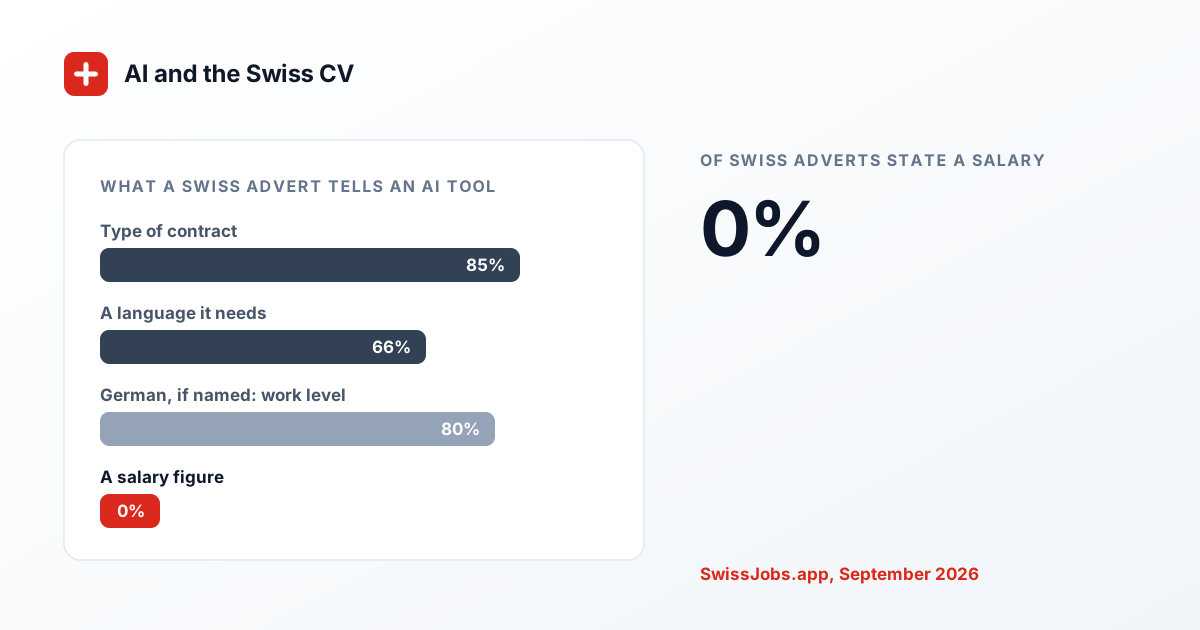
Look at what a Swiss advert states. 85% say what kind of contract it is and two thirds name a language. Not one of the Swiss adverts we read gives a salary figure. That is a measured absence, and it has a consequence people rarely hear: no tool, ours included, can benchmark a Swiss salary from advert data, because the data does not exist. A chatbot that answers "what should a marketing manager in Basel earn" is repeating whatever it read online, usually without a date or a source.
Salary matters for the CV and the letter because many Swiss application forms ask for a Lohnvorstellung, and the question comes up early in the first interview. The number you give should come from the federal wage survey, which is the only broad source of actual Swiss pay. The SGB Lohnrechner is built on it: put in canton, sector, age and function and it returns a median. Use that as a floor and give a gross annual band.
Where AI is useful here is the wording around the number: a clean sentence that states the band, says whether it assumes twelve or thirteen monthly salaries, and names the Pensum it is based on.
Share of live Swiss adverts stating each item. Measured across Swiss job adverts on SwissJobs.app, September 2026.
What can an AI tool not invent, and where does a Swiss employer catch it?
Experience, results and references, and a Swiss dossier cross-checks all three against paper.
A Swiss application is more than a CV. It usually includes the Arbeitszeugnisse, the written references every Swiss employer issues at the end of a job, and they describe your tasks and how well you did them. So an achievement on the CV that the reference does not mention, or a responsibility that sits two levels above the job title in the reference, is visible to anyone who reads both. AI-polished CVs fail here more than anywhere else, because the tool writes confident lines about impact that the paperwork does not support.
The other giveaway is sameness. Ask a model for achievement bullets and you get "drove cross-functional initiatives" and "delivered measurable results" with no measure in them. A recruiter who reads a stack of CVs a day has seen that sentence many times this month. Concrete lines with a number, a system or a customer in them read as yours: "moved 40 clients from the old billing system without an outage" is something only you can write, and the tool can only tidy it.
So the workflow that works is the reverse of the common one. Write down the facts first: employers, dates, what you did, what changed because of it, with numbers where you have them. Then let the tool do the Swiss format, the advert's vocabulary and the translation. Then check every line against your references and your real language level before it goes out. The tool saves you an hour. It does not stand behind the document in the interview. You do.
The tools for this
Two of ours, both built for the format and wording part, and one independent source for the salary part that no advert-based tool can do.
SwissJobs CV Builder our tool
Paste the advert and your details, get a CV in the Swiss format written to that advert, in the advert's language. It works from the facts you give it and does not add experience. Ours, and free.
Try it freeSwissJobs CV Check our tool
Reads your CV against a specific advert and shows which requirements it answers and which it misses, including the language line. Ours, and free.
Try it free- SGB Lohnrechner
The Swiss trade union federation's wage calculator, built on the federal wage survey. Canton, sector, age and function in, a median wage out. Use it for the salary band.
Visit site
The honest summary: AI is a good editor and translator for a Swiss CV and a poor source of facts. Let it do the format, the wording and the second language. Keep the experience, the language level and the salary number in your own hands, because those are the parts a Swiss employer checks against references, in conversation and against its own budget.
And before you send anything a tool produced, read it once as the person who will interview you would. Every line on it is a question you may be asked.
The tools compared
We checked 16 Swiss and international application tools on their own pages — prices, free tiers, and what is actually included.