AI tools that actually help a Swiss job hunt (and the ones that don’t)
I pulled the inventory this morning before coffee: 17,040 live jobs on our platform, and 2,327 of them went up in just the last seven days. Half my inbox lately is some version of the same question — which AI tool is finally going to land me a job in Switzerland?
So I tested the lot. The honest answer isn’t a single app. AI is genuinely good at a handful of things in a Swiss job hunt, useless at a few others, and quietly harmful at exactly one. Here’s the split, with the numbers that decide it.
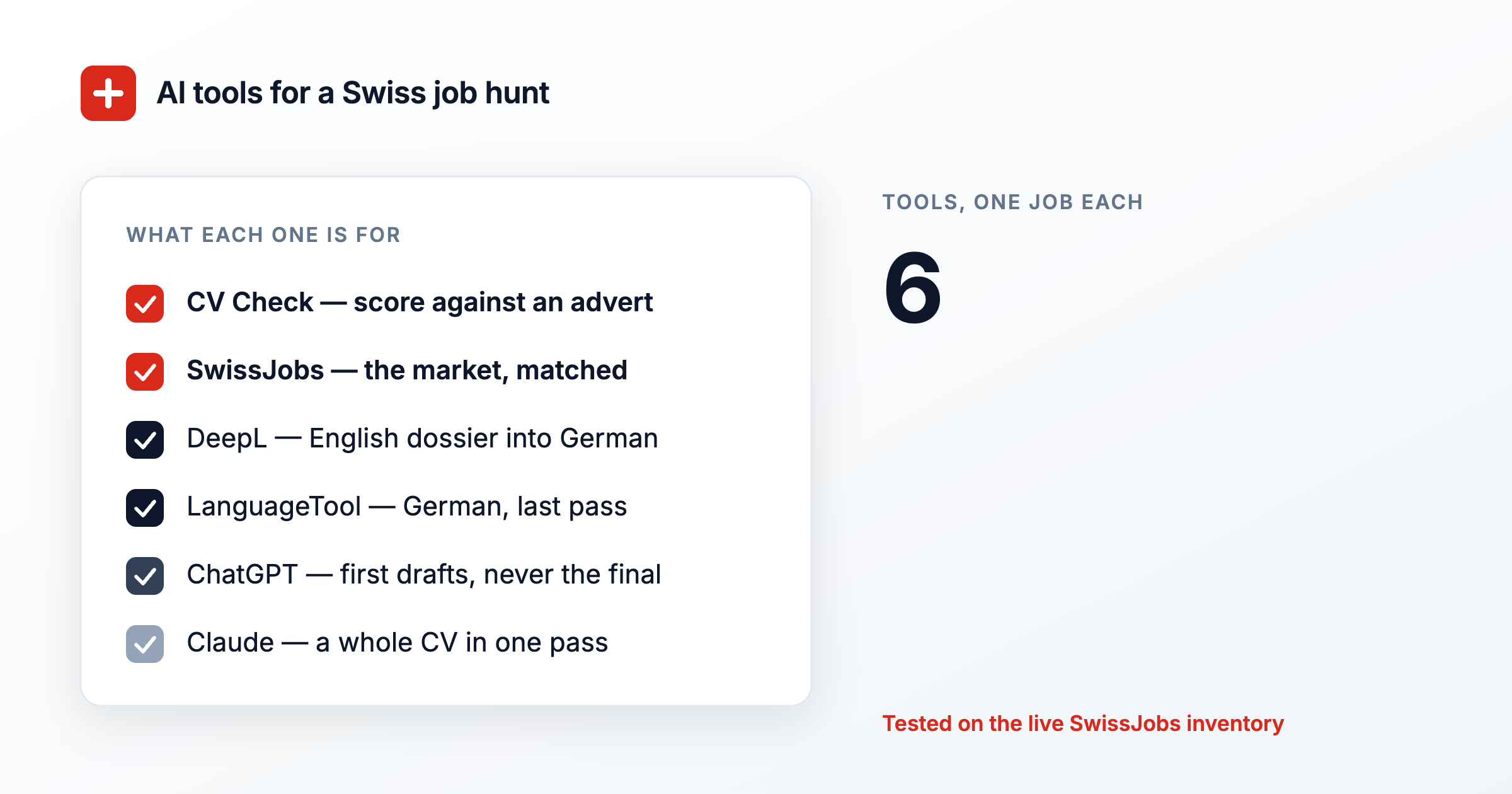
The six tools, and the one job each of them does
Ranked according to the magnitude of their impact on the outcome of a Swiss application, rather than their level of recognition.
Upload your CV and a job posting, and the tool generates a match, pinpointing the essential qualifications you're lacking. This algorithmic process is based on how Swiss recruiters evaluate candidates, taking into account not just keyword matches, but also specific requirements such as work permits and language proficiency.
All relevant job postings in Switzerland are constantly matched against your profile and updated through the day. By doing so, our system ensures you get comprehensive and timely coverage, allowing you to apply for a role as soon as it's posted, even before the selection process begins.
When an English document needs to be translated into German or French, the go-to translator for the task is one that understands the nuances of a CV. This is because a standard chatbot can easily fall into marketing jargon, which doesn't translate well in the formal context of a Swiss job application.
Following a thorough review of the German translation, the text undergoes a second pass to address any grammatical errors. The software scrutinizes the document for inflectional errors and agreement discrepancies, which can betray the text's foreign origin to a native Swiss reader. It also ensures compliance with regional spelling conventions, substituting the German sharp s with the Swiss ss.
This tool is suitable for creating a first draft of a motivation letter or for rearranging content. Do not submit the text it generates: it produces the same generic introduction as others, and will also fabricate a portion of your background that you don't actually possess.
For lengthy documents, this feature is particularly useful: it can accommodate both a comprehensive CV and a lengthy job description simultaneously, eliminating the risk of truncating the middle sections. The principle remains the same, however. It generates the content, and you review each piece of information it inserts to ensure accuracy.
Short version
- Can AI help me find a job in Switzerland?
- Yes — for specific tasks. AI is good at tailoring your CV to a posting, scoring your fit before you apply, translating a dossier into German or French, and watching 17,040 live listings so you don’t have to. It can’t get you a work permit, invent a language you don’t speak, or produce an Arbeitszeugnis you never earned.
- What’s the best AI tool for a Swiss job search?
- There’s no single all-in-one. Use a CV/match checker to pre-screen each application (ours is free), a serious translator like DeepL for German and French versions, and a general model like ChatGPT for first drafts — then edit hard, because Swiss recruiters spot raw AI text fast.
- Can AI write my Swiss CV for me?
- It can draft and format one, but don’t send it unedited. A Swiss dossier has specific expectations — permit line, languages near the top, Arbeitszeugnisse, roughly two pages — and a generic AI CV misses them. Use AI for the first draft, then fix it against how Swiss screens actually work.
- Do AI job alerts actually work in Switzerland?
- They help, because the market moves fast: 2,327 of today’s 17,040 postings are under a week old. An alert or matching agent that surfaces fresh roles every day saves real time. What it won’t do is improve your odds on any single job — that’s the CV’s job, not the alert’s.
- What can AI not do in a Swiss job hunt?
- The things that actually decide Swiss applications: your permit status, whether you genuinely speak the language a job needs (47% of live postings still name German), and your references and Arbeitszeugnisse. AI can present these well. It cannot manufacture them.
Working on your CV right now? ATS CV checker: free, against a real Swiss job ad
See what a Swiss recruiter checks first
Upload your CV and get a score against a specific job ad in about 30 seconds — language levels, work permit, photo, how your achievements are phrased.
ATS CV checker, freeWhat can AI actually do for a Swiss job hunt?
Four things, genuinely well: tailor your CV to a posting, score your fit before you apply, translate your dossier, and monitor a fast-moving market so you don’t miss fresh roles.
Let’s be concrete. When I say AI helps, I mean four specific jobs. One: rewriting your CV to mirror a specific posting’s language, so the first 30-second screen sees the match. Two: scoring your fit against a job ad before you send — a quick reality check on whether you’re a 40% or an 80%. Three: translating a clean English dossier into German or French without mangling it. Four: watching the inventory, because 2,327 of today’s postings are less than a week old and good ones close quickly.
None of that is magic. It’s just tedious work AI does faster than you do at 11pm. Tailoring a CV by hand for every application is exactly the kind of grind people skip — and then wonder why nothing lands.
So yes, use it for those four. But notice what’s not on the list: nothing about qualifications, permits, or whether you can actually do the job. AI moves the paperwork. It doesn’t move you up the shortlist on merit you don’t have.
Write a custom CV for every job you apply to
Most people send the same CV everywhere. The AI editor rewrites yours per application — Swiss format, the right language, in about a minute.
CV maker & resume builder: tailor it to this jobWhich AI tools are worth your time?
A CV/match checker first, a serious translator second, a general model for drafts third — in that order of value.
The one I’d never skip is a match checker: paste your CV and the posting, get back where you’re strong and where you’re missing the ad’s must-haves. It turns “I think I’m qualified” into a list. Do that before every application and you stop wasting sends on roles you were never going to clear.
Second, translation. If you’re applying in the German- or French-speaking market from English, DeepL is better than a general chatbot at keeping a CV natural — but read the output. It will happily translate “B2 German” into a sentence that implies fluency you don’t have, and that gap surfaces in the interview.
Third, a general model like ChatGPT for cover-letter first drafts and reformatting. Useful, but it’s the most dangerous of the three if you ship it raw — more on that below. Draft with it. Never send what it hands you.
The six below are the ones that survived that test, with what each is for and where to find it.
See what a Swiss recruiter checks first
Upload your CV and get a score against a specific job ad in about 30 seconds — language levels, work permit, photo, how your achievements are phrased.
ATS CV checker, freeWhat can AI absolutely not fix?
Your permit status, your actual language ability, and your Arbeitszeugnisse — and the language one is bigger than most people admit.
Here’s the number that ends the fantasy. Of the 17,040 postings live this morning, 47% name German somewhere in their requirements. 70% name English — higher than people expect, and real — but German still gates nearly half the market, French another 16%. No prompt fixes that. If a job needs C1 German and you have A2, the best-tailored CV in the country doesn’t change the screen.
Same with permits. A recruiter’s first screen for a non-EU applicant is often “can we even hire this person?” AI can make sure your permit line is clear and near the top — that genuinely helps — but it can’t turn a B permit into a C, or make quota-limited hiring disappear.
And references. Swiss hiring runs on Arbeitszeugnisse, and those are documents you earn, not generate. AI can help you present them; inventing one is fraud that unravels in a reference call. The tools polish reality. They don’t replace it.
Live SwissJobs inventory, 3 August 2026. Share of 17,040 published postings whose text names each language.
Do AI job alerts actually help here?
Yes — because the Swiss market turns over fast, and an agent watching it daily catches roles before they fill.
This is where the churn number earns its keep. 2,327 of the 17,040 live postings went up in the last seven days; 7,404 in the last month. That’s a market where the right role can appear and get filled inside a fortnight. If you check job sites once a week, you’re seeing a stale slice.
An AI alert or matching agent that scans the whole inventory daily and pings you when something fits is a real time-saver — not because it’s clever, but because it’s consistent. It doesn’t forget to look on the busy days.
Just keep the expectation honest: alerts win you speed and coverage, not a better shot at any single job. Being first in the inbox helps at the margin. Being the right fit, clearly presented, is what actually gets you the call.
Live SwissJobs inventory, 3 August 2026. 17,040 published postings, bucketed by how recently they went live.
How do I use AI without it backfiring?
Draft with it, never send it raw — recruiters clock generic AI phrasing and hallucinated facts inside the first screen.
The one place AI quietly hurts you: the cover letter that reads like every other cover letter. Recruiters here read hundreds of these. “I am excited to leverage my skills to drive impact” lands with a thud — it’s the sound of nobody home. If your letter could be for any job, it’s working against you.
Worse is when a model invents a fact to fill a gap — a certification you don’t hold, a tool you’ve never touched. It reads fine on the page and collapses in the interview. Every line on your dossier has to be something you’d defend across a table.
So use AI as a first-draft engine and a checker, then bring the human part: your real numbers, your actual Arbeitszeugnisse, the specifics only you know. Before you send anything, run the finished CV through a check against the posting and Swiss screening habits — that’s the 30 seconds that decides whether the human even keeps reading.
The tools I’d actually use
Three links, no affiliate anything:
- SwissJobsour tool
Ours. The whole Swiss market aggregated — 17,040 live postings today — with AI matching and search across four languages, so the alerts watch the churn for you.
SwissJobs SwissJobs CV Check our tool
Ours, free. Scores your CV against a specific posting and Swiss screening habits in about 30 seconds — the pre-send reality check this whole article is really about.
Try it free- DeepL
The translator I’d trust for a German or French version of an English dossier — more natural than a general chatbot, but still read every line before you send.
Visit site
AI is a fast intern with no judgement. Brilliant at the tedious parts — tailoring, translating, watching the market — and dangerous the moment you let it speak for you unedited.
Use it for the four things it’s good at, ignore it for the things only you can prove, and check the finished application before it goes. The data just makes the split visible.
The tools compared
We checked 16 Swiss and international application tools on their own pages — prices, free tiers, and what is actually included.