The best job sites in Switzerland — from someone who tracks all of them
We count Swiss job postings for a living. So when people ask us which job site to use, we're not guessing — I watch where the postings actually come from, what language they're written in, and how fast they turn over, every single day.
Short answer: there is no one best site. There's a best site for your language, your region, and your kind of role. Here's the honest map, including where our own platform fits and where it doesn't.
Swiss job sites at a glance — what each one is actually for
Our own platform is first, and we say so rather than hiding it in a ranking. Everything below is a live Swiss job site; the note says what it is genuinely good at, so you can pick two or three instead of opening all of them.
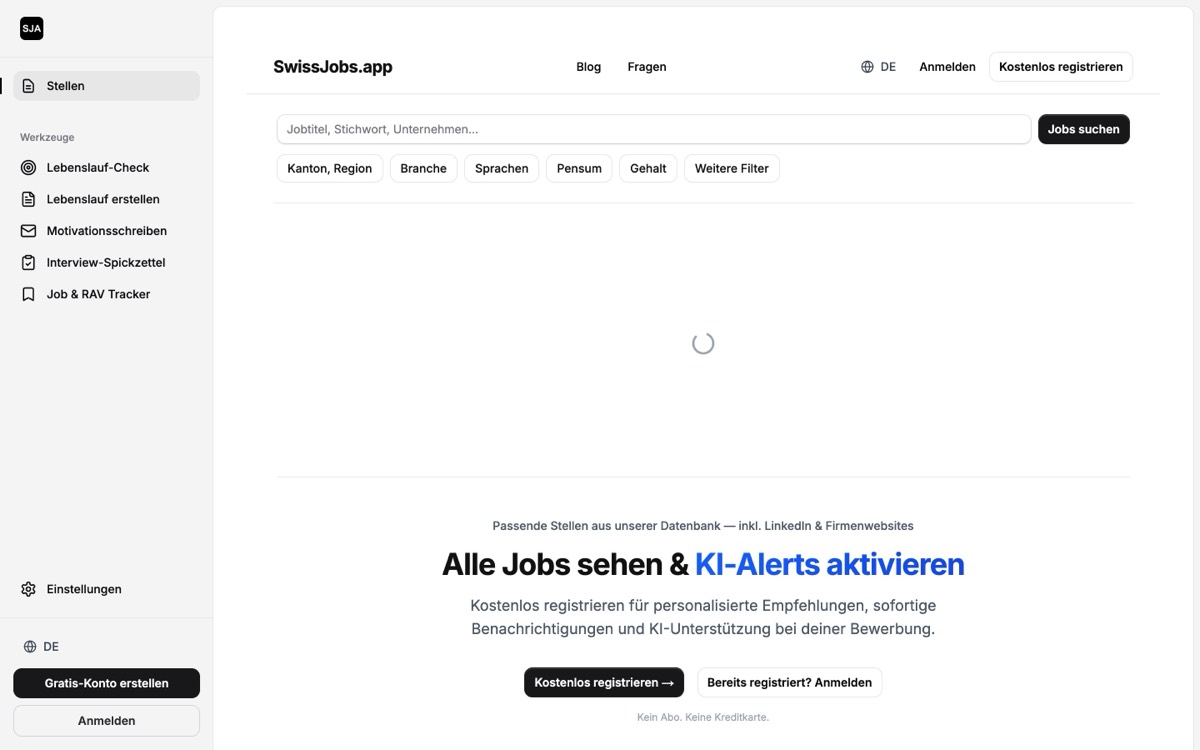
1. SwissJobs.appOur app
The full set of Swiss adverts — pulled from company ATS systems, employer sites and LinkedIn into one index — with the tools for actually applying built into the same place. From any advert you get a CV rewritten for that specific job automatically, a matching cover letter, a CV check that applies its own corrections on a click, and spoken interview practice with AI. Your applications feed the RAV job-search record on their own. Building a CV, tailoring it and downloading it once needs no account at all.
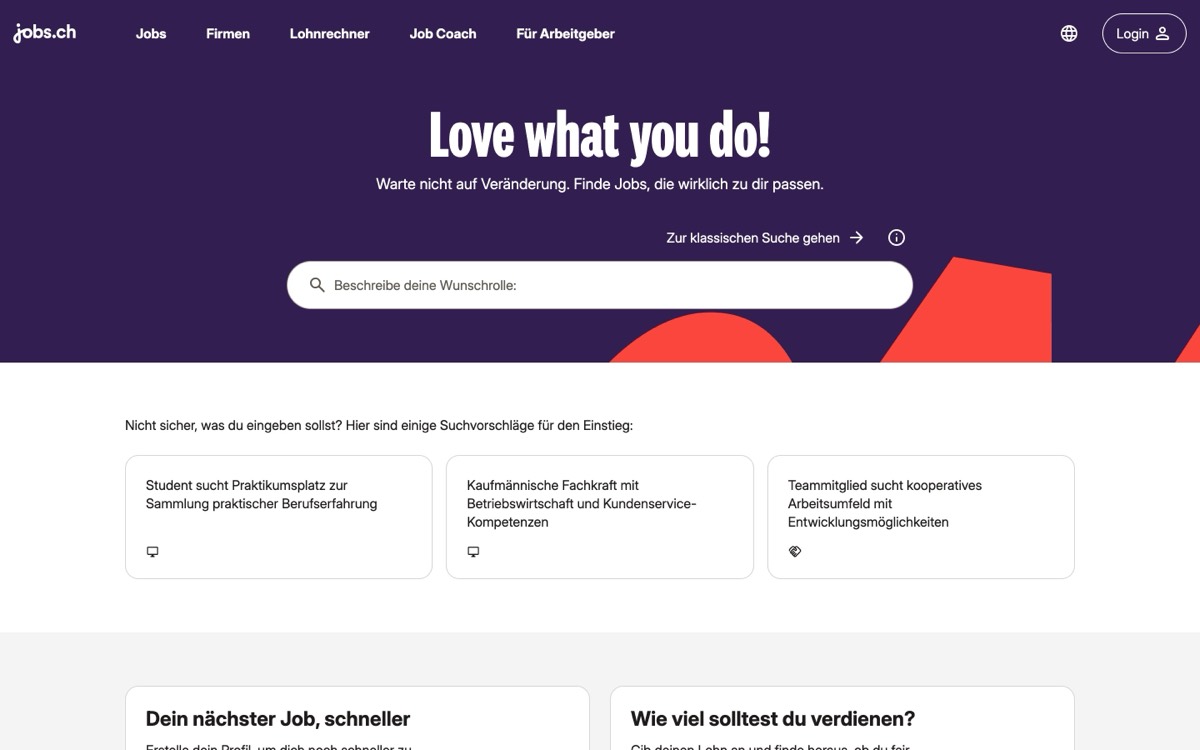
The largest index in the country and the default in German-speaking Switzerland. If you only ever open one commercial board, this is it. Owned by JobCloud AG.
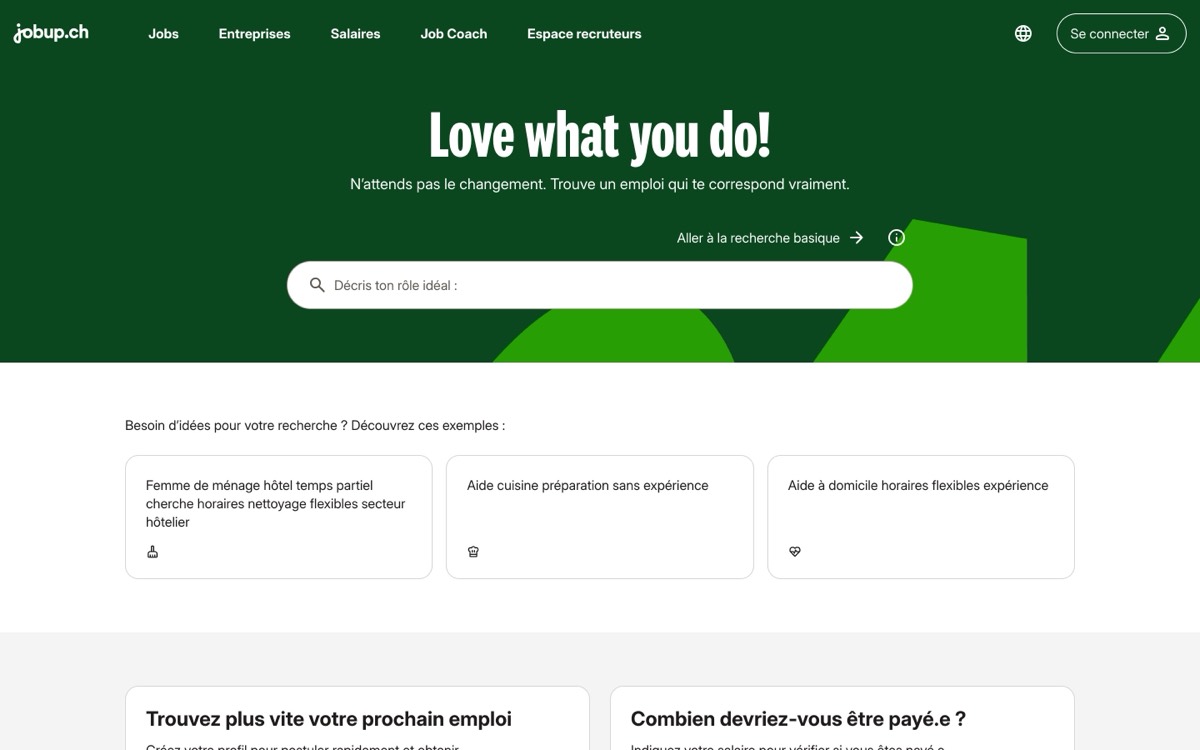
The standard in French-speaking Switzerland and the first place to look for Geneva, Vaud and Neuchâtel. Same owner as jobs.ch, so treat the two as one source rather than two.
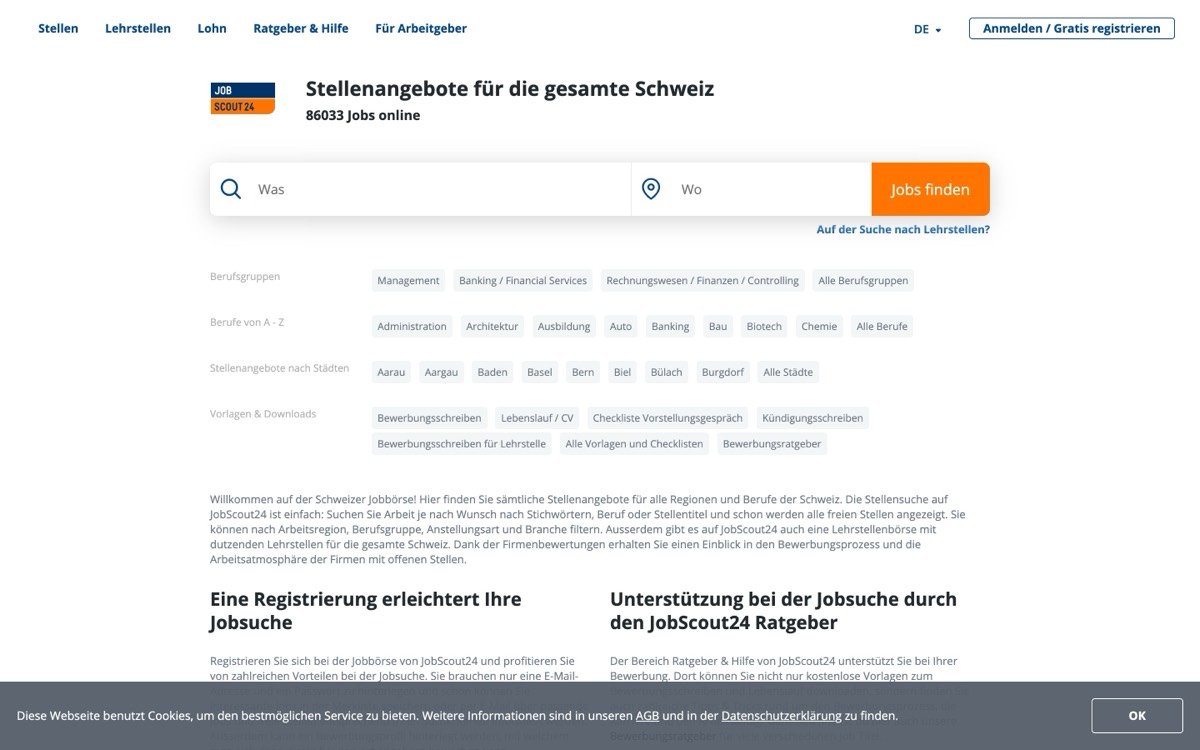
The third JobCloud brand. Worth knowing mainly so you do not mistake searching all three for searching broadly — it is one company’s inventory under three names.
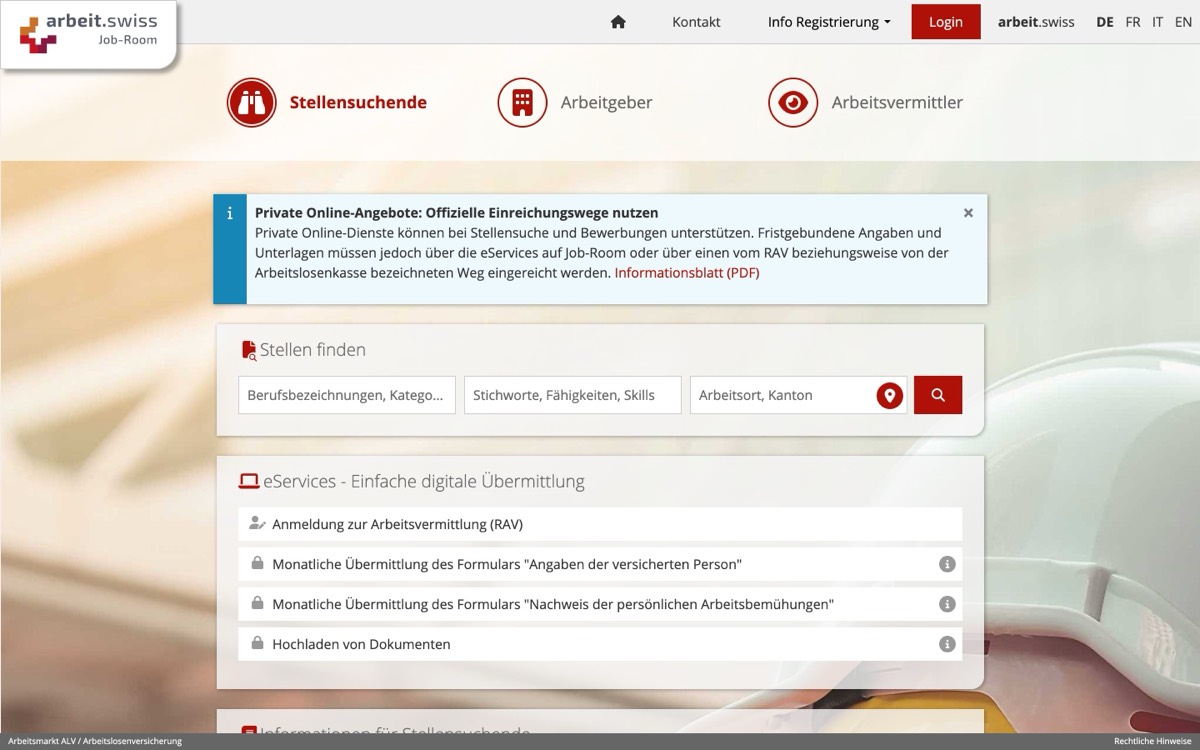
5. Job-Room (arbeit.swiss)Public service
The public employment service’s own portal, and the one thing no private board can replicate: if you are registered with an RAV, notifiable vacancies appear here five working days before an employer may advertise them anywhere else. It also carries the eService for your monthly job-search record. Free, and no account is needed to search.
The broadest aggregation, because it also collects from other portals. The trade-off is duplicates: the same vacancy often appears several times from different sources.
Best for English-language, international and office roles in Switzerland, and the only one where the application and your professional profile are the same thing. Noticeably thinner for trades, care work and retail.
A Swiss aggregator built around saved searches and email alerts. Useful as the passive layer — set it once and let new adverts come to you while you search actively elsewhere.
The Federal Administration’s own vacancies. Public-sector roles are rarely well represented on commercial boards, so if you want to work for the Confederation, this is the source rather than a shortcut to it.
10. ostjob.ch and its regional siblings
A network of strictly regional boards — Eastern Switzerland, Central Switzerland and others by canton. Smaller employers who never advertise nationally do post here, which is where a regional search finds what the big indexes miss.
The German-speaking alternative to LinkedIn. Still meaningful for German-language and DACH-region roles, particularly with employers who also recruit across the German border.
12. Michael Page and the specialist recruiters
Agency listings for qualified and senior positions in finance, IT, engineering and legal. Many such roles are never advertised publicly, so the agency is the only route to them.
Staffing and temporary work at scale, and in practice the entry route into the Swiss market for many people arriving from abroad. Temporary placements convert to permanent contracts more often than their reputation suggests.
Academic and research posts across the Swiss universities, the ETH domain and the research institutes. For a doctoral, postdoctoral or lab position, general boards will not show you the field.
Healthcare specifically — nursing, medical and care roles. A sector board matters more here than in most fields, because hospital and care-home vacancies are often filled through channels the general indexes never see.
Hospitality, catering and hotel work, including the seasonal roles that drive a large part of the Swiss market in the mountains and around the lakes.
Short version
- What is the best job site in Switzerland?
- There is no single best site — it depends on your language, your region and your kind of role. jobs.ch is the default for German-speaking Switzerland, jobup.ch for the French-speaking market, LinkedIn for international and senior roles. Most successful searches run two or three in parallel. An aggregator — ours or another — mainly helps before that: seeing what is actually advertised, instead of judging the market from inside one board.
- Is LinkedIn enough to find a job in Switzerland?
- For international, English-language corporate roles — often yes. For everything else, no. A huge share of Swiss SME jobs never appears on LinkedIn; they live on jobs.ch, jobup.ch, company career pages and cantonal boards. If you only search LinkedIn, you're seeing maybe a third of the market.
- Can I search Swiss jobs in English?
- Yes — and this surprises people: close to a third of the Swiss postings we process every day are written in English, mostly in tech, pharma, finance and international firms in Zurich, Zug, Basel and Geneva.
- Are there free tools to check my chances before applying?
- A few sites now score your CV against a posting before you apply. Ours does it free in about 30 seconds — it checks your CV against Swiss screening habits (permit line, languages, format) and the specific job ad. Whatever tool you use: check before you send, because Swiss first screens take about 30 seconds.
- Where do jobs in Romandie (French-speaking Switzerland) get posted?
- jobup.ch first — it's the default in Geneva, Lausanne and the whole French-speaking arc. French-language postings cluster heavily in Geneva and Vaud. LinkedIn adds the international Geneva layer.
Working on your CV right now? ATS CV checker: free, against a real Swiss job ad
See what a Swiss recruiter checks first
Upload your CV and get a score against a specific job ad in about 30 seconds — language levels, work permit, photo, how your achievements are phrased.
ATS CV checker, freeWhat does the Swiss job market actually look like right now?
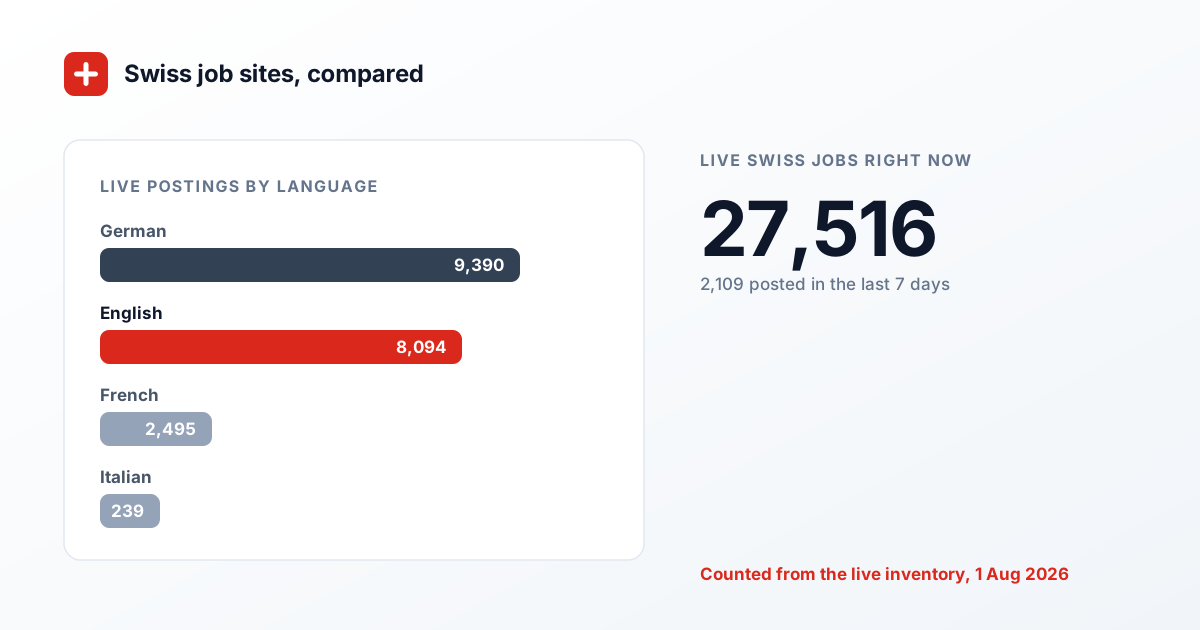
Zurich dominates the map, but the language split is the real story.
Before comparing sites, look at the terrain. Zurich carries by far the most live postings, followed by Bern, Geneva and Basel-Stadt. No surprises there.
The detail that changes strategy: German is the most common posting language, but nearly one in three adverts is written in English. If you've been telling yourself you can't job-hunt here without German — for a substantial part of the market, that isn't true.
And the market moves fast. A good share of postings are less than a week old. Whatever site you use, sort by date and check often; good roles in Switzerland don't sit around.
Share of the Swiss postings we track, August 2026; postings without a detected language omitted.
Write a custom CV for every job you apply to
Most people send the same CV everywhere. The AI editor rewrites yours per application — Swiss format, the right language, in about a minute.
CV maker & resume builder: tailor it to this jobWhere our own platform fits — and where it doesn't
We aggregate the whole market into one place and add AI matching plus a free CV check — that is the honest pitch, and the ownership is disclosed up front.
Full disclosure: SwissJobs is our platform, so weigh this section accordingly. What we do is aggregate: postings from across the market — boards, company career pages, LinkedIn — deduplicated and searchable in one place, in four languages. That's useful for getting the lay of the land. It does not replace the big boards: for local SME roles jobs.ch remains the fuller source, and jobup.ch in the Romandie.
The part we would actually argue is unique: before you apply anywhere (including on the other sites above), you can run your CV against a specific posting for free. It scores you the way a Swiss first screen does — permit visible? languages stated? results instead of duties? — and that check takes 30 seconds. The application you don't waste matters more than the site you found the job on.
See what a Swiss recruiter checks first
Upload your CV and get a score against a specific job ad in about 30 seconds — language levels, work permit, photo, how your achievements are phrased.
ATS CV checker, freejobs.ch and jobup.ch: the Swiss default
The biggest classic boards — jobs.ch for the German-speaking market, jobup.ch for Romandie. The place to add once you are targeting local employers directly.
These two (same company, by the way) are where Swiss HR departments post first, especially SMEs that never touch LinkedIn. Coverage of local, German- and French-language roles is unmatched.
The trade-off: filtering is old-school keyword search. You'll scroll. And the interface assumes you already know exactly what title you're looking for — which, with Swiss title conventions (Sachbearbeiter, anyone?), is a real assumption.
LinkedIn and Indeed: the international layer
LinkedIn for corporate, English-language and senior roles; Indeed as a broad aggregator with mixed Swiss depth.
LinkedIn is genuinely strong for the international slice — the Zurich/Zug tech scene, Basel pharma, Geneva organisations. Recruiters actively source there, so a good profile works for you while you sleep.
But we keep meeting people who searched only LinkedIn for months and concluded 'there are no jobs'. There are. They're just on the Swiss boards, in German or French, under titles LinkedIn's search never surfaces. Indeed aggregates some of this, but its Swiss coverage is patchier than people assume.
So which sites should you actually use?
Two or three in parallel, chosen by your language and region — not one site, and not five.
German-speaker aiming at Swiss SMEs: jobs.ch, plus an aggregator for the overview. Romandie: jobup.ch, same pattern. English-speaking international: LinkedIn — and don't skip company career pages in your niche.
And whichever combination you pick — put your effort into fewer, better applications. The Swiss market rewards precision. A CV that survives the 30-second screen on three well-chosen roles beats twenty scattered applications every single week. I've watched both strategies from the data side; it isn't close.
What the adverts actually ask for
Counted across every published advert in our index that states a language requirement, on 7 September 2026.
German is asked for in 65.6 per cent of those adverts and English in 46.1 per cent, which is roughly the split most people expect. The part that surprises almost everyone is the level. Where an advert names English, it wants professional or native English 86 per cent of the time — more often than it wants that standard of German, which comes in at 81 per cent. English is rarely the language an employer wants a little of. If your CV hedges on it, that hedge is doing more damage than the equivalent hedge on German.
French appears in 21.9 per cent of those adverts and Italian in 3.4 per cent. One advert in five asks for two languages or more, so a single-language search is a narrower search than it feels like. Apprenticeships are excluded from all of this, because a Lehrstelle names the qualification it leads to rather than what it demands on arrival, and leaving them in distorts every share.
Share of adverts stating a language requirement that name each language, per cent. Counted per advert, apprenticeships excluded.
Part-time work is four times more common than the filters suggest
The single most useful thing our index shows about how job sites mislead you.
Only about 5 per cent of adverts are tagged part-time in the structured field that every portal filter reads. Count the workload written into the job title as well — all the roles advertised at 80 to 100 per cent — and the real figure is 20 per cent. So when you tick the part-time box on any Swiss job site, you are looking at roughly a quarter of what is actually being advertised. The rest is there; it simply never got tagged.
Where it shows up varies sharply: a reduced workload appears in the title of 36 per cent of adverts in Aargau, 34.5 per cent in Lucerne, 30.8 per cent in Bern, 21 per cent in Zurich and 5.8 per cent in Geneva. Read that last figure carefully, because it mostly measures a habit rather than a market. Romandie states the workload in the title only 12.7 per cent of the time against 23 per cent nationally, so a title-based count necessarily finds less of it there. This is where part-time is visibly advertised, not where it exists.
Share of adverts whose title states a reduced workload, per cent. Cantons with at least 300 adverts.
How old is the advert you are looking at?
Freshness is the one thing job sites compete on and the one thing they never quantify.
The median advert currently live in our index is 33 days old. A quarter are 9 days old or newer, a quarter are older than 80 days, and one in ten has been up for more than 115 days. Just under 22 per cent went up within the last week.
One caveat matters more than the numbers, and no job site will tell you this one. That is the age of adverts that are still live — not how long a vacancy lasts. A role filled in four days never appears in a snapshot at all, so any snapshot over-represents the long-lived listings, which are disproportionately the hard-to-fill ones. The practical reading is the opposite of discouraging: if a posting is a week old and still up, you are not late.
Cumulative share of currently live adverts by age, per cent.
The tools I'd start with
Three links, no affiliate anything:
- SwissJobsour tool
Ours. Swiss postings from boards, career pages and LinkedIn aggregated in one place — with AI matching and search in four languages.
SwissJobs SwissJobs CV Check our tool
Ours, free. Scores your CV against a specific posting and Swiss screening criteria in about 30 seconds, before you burn the application.
Try it free- jobup.ch
The default board for French-speaking Switzerland — essential if you're targeting Geneva, Lausanne or the Romandie arc.
Visit site
The site matters less than people think, and the application matters more. Pick two or three platforms that cover your language and region, set up alerts, and spend the saved time making each application survive a 30-second Swiss screen.
That's the whole game. The data just makes it visible.
The tools compared
We checked 16 Swiss and international application tools on their own pages — prices, free tiers, and what is actually included.