Why does a beautifully designed CV fail in Switzerland?
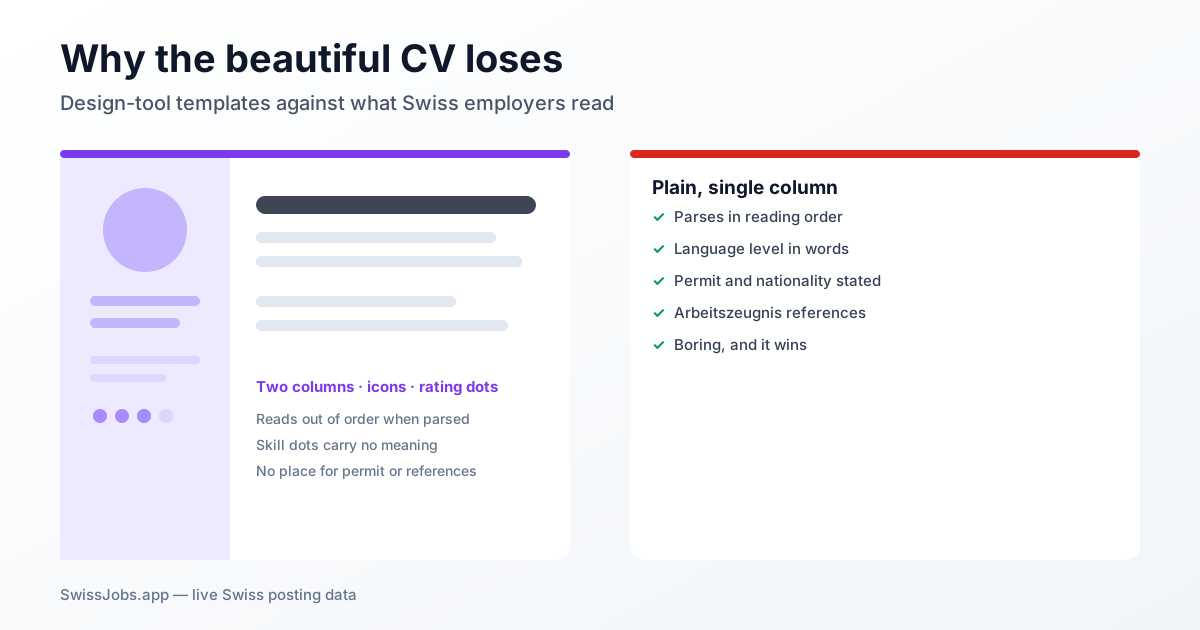
A designed CV feels like effort. Two columns, a colour sidebar, icons for the contact details, little rating dots for each skill. It looks like someone who cares.
It is also the version most likely to lose information on the way to a human being, and in Switzerland it carries a second cost that has nothing to do with software: in a conservative hiring market, visual flourish reads as unserious rather than creative.
This is not an argument against the tools. Canva is taught in Swiss schools as part of application training — school leavers are coached to build their CV in it, alongside using AI for the letter. Nobody choosing a template made a mistake. The problem is the specific layout those tools default to, and it is fixable without abandoning the tool at all.
Short version
- Can you use a Canva CV in Switzerland?
- Yes, if you change the layout. Use a single-column template, real text rather than text inside images, and no skill rating bars. The tool is fine; the default two-column design is what causes problems.
- Why do two-column CVs cause problems?
- Software that reads the file before a human does often parses it left-to-right across both columns, which interleaves your sidebar with your job history and scrambles the reading order.
- Are skill rating dots bad on a CV?
- They carry no information. Four dots out of five means nothing shared — there is no scale behind it. A CEFR language level or a sentence about what you built with a tool says something checkable.
- What layout do Swiss employers expect?
- One or two pages, single column, reverse-chronological, with permit status and language levels in the top third, and Arbeitszeugnis references at the end.
- Does a designed CV work if you are registered with the RAV?
- It creates extra work. Anyone claiming Swiss unemployment benefit has to document their applications for the RAV, and a design file that cannot produce a clean, consistent record makes that monthly obligation harder than it needs to be.
Working on your CV right now? ATS CV checker: free, against a real Swiss job ad
See what a Swiss recruiter checks first
Upload your CV and get a score against a specific job ad in about 30 seconds — language levels, work permit, photo, how your achievements are phrased.
ATS CV checker, freeWhat actually goes wrong with a two-column CV?
The reading order breaks. Software reads across the page, so your sidebar ends up interleaved with your experience.
Most applications pass through software before a person opens them. That software converts your PDF into text, and the conversion is where a two-column layout fails: many parsers read straight across the page rather than down each column. What comes out is your address, then a job title, then a skill, then half a bullet point.
A recruiter opening that file may still see the pretty version and never know. But the searchable text stored in the system is the mangled one, and if anyone later searches the database for a skill you actually have, you may not come back.
The failure is invisible from your side, which is what makes it worth taking seriously. You get no error and no feedback. The document simply performs worse than it looks, and nothing tells you.
The fix costs nothing aesthetically. A single column, generous spacing and clear headings look calm and deliberate — which in this market is the impression you want anyway.
Write a custom CV for every job you apply to
Most people send the same CV everywhere. The AI editor rewrites yours per application — Swiss format, the right language, in about a minute.
CV maker & resume builder: tailor it to this jobWhy do skill rating dots not work?
Because there is no scale behind them. Four out of five dots is a claim with no unit.
Rating widgets are the single most common feature of designed templates and the least useful thing on the page. What is the difference between three dots and four? Nobody knows, including the person who filled them in.
They also fail the parsing test twice over, because a dot is a drawing. When the file becomes text, the graphic disappears and so does whatever it was meant to convey — leaving the skill name floating with no qualifier at all.
Languages are where this costs the most, because in Switzerland the language line is genuinely load-bearing. Across the live Swiss postings we index, around eighty-five percent state a language requirement outright. Of those, roughly seven in ten want German, four in ten English, two in ten French. And of the roles demanding German, close to nine in ten want it at professional working level rather than conversational.
A recruiter filtering for professional German cannot do anything with four dots. They can do something with "German C1 — client meetings and technical documentation for three years". Same space on the page, entirely different value.
Live SwissJobs.app postings. Shares exceed 100% because many roles require more than one language.
See what a Swiss recruiter checks first
Upload your CV and get a score against a specific job ad in about 30 seconds — language levels, work permit, photo, how your achievements are phrased.
ATS CV checker, freeWhat does a Swiss dossier need that a template has no field for?
Permit status and Arbeitszeugnis references — neither of which appears in any international template.
Design tools build templates for a global audience, so they contain the fields every market shares: contact, experience, education, skills. What they omit is everything local, and in Switzerland the local parts are the ones a recruiter looks for first.
Permit status is the big one. An employer reading an application has an immediate practical question about whether you can legally start and how much administration is involved. One line — Swiss citizen, C permit, EU citizen under freedom of movement, already resident — closes it. No template has a field for this, so almost nobody adds one, and the reader is left to assume the expensive answer.
Arbeitszeugnisse are the other. Swiss employers issue detailed written references at the end of every employment, and hiring managers expect them referenced and usually attached. A CV that never mentions them signals unfamiliarity with how the system works.
Both are one line each. The reason they are missing is not that they are hard — it is that the template did not prompt for them, and a template is a very effective way of forgetting things.
What if you are registered with the RAV?
Then the document is also a record. Anyone on unemployment benefit has to evidence their applications every month.
This is the part international CV advice never covers, because it does not exist elsewhere in the same form. If you are claiming unemployment benefit in Switzerland you are registered with the RAV, and you have to document a required number of applications each month and show that record at your appointments.
That turns the CV from a purely persuasive document into part of an administrative trail. You need consistent versions, a clear sense of what went where and when, and exports you can reproduce. Swiss application vendors advertise RAV-compatible exports and Job-Room evidence as a headline feature precisely because this obligation is real and tedious.
A design file is a poor fit for that job. It is built for one beautiful artefact, not for twenty consistent variants and a log of where each went. If you are job hunting under RAV obligations, the tracking matters as much as the layout, and choosing a tool that ignores it creates work you will do by hand every month.
When is a designed CV actually the right call?
When the design is the work sample — and even then, send the plain one too.
If you are a graphic designer, an art director, a motion designer or an illustrator, the CV is a portfolio piece and a plain one undersells you. The same goes for some marketing and front-end roles where visual judgement is part of the assessment.
Even there, the practical move is two files. A designed version for the human, and a plain single-column version for the system — or a plain CV plus a portfolio link, which is what most design hiring actually runs on.
Outside those fields, the calculation is simple. Swiss recruiting is conservative enough that visual flourish is a small negative rather than a small positive, and the parsing risk is real. There is no upside to spend against it.
One more thing worth weighing: speed. Over a quarter of the postings we index were published in the last seven days and around sixty percent within thirty, with a median age of roughly twenty days. An afternoon spent adjusting a colour sidebar is an afternoon a role stayed open without your application in it.
How do you fix a designed CV without starting again?
Keep the content, drop to one column, convert every graphic into words.
Start by collapsing the layout to a single column and putting sections in reading order: contact and permit, languages, experience, education, references. Nothing here needs rewriting — it needs re-stacking.
Then convert every graphic into text. Rating dots become stated levels. Icons beside your phone number and email become plain labels, or nothing at all, since the fields are obvious. Any text sitting inside an image becomes real text.
Add the two missing lines: permit status near the top, Arbeitszeugnis references at the end.
Then check it the way the software does. Open the exported PDF, select all, copy, and paste it into a plain text editor. What you see is roughly what the parser sees. If your sidebar is interleaved with your job history, or your skills have vanished, you have found the problem — and you found it before an employer did.
Making it plain without making it worse
The content is usually fine. It is the layout that needs to change, and that is a twenty-minute job rather than a rewrite:
SwissJobs.app CV Check our tool
Ours. Free — upload the designed version and it shows what survives parsing and what is missing against Swiss convention, including permit and language levels.
Try it freeSwissJobs.app AI CV Builder our tool
Ours. Rebuilds the same content as a single-column Swiss CV with the permit line and language block in place, and exports something that stays readable as text.
Try it free- SwissJobs.app job searchour tool
Ours. Filter by canton and by the language a role actually requires, so you tailor once rather than guessing.
SwissJobs.app job search
Keep the tool if you like it. Change the template, and convert every picture into a sentence.
The plain version is not the lazy version. In this market it is the one that survives the first read.
The tools compared
We checked 16 Swiss and international application tools on their own pages — prices, free tiers, and what is actually included.