Europass or a Swiss CV? What the EU template leaves out
Europass is free, standardised, available in every EU language, and recommended by name on a lot of official career pages. If you are applying from inside the EU it is a reasonable default, and nobody who used one made a mistake.
Switzerland is not in the EU. That single fact is what makes the template awkward here — not because it is badly made, but because the things it deliberately leaves out are the things a Swiss recruiter reaches for first.
This is worth being precise about, because the internet is full of people telling you Europass is "outdated" or "unprofessional". It is neither. It is a document with a specific purpose, and that purpose is cross-border mobility inside the EU and EEA. Understanding what it was designed to do explains everything else.
Short version
- Can you use a Europass CV in Switzerland?
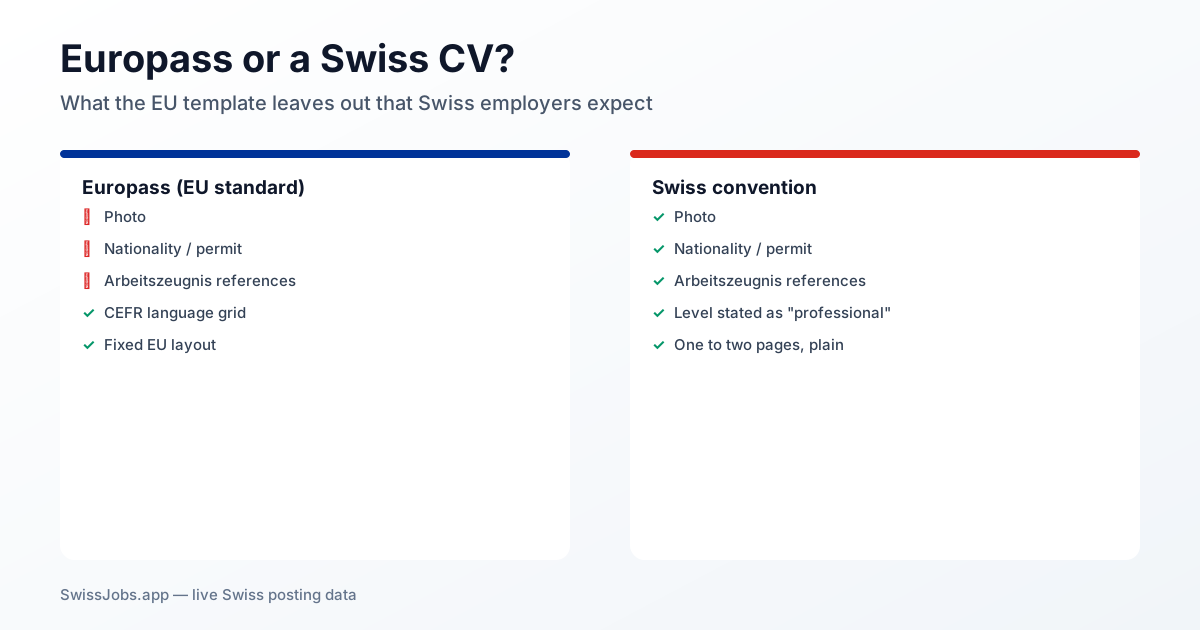
- You can, and it will not be thrown out. But it omits three things Swiss employers expect — a photo, your nationality or permit status, and any reference to your Arbeitszeugnisse — so it reads as a document written for a different market.
- Why does Europass leave out the photo and nationality?
- On purpose. EU anti-discrimination guidance discourages both, so the template has no field for them. Swiss hiring convention runs the other way, which is why the same document behaves differently on each side of the border.
- When is Europass still the right choice?
- Applications to EU institutions, Erasmus and academic mobility programmes, and any employer who explicitly asks for it. In those cases it is not just acceptable, it is expected.
- What is the one part of Europass worth keeping?
- The CEFR language grid. Stating levels as A2, B2 or C1 rather than "good" or "fluent" is genuinely better practice, and it maps onto what Swiss postings ask for.
Working on your CV right now? ATS CV checker: free, against a real Swiss job ad
See what a Swiss recruiter checks first
Upload your CV and get a score against a specific job ad in about 30 seconds — language levels, work permit, photo, how your achievements are phrased.
ATS CV checker, freeWhat is Europass actually for?
It is an EU mobility instrument, not a CV design. Its job is to make a Portuguese qualification legible to a Finnish employer.
Europass was created so that qualifications and experience earned in one member state could be read without ambiguity in another. That is a real problem worth solving. A diploma title means nothing across a border unless something translates it, and the standard format plus the CEFR language grid does exactly that.
It follows that everything about the template optimises for comparability. Fixed field order, the same section names in every language, no room for interpretation. If you are one of thousands of applications moving between EU states, that consistency is the entire value.
The moment you apply outside that system, the calculation inverts. Comparability with EU norms stops being an asset, and the rigid structure starts preventing you from including things the local market expects. Switzerland is the clearest case of that, because Swiss hiring convention diverges from EU guidance on exactly the points Europass is strictest about.
Write a custom CV for every job you apply to
Most people send the same CV everywhere. The AI editor rewrites yours per application — Swiss format, the right language, in about a minute.
CV maker & resume builder: tailor it to this jobWhat does a Europass CV leave out for Switzerland?
Three things: a photo, your nationality or permit status, and anywhere to reference your Arbeitszeugnisse.
The photo comes first because it is the most visible. A Swiss dossier from a domestic employer still typically carries one. Europass has no photo field in its current form, and the omission is deliberate — EU guidance treats photos as an invitation to bias. Neither position is wrong; they are simply different conventions, and you are applying under one of them.
Nationality and permit status matter more, and this is where the template genuinely costs you. A Swiss employer reading an application from outside Switzerland has one immediate question: can this person legally start, and how much administrative work is involved? If you hold a C permit, or you are an EU citizen with freedom of movement, or you already live in the country, that is the single most reassuring line on the page. Europass has no natural place for it, so most people leave it out, and the reader is left to assume the expensive answer.
The third is the Arbeitszeugnis, and it is the one most non-Swiss applicants have never heard of. Swiss employers issue detailed written references at the end of every employment, and hiring managers expect to see them referenced and usually attached. A CV that never mentions them reads as though the applicant does not know how the system works — which, fairly often, is exactly what it is signalling.
None of these is fatal on its own. Together they produce a document that is competent, complete by EU standards, and unmistakably written for somewhere else.
See what a Swiss recruiter checks first
Upload your CV and get a score against a specific job ad in about 30 seconds — language levels, work permit, photo, how your achievements are phrased.
ATS CV checker, freeWhat do Swiss job ads actually ask for?
Language, mostly — and more specifically than a self-assessment grid captures.
Across the live Swiss postings we index, roughly eighty-five percent state a language requirement outright. That is a strikingly high share, and it tells you what the first filter is. It is not your degree and it is not your job title.
Of the postings that state a requirement, around seven in ten ask for German. English appears in about four in ten, French in about two in ten, Italian in fewer than one in twenty. Those overlap, because plenty of roles want two languages — and the overlap is the point. A CV that presents one language convincingly and stays vague about the second is answering half the question.
The level asked for matters more than the language. Of the postings demanding German, close to nine in ten want it at a professional working level rather than conversational, and only a small minority ask for native. That is good news if you are learning: the bar is high but it is not native fluency, and it is stated far more often than people assume.
This is where Europass accidentally helps. Its language grid forces you to state a CEFR level rather than write "good German", and a stated B2 is far more useful to a recruiter than an adjective. Keep that habit even if you abandon the template.
Live SwissJobs.app postings. Shares exceed 100% because many roles require more than one language.
Is the Europass language grid worth keeping?
Yes. It is the best part of the template and the part most people drop.
There is a habit in CV writing of describing languages with adjectives — fluent, good, basic, business level. Every one of those means something different to every reader, which makes them close to worthless as information.
CEFR levels are not perfect but they are shared. B2 means a specific, testable thing. A recruiter comparing forty applications can sort B2 from A2 without interpretation, and cannot do the same with "good" and "solid".
The refinement for Switzerland is to state the level and then, in one clause, what you have actually done in that language. "German C1 — ran client meetings and wrote technical documentation in German for three years" is far stronger than either the level alone or the description alone. You are giving the recruiter the comparable value and the evidence at once.
That is the pattern for the whole document, really. Keep the discipline Europass imposes; drop the container.
When should you use Europass anyway?
When the reader is an EU institution, an academic mobility programme, or anyone who asked for it by name.
If a posting names Europass, send Europass. This sounds obvious and it gets ignored constantly by people who have read one article saying the format is dated. An employer asking for a specific format is telling you how their process works, and second-guessing it costs you nothing but goodwill you did not need to spend.
EU institutions, agencies and EU-funded programmes generally expect it. Erasmus and academic mobility applications frequently require it. Some Swiss universities and research institutions working within EU frameworks will accept or prefer it, because their administrative processes are tied into those systems.
There is also a reasonable middle path that almost nobody uses: keep a Europass version for the applications that want it, and a Swiss version for everything else. The underlying content is identical. It is twenty minutes of work once, and it removes the question permanently.
What does the Swiss version look like instead?
One or two pages, single column, plain, with permit and languages visible in the top third.
Start with the contact block, and put nationality or permit status in it. One line. If you are Swiss or hold a C permit, say so and the question closes. If you are an EU citizen relying on freedom of movement, say that instead. The reader is trying to work out how complicated hiring you is, and silence is read as complicated.
Photo if you are applying to a Swiss-domestic employer, and a proper one — the same head-and-shoulders framing you would use for a passport, taken against a plain background. If you are applying to an international firm in Zurich or Geneva with a global hiring process, it matters much less, and increasingly those employers strip it anyway.
Then languages, high on the page, with levels stated in words rather than dots or bars. Then experience in reverse chronological order, with results rather than duties. Then education, then the Arbeitszeugnis references.
Single column throughout. This is not an aesthetic preference — two-column layouts and graphical skill ratings parse unreliably when the document is read by software before a human sees it, and Swiss recruiting is conservative enough that visual flourish reads as unserious rather than creative. The plain version wins on both counts.
One thing to weigh against all of this: speed matters more than polish. Over a quarter of the postings we index were published within the last seven days, and around sixty percent within the last thirty. Roles move fast enough that a good CV sent this week beats a perfect one sent next month.
Turning a Europass CV into a Swiss one
The content rarely needs rewriting — it needs restructuring, and the three missing fields need adding. A few things that help:
SwissJobs.app CV Check our tool
Ours. Free — upload the Europass export and it scores what is missing against Swiss convention, then rebuilds it in Swiss format with the permit, photo and language blocks in the right places.
Try it free- Europass
The official EU tool. Free, and the right choice when the employer asks for it by name.
Visit site SwissJobs.app AI CV Builder our tool
Ours. Rebuilds the CV in Swiss format from what you already have — single column, permit and languages in the top third, and an export that stays parseable.
Try it free- SwissJobs.app job searchour tool
Ours. Filter by canton and by the language a role actually requires, so you can see which version of your CV a posting needs before you send it.
SwissJobs.app job search
Europass is not the problem. Sending an EU document into a non-EU market and hoping the reader fills in the gaps is the problem.
Keep the language discipline it taught you. Add the three fields it had no reason to include. That is genuinely the whole job.
The tools compared
We checked 16 Swiss and international application tools on their own pages — prices, free tiers, and what is actually included.