Is a robot really rejecting your CV? What Swiss job adverts actually show
If your applications keep disappearing without a reply, you have almost certainly been told why: an algorithm rejected you before a human saw anything. Rewrite for the robot, strip the formatting, load it with keywords, and you will get through.
That advice is everywhere, and it is aimed at the wrong software.
We classified roughly twenty thousand published Swiss job adverts by where the apply button actually leads — not by domain alone, which is how such counts are usually done and how we got this wrong ourselves the first time, but by the structure of the URL, because the largest tracking system in Switzerland runs on its customers' own domains.
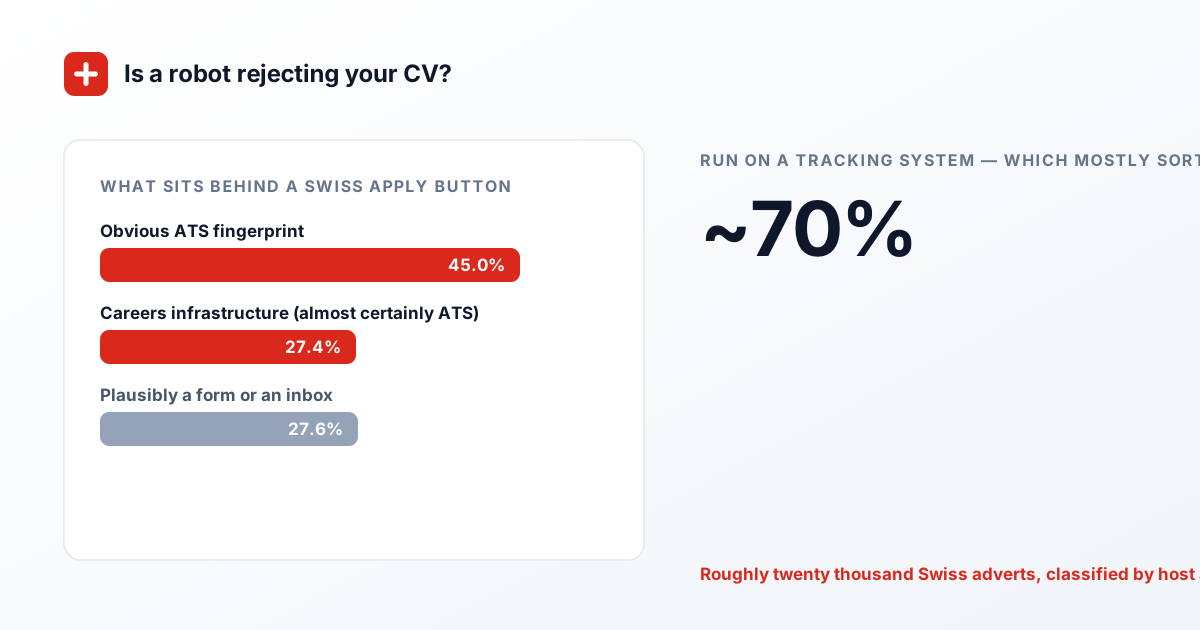
Two things came out of that. Once careers-page infrastructure is counted, something like 70% of Swiss adverts run on a tracking system — considerably more than a domain-name count suggests. And the biggest of them is one almost nobody names.
Both change what you should be optimising for.
Short version
- Do Swiss employers use applicant tracking systems?
- More than a domain-name count suggests. About 45% of adverts carry an obvious fingerprint, and roughly half the remainder sit on careers subdomains with structured job URLs, which is tracking-system infrastructure on the employer's own domain. Something like 70% in total; only about a quarter look like a plain form or an inbox.
- Which applicant tracking system is most common in Switzerland?
- SAP SuccessFactors, at 24.4% of adverts we can identify, ahead of Workday at 20.2%. It is rarely named because it runs on the employer's own domain, so it looks like an ordinary company careers page.
- Should I write my CV for the software or for a person?
- For a person. Even the largest systems here are used mostly to sort and store rather than to reject automatically; a recruiter still decides.
- Do keywords still matter?
- Yes, but not as keyword stuffing. What matters is describing your own work using the same words the advert uses, because both a skim-reading recruiter and a search box miss a synonym.
Working on your CV right now? ATS CV checker: free, against a real Swiss job ad
See what a Swiss recruiter checks first
Upload your CV and get a score against a specific job ad in about 30 seconds — language levels, work permit, photo, how your achievements are phrased.
ATS CV checker, freeWhat actually reads your application in Switzerland?
Roughly 70% of Swiss adverts run on a tracking system — but those systems mostly sort applications rather than reject them.
The picture almost every CV guide assumes is an American one: you apply, a tracking system parses your document into fields, scores it against the requirements, and a recruiter only ever sees what survives.
Half of that is right here, and the wrong half is the part people worry about. Following the apply button on roughly twenty thousand published Swiss adverts to its destination, about 45% arrive somewhere carrying an obvious tracking-system fingerprint. Of the rest, roughly half sit on a careers subdomain with structured job URLs — which is tracking-system infrastructure wearing the employer's own domain, not a page somebody hand-built. Counting those, something like 70% of Swiss adverts involve a system somewhere.
So the software is more present than a count of domain names suggests, and anyone telling you Swiss hiring is mostly humans-with-inboxes is reading the domain rather than the plumbing. Only about a quarter of adverts look like a genuine form or an inbox.
What is oversold is the rejection. SuccessFactors and Workday, the two largest systems here, are normally configured to sort, store and route rather than to score and discard. A recruiter still opens the application. The system decides what order they see things in, not whether they see them.
That distinction is the whole practical point. There is usually software in the path, and it is usually not the thing rejecting you.
Share of published Swiss adverts by what sits behind the apply button, August 2026. Careers infrastructure is inferred from host and URL structure rather than confirmed vendor by vendor.
Write a custom CV for every job you apply to
Most people send the same CV everywhere. The AI editor rewrites yours per application — Swiss format, the right language, in about a minute.
CV maker & resume builder: tailor it to this jobWhich system is actually the biggest? Not the one you would guess
SuccessFactors carries the largest share of identified adverts, and it is invisible unless you read the URL's shape rather than its domain.
This is the finding that surprised us, and that we initially got wrong ourselves.
The largest applicant tracking system in Swiss job adverts is SAP SuccessFactors, at 24.4% of the adverts we can identify. Workday follows at 20.2%, then Prospective at 15.6% and jobs.ch at 13.3%. Greenhouse, which a great deal of English-language CV advice is implicitly written about, accounts for 6.1%. Personio, often named as the European default, 0.7%.
SuccessFactors is missing from most market write-ups for a mechanical reason: it runs on the employer's own domain. Apply at a large Swiss employer's careers site and nothing in the address says SuccessFactors — a classifier reading domains sees a company careers page. Only the structure of the URL gives it away.
That matters to you directly, because it means a large share of what looks like applying directly to a company is in fact applying into a full enterprise tracking system. The friendly careers page is a skin over SAP.
It also means most of the advice you have been given is aimed at the wrong software. Guides written about Greenhouse's parser are describing a system sitting behind roughly one Swiss advert in sixteen.
Share of identified published Swiss adverts by system, August 2026.
See what a Swiss recruiter checks first
Upload your CV and get a score against a specific job ad in about 30 seconds — language levels, work permit, photo, how your achievements are phrased.
ATS CV checker, freeWhy does the biggest system stay invisible?
About one Swiss advert in six runs on a tracking system wearing the employer's own domain name.
Split the adverts by how the system announces itself and the reason becomes obvious. About 34.6% of all Swiss adverts sit on a recognisable ATS domain. Another 16.3% sit on a vanity domain that reveals nothing at all.
So roughly one Swiss advert in six is running enterprise recruiting software while looking exactly like a small company's own careers page.
Grouped by origin rather than by name, international systems account for 64.9% of identified adverts and Swiss ones for 35.0%. That is a substantial Swiss presence — Prospective and jobs.ch together outrank Greenhouse several times over — but it is not the majority you would infer from domain names alone.
The practical consequence for an applicant is that you cannot tell from the address bar what will read your document. A large pharma company's careers page and a family firm's contact form can look equally homespun and are not remotely the same thing.
Which argues against tuning your CV for any particular system, and for the one property that survives all of them: a structurally plain document that a parser can read and a person wants to.
Share of all published Swiss adverts by how the system is addressed, August 2026.
So do keywords matter at all?
They matter, but as vocabulary matching rather than keyword stuffing — and mostly for the human reader.
Here is where the robot story is half right, and the half it gets wrong causes real damage.
Vocabulary overlap does matter — to the software. A tracking system matches the terms in your document against the terms in the advert, so an advert asking for Prozessoptimierung and a CV offering "continuous improvement" registers as no match at all. Going through the stated requirements and making sure each appears in your CV in the advert's own wording is twenty minutes well spent.
But the person who opens it afterwards is not doing that. They are looking at where you have worked, what you actually delivered in those roles, the portfolio if the job has one, and whether your skills line up with what the team needs. None of that is keyword matching, and none of it improves by adding more terms.
Which is why keyword stuffing backfires so reliably. It optimises for the reader who sorts and against the reader who decides — a CV padded with terminology may surface higher in the system and then lose the round it was surfaced for.
The version that works treats them as two separate jobs. The advert's vocabulary, so the software surfaces you. Specific achievements attached to real roles, so the human keeps reading past the first ten seconds.
Share of identified published Swiss adverts by system origin, August 2026.
What should you actually change?
Write for a person, keep the structure simple enough to survive a parser, and match the advert's vocabulary.
Three things, in the order they pay off.
Match the advert's language. Take its stated requirements one at a time and make sure each has a counterpart in your CV, using the advert's term. This is the highest-value edit available and it takes twenty minutes per application.
Keep the document structurally plain. Not because a robot demands it, but because plain documents survive everything: a parser, a phone screen, a printer, and a recruiter skimming on a train. Single column, real text rather than text inside images, dates in a consistent format, one page unless you have a decade behind you.
Complete the Swiss dossier. Work references and diplomas are expected here in a way they are not elsewhere. Their absence is read as an incomplete application rather than a stylistic choice.
If you want to see how your CV reads against a specific advert before you send it, our <a href="https://swissjobs.app/cv-check">CV check</a> compares the two and shows which requirements have no counterpart in your document. If you are starting from scratch, the <a href="https://swissjobs.app/cv-builder">CV template</a> for Switzerland produces a structurally plain document with the dossier sections Swiss employers expect. Both are free.
None of this is about defeating an algorithm. There is usually one in the path, and it is usually sorting rather than rejecting. The decision is made by a person with limited time, and the whole game is making it easy for them to see that you match.
Tools mentioned in this article
Both are free and both are ours, which is labelled.
CV check our tool
Compares your CV against a specific advert and shows which requirements have no counterpart. Free.
Try it freeCV template for Switzerland our tool
Produces a Swiss-format CV that stays readable to people and to parsers.
Try it free
The short version: something like 70% of Swiss adverts run on a tracking system once careers-page infrastructure is counted, the largest is SAP SuccessFactors hiding behind employers' own domains, and those systems mostly sort rather than reject.
So if your applications are not landing, being auto-rejected is a less likely explanation than it feels. The more common story is that a person read your CV, could not quickly see the things the advert asked for, and moved on. That is fixable, and it is fixed with words rather than formatting tricks.
The tools compared
We checked 16 Swiss and international application tools on their own pages — prices, free tiers, and what is actually included.