Jobs in Ticino: where the openings are, which languages they really ask for, and how to apply from Italy
Ticino usually gets described in one sentence: the Italian-speaking canton, warm, an hour from Milan. That sentence is fine for a holiday. For a job search it hides the most useful thing to know about the place.
We went through the open adverts located in Ticino, 400+ of them this month, and read what they ask for. There are really two markets there. One is trades, building and installation work, where the advert is written in Italian, asks for Italian, and almost never asks for anything else. The other is everything with a desk or a lab attached, and there English turns up more often than Italian.
Which of the two you are in changes what you learn, what you put first on your CV and whether an application from Como or Varese has a real chance. If you are not an EU or EFTA citizen, the permit question comes before all of this: the employer has to justify hiring you over local and EU candidates, and that is hard for most roles.
Short version
- Where are most jobs in Ticino?
- Around Lugano. About 42% of Ticino job adverts are in the Lugano area, 24% in the Mendrisiotto (Mendrisio, Chiasso, Stabio), 17% around Bellinzona and 14% in the Locarnese. Measured across Swiss job adverts on SwissJobs.app, September 2026.
- Do I need Italian to work in Ticino?
- For trades and building jobs, yes: 98% of those adverts that state a language ask for Italian, and 88% ask for Italian only. For office, technical and sales roles it is different. Only 44% ask for Italian and 70% ask for English.
- Do jobs in Ticino require German?
- About one Ticino advert in five that states a language asks for German, and when it does, conversational German is enough in 59% of cases. Elsewhere in Switzerland that figure is 24%, so German in Ticino is usually an asset rather than a gate.
- Can I work in Ticino and live in Italy?
- Yes, as an EU citizen with a G permit (permesso G). You must return to your home abroad at least once a week, and the permit is valid for five years if your contract is open-ended or longer than a year. The employer applies for it once you have a contract.
- How many Swiss jobs are in Ticino?
- A small share. Roughly one Swiss job advert in sixty is located in Ticino, so the local market is tight. Many candidates also search Zurich or Bern, where German is asked in about two thirds of adverts.
Working on your CV right now? ATS CV checker: free, against a real Swiss job ad
See what a Swiss recruiter checks first
Upload your CV and get a score against a specific job ad in about 30 seconds — language levels, work permit, photo, how your achievements are phrased.
ATS CV checker, freeWhere are the jobs in Ticino?
Mostly around Lugano, then the Mendrisiotto on the Italian border, with Bellinzona and the Locarnese well behind.
About 42% of the Ticino adverts we read are in the Lugano area: the city itself, plus the business parks in Manno, Bioggio, Agno and Lamone. That is where banks, trading companies, IT firms and most of the head offices sit. If you want an office job in Ticino and do not have a strong reason to look elsewhere, start there.
The Mendrisiotto comes second with about a quarter of adverts, and it is a very different place to work. Stabio and Mendrisio host fashion and logistics companies, some of them international groups with their European operations run from here, and a lot of manufacturing. It is also the part of Switzerland closest to Como and Varese, which is why so many of its employees cross the border every morning.
Bellinzona, the cantonal capital, has about one advert in six: engineering firms, the hospital, retail and a fair amount of building work. The Locarnese is smaller again and leans heavily towards building work, with some hospital and hotel roles on top.
One thing to keep in mind: Ticino is a small market. Roughly one Swiss job advert in sixty is located there. If your profession has a handful of openings in the whole canton, it is worth deciding early whether you are looking only in Ticino or in Ticino plus the German- or French-speaking cities.
Share of job adverts located in Ticino, by region. Measured across Swiss job adverts on SwissJobs.app, September 2026.
Write a custom CV for every job you apply to
Most people send the same CV everywhere. The AI editor rewrites yours per application — Swiss format, the right language, in about a minute.
CV maker & resume builder: tailor it to this jobWhich languages do job adverts in Ticino ask for?
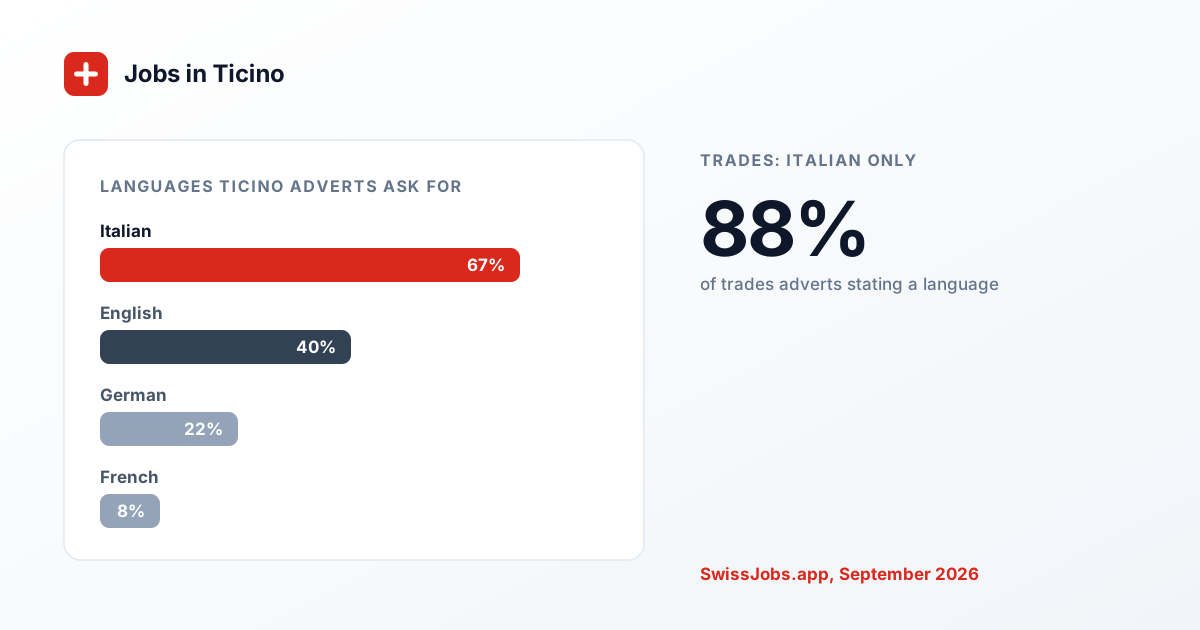
Italian in two thirds of adverts that state a language, English in four in ten, German in one in five and French rarely.
Among Ticino adverts that name a language, 67% ask for Italian. That is the number you would expect. The next one is less obvious: 40% ask for English, far more than ask for German. French barely appears.
Compare the rest of Switzerland, where German is asked for in about two thirds of adverts and Italian in 2%. So an Italian speaker has a real advantage in Ticino and almost none outside it. That is worth knowing if you are searching Zurich from Milan: outside Ticino, the question is your German or your English, not your Italian.
The English figure is what surprises people who have never worked there. It comes from companies that run in English whatever the local language is: fashion groups in the Mendrisiotto, trading and finance in Lugano, engineering and software firms with owners abroad. Some of their adverts do not ask for Italian at all.
Share of Ticino job adverts stating a language requirement that ask for each language (an advert can ask for several). Measured across Swiss job adverts on SwissJobs.app, September 2026.
See what a Swiss recruiter checks first
Upload your CV and get a score against a specific job ad in about 30 seconds — language levels, work permit, photo, how your achievements are phrased.
ATS CV checker, freeIs Ticino one job market or two?
Two: trades and building work is almost entirely Italian-only, while office, technical and sales roles ask for English more than Italian.
Split the adverts by type of job and the language picture changes completely. Trades, building, installation and driving jobs make up about two in five Ticino adverts: plumbers, electricians, roofers, fitters, crane operators, drivers. Of those that state a language, 88% ask for Italian and nothing else. English appears in 2%.
The rest is office, technical, sales, health and hospitality work, and there only 12% ask for Italian alone. English is asked for in 70%, and in 43% it is the only language named. More than a third of those adverts are written in English.
What that means in practice: an electrician from Lombardy walks into the first market with the language already sorted, and the questions are the Swiss qualification and the permit. A software developer or a marketing manager may not need Italian to be hired, but will need strong English, and Italian still helps with everything around the job itself.
Share of Ticino job adverts stating a language requirement, split by type of job. Measured across Swiss job adverts on SwissJobs.app, September 2026.
How good does my Italian and German need to be for a job in Ticino?
Italian at a professional or native level in 92% of cases, while German, when asked for at all, is usually wanted at a conversational level.
When a Ticino advert asks for Italian, it wants it properly: 92% of those requirements are at professional or native level. Conversational Italian is rarely enough on its own. If yours is somewhere between holiday and working level, say that honestly on the CV and state a CEFR level (B1, B2, C1) rather than a word like "good".
German works the other way. In Ticino, 59% of the adverts asking for German are happy with conversational German. Across the rest of Switzerland it is 24%. The German in these jobs is for talking to head office in Zurich or to customers north of the Gotthard, not for writing contracts.
So if you speak Italian and some German, you have a better hand in Ticino than your German alone suggests. Put both on the CV with levels, in the language section right under your contact details, where a Swiss reader looks for it.
Share of language requirements at each level, among Ticino adverts asking for Italian or German, compared with German requirements elsewhere in Switzerland. Measured across Swiss job adverts on SwissJobs.app, September 2026.
How do I apply for a job in Ticino from Italy?
As an EU citizen you apply like anyone else, and once you have a contract the employer requests a G permit for you as a cross-border worker (frontaliere).
The G permit is for EU and EFTA citizens who live in an EU or EFTA country and work in Switzerland. The rule that matters: you must go back to your home abroad at least once a week. It is valid for five years if the contract is open-ended or longer than a year, and for the length of the contract if shorter. The old border zones were abolished, so formally you can work anywhere in Switzerland on it, but in practice most frontalieri in Ticino live within commuting distance in Lombardy or Piedmont.
You do not need the permit to apply. What you do need is to make the question disappear before anyone asks it. Put one line near the top of the CV: "EU citizen, resident in Como, available as cross-border worker (G permit)". A Swiss recruiter who sees an Italian address and no such line will wonder, and some will simply move on.
Two other things are worth doing before you send anything. For a trade that Swiss adverts list with an AFC certificate, check whether your Italian qualification is recognised; SERI, the federal education secretariat, handles that. And look at the tax side before you compare salaries. The rules for cross-border workers changed with the agreement between Italy and Switzerland that applies from 2024, and the answer depends on when you were hired and where you live, so check it with a tax adviser rather than a forum thread.
What should a CV for Ticino look like?
A Swiss CV in the language of the advert: two pages at most, a photo, your languages with levels, your permit status, and the advert's own terms for your skills.
Write it in the language the advert is written in. An Italian advert gets an Italian CV and an English advert an English one. Sending an Italian CV to an English-language job at a fashion group in Stabio tells the reader you did not read the advert carefully.
Keep the Swiss conventions: reverse-chronological, no more than two pages, a professional photo (still the Swiss convention), and a short line at the top with nationality, permit or cross-border status, and availability. For trades jobs, put certificates and licences near the top, with the Swiss equivalent if you know it.
Then match the advert. Many Swiss employers, Ticino's included, read applications through recruiting software first, and that software compares your CV with the advert's wording. If the advert says "installatore sanitario" and your CV says "idraulico", use both. A person reads it afterwards and looks at where you worked and what you actually did, so concrete results matter more than extra keywords. Our free CV builder produces the Swiss format in Italian, German, French or English, and the CV Check compares your CV against a specific advert before you send it.
The tools for this
Two of ours for the search and the CV, and the official page on the cross-border permit.
- SwissJobs: jobs in Ticinoour tool
The open adverts in Ticino from job boards and company career pages in one list, filterable by town. Ours, and free.
SwissJobs: jobs in Ticino SwissJobs CV builder our tool
Builds a CV in the Swiss format, in Italian, German, French or English, so the CV can match the language of the advert. Ours, and free.
Try it freeSwissJobs CV Check our tool
Compares your CV with a specific advert and shows which requirements it answers. Useful when the advert is in a language your CV is not. Ours, and free.
Try it free- SEM: G permit for cross-border workers
The federal migration office's page on the G permit: who qualifies, how long it lasts, the weekly return rule.
Visit site
Ticino is two job markets sharing the same towns. In trades and building work, Italian is the whole requirement and the open questions are the Swiss certificate and the permit. In office, technical and sales work, English opens more doors than Italian, and Italian is what makes you the easier hire.
Work out which of the two your job belongs to, write the CV in the language of the advert, and put your permit status and language levels where a Swiss reader looks first. Then apply to fewer adverts, each with a CV that answers that one.
The tools compared
We checked 16 Swiss and international application tools on their own pages — prices, free tiers, and what is actually included.