Why you're not hearing back from Swiss job applications
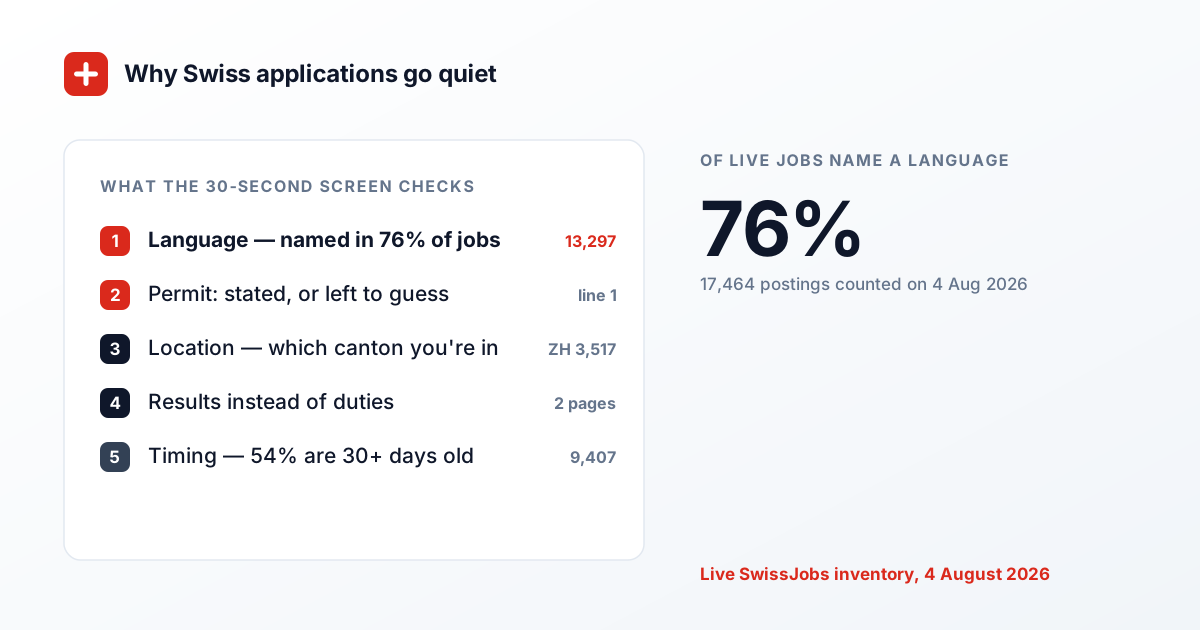
Twenty applications out. Three automated confirmations back, and then nothing. Not a rejection — nothing. That's the part that grinds people down, because a rejection at least tells you something and silence tells you nothing at all.
I pulled our inventory this morning: 17,464 live Swiss jobs, 2,331 of them posted in the last seven days. I've also read more Swiss CVs than is good for anyone. Put those two things next to each other and most of the silence explains itself. Almost none of it is about whether you can do the job.
Short version
- Why do I never hear back from Swiss job applications?
- Because most applications are eliminated in a 30-second first pass before anyone reads them properly. That pass checks whether you're allowed to work here, whether you have the language the job names — 13,297 of the 17,464 live postings name at least one — and whether you're in the right region. If any of those is unclear, your file goes on the maybe pile, and the maybe pile rarely gets called.
- Does no response mean rejection in Switzerland?
- Usually yes. Swiss employers are generally decent about sending rejections to people they've actually spoken to, but a first-round no often just doesn't arrive. If four weeks have passed and all you've had is an auto-reply, treat it as closed and put the energy into the next application.
- How long should I wait before following up?
- Ten to fourteen days after you applied. Once, by email, three sentences. Then stop. A Swiss hiring process is usually blocked on someone's calendar, not on your enthusiasm, and chasing harder doesn't move it.
- Does my CV really matter if I'm clearly qualified?
- In Switzerland it decides more than the qualification does. A Swiss dossier has specific expectations — permit line, language levels near the top, roughly two pages, Arbeitszeugnisse — and a CV built for another market reads as 'doesn't know how it works here'. Same person, same skills, very different outcome.
- Am I applying too late?
- Often, yes. Of the postings you can see right now, 9,407 have been live for more than 30 days, and Swiss shortlists are usually built inside the first two weeks. If you only apply to what surfaces after a week of browsing, you're arriving after the decisions were made.
Working on your CV right now? ATS CV checker: free, against a real Swiss job ad
See what a Swiss recruiter checks first
Upload your CV and get a score against a specific job ad in about 30 seconds — language levels, work permit, photo, how your achievements are phrased.
ATS CV checker, freeWhy do Swiss employers just go silent?
Because most applications are sorted out in a pass that takes about half a minute, and nobody writes a personal rejection for a file they spent 30 seconds on.
Here's the uncomfortable mechanic. A mid-sized Swiss company posts a role, collects somewhere between 40 and 200 dossiers, and one person — often the hiring manager, between two meetings, on a Friday — goes through them. They're not evaluating you. They're making three piles: obvious yes, obvious no, and maybe. The maybe pile is where applications go to die, because once the yes pile has five names in it nobody opens the maybes again.
Writing 150 personal rejections takes real hours. Plenty of Swiss employers only do it for candidates they actually met. So the silence isn't a verdict on you. It's a volume problem wearing a verdict's clothes.
Which means 'why didn't they reply' is the wrong question. The one worth asking is 'what made me a maybe in those 30 seconds' — and that one has answers you can actually do something about.
Write a custom CV for every job you apply to
Most people send the same CV everywhere. The AI editor rewrites yours per application — Swiss format, the right language, in about a minute.
CV maker & resume builder: tailor it to this jobWhat gets checked in the first 30 seconds?
Work authorisation, language, location, and whether your last job looks like this one — in roughly that order, and all of it from the first half page.
Four checks. Can this person legally work here, and from when. Do they have the language the team actually works in. Are they in the region, or clearly moving to it. Does the previous role resemble the one being filled.
Notice what isn't on that list: your motivation, your degree classification, the typography of your CV. Those matter in round two, when a human is genuinely reading. In the first pass they're invisible.
The trap is that all four are things applicants leave implicit. You know you hold a B permit. You know you speak French. But if the screener has to hunt page two to find out, you become a maybe. 'Swiss C permit, based in Bern' is one line, and it deletes an entire category of doubt before it forms.
See what a Swiss recruiter checks first
Upload your CV and get a score against a specific job ad in about 30 seconds — language levels, work permit, photo, how your achievements are phrased.
ATS CV checker, freeIs language the thing actually killing my applications?
For a lot of people applying from outside, yes — 13,297 of the 17,464 live postings name a specific language, and 8,354 of them still name German.
This is the number I'd want every international applicant to see before they send anything. Of the 17,464 jobs live on our platform this morning, only 4,167 name no language at all. Everything else states one, and German turns up in 8,354 of them. Still, in 2026, the biggest single gate in this market.
English appears in 12,130 postings, which looks encouraging until you read what it's doing there. Often it's the second requirement, not the first — 'German C1 and fluent English'. The roles where English genuinely stands alone cluster in pharma, finance and tech around Zurich, Basel and Zug. Real, and worth targeting. But a slice, not the market.
So a CV that doesn't state language levels hands the screener a question they can't answer, on the exact criterion they're screening for. Levels, not adjectives. 'German B2, English C1, French A2' beats 'excellent language skills' every time, and it costs you one line near the top.
Live SwissJobs inventory, 4 August 2026. 17,464 published postings; a posting can name several languages, so the shares add up to more than 100%.
Am I applying too late to be considered?
Sometimes, and more often than people think — over half of what's visible on any board today has been up for more than a month, and Swiss shortlists close early.
Of everything live right now, 9,407 postings are older than 30 days. Only 2,331 went up in the last week. That ratio is normal for a job board, and it's also a quiet trap: the old half is where most applications land, because it's what fills the search results you scroll.
A Swiss process typically builds its shortlist inside the first two weeks, then grinds through interviews for another six. Apply in week five and your dossier arrives in a folder that has already been sorted. Nobody is being rude by not answering. The decision happened before you got there.
The fix is unglamorous: apply within a few days of a posting going live, and spend more time checking for new ones than polishing old applications. Fewer, faster, fresher beats twenty immaculate dossiers sent into month-old vacancies.
Live SwissJobs inventory, 4 August 2026. 17,464 published postings, bucketed by how long they have been live.
So what do I actually change?
Move permit, languages and location into the top third of page one, turn duties into results, and check the dossier against the posting before you send it rather than after twenty silences.
Top third of page one, before the profile paragraph: permit or citizenship, languages with levels, where you live. Three lines. If you're applying from abroad, add your notice period and say plainly whether you'd need a permit — for an EU/EFTA passport that's an administrative step, for a non-EU one it's a real hurdle, and vagueness gets read as the worse case.
Then the work history. Swiss screeners want evidence, not responsibilities. 'Responsible for regional sales' says nothing. 'Grew regional sales from CHF 2.1m to 3.4m in 18 months' says everything, and it's the same job. Two pages, reverse chronological, gaps explained in a half-sentence rather than hidden, Arbeitszeugnisse attached if you have Swiss ones.
And check it against the actual advert before it goes. Not your general CV against your general sense of the role — this version against this posting. That's the whole point of the CV check below, and it's the difference between guessing why nobody answered and knowing.
What I'd actually use
Three links, one of them not ours:
- SwissJobsour tool
Ours. The Swiss market aggregated in one place — 17,464 live postings today — filterable by canton and language, which makes it a lot easier to reach the fresh ones before the shortlist closes.
SwissJobs SwissJobs CV Check our tool
Ours, free. Run your CV against one specific posting and it flags what a Swiss screener would stumble on in the first 30 seconds: missing permit line, vague language levels, duties where results should be.
Try it free- Job-Room (arbeit.swiss)
Neutral and official. The public employment service's own board — roles covered by the Stellenmeldepflicht show up here before they're advertised publicly, so registered jobseekers get a head start.
Visit site
Silence feels personal. It almost never is. It's a volume problem meeting a file that made someone hesitate for half a second on a Friday afternoon with 140 dossiers still to go.
Remove the hesitations — permit, language level, location, results — and your reply rate moves before your qualifications change at all. That's the annoying, useful thing the numbers keep saying.
The tools compared
We checked 16 Swiss and international application tools on their own pages — prices, free tiers, and what is actually included.