Nurse jobs in Switzerland: the diploma and the German the adverts actually ask for
In Swiss care work the job title screens you before anyone opens your application. Not the CV. The title.
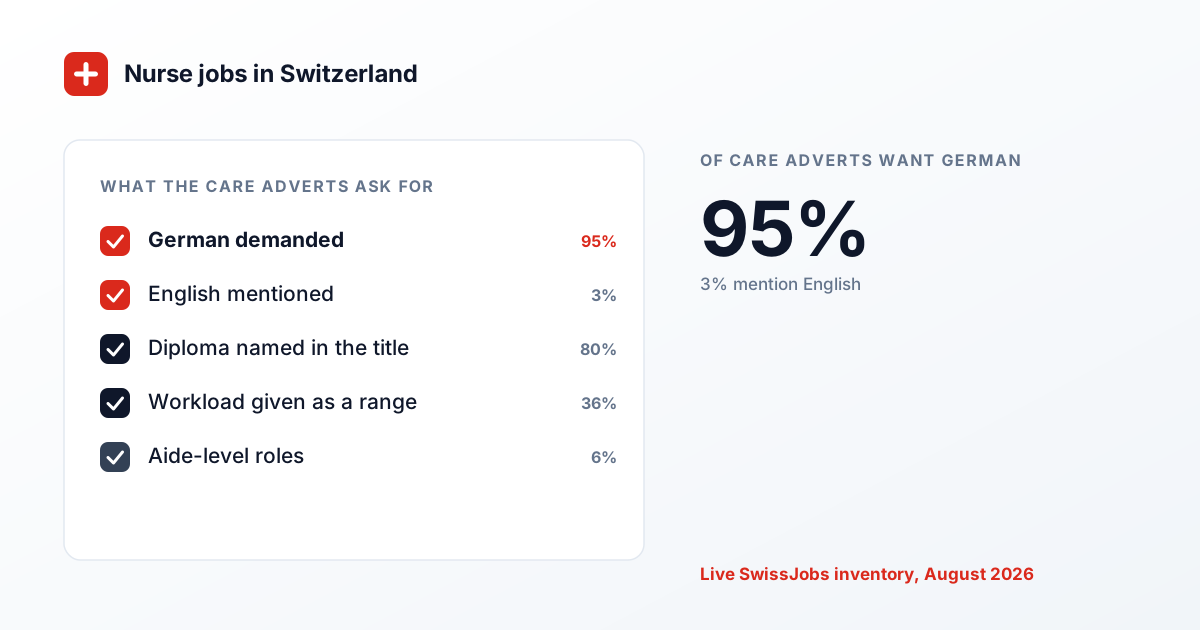
We counted the open Swiss care and nursing roles on our own search this morning. Out of 20K+ live adverts, roughly one in twenty-five is a care role — and 80% of those name the required qualification right in the title: Dipl. Pflegefachfrau HF, FaGe EFZ, Pflegehelfer SRK. Across the rest of the market, 5% do. No other field sorts this early or this hard.
The second filter sits in the body text and it is the harder one. Among care adverts that name a language at all, 95% ask for German. English appears in 3%. Across the rest of the market those numbers are 67% and 43% — which is not the same market wearing a different hat, it is a different market.
And then one thing runs the opposite way here, which almost nobody arriving from abroad expects: the Pensum, the workload percentage. In care it is negotiable, and the advert says so in the title.
Short version
- What qualification do Swiss nursing jobs require?
- Usually the highest one. About half of all open care adverts name a diploma at HF or FH level in the title — that is the Swiss tertiary nursing qualification — a good fifth name FaGe (the three-year federal health-care certificate), and only about one in sixteen an assistant or aide role. The entry tier is the smallest part of the advertised market.
- Can I work in Swiss healthcare without German?
- Barely. Of the care adverts that state a language, 95% want German and only 2% want English without German. Across the rest of the Swiss market almost a quarter of roles are open to English without German. The exceptions in care sit in French-speaking Switzerland and Ticino, where French or Italian replaces German rather than removing the requirement.
- Is conversational German enough for a nursing job?
- Rarely. Where a care advert asks for German, 95% of the time it asks for professional working level rather than basics. That holds at every tier: adverts for aides and assistants ask for professional-level German just as often as those for diploma nurses. You cannot enter at the bottom and pick the language up on the way.
- Are Swiss nursing jobs available part time?
- More than anywhere else in the market. 54% of care adverts put a workload figure in the title, and 36% give a range rather than a fixed number — 80-100%, 60-100%, 40-100%. Across the rest of the market that is 21% and 12%. A range means the employer has not decided yet, which is an opening for you.
- Will my foreign nursing diploma be recognised in Switzerland?
- Recognition for health-care professions runs through the Swiss Red Cross, which assesses and registers foreign qualifications. The process is separate from any application and takes time, so if yours is granted or under way, put it on page one of your CV. For many employers it is the question that comes before every other question.
Working on your CV right now? ATS CV checker: free, against a real Swiss job ad
See what a Swiss recruiter checks first
Upload your CV and get a score against a specific job ad in about 30 seconds — language levels, work permit, photo, how your achievements are phrased.
ATS CV checker, freeWhat diploma do Swiss care adverts ask for?
Mostly the highest one: about half of the open roles carry HF, FH or Dipl. in the title, and only around one in sixteen is an assistant or aide position.
Swiss care adverts sort candidates in the job title. Roughly half name a diploma at HF or FH level, a good fifth name FaGe or Fachperson Gesundheit, and one in eight names a specialisation — intensive care, anaesthesia, theatre, psychiatry. Leadership roles and the assistant tier share what is left.
This is not a formality. In Swiss care the title works as a licence: an advert that says FaGe means FaGe, and an advert that says HF will not read an EFZ application as a near-enough compromise. Which is why filtering by your own tier beats searching the word nursing — otherwise you spend the evening reading roles you are not formally eligible for.
The reverse matters just as much. The aide tier is the smallest slice of the advertised market, which is the hard news for anyone hoping to switch into care from another field. The entry exists, but it is narrow, and it runs through long-term and home care more often than through a hospital.
Share of open Swiss care roles on SwissJobs.app by qualification named in the title, August 2026. Titles can name more than one.
Write a custom CV for every job you apply to
Most people send the same CV everywhere. The AI editor rewrites yours per application — Swiss format, the right language, in about a minute.
CV maker & resume builder: tailor it to this jobCan I get a care job in Switzerland without German?
Effectively no: 95% of care adverts that state a language ask for German and 3% mention English, against 67% and 43% across the rest of the market.
This is the widest gap between care work and the rest of the Swiss market, and it has nothing to do with how international the employer is. A software role in Zurich can run in English because the team does. A ward cannot, because the patient does not. Here the language is part of the work, not part of the company culture.
The number that matters if you are applying from abroad: about 2% of care adverts stating a language ask for English without also asking for German. Across the rest of the market it is 23% — close to one role in four. Outside care you have many times the choice; inside it you have one sensible order of operations, which is the language first and the applications after.
French shows up in about one care advert in eleven that names a language, Italian almost never. So French-speaking Switzerland and Ticino are not a loophole for English speakers — there one national language simply replaces another. The permit question runs on the same logic: EU and EFTA nationals can take the job once the diploma is recognised, and non-EU applicants need an employer willing to run a permit case — in a shortage occupation, more common than elsewhere.
Share of adverts that name a language, Swiss roles on SwissJobs.app, August 2026
See what a Swiss recruiter checks first
Upload your CV and get a score against a specific job ad in about 30 seconds — language levels, work permit, photo, how your achievements are phrased.
ATS CV checker, freeIs conversational German enough on a ward?
No: where a care advert asks for German, 95% of the time it asks for professional level — and that holds identically at every qualification tier.
The obvious plan is to enter at the bottom, pick the language up on the job and move up later. The adverts do not support it. Across care roles that state a language, 90% ask for German at professional level. Across the rest of the market, 61%.
Split by tier, the difference vanishes entirely. Among the aide and assistant adverts, 98% of those stating a language want professional-level German; for FaGe and for diploma roles it is 96%. The assistant tier is a small group of adverts, and on the language question they are if anything stricter than the rest. Anyone working at the bedside documents, hands over and reports — all of it in German.
In practice B2 is the threshold worth talking about, and the certificate belongs on the CV rather than in the cover letter. If you understand Swiss German but do not speak it, write exactly that. On a ward it counts as an argument.
Share of adverts stating a language that ask for German at professional level, Swiss roles on SwissJobs.app, August 2026
How many hours do Swiss care jobs actually want?
Fewer than you would expect, and more often negotiable: 36% of care adverts put a workload range in the title instead of a fixed figure, against 12% across the rest of the market.
Here the picture flips. In care, 54% of adverts already carry a workload percentage in the title; across the rest of the market it is 21%. And the shape matters more than the presence: 36% of care adverts advertise a range — 80-100%, 60-100%, 40-100%. One in eight does that elsewhere.
A range is not vague drafting. It is an open door: the employer has not settled the number and is telling you so in the title. If you want or need to start at 60%, care has far more roles where that was the plan from the beginning than almost any other field in Switzerland.
The reason is unromantic — rosters. An employer covering nights and weekends would rather fill a gap with two people at 60% than with one at 100% who does not exist. It is still a real advantage for you: part-time here is not a special request you have to justify.
Share of adverts naming a workload percentage in the job title, Swiss roles on SwissJobs.app, August 2026
Which workloads are actually advertised?
80-100% is by far the most common range, but more than half of all advertised ranges start at 60% or lower.
Among care adverts carrying a range, 80-100% leads comfortably, followed by 60-100%, 50-100% and 40-100%. The typical span is about thirty percentage points wide — a lot of negotiating room for one line in a job title.
And the lower edge sits lower than the reputation of the profession suggests: more than half of the ranges start at 60% or below, and a good third at 50% or below. If you are working around children, a degree or a second contract, this is a genuine choice rather than an exception you have to be granted.
One practical note. When the advert gives a range, name your number in the application. The advert asked. A dossier that leaves it out forces HR to come back and ask, and those questions cost days that other applications are not spending.
Share of care adverts carrying a workload range in the title, Swiss roles on SwissJobs.app, August 2026
What else do the adverts ask for?
Experience in a good seven out of ten texts, willingness to keep training in about half — and shift work far more often than anywhere else in the market.
Read the body text instead of the titles and the picture sharpens. Experience is asked for or preferred in a good seven out of ten care texts. Further training shows up in around half, usually as something the employer offers rather than demands — in a market this short of staff, that is a sales pitch.
Shift work stands out. Nights, weekends and on-call duty come up in care texts roughly seven times as often as across the rest of the market, where the subject barely appears at all. If you are used to nights, or actively want them, that is a line worth having on the CV. Counted across the adverts whose text we can read.
What almost never appears is the permit question. Swiss employers do not write down which permit they expect — they assume it. So if you hold a B, a C or an EU passport, say so yourself, because it is the first silent question in the screen.
What does that mean for your CV?
Three lines in the top half of page one: your tier in the advert’s own wording, your German level with evidence, and the workload you want.
The qualification belongs in the header, written exactly the way the advert writes it. Registered Nurse and Dipl. Pflegefachfrau HF are different search terms, and in a field where 80% of adverts carry the qualification in the title, that is the first thing anyone compares.
The language level comes straight after, with a level and evidence rather than a row of dots: German B2, certificate 2024. If a Swiss Red Cross recognition is granted or in progress, it goes on page one, not in an annex. For many employers it is the precondition for reading the rest.
Then the workload. If the title gives a range, name your figure. That is not a concession, it is the answer to the question the advert asked. If you want to see what survives the first thirty seconds of your dossier, run it through our CV Check — it looks at exactly those three lines first.
What we use for this
Three of our own tools and one neutral authority. Every share above was counted across the open Swiss care roles on our own search.
- SwissJobs job searchour tool
Ours, free. Filter by tier, workload and canton — these are the adverts every share in this article was counted across.
SwissJobs job search SwissJobs CV Check our tool
Ours, free. Shows what a Swiss reader takes away from your dossier in the first thirty seconds — qualification tier, language level, workload.
Try it freeSwissJobs CV builder our tool
Ours, free. Builds a CV in the Swiss format, with the header, languages and qualification where a Swiss recruiter looks for them.
Try it free- Swiss Red Cross — recognition
Neutral and official. The body that assesses and registers foreign health-care qualifications in Switzerland.
Visit site
What strikes us about these numbers is the order they come in. The market sorts on the diploma first and the language second. Both are printed in the advert, both can be checked before you apply, and neither can be argued away by a good cover letter.
The third question — how much do you want to work — is the one other fields quietly use to reject people, and here it is open. In care the answer is advertised as a range in the title. Treat it as the offer it is, instead of applying for a 100% you do not want.
Measured across the open Swiss job adverts on SwissJobs.app, August 2026. Language shares counted across the adverts that name a language at all.
The tools compared
We checked 16 Swiss and international application tools on their own pages — prices, free tiers, and what is actually included.