Do you put a photo on a Swiss CV?
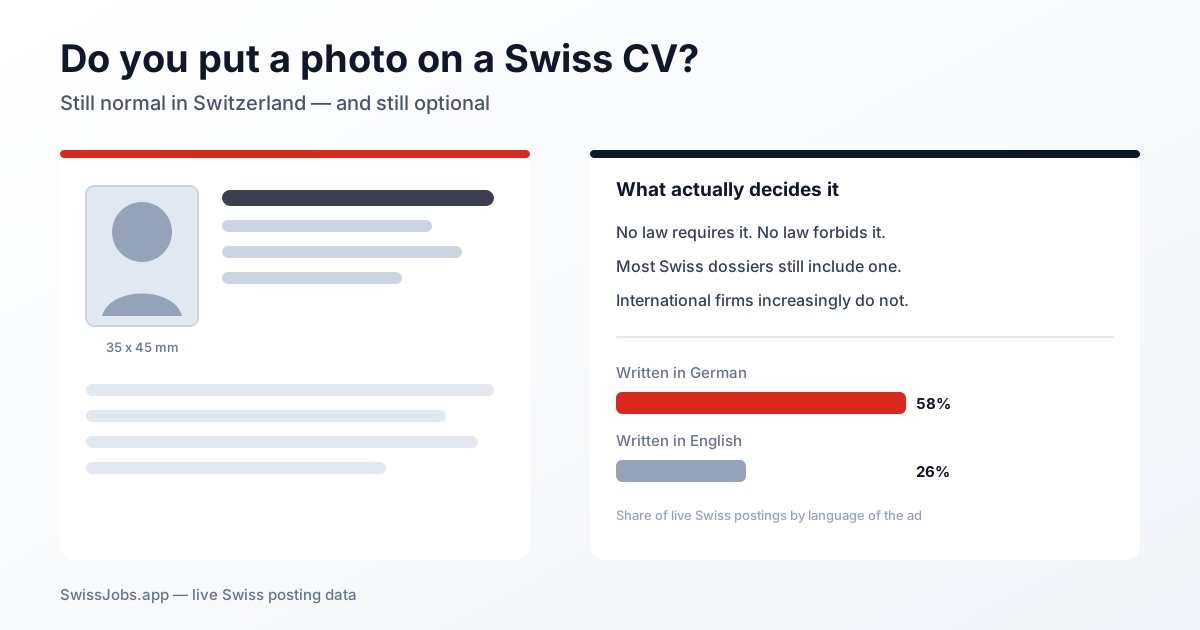
No Swiss law requires a photo on a CV. No Swiss law forbids one. That is the entire legal position, and it is why the question never goes away.
What fills the gap is convention, and Swiss convention still leans towards including one — more strongly for a domestic employer, much less so for an international firm with a global hiring process.
But the photo is almost never the real question. Every time it comes up among Swiss recruiters and career advisers, it arrives attached to three others: date of birth, nationality, and marital status. People treat them as one decision about how much of yourself belongs on the page. They are not one decision, and answering them together is how good candidates end up cutting the wrong thing.
Short version
- Is a photo required on a Swiss CV?
- No. It is not a legal requirement and has not been for years. It remains customary, and most Swiss-domestic employers still expect to see one.
- Does leaving the photo off hurt your application?
- Rarely on its own. A bad photo hurts more than no photo — a phone selfie, a cropped holiday picture or a ten-year-old image does more damage than a clean layout with no image at all.
- What about date of birth, nationality and marital status?
- Different answers. Nationality or permit status is worth including because it removes a real question for the employer. Marital status and children can go — they are not relevant to most roles. Date of birth is optional and increasingly omitted.
- Do international employers in Switzerland want a photo?
- Often not. Firms running a global process frequently strip photos before a hiring manager sees the file, and some ask you not to include one. When the posting says so, follow the posting.
Working on your CV right now? ATS CV checker: free, against a real Swiss job ad
See what a Swiss recruiter checks first
Upload your CV and get a score against a specific job ad in about 30 seconds — language levels, work permit, photo, how your achievements are phrased.
ATS CV checker, freeWhat is the actual rule in Switzerland?
There is no rule. There is a convention, and it is weaker than it was ten years ago but still real.
Switzerland never adopted the anti-photo position that spread through EU hiring guidance, so the practice continued here while it faded elsewhere. That divergence is the whole reason applicants arriving from Germany, France or the UK find contradictory advice — both sets of advice are correct, for different markets.
What has changed is uniformity. A decade ago a Swiss dossier without a photo looked incomplete. Today a meaningful minority of employers deliberately do without, particularly larger firms with structured, anonymised first screens. The convention has softened rather than reversed.
The practical consequence is that including one is the safer default for a Swiss-domestic employer, and omitting one costs you very little with an international employer. Neither choice is a mistake. Which is why it is worth spending less energy on this decision than most people do.
Write a custom CV for every job you apply to
Most people send the same CV everywhere. The AI editor rewrites yours per application — Swiss format, the right language, in about a minute.
CV maker & resume builder: tailor it to this jobWhy do Swiss recruiters say the photo helps?
Because pre-selection is a human process, and a face makes a file memorable.
The argument you hear repeatedly from people who do this work is not about competence. Nobody claims a photo tells you whether someone can do the job. The claim is narrower and more honest: in a stack of comparable applications, a photo makes yours easier to recall, and being recalled is a real advantage at the shortlist stage.
That is an uncomfortable argument, because it is straightforwardly about likeability rather than merit, and it is the same mechanism EU guidance objects to. It is worth knowing that this is the actual reasoning rather than a tidier one, because it tells you what a useful photo looks like: approachable and professional, not merely present.
The corollary matters more. If the photo works by making you memorable, a bad photo makes you memorable in the wrong way. That is the failure mode people in the field keep warning about — not applicants who omit the photo, but applicants who attach a cropped holiday snap or a phone selfie taken against a kitchen wall.
See what a Swiss recruiter checks first
Upload your CV and get a score against a specific job ad in about 30 seconds — language levels, work permit, photo, how your achievements are phrased.
ATS CV checker, freeWhat should the photo actually look like?
Passport framing, plain background, current, and taken on something other than a phone at arm's length.
Head and shoulders, facing the camera, plain and untextured background. Roughly passport proportions — the familiar 35 by 45 millimetre shape is a safe guide, placed top right or top left of the first page.
Current means within about two years. An out-of-date photo is a small credibility problem that costs more than it seems, because the interview reveals it immediately and starts the conversation with a tiny discrepancy.
Dress as you would for the interview, not more formally. A suit in a photo attached to an application for a workshop role reads as borrowed. Matching the role is more convincing than dressing up for it.
Professional photographers exist for this and are not expensive relative to the outcome, but a phone will do if someone else holds it, the light comes from in front of you, and the background is a plain wall. The thing to avoid is the arm's-length selfie, which is recognisable instantly and undermines everything else on the page.
Which personal details should you keep?
Keep nationality or permit. Drop marital status and children. Date of birth is your call.
This is the part that gets answered wrong, because people decide all four fields at once. They deserve separate answers.
Nationality or permit status is worth including, and it is the one most non-Swiss applicants omit. A Swiss employer reading an application has an immediate practical question about whether you can legally start and how much administration is involved. If you are Swiss, hold a C permit, are an EU or EFTA citizen relying on freedom of movement, or already live in the country, one line closes that question. Leaving it blank does not make the question go away; it makes the reader guess, and the guess is usually the expensive one.
Marital status and children can go. For the overwhelming majority of roles they are simply not relevant, they invite assumptions that help nobody, and their absence is not noticed. This is the field where Swiss practice has moved fastest, and dropping them is now unremarkable.
Date of birth sits in between. Still common, increasingly omitted, and rarely decisive either way. If your career history makes your approximate age obvious anyway — and it usually does — including it costs nothing.
One thing that is worth more than all four combined: the language line. Around eighty-five percent of the live Swiss postings we index state a language requirement explicitly, and of those roughly seven in ten want German. Of the roles demanding German, close to nine in ten want it at professional working level rather than conversational. That is the field a recruiter is actually scanning for, and it deserves the space near the top that people spend arguing about photographs.
Live SwissJobs.app postings. Shares exceed 100% because many roles require more than one language.
When should you definitely leave the photo off?
When the employer asks you to, when the process is anonymised, and when the only photo you have is a bad one.
If a posting or application portal says not to include a photo, do not include one. This happens more often than it used to, particularly with large international employers and public-sector processes that run structured anonymous screening. Ignoring an explicit instruction is a worse signal than any photo could offset.
Some applicant portals also strip images automatically when parsing an upload, which means the photo you carefully placed may never reach a human. That is not a reason to omit it, but it is a reason not to build the layout around it — the document has to work with the image gone.
And if the only available photo is poor, send it without one. A clean, well-structured CV with no photo reads as deliberate. A good CV with a bad photo reads as careless, and carelessness is the more expensive impression.
How much does this decision actually matter?
Less than the time people spend on it. Speed and language matter more.
Worth putting in proportion. Nobody is rejected for a well-taken photo, and nobody is rejected for the absence of one. It is a convention with a soft edge, and both choices sit comfortably inside it.
What does move outcomes is whether the CV answers the language question clearly, whether the permit question is closed, and whether it arrives while the role is still open. Over a quarter of the postings we index were published within the last seven days and around sixty percent within the last thirty, with a median age of about twenty days. Roles fill fast enough that a good application sent this week beats a perfect one sent next month.
So: take one decent photo, keep it for two years, and stop thinking about it. The half-hour saved is better spent on the first third of the page.
Getting the top third of the page right
The photo is the part people worry about; the permit line and the language block are the parts that get read. A few things that help:
SwissJobs.app CV Check our tool
Ours. Free — checks the CV against Swiss convention, including whether permit status and language levels are stated where a recruiter looks for them.
Try it freeSwissJobs.app AI CV Builder our tool
Ours. Builds the Swiss layout around whatever you already have — photo placed properly if you want one, and a document that still works if it is stripped.
Try it free- SwissJobs.app job searchour tool
Ours. Filter by canton and by the language a role actually requires before you tailor anything.
SwissJobs.app job search
Yes, usually include one. Make it current, make it plain, and stop there.
Then spend the recovered time on the line about your permit and the line about your German, because those are the ones being read.
The tools compared
We checked 16 Swiss and international application tools on their own pages — prices, free tiers, and what is actually included.