How to see a new Swiss job the day it appears — not a week later
Most applications in Switzerland are late on arrival. Not badly written, not under-qualified — late. The advert went up on a Tuesday, the application lands twelve days later, and in between the recruiter has quietly built a shortlist and picked a favourite.
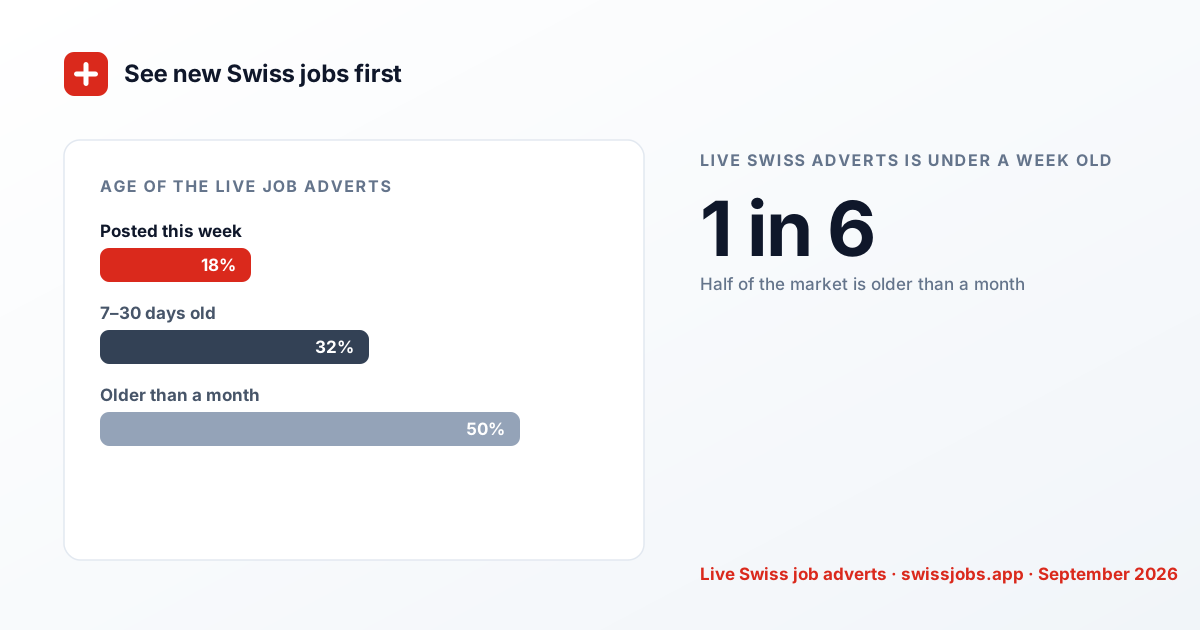
Across north of twenty thousand live Swiss job adverts, half are more than a month old — and only about one in six went up within the last seven days. Whoever sees that fresh sixth on the day it appears is applying against a handful of people instead of a hundred. This piece is about how to be that person: five minutes of setup, once, and no paid tool anywhere in it.
Short version
- Why should you apply in the first week of a Swiss job advert?
- Swiss recruiters read applications as they arrive rather than waiting for a closing date, so an application from the advert's first days is read against a much shorter pile than one from week three.
- How fresh is the Swiss job market really?
- About one live Swiss advert in six was posted within the last week, while half of what a search returns is more than a month old — a daily, date-sorted check is what surfaces the fresh part.
- What is the best way to be told about new Swiss jobs?
- A saved search per job title and canton on each platform you use, sorted by newest first, with the email alert switched on. jobs.ch, jobup.ch, LinkedIn and SwissJobs all support this; SwissJobs emails new matches every morning.
- Should you search for Swiss jobs in German or in English?
- Both. More than a quarter of Swiss adverts are written entirely in English, and most engineering titles carry only the English word — so set one alert per language variant of your job title.
Working on your CV right now? ATS CV checker: free, against a real Swiss job ad
See what a Swiss recruiter checks first
Upload your CV and get a score against a specific job ad in about 30 seconds — language levels, work permit, photo, how your achievements are phrased.
ATS CV checker, freeWhy does the first week of a Swiss job advert matter so much?
Swiss applications are read as they arrive, so an application from the advert's first days lands on a short pile and one from week three lands on a tall one.
Hardly any private-sector advert in Switzerland carries a closing date. Applications are opened in the order they come in, the shortlist forms while the advert is still live, and the first interviews are often running before the posting comes down. We can't see into anyone's shortlist, and we won't pretend to. But we read the adverts themselves every morning, and they move: half of what is live right now has been up for more than a month.
Read that from the employer's side. An advert that stays up five or six weeks has been collecting applications the whole time — the person applying in week five queues behind everyone who came earlier. The fresh part of the market is small, it rotates constantly, and it is the only place an application still arrives early. That is the whole argument for checking daily: not diligence for its own sake, but arriving while the pile is short.
Age by stated posting date, live Swiss job adverts on SwissJobs.app, September 2026.
Write a custom CV for every job you apply to
Most people send the same CV everywhere. The AI editor rewrites yours per application — Swiss format, the right language, in about a minute.
CV maker & resume builder: tailor it to this jobHow do you actually see a posting the day it goes up?
A saved search per job title and region, sorted by date instead of relevance, opened once a day — that is the entire technique, and every serious platform supports it.
The default experience works against you. A relevance-sorted list happily mixes a three-day-old advert in with ones from early summer, and most people search a couple of evenings a week, whenever the energy is there. Those two things together are why a posting is typically found in week two of its life.
The fix costs five minutes, once. Pick the two or three job titles you would genuinely apply for. On each platform you use, save one search per title and region, and switch the sorting to newest first. Then open it once a day with your coffee — you only ever read the top of the list, which is yesterday's and today's adverts, and that takes two minutes. jobs.ch and jobup.ch both do saved searches with email alerts well, LinkedIn does, and so do we. Wherever a platform offers a daily alert email, take it: the posting comes to you on day one instead of waiting to be found.
One habit matters more than any tool: date sort, never relevance sort. Relevance shows you what matches best; date shows you what is new. For this game, new wins.
See what a Swiss recruiter checks first
Upload your CV and get a score against a specific job ad in about 30 seconds — language levels, work permit, photo, how your achievements are phrased.
ATS CV checker, freeWhich word should the saved search contain?
The exact word decides which part of the market you see: among live engineering roles, 83% carry only the English word in the title, and a search for 'Ingenieur' never shows them.
We measured this across the engineering titles in the live market, and the split is stark: only 17% carry the German or French word, and almost none carries both. Two searches that feel like synonyms return two nearly disjoint markets.
Engineering is the extreme case, not an exception. Software and anything corporate lean hard toward English titles; care, trades and retail stay local — a Pflegefachfrau is almost never advertised as a nurse. So set one saved search per language variant of your title: Projektleiter and project manager, infirmier and nurse, Buchhalter and accountant. The second alert costs nothing and regularly turns out to be the bigger half of your market.
Measured across live engineering-titled adverts, SwissJobs.app, September 2026.
Do you need a search in a second language?
Yes: more than a quarter of Swiss adverts with an identifiable language are written entirely in English, and they never surface in a German-only search.
The English part of the market is not a niche. It is the international employers, most of the corporate market in Zurich and Geneva, and a large slice of tech and pharma. If you search only in German, that whole shelf stays invisible; if you search only in English, the German-written half — the majority — stays invisible instead.
For an international reader there is a second, quieter finding in there: among the English-written adverts that state any language requirement at all, only about a quarter ask for German. That corner of the market is far more open to a non-German speaker than the averages suggest — which is exactly why it deserves its own alert rather than an occasional scroll.
Language of the advert where identifiable, live Swiss adverts on SwissJobs.app, September 2026.
Where should the alerts point?
At the two or three cantons you would genuinely commute to — a canton-level alert catches what a city-name search misses, and a national alert just buries you.
Counted across the postings where the location is known, Zurich alone carries about a quarter of the market, with Vaud, Geneva, Bern, Lucerne and Basel following well behind. That concentration cuts both ways: a Zurich alert will be busy every single morning, a Graubünden one a few times a week — but the quiet alert is exactly where an early application meets the least company.
Search by canton rather than by city name wherever the platform allows it. Plenty of employers advertise under the municipality where the office actually stands, and a text search for Zürich never shows you the job in Wallisellen. And resist the everything-everywhere alert: if you wouldn't commute there or move there, it is noise — and noise is why people stop checking after week two.
Share of live adverts where the location is known, SwissJobs.app, September 2026.
What do you do the morning a matching advert appears?
Send within a day or two — the early advantage only exists if your dossier is finished before the advert exists.
Seeing a posting on day one is worth nothing if the application follows on day ten. The Swiss dossier is heavy — CV, Arbeitszeugnisse, diplomas, sometimes a letter — and building it from scratch under time pressure is how good adverts get away. So build it now, while no deadline is pressing: a current CV, the Zeugnisse merged into one clean PDF, a letter skeleton that takes twenty minutes to adapt.
Then the morning routine is short. Read the advert properly. Adjust the CV's title line and the top third to the advert's own wording — two thirds of Swiss adverts state a language requirement outright, so your levels belong on page one, not page two. Run the result against the advert once (our CV check reads your CV the way a Swiss recruiter does) and send. Done before lunch, while most of your competition has not seen the posting yet.
The tools for this
Both of ours are free; the third is the biggest Swiss job board, and its alerts are genuinely good.
- SwissJobs job searchour tool
The whole Swiss market in one place — save a search, and a free account emails you new matches for your title and canton every morning.
SwissJobs job search SwissJobs CV Check our tool
Reads your CV against a specific advert the way a Swiss recruiter does — run it before the same-day send.
Try it free- jobs.ch
The biggest Swiss job board. Its saved searches and email alerts work well — set your alerts here too.
Visit site
None of this is clever. A saved search per language variant of your title, sorted by date, pointed at your two or three cantons, opened once a day, dossier ready to go. It is the least glamorous advice on this blog, and it probably beats everything else here for effect.
Set it up wherever you already search — jobs.ch and jobup.ch are genuinely good at alerts — and if you want the whole Swiss market in one morning email, ours does exactly that, free. Either way: from tomorrow, be the application that arrives while the pile is still short.
The tools compared
We checked 16 Swiss and international application tools on their own pages — prices, free tiers, and what is actually included.