Swiss CV format: your foreign CV rewritten line by line
You have a CV that works. It got you interviews at home, people told you it was good, and it is good. Then you send it to twenty Swiss employers and nothing comes back, and the obvious conclusion — that the market is closed — is almost always the wrong one.
What usually happened is smaller and duller than that. A Swiss first screen asks a handful of questions your document was never built to answer, and when it cannot find them it stops. Not because anyone judged your career. Because the person holding it could not tell, in the first few seconds, whether you may work here, from when, and in which language.
So this is not a rewrite. Open your CV next to this and change about eight lines. We have gone through them in the order a Swiss reader hits them, and behind each one is what the adverts themselves ask for — which is the only reason to believe any of it.
Short version
- What is different about a Swiss CV format?
- Two pages, reverse-chronological, a compact header carrying nationality or permit, city, languages with levels and availability, and a photo that is still the norm. No references section, no date of birth debate, no objective paragraph. The career history itself barely changes — the header does most of the work.
- Which language should I write my Swiss CV in?
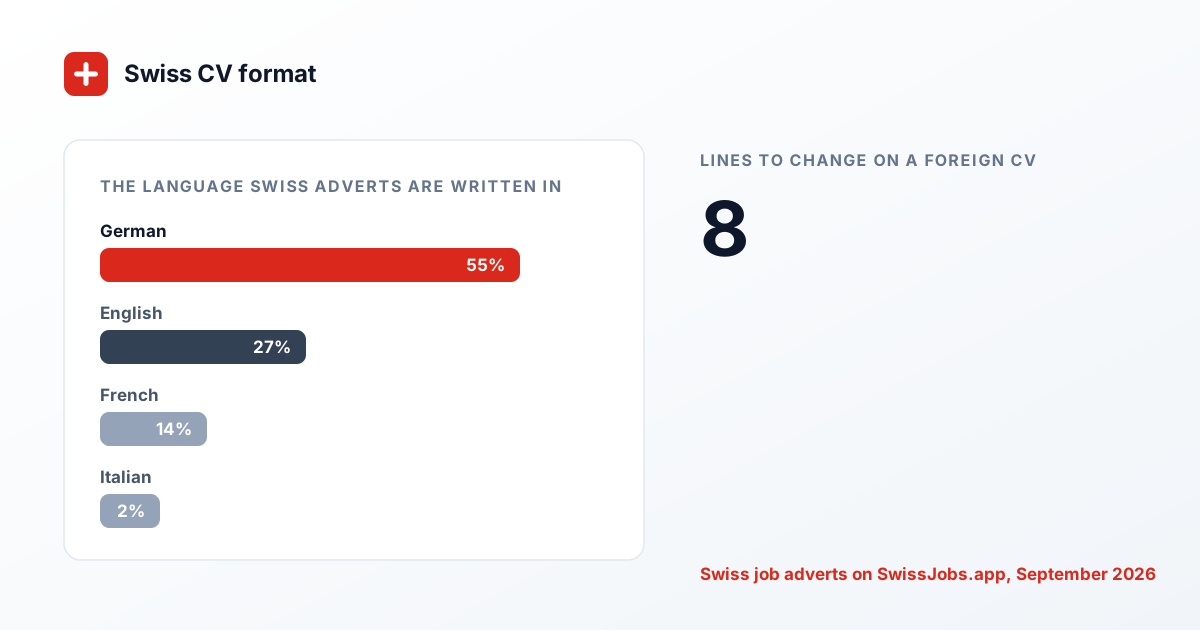
- The language of the advert. Around 55% of Swiss adverts are written in German, more than a quarter in English and about one in seven in French. If the advert is in German, a German CV; if a Swiss employer advertises in English, an English CV is expected and translating it into German helps nobody.
- Do I need to put my permit on a Swiss CV?
- Yes, or your nationality if you have no permit yet. EU or EFTA nationality is itself the answer, because the process is a formality. Non-EU, write the permit type if you hold one and the fact that you would need sponsorship if you do not. An unanswered status question is read as a problem.
- Should I keep my two-page CV or cut it to one?
- Two pages is the Swiss norm and one page reads as thin rather than efficient. The trimming happens inside the two pages: the last ten years in detail, everything older as one line per role, and no paragraph explaining what a project manager does.
- Do Swiss employers expect a photo on the CV?
- Most still do, and it stays the safe play even though the rule is dated. A plain business portrait in the header. Large international employers will not mind if it is absent; SMEs and anyone hiring through a Swiss recruiter mostly expect it.
- In what order does a Swiss recruiter read a CV?
- Roughly: permit and location first, then languages, then your current title and employer, then the type of your degree, then the shape of your history — and achievements only sixth, if the CV got that far. It is why permit and languages belong in the top third of page one, and why rejections without a call usually come from the first four steps rather than from weak accomplishments.
- Does my degree matter more than my experience in Switzerland?
- Often it matters first. Switzerland has a dedicated education route for nearly every profession, so a CV is read as a certified path before it is read as a list of achievements, and the degree filter tends to run before the skills filter. Making adjacency explicit, front-loading anything certified, and a referral are what get around it.
Working on your CV right now? ATS CV checker: free, against a real Swiss job ad
See what a Swiss recruiter checks first
Upload your CV and get a score against a specific job ad in about 30 seconds — language levels, work permit, photo, how your achievements are phrased.
ATS CV checker, freeIn what order does a Swiss recruiter actually read your CV?
Not top to bottom. The first pass is about thirty seconds and runs in a rough priority — and almost everything else on this page follows from it.
Recruiters and hiring managers in Zürich describe the same rough sequence, and applicants who have been through it recognise it immediately. It is not a rule anybody publishes, and no job advert admits to it, but it is consistent enough to build a CV around. First: permit and location — can this person be hired without a work-permit process, are they already here. It behaves like a yes/no gate before anything else is considered, and unclear is treated as no. Second: languages, checked against the line in the advert. In this market that is a hard filter rather than a preference, and it removes more candidates than anything else on the page.
Third comes your current title and employer — are you doing roughly this job already, at roughly this kind of company. Fourth, the type of your degree. Fifth, the shape of the history: progression, tenure, gaps, with job-hopping judged more harshly here than in the US or UK. Only sixth do your achievements get read, if the CV survived that far. Everything else — hobbies, soft skills, references — comes last and rarely decides anything.
The uncomfortable consequence is that most people spend their editing time on step six and get eliminated at step one. If you are being rejected without a single call, the problem is almost certainly in steps one to four, and no amount of rewriting your accomplishments will reach it. Permit and languages belong in the top third of page one — not on page two, and not in the motivation letter, which at that point nobody has opened.
This is also why a short profile line at the very top earns its space. Three or four lines that state what you do, what you are looking for and why this employer, with the permit and language facts sitting beside them, answer steps one and two before the reader has to hunt. One sentence does most of the work: "Based in Zürich, B permit, no sponsorship required, German C1 and English C2."
Write a custom CV for every job you apply to
Most people send the same CV everywhere. The AI editor rewrites yours per application — Swiss format, the right language, in about a minute.
CV maker & resume builder: tailor it to this jobWhich language should a Swiss CV be written in?
The language of the advert, without exception — and that is German more often than half the time, English on more than a quarter of adverts, French on roughly one in seven.
This is the first line-level decision and people get it wrong in both directions. One group translates everything into German because the country is German-speaking, including applications to adverts written in English by an employer whose working language is English. The other group sends English everywhere, into a market where the majority of adverts are not in English at all.
Across 20K+ live Swiss adverts, the split is not close: German carries more than half of everything written, English sits above a quarter, French around a seventh, Italian a small slice that is mostly Ticino. Match the advert and the question disappears. If you genuinely cannot write German at the level the advert is written in, that is information — apply in English to the adverts in English, of which there are far more than the reputation suggests.
Share of live Swiss adverts by the language of the advert itself, where the language is detectable. Measured across Swiss job adverts on SwissJobs.app, September 2026.
See what a Swiss recruiter checks first
Upload your CV and get a score against a specific job ad in about 30 seconds — language levels, work permit, photo, how your achievements are phrased.
ATS CV checker, freeWhere do languages and levels go on a Swiss CV?
In the header block on page one, each with a CEFR level next to it — never in a skills box at the bottom of page two.
Two adverts in three name at least one language they need. That makes it a screening question, and screening questions get answered above the fold or not at all. German is asked for on about 44%, English on 30%, French 15%, Italian a couple of percent.
Write levels, not adjectives. "German B2, English C1, French A2" can be checked; "good German" has to be verified in a phone call, which is exactly the thing that does not happen if the screen fails first. And do not inflate them — an overstated C1 is found out in the first three minutes of that call, and it costs the application rather than the line.
And the third of adverts naming no language at all are not language-free jobs. The employer assumed it was obvious from the language the advert is written in.
Share of live Swiss adverts naming each language as a requirement; an advert can name more than one. Measured on SwissJobs.app, September 2026.
Do you put nationality, permit and address on a Swiss CV?
Yes to all three, in one line each, in the header — because the advert is precise about its own terms and completely silent about yours.
Look at what an advert commits to. Around 84% state the type of contract, two thirds state a language, and practically none name a salary figure. An employer being that specific about the shape of the job and that vague about the money tells you where the burden of clarity sits: the terms of the role are theirs to state, and your ability to take it is yours.
So: nationality, or the permit if you hold one. EU or EFTA is the whole answer, because the permit follows the contract as a formality. Non-EU without a permit, write it plainly — "non-EU, would require sponsorship" — because a recruiter who has to guess assumes the harder case anyway, and half of them stop there. Then the city and canton you live in, or the one you are moving to with a date. "Relocating to Basel from October" is a fact. An address in Manchester with no comment is a question.
On money, since the adverts do not raise it: leave a salary expectation off the document. Any number you write can only be too high or too low against a range you cannot see. If a form insists, give a band and keep it out of the CV.
Share of live Swiss adverts stating each item. Measured across Swiss job adverts on SwissJobs.app, September 2026.
Does a Swiss CV still need a photo?
Most employers still expect one, and leaving it off is a risk you take for a principle rather than an advantage.
If you come from the UK, the US, Ireland or Australia, this is the line that will bother you most, and the objection is correct — a photo invites exactly the bias your home market spent twenty years designing out. Switzerland has not had that debate in the same way. A CV without a photo here reads as incomplete rather than as principled, particularly at smaller employers and with Swiss recruitment agencies.
The practical version: a plain business portrait, head and shoulders, neutral background, in the header next to your details. Not a cropped holiday picture, not a LinkedIn shot with a wine glass edited out. If you genuinely will not do it, the cost is highest at SMEs and lowest at large international employers, so aim your applications accordingly rather than sending the same document everywhere and wondering.
While you are up there: date of birth is common and optional, marital status and religion are gone, and the block should be four or five short lines. It is passport control, not an introduction.
How do you turn duties into results — and in whose words?
Two lines per role, each naming a number or an outcome, using the vocabulary the advert used rather than your last employer internal titles.
Almost every CV that arrives from abroad describes responsibilities: "responsible for regional sales", "managed a team of six". A Swiss reader takes that as a job description, not as a record of what you did. Rewrite the last two roles as outcomes — what changed, by how much, over what period — and leave older roles as a single line each.
The vocabulary matters more than people expect, because the words in Swiss job titles are not evenly split between languages. Manager, Engineer, Senior and Specialist each appear in a meaningful share of titles across the country; the German-language equivalents like Verkäufer or Mitarbeiter appear far less often even though those jobs are everywhere. That gap is a searching problem and a writing problem at once: if you describe yourself only in the local word, you are invisible to a search for the English one, and the other way round.
The fix is dull and works. Take the five nouns the advert uses for the work and make sure your document carries them where you actually did that work — in the bullet, in the title line. Not in a keyword list at the bottom.
Share of live Swiss job titles containing each word. Measured on SwissJobs.app, September 2026.
What do you write about Pensum and availability?
One line: the workload you want as a percentage, and the date you can start — because the default assumption is full time and immediate, and a wrong assumption costs you the role at offer stage.
Pensum is the Swiss word for workload and it is written as a percentage: 100%, 80%, 60%. It appears in adverts, in contracts and in conversation, and a foreign CV never mentions it because no other market talks this way. Nine in ten adverts that state a contract type are full time; part-time roles are a small slice, and temporary and internship positions smaller again.
That distribution is why the line is worth writing. If you want 100%, saying so costs you nothing and removes a doubt. If you want 80% — normal here, and far more common than in most countries — say it at the start rather than at the offer, because a recruiter who finds out late has to reopen a decision they already made, and reopening is where applications die.
Availability is the same principle in one word: a date. "Available from 1 November", or your notice period. An unstated notice period is a guess, and guesses lose to the person who wrote it down.
Share of live Swiss adverts by contract type, counted across the adverts that state one. Measured on SwissJobs.app, September 2026.
Why the type of your degree can outrank your skills
Switzerland has a dedicated education route for nearly every profession, and a CV gets read as a certified path first and a list of achievements second.
Apprenticeships, Berufsmaturität, Fachhochschulen, ETH — the system is deep, it works, and employers trust it. The effect on an incoming CV is specific: the degree filter runs before the skills filter. Applying for a software role without a computer-science degree often does not mean competing against the CS graduates and losing; it means being filtered out before the comparison happens, with the portfolio never opened. This is the part of the Swiss market that surprises people most, and no advert states it.
Two adjacent filters work the same way. Company size is one: moving from a twenty-person startup into a five-thousand-person insurer reads as a risk, and the reverse reads as a different risk — "has operated at our scale" carries more weight here than most newcomers expect. Domain is the other: B2B SaaS, marketplace and banking software are not interchangeable, and "similar product, similar problem" beats "more senior, different domain" more often than it would elsewhere.
Underneath all of it is that employers can afford to wait. A deep local talent pool, low unemployment and long notice periods mean there is no pressure to take the interesting-but-imperfect candidate, so they generally do not. That is not a judgement about you; it is what a small, well-supplied market permits.
What appears to work against it: make the adjacency explicit rather than leaving it to be inferred — same regulated industry, same team size, same customer type, in your own words. Front-load anything certified, high on page one rather than buried at the bottom. Match most of the advert rather than some of it, because with this many applicants per role a partial match does not get the benefit of the doubt. And a referral bypasses the whole screening logic, which is why it remains the single highest-leverage move available to anyone applying here.
The tools for this
Two of ours, both free, and one place to read how adverts in your field are actually worded.
SwissJobs CV Check our tool
Reads your CV against one specific advert and tells you which of the screening questions — status, languages, availability, the words the advert uses — it answers in the first screen. Ours, and free.
Try it free- SwissJobs job searchour tool
The Swiss market in one place, searchable in German and English. Useful here for reading a dozen adverts in your field before you touch the document.
SwissJobs job search - jobs.ch
The largest German-language board in the country and better than us for local SME roles. Worth a search there for the vocabulary alone.
Visit site - Swiss CV template: 190 occupationsour tool
Ours, free. One template per occupation, in the Swiss layout with example text.
Swiss CV template: 190 occupations
Nothing on this list is about the quality of your career, which is the part people assume is the problem. The header carries your status, your city, your languages with levels and your availability. The photo stays. The last two roles read as outcomes, in the words the advert uses. The Pensum line says what you want.
That is an hour of work on a document you already have, and it converts a CV that is being guessed about into one that answers the questions before they are asked. If nothing comes back after that, then it is worth looking at where you are applying — but fix the eight lines first, because they are the cheap half.
The tools compared
We checked 16 Swiss and international application tools on their own pages — prices, free tiers, and what is actually included.