The 5 CV mistakes I see most in Swiss applications, ranked by how fast they kill
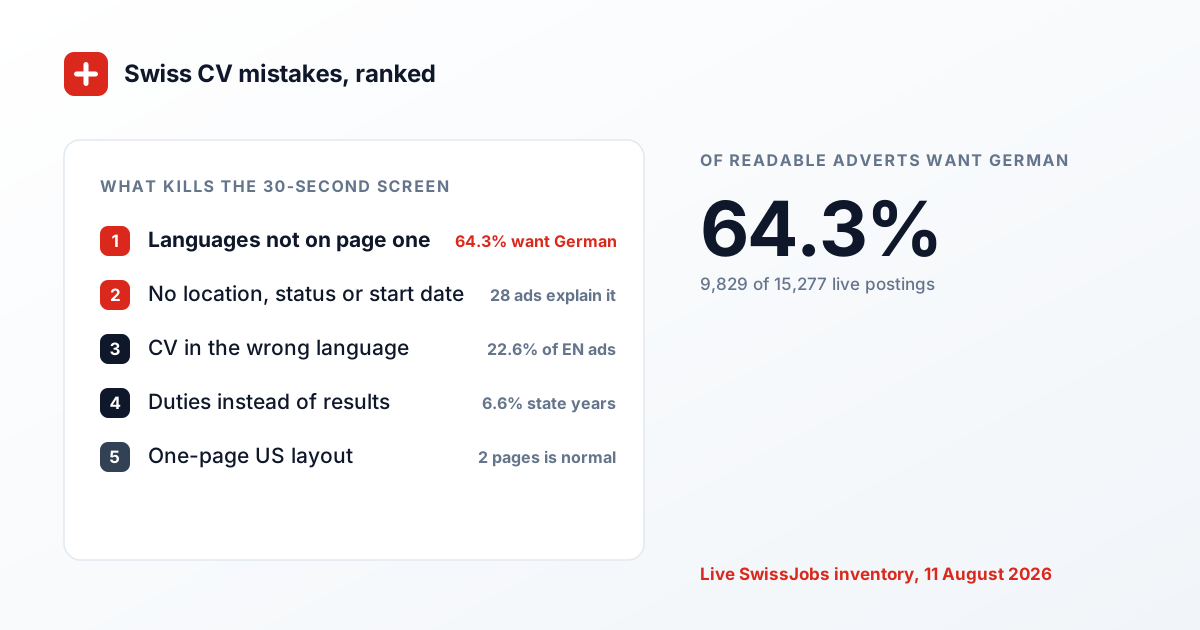
I pulled the inventory again this morning: 19,738 live Swiss postings, 3,648 of them posted in the last seven days. And I did something slightly different with it than usual. Instead of asking what the market wants, I asked what the market states out loud — because the gap between those two things is exactly where most CVs die.
Here's the thing about the Swiss first screen. It isn't an evaluation. It's a logistics check, run in about thirty seconds, usually by someone who has forty other dossiers in the same folder and a meeting at four. Can this person legally work here. Can they get to the office. Do they have the language the team speaks. Only after all three come back yes does anyone read about your experience.
So the mistakes below are ranked by how fast they end the screen, not by how bad they are in some abstract sense. Number five is a genuine mistake and will cost you interviews. Number one costs you the application in under ten seconds, and you'll never know it happened, because nobody writes back to tell you your language block was on page two.
Short version
- What do Swiss recruiters actually check first on a CV?
- Three logistics facts, in roughly this order: whether you can legally work in Switzerland, where you live relative to the office, and which languages you speak at working level. All three sit outside your experience, and all three need to be findable in the top third of page one. Of the 19,738 postings live on our platform on 11 August 2026, only 28 explain the permit question in the advert itself — so the recruiter resolves it from your CV, or guesses, and guessing goes against you.
- Do I need German to get a job in Switzerland?
- Not always, but more often than the English-speaking internet suggests. Of the 15,277 live postings where we could read the advert and extract requirements, 9,829 (64.3%) name German, and 3,711 (24.3%) name English with no German at all. The trap is the middle: 1,012 of the 4,475 adverts written in English — 22.6% — still list German as a requirement. In Zurich that rises to 26.1%, in Basel 30.4%.
- Is 'German: basic' enough for a Swiss job advert?
- Almost never. When a Swiss advert names German, it asks for professional working level in 8,951 of 9,829 cases and native level in another 218 — 93.3% combined. Conversational shows up on 606 postings (6.2%) and basic on 54 (0.5%). So writing 'German: basic, improving' answers a question nobody asked. Put the level you can actually work in, name the certificate if you have one, and be specific about which language you'd take a meeting in.
- Should my CV mention my work permit?
- Yes, in one line, near your name. EU/EFTA citizens should write it plainly ('EU citizen, no permit required'); permit holders should name the type (B, C, G); non-EU applicants should state their current status and whether they need sponsorship. The adverts won't prompt you: 28 of 19,738 mention permits at all. Leaving it blank doesn't make the question go away, it just hands the answer to somebody's assumption.
- How long should a Swiss CV be, and what goes with it?
- Two pages. Not one — the one-page rule is American and reads as thin here. A Swiss dossier is CV plus Arbeitszeugnisse (employer references), plus diplomas, usually as one merged PDF. A photo is still standard and still the safe play. Keep the layout in a single column: 3,413 different employers are posting on our platform right now, most of them small enough that a human opens your PDF directly, and the ones using an ATS will mangle anything with columns or graphics.
Working on your CV right now? ATS CV checker: free, against a real Swiss job ad
See what a Swiss recruiter checks first
Upload your CV and get a score against a specific job ad in about 30 seconds — language levels, work permit, photo, how your achievements are phrased.
ATS CV checker, freeMistake 1: your languages aren't on page one
64.3% of readable live adverts name a required language and 26.7% want two or more, so a CV that leaves the language block until page two fails the fastest check there is.
This is the number one mistake by a distance, and it's the most fixable, which is what makes it painful. I see CVs where the language section is the last block before hobbies. In a Swiss screen that's the same as not having one.
The inventory is unambiguous about how central languages are. Of the 15,277 live postings where the advert text was readable enough to extract requirements from, 14,982 name at least one language — 98.1%. German on 9,829 (64.3%), English on 6,500 (42.5%), French on 2,969 (19.4%), Italian on 557 (3.6%). And 4,082 postings, 26.7%, want two or more. The most common combination in the entire country is English plus German, on 2,013 adverts.
So the screener isn't reading your language block as background colour. It's a filter with a pass and a fail, and it runs before the experience section gets a glance. Which means the block belongs in the header area — same visual zone as your phone number — not at the bottom.
One caveat on my own numbers, because I'd rather you trust the rest of the article. 4,461 of the 19,738 live postings carry no readable advert text on our side, so no requirements could be extracted from them at all. I've excluded them from every percentage here rather than counting them as 'no language required', which would have quietly understated everything by a fifth. Every base in this piece is 15,277, and I say so under each chart.
Live SwissJobs inventory, 11 August 2026. Base: the 15,277 of 19,738 published postings whose advert text could be read and parsed for requirements. Adverts naming several languages count in several bars.
Write a custom CV for every job you apply to
Most people send the same CV everywhere. The AI editor rewrites yours per application — Swiss format, the right language, in about a minute.
CV maker & resume builder: tailor it to this jobMistake 2: no location, no status, no start date
97.5% of live adverts name a specific Swiss town and only 28 of 19,738 explain the permit question, so if your CV doesn't answer 'where are you and can you start', someone else's assumption does.
Second on the list and the one that hits international applicants hardest. The Swiss job advert is a strangely silent document about status. It'll tell you the town, the Pensum and the team size, and say absolutely nothing about who is eligible to apply.
The numbers: 19,241 of 19,738 postings — 97.5% — name a specific place, across 1,130 distinct locations. Only 497 say something generic like 'Switzerland' or 'remote'. Just 410 postings (2.1%) mention remote work or home office anywhere in the title or summary. And permits? 28 postings. 0.1%. Effectively zero.
Read those two facts together and you get the whole problem. The job is at a desk in a named town, the advert assumes you already know whether you're allowed to sit at it, and the recruiter has to work out your status from your CV in the same thirty seconds they're doing everything else. If your address says Manchester and there's no other signal, the honest reconstruction of what happens next is: they move to the next dossier. Not out of prejudice — out of workload.
So write the line. 'Zurich · EU citizen · available from 1 October' answers all three questions in eleven words. If you're abroad, say what your plan is: 'relocating to Basel in October, EU citizen, no permit required' is a completely different signal from a Manchester postcode and silence. And if you're non-EU, be straight about it — a recruiter who finds out at offer stage is a recruiter who stops replying.
One aside for people applying from just over the border. If you're a Grenzgänger or planning to be, say so with the permit type (G). Employers in Basel, Geneva and Ticino deal with cross-border staff constantly, and 'G permit, currently in Lörrach' is a normal, boring, entirely acceptable sentence to them.
Live SwissJobs inventory, 11 August 2026. Base: all 19,738 published postings, across 1,130 distinct stated locations. Permit and remote mentions searched in job title and advert summary.
See what a Swiss recruiter checks first
Upload your CV and get a score against a specific job ad in about 30 seconds — language levels, work permit, photo, how your achievements are phrased.
ATS CV checker, freeMistake 3: the CV is in the wrong language
99.9% of German-language adverts require German and 22.6% of English-language ones do too, so the language of the advert is the language of the CV — and an English advert is not a promise that German doesn't matter.
Simple rule, constantly broken in both directions. If the advert is in German, the dossier is in German. If it's in English, English. Sending an English CV to a Stelleninserat written in German reads as 'I didn't notice which country this is' — and 99.9% of those 8,182 German-language adverts require German anyway, so the CV is answering its own question badly.
The other direction is subtler and costs more people more interviews. English-language adverts feel like a green light. They're often not. 1,012 of the 4,475 English-language postings — 22.6% — still list German as a required language. By canton it gets sharper: 26.1% of the 1,358 English adverts in Zurich want German, 30.4% in Basel, 35.3% in Bern. Geneva is the genuine exception at 9.4%, which is why Geneva feels like a different country to job hunt in. It sort of is.
French-language adverts do the same thing, by the way: 26.5% of the 2,001 of them also want German. Italian adverts, 29.2%. The multilingual squeeze is real and it's mostly one-directional, because German is the language 74.9% of adverts in the German-speaking cantons ask for while French only shows up in 9.1% of them.
What I'd actually do: write the CV in the advert's language, and if you can't write it properly in that language, write it in English and put the honest level in the language block. Don't run a German CV through a translator and hope. A hiring manager in Bern can spot machine-translated German in one paragraph, and now you've claimed a level you don't have — which is worse than not claiming it, because it costs you the interview and the trust at the same time.
Live SwissJobs inventory, 11 August 2026. Base: the 15,277 postings with readable advert text, split by the language the advert itself is written in. Read the English bar as: nearly one in four English-language Swiss adverts wants German too.
Mistake 4: duties where results should be
Only 6.6% of live adverts state a number of years and 0.7% mention a budget or revenue figure, so the advert won't quantify the bar for you — your CV has to quantify the answer.
Now we're past the logistics check and into the part where CVs get compared. Mistake four is 'Responsible for the onboarding process' where 'Cut onboarding from 6 weeks to 11 days across 40 hires' should be.
I looked at what the adverts themselves specify, because it explains why this matters here specifically. 58.7% of postings talk about experience in general terms — Erfahrung, experience, expérience. Only 6.6% put a number of years on it. 15.8% name a degree or a formal qualification. And 0.7% mention a budget, a revenue figure or a KPI. So the bar is almost never stated numerically.
That cuts both ways. It means nobody can disqualify you for missing a stated threshold — but it also means the shortlist is decided by whoever made the strongest case, and vague duty lists make no case at all. Two candidates write 'Verantwortlich für Social Media'. One writes '4 channels, 18k to 61k followers in 14 months, 2 people'. Same job. One of them is a person the hiring manager can picture doing the work.
The Swiss-specific twist: Arbeitszeugnisse do a lot of this work in a local career, because a Zeugnis describes performance in coded language everyone here can read. If you're coming from abroad you have no Zeugnisse, and people rarely tell you that you're expected to compensate somewhere. Numbers in the CV are how you compensate.
Three per role is plenty. Scope, outcome, timeframe. If you genuinely can't quantify a job — some jobs really don't produce numbers — name the scale instead: team size, portfolio value, number of sites, how many countries. Anything that lets a reader calibrate against the person before you in the pile.
Live SwissJobs inventory, 11 August 2026. Base: all 19,738 published postings, matched on job title and advert summary text in four languages. The advert rarely sets a numeric bar — which is exactly why the CV should clear one.
Mistake 5: the layout fights the reader
The one-page US CV, the two-column design template and the missing Arbeitszeugnisse are the three format errors that cost you an interview you'd otherwise have got.
Fifth because it rarely kills instantly — it just quietly costs you. Three versions of it, in the order I see them.
The one-page CV. It's an American convention and it doesn't travel. A Swiss dossier is two pages, and the second page carries the detail that makes the first credible: full employment history with months, education with institutions, languages with levels, references. Squeezing a fifteen-year career onto one page here doesn't read as disciplined, it reads as missing information.
The design template. Two columns, a skills bar chart, a sidebar of icons, maybe a colour block down the left. It looks great in the preview and it comes out of an ATS parser as gibberish. Even where a human opens the PDF directly — which happens a lot, with 3,413 different employers posting on our platform and most of them nowhere near enterprise recruiting software — you've spent your visual hierarchy on decoration instead of on the four facts they need. Single column. Real headings. Boring is a feature.
And the missing Arbeitszeugnisse. In Switzerland the complete dossier is CV, Zeugnisse, diplomas, usually one merged PDF. If you're local and you leave them out, it reads as though there's something in them. If you're international, say so explicitly — 'references available; UK employers issue letters rather than Arbeitszeugnisse' — because the absence gets noticed and an explanation costs you one line.
The photo question I've written about separately and my view hasn't moved: still standard, still the safe play, top right, professional, not a cropped holiday shot. I think the convention is dated. It's still the convention.
What actually goes in the top third of page one
Name, role, and one line answering location, status, availability and languages at the level the advert asked for — because when an advert names a language, it wants working level 93.3% of the time for German.
Here's the whole fix, and it's about four lines long.
Name. Target role, matching the advert's wording. Then one logistics line: 'Zurich · EU citizen · available from 1 October · 80–100%'. Then the language block, right there, not on page two: 'German C1 (Goethe C1, 2024) · English native · French B1'. That's it. That's the part that gets you past the screen.
Be precise about the level, because the adverts are. When a Swiss advert names German it wants professional working level in 8,951 of 9,829 cases and native in 218 more — 93.3% at working level or above. English is a bit softer at 82.7%, French 73.5%, Italian 64.3%, which tells you something about which language is treated as non-negotiable and which as useful. 'Good German' means nothing on paper. 'C1, Goethe certificate 2024, I work in German daily' means something to a person deciding in thirty seconds.
If your level genuinely isn't there yet, say the true thing plus the trajectory: 'German B1, A2 to B1 in eight months, currently in a B2 course'. I'd take that over an inflated C1 every single time, and so would every recruiter I've ever spoken to, because the inflated one gets discovered in the first phone call and the honest one gets a conversation about whether the team can work with B1.
Then match the wording. If the advert says Sachbearbeiter Debitoren, the CV says Sachbearbeiter Debitoren somewhere visible — not 'Accounts Receivable Specialist' and a hope that someone maps it. That's not keyword stuffing, it's just answering in the language of the question.
And if you want to know whether a stranger can find those four facts in your CV in thirty seconds, that's precisely what we built the CV check for. Paste the posting, upload the CV, get told which of them a Swiss screener can't locate. It takes less time than it took you to read this section.
Live SwissJobs inventory, 11 August 2026. Base: the postings naming each language, out of 15,277 with readable advert text. 'Working level or above' combines professional and native; the remainder ask for conversational or basic.
What I'd actually use for this
Three links. Two of them are ours and I'll flag it.
SwissJobs CV Check our tool
Ours, free. Run your CV against one specific posting. It checks the same things a Swiss first-pass screener checks — location, status, availability, Pensum, language levels against what the advert asked for — and tells you which of them can't be found in the top third of page one.
Try it free- SwissJobsour tool
Ours. The 19,738 live Swiss postings every number above came out of. Useful here for a specific reason: read ten adverts in your field before you rewrite anything, and copy the language levels and job-title wording they use back into your CV.
SwissJobs - State Secretariat for Migration (SEM)
Not ours. The federal source on permits — B, C, G, L, EU/EFTA versus third country. If mistake number two applies to you, spend twenty minutes here and then write your status on your CV in words you can defend.
Visit site
If I had to compress this into one sentence: four of the five mistakes are about facts, not quality. Where you are, what you're allowed to do, which languages you actually work in, what you actually achieved. None of that requires a better career. It requires putting what you already have where a tired person can find it in thirty seconds.
The number I'll keep watching is that 22.6% — English-language Swiss adverts that still require German. It's the single most misleading signal in this market, because it looks like an open door and it's a door with a language test behind it. I'll re-run it in a quarter. If it's still near a quarter of all English adverts, then the honest advice to anyone moving here stays what it's been for years: start the German course now, and put the level on page one while you do.
The tools compared
We checked 16 Swiss and international application tools on their own pages — prices, free tiers, and what is actually included.