Job interview in Switzerland: the questions it opens with, and what each one is testing
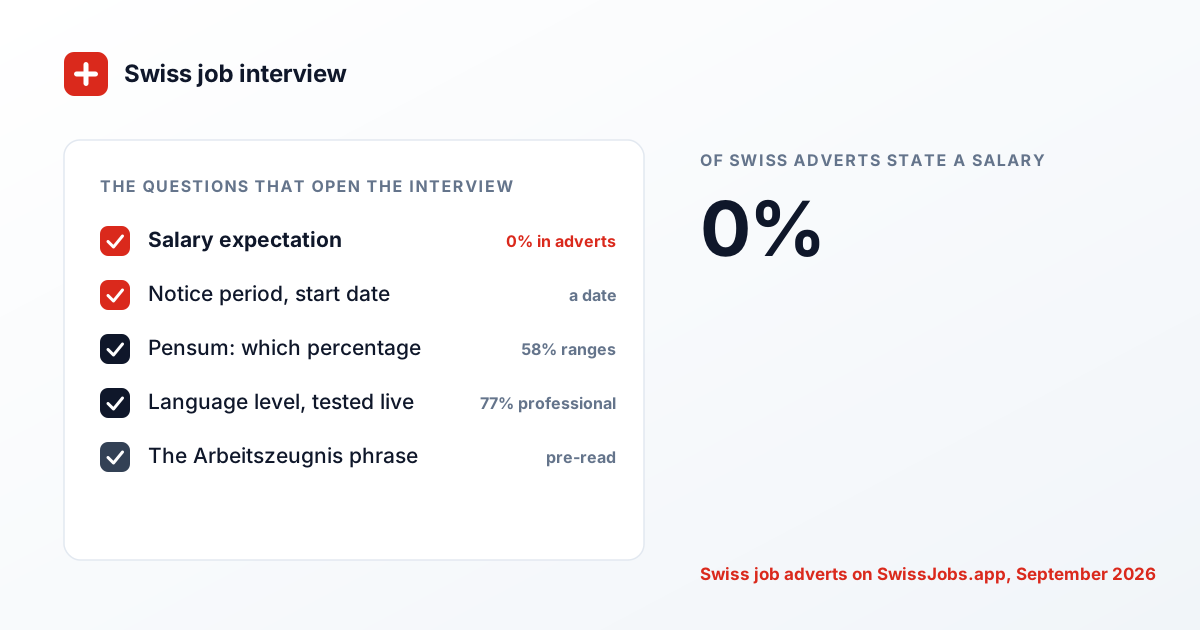
People prepare for a Swiss interview the way they would for one anywhere: strengths, weaknesses, a story about a difficult project. Then the first question is about their notice period, the second is about salary, the third is whether 80% would also work for them, and the prepared material does not come up until the last quarter of an hour.
That order is not rudeness and it is not a trick. It follows from what a Swiss job advert leaves out. The advert states the contract type and the languages it needs, and stays silent on everything the employer has not decided yet — money, start date, exact workload. Those open points are what the interview opens with, because nobody wants to spend forty minutes on someone who turns out to need a start date they cannot offer.
We cannot see inside interviews and we will not pretend to. What we can see is what the adverts commit to and what they leave open, across every Swiss advert we read. The measured part below is the adverts; the rest is how those open points get asked in the room, and what to say back.
Short version
- What questions does a Swiss job interview open with?
- Usually the practical ones first: your notice period or earliest start date, your salary expectation, the workload you want if the advert offered a range like 80–100%, and a check of the language level you wrote on the CV. Career and motivation questions come after these, not before.
- Why does the salary question come so early in Switzerland?
- Because the advert did not answer it. None of the Swiss adverts we read states a salary figure, so the expectation has to be asked, and it is asked early to avoid a mismatch at offer stage. Answer with a gross annual band and say whether it assumes twelve or thirteen monthly salaries.
- How do I answer the notice-period question in a Swiss interview?
- With a date. Swiss statutory notice runs one to three months to the end of a month depending on tenure, and many contracts fix three. Say the exact date you can start, and if it is more than three months away, say whether an earlier release is realistic. A vague answer is read as a problem.
- What does the Pensum question in a Swiss interview mean?
- Pensum is workload as a percentage. When the advert said 80–100%, the employer can accept either and the interview asks which you want. Answer with a number. Salary and holiday scale with it, so this is a negotiation point rather than small talk.
- Will a Swiss interviewer test my language level?
- Often, and usually by switching language for a few minutes rather than by asking about it. Around three quarters of language requirements in Swiss adverts ask for a professional working level, so the switch is checking the level you claimed. Do not claim above what you can sustain for ten minutes.
- What is a Swiss HR interviewer checking in the first call?
- A checklist rather than a conversation: your motivation for this specific employer, whether you fit the company's size and type, whether you have done comparable work at a comparable organisation, your permit and availability, and your salary expectation. Language level is usually tested in passing by switching language mid-conversation. Technical depth comes in a later round.
- Why do Swiss interviews ask whether you prefer a corporation or a startup?
- Because company-size fit is treated as a real risk in both directions, and they can afford to care: 45% of the 3,566 employers advertising in our index have exactly one opening, so a single wrong hire is felt immediately. Answer with the explicit parallel — same industry, team size, customer type and decision-making style — and if you are genuinely changing scale, say what you want from the change.
Practise the interview out loud, and see how you scored
An AI panel asks the questions and you answer by voice, the way the real call goes. Afterwards you get a pass probability and the moments that cost you.
Start a live practice interviewWorking on your CV right now? ATS CV checker: free, against a real Swiss job ad
See what a Swiss recruiter checks first
Upload your CV and get a score against a specific job ad in about 30 seconds — language levels, work permit, photo, how your achievements are phrased.
ATS CV checker, freeWhat is the interviewer actually working through?
A list, not a conversation. Most Swiss first interviews cover the same items in roughly the same order, and knowing which item you are in explains why the opening feels so abrupt.
The first conversation with HR is usually a screening call with a checklist behind it, and the person running it has to be able to tick every line before passing you on. That is why it opens on salary and availability rather than on your work: those are the items that disqualify, and there is no point spending twenty minutes on your achievements if the budget or the notice period rules you out anyway. It is not coldness. It is item two.
The items, roughly in the order they get covered: your motivation for this specific role and this specific employer; whether you fit the company — its size, its type, its way of working; whether you have done comparable work at a comparable organisation; your permit and availability; and your salary expectation. Language level is checked in passing, usually by switching into the language mid-conversation rather than by asking. The technical or professional depth comes later, with the people you would actually work with.
The practical consequence is that preparing only for "tell me about yourself" and your proudest project prepares you for the wrong half. Have a two-sentence answer ready for each checklist item, and make the motivation one specific enough that it could not be sent to another company — a generic motivation answer is the most common way a strong candidate fails a screening call, because it is the item HR is least able to tick on your behalf.
Write a custom CV for every job you apply to
Most people send the same CV everywhere. The AI editor rewrites yours per application — Swiss format, the right language, in about a minute.
CV maker & resume builder: tailor it to this jobWhy does a Swiss interview ask about salary so early?
Because the advert never mentioned it, and the employer wants to rule out a mismatch before spending an hour on you.
Look at what a Swiss advert commits to. Across 20K+ live adverts, 84% state the contract type and two thirds name a language they need. Not one states a salary figure. A few say the pay is competitive; none puts a number on it. So the salary conversation happens here in the first screening call or the first ten minutes of the first interview, and many application forms ask for a Lohnvorstellung before anyone has spoken to you.
The question is not testing your ambition. It is testing whether your number sits inside a range they have already fixed and will not tell you. So answer with a band, in gross annual terms, and name the convention: "I am expecting a gross annual salary between X and Y on thirteen monthly salaries, depending on the Pensum and what is included." Thirteen months is common but not universal, and if you do not name the basis the employer picks the cheaper reading.
Where the number comes from is the part people skip. Use a wage calculator built on the federal wage survey, put in canton, sector, age and function, and take the median for a comparable role as your floor. Then say the band without apology.
Share of live Swiss adverts stating each item. Measured across Swiss job adverts on SwissJobs.app, September 2026.
See what a Swiss recruiter checks first
Upload your CV and get a score against a specific job ad in about 30 seconds — language levels, work permit, photo, how your achievements are phrased.
ATS CV checker, freeWhat are the notice-period and start-date questions actually checking?
Whether you can start when they need you, and whether you know your own contract — and the answer has to be a date.
"When could you start?" arrives in the first five minutes and it is one of the few questions in a Swiss interview with a hard answer. Notice periods are set by the Code of Obligations unless the contract says otherwise: one month in the first year of service, two months from the second to the ninth year, three from the tenth, always to the end of a month. Contracts routinely fix three months for everyone. Whatever yours says, know the date it produces if you resigned tomorrow.
The employer is checking two things. The obvious one is fit with their plan: roughly one advert in five is less than a week old and about half are under a month, so a good share of employers are hiring for a gap that already exists. The second is whether you have thought this through. A candidate who says "probably around three months, I would have to check" has told the interviewer they have not yet decided to leave.
So the answer is one sentence: "My notice period is three months to the end of the month, so the earliest start is 1 January; if you need someone sooner I can ask about an early release, but I would not promise it." That last clause matters: offering to walk out of a current contract early reads worse here than it sounds. If you are between jobs, say "immediately" and mean it. If you are relocating, give the month you will be in the country with a permit in hand.
What does the Pensum question mean, and what should you answer?
Pensum is workload as a percentage, the advert usually offered a range, and the interview wants a single number from you.
About one Swiss job title in four carries a workload percentage, and of those nearly three in five state a range rather than a fixed figure: 80–100%, 60–80%, 50–100%. A range means the employer has already decided they can live with less than full time, and the interview will ask where in that range you want to be. Candidates from abroad tend to hear it as a trick.
It is not. It is a scheduling and budget question, and it wants a number. "100%" is a complete answer. So is "80%, ideally with Friday off" — a normal thing to say in a Swiss interview, and nobody flinches. What does not work is "I am flexible", because flexible means the employer decides for you, and they will decide 100% and then be surprised when you ask for four days at offer stage.
One consequence to have in your head before you answer: salary, holiday and pension contributions all scale with the Pensum. An 80% role pays 80% of the full-time figure, and the salary band you gave ten minutes earlier is understood as the 100% number. If you want 80%, give the full-time band and name the Pensum in the same breath, so nobody does the arithmetic twice.
Share of live Swiss adverts whose title carries a workload percentage, by how the percentage is written. Measured across Swiss job adverts on SwissJobs.app, September 2026.
Will they test the language level you wrote on the CV?
Usually, and usually by switching into that language for a few minutes rather than by asking you to rate yourself.
Two adverts in three name at least one language they need, and when they do, the level asked for is almost always a working level. Around three quarters of the language requirements in Swiss adverts ask for professional fluency, roughly a fifth for conversational, and only a sliver for basic. So the line on your CV that says "German B2" is a claim the employer has a business reason to verify, and the cheapest way to verify it is to ask the next question in German.
The switch usually comes without warning, three or four questions in, and lasts as long as it needs to. It is not checking grammar. It is checking whether you could take a customer call or sit in a team meeting in that language without everyone slowing down for you. Ten minutes of conversation is enough to tell.
The preparation is unglamorous: practise the salary, start-date and Pensum answers out loud in the second language, because those are the ones that will be asked in it. And do not overstate the level on the document: a C1 that turns out to be a B1 loses the interview in the first quarter of an hour, while an honest B1 held competently passes the test you set yourself.
Share of language requirements in live Swiss adverts by the level demanded; an advert can name more than one language. Measured across Swiss job adverts on SwissJobs.app, September 2026.
Which language will the interview actually be in?
The language of the advert for most of it, and a second language for part of it more often than people expect.
One Swiss advert in five asks for two languages or more, and the pairing is not random. Nearly a quarter of adverts written in English also demand German; about a fifth of adverts written in French demand German, and a similar share English; a fifth of German-language adverts want English on top. An English advert from a Zurich employer is often a bilingual workplace advertising in the language the team writes in, and the interview reflects that: the hiring manager in English, HR in German, or the other way round.
So expect at least one interviewer to use the second language on the advert, and prepare the practical answers in both. It also settles what to do when you are unsure: open in the language of the advert, and if an interviewer switches, follow without comment.
For people applying from abroad: a German-language advert that also wants English is telling you the working language is German, and no interview polish changes that. Choose the adverts whose second language is the one you actually have.
Share of live Swiss adverts in each advert language that name the second language as a requirement. Measured across Swiss job adverts on SwissJobs.app, September 2026.
How does the Arbeitszeugnis come up, and how formal should you be?
The work reference has been read before you arrive, a phrase from it may be quoted back at you, and the whole conversation runs at a lower temperature than you are used to.
Swiss employers issue a written reference at the end of every employment, and applicants attach them to the dossier. So the interviewer has already read what your last two employers wrote, in the coded phrasing Swiss references use, and a phrase that reads as lukewarm will be asked about: "Your reference says you performed to our satisfaction — what happened there?" Keep the answer short and factual. Say what the role was, what the circumstances were, and move on.
References who can be called are a separate thing. They are usually asked for after a second interview, with your consent, and the interviewer will ask whether they may contact your current employer. "Not before an offer" is a normal answer and nobody holds it against you. Have two names ready who know they might be called.
On register: Sie and vous until someone offers du or tu, which in a first interview they usually will not. Answers are concrete and understated. "I led the migration and it went live on schedule" is a strong sentence here; "I am extremely passionate about driving transformational change" makes a Swiss interviewer look at the clock. Then send a two-line thank-you the same day, in the language the interview was in, and nothing more until they come back to you.
Are you a corporate person or a startup person?
This gets probed harder in Switzerland than most newcomers expect, and it is a real question rather than small talk.
Moving from a twenty-person startup into a five-thousand-person insurer reads as a risk here, and the reverse reads as a different one. The concern is not your ability but your tolerance: will someone used to deciding things in a corridor cope with a governance process, and will someone used to that process cope without one. Interviewers ask it indirectly — how decisions were made in your last role, how big your team was, who signed things off — and they are listening for whether their environment will feel normal to you.
The market shape explains why they can afford to care. Counted on 9 September 2026, our index carried 22,518 open adverts from 3,566 distinct employers, and 45% of those employers had exactly one advert open. Most Swiss hiring is a single role at a small organisation, where one wrong hire is felt immediately — and the ten largest advertisers accounted for only 17.4% of adverts, so the market is not concentrated enough for a candidate to rely on volume hiring. (Several of the largest advertisers are staffing agencies rather than end employers, so those shares describe adverts rather than workplaces.)
The answer that works is the explicit parallel. Rather than insisting you adapt to anything, name the match: same regulated industry, same team size, same customer type, same decision-making style. If you are genuinely crossing sizes, say so and say what you are looking for in the change — "I want the process, I was tired of improvising it" is a better answer than pretending the difference is not there, because the interviewer has already noticed it and is waiting to see whether you have.
The tools for this
Two of ours and one from the federation of trade unions, which is where the salary band comes from.
- SwissJobs interview cheatsheetour tool
Paste the advert and it builds a one-page sheet of the questions that advert is likely to produce, with space for your answers on salary, start date, Pensum and languages. Ours, and free.
SwissJobs interview cheatsheet SwissJobs CV Check our tool
Reads your CV against a specific advert before you send it, which is where the language levels and the availability line get set. Ours, and free.
Try it free- SGB Lohnrechner
The Swiss trade union federation calculator built on the federal wage survey. Canton, sector, age and function in, a median wage out. Use it for the salary band.
Visit site
None of the opening questions is about how good you are. They are about whether the practical pieces fit: a number, a date, a percentage, and a language level that holds up for ten minutes. Get those four ready in one sentence each, in both languages on the advert, and the interview reaches the part you prepared for with the interviewer still interested.
And read the advert one more time before you go. Everything it states is settled, and everything it leaves out is a question you are about to be asked.
The tools compared
We checked 16 Swiss and international application tools on their own pages — prices, free tiers, and what is actually included.