Why does my CV get rejected in Switzerland?
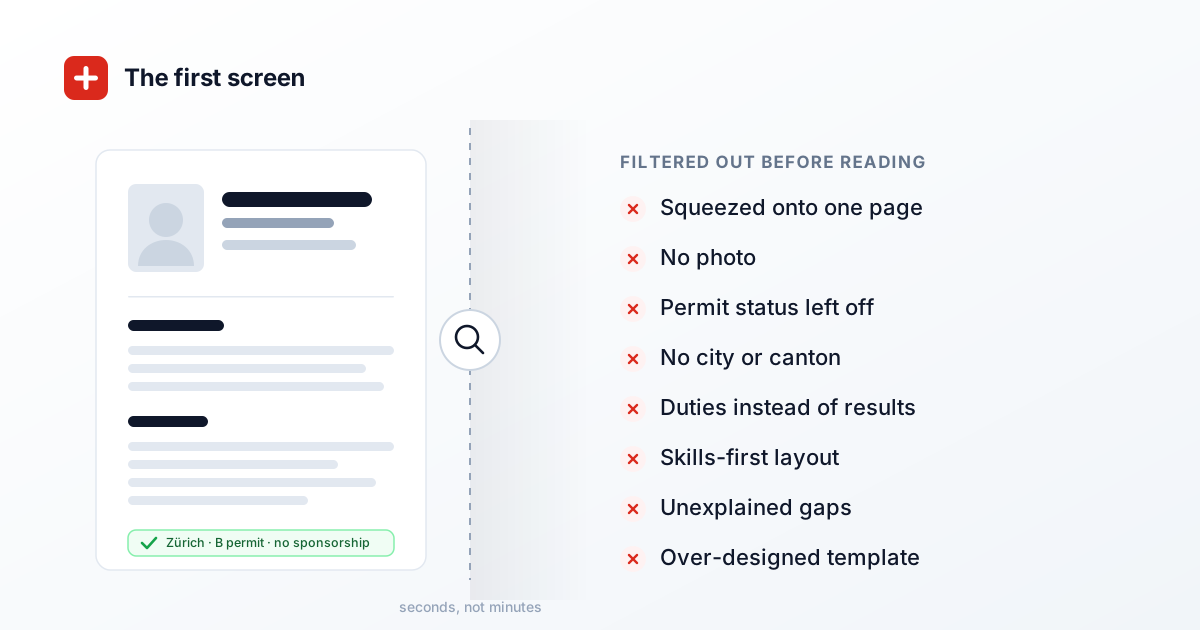
For everyone job hunting in Switzerland — these are the things I noticed that seem to get a CV rejected before anyone really reads it.
None of it is scientific. It is just what kept coming up in my own applications, and in conversations with people in Zürich going through exactly the same thing. Take it as field notes, not as rules.
Short version
- Should a Swiss CV be one page or two?
- Two pages is the norm in Switzerland, and three is fine for senior roles. The one-page rule is US advice — applying it here cuts exactly the detail Swiss recruiters are looking for and makes the CV read as thin.
- Do you need a photo on a Swiss CV?
- Yes, a professional headshot is still expected on a Swiss CV. Some very international companies do not care either way, but they do not hold it against you either, which makes including one the low-risk choice.
- Should you mention your work permit on a Swiss CV?
- Yes. If a recruiter cannot tell within seconds whether you need sponsorship, you quietly become a "maybe", and maybes get skipped. One line solves it: "Based in Zürich, B permit, no sponsorship required."
- Should a Swiss CV list duties or results?
- Results, with numbers. "Responsible for the marketing budget" says nothing; "Ran a CHF 400k budget, cut CAC by 22%" says everything. The feedback here is consistently pragmatic: what did you deliver, not what were you assigned.
- Is a skills-based CV a good idea in Switzerland?
- No. Reverse-chronological is the safe default. Skills-first layouts tend to be read as hiding a gap or a career switch, fair or not.
- Should a Swiss CV have a creative design?
- No. Columns, colour blocks and skill rating bars trip up parsing systems, and in a market that values precision they read as unserious. Clean and boring keeps winning.
Working on your CV right now? ATS CV checker: free, against a real Swiss job ad
See what a Swiss recruiter checks first
Upload your CV and get a score against a specific job ad in about 30 seconds — language levels, work permit, photo, how your achievements are phrased.
ATS CV checker, freeShould a Swiss CV be one page or two?
Two pages is standard in Switzerland. Three is fine for senior roles.
I brought the one-page habit with me. Here it reads as thin.
Squeezing a career onto one page cuts exactly the detail Swiss hiring managers are looking for — the specifics of what you ran, for how long, and with what result. Give it the room it needs.
Write a custom CV for every job you apply to
Most people send the same CV everywhere. The AI editor rewrites yours per application — Swiss format, the right language, in about a minute.
CV maker & resume builder: tailor it to this jobDoes your language line get your CV rejected?
More often than the photo does — and unlike the photo, it is a hard filter rather than a matter of taste.
Of the 21,407 openings we track, 11,106 require German and 10,797 of those want it at professional level. Only 926 accept conversational. So the band where a vague claim survives contact with a screener is very narrow.
The rejection usually is not about the level itself. It is about ambiguity: an advert asking for verhandlungssicheres Deutsch, met by a CV saying German - good, forces the reader to decide what good means for a stranger under time pressure. That decision goes against you for the same reason every other ambiguity on the page does.
Write the CEFR level you could defend in an interview held in that language, and add the employer wording next to it. German - C1 (verhandlungssicher) answers the question. And if your German is genuinely not there yet, 3,747 of these postings need English and nothing else, concentrated in Geneva, Zurich and Zug - that is a better use of the same afternoon than rewriting the layout.
Across 11,106 postings requiring German. SwissJobs.app inventory, 15 August 2026.
See what a Swiss recruiter checks first
Upload your CV and get a score against a specific job ad in about 30 seconds — language levels, work permit, photo, how your achievements are phrased.
ATS CV checker, freeDo you need a photo on a Swiss CV?
Yes — a normal professional headshot is still expected here.
This one surprised me, coming from markets where a photo is actively discouraged.
A few very international companies do not care either way. But they do not hold it against you either, which makes including one the low-risk option.
Should you put your work permit on your CV in Switzerland?
Yes, and it belongs near the top. This is the one I underestimated most.
If a recruiter cannot tell in a few seconds whether you need sponsorship, you quietly become a "maybe" — and maybes get skipped in favour of the candidate whose status is obvious.
One line fixes it: "Based in Zürich, B permit, no sponsorship required."
Who is reading also changes how much the permit line costs you. Outside the staffing agencies, the largest direct employers on our platform are Coop with 725 open roles, Luzerner Kantonsspital with 268 and On Running with 253 — organisations with HR functions that process permits as routine, which is a very different reception from a ten-person firm doing it for the first time.
SwissJobs.app inventory, 15 August 2026.
Does your location matter on a Swiss CV?
Yes. Put the city and the canton, not the country.
"Europe", or just a country name, was not enough.
Being local seems to matter, especially at smaller companies where nobody wants to manage a relocation. If you are already here, say exactly where.
Location is not a formality, because the market is concentrated. Zurich alone carries 2,344 of the 21,407 openings we track, more than Bern and Geneva together — so a recruiter outside the big centres is reading your address as a question about whether you will really commute or move.
21,407 published postings. SwissJobs.app inventory, 15 August 2026.
Should a Swiss CV list duties or results?
Results, with numbers attached.
"Responsible for the marketing budget" says nothing. "Ran a CHF 400k budget, cut CAC by 22%" says everything.
The feedback I got was consistently pragmatic: what did you deliver, not what were you assigned. Every bullet that survives should have an outcome in it.
Results matter more here than the volume of duties because of who the openings are written for. Titles containing senior, lead or head of outnumber junior and graduate titles by nearly four to one, so the reader is usually looking for evidence that you have already done the thing — and a duty describes a job description, while a number describes you.
Title keywords across 21,407 postings. SwissJobs.app inventory, 15 August 2026.
Is a skills-based CV a good idea in Switzerland?
No — reverse-chronological is the safe default.
Skills-first layouts, from what I saw, get read as hiding something: a gap, a switch, a short tenure.
That may be unfair. It still seems to be how they land, so unless you have a strong reason, lead with the timeline.
There is a practical test for any layout decision here: can a reader answer permit, location, language and current role in under ten seconds without scrolling? Every choice that delays one of those four costs more than it gains, however good it looks.
How do you explain a gap on a Swiss CV?
Name it in one line. A blank gap gets filled in with the worst assumption.
Sabbatical, relocation, study, family, caring for someone — one line seemed to close it completely.
The problem is never the gap itself. It is leaving the reader to invent an explanation.
It also helps to know how much competition a gap is being judged against. The market is concentrated enough that a single staffing agency accounts for over ten percent of everything open, and the largest direct employers post hundreds of roles each — so the reader is working at volume, and a gap that is explained in one clause costs far less than one left for them to interpret.
Should a Swiss CV have a creative design?
No. Clean and boring keeps winning.
Columns, colour blocks, skill rating bars. Two problems at once: they trip up the parsing systems that read the file before a human does, and in a market that values precision they read as unserious.
Save the craft for the portfolio. The CV is a document that has to survive being machine-read.
One last thing worth weighing against all of the above: the market moves fast enough that a good-enough CV sent this week beats a perfect one sent next month. 5,614 of the 21,407 postings we track were published in the last seven days, and 12,961 within thirty. The roles you are polishing for will mostly be filled by the time the polishing is finished.
Check the CV against the actual job ad, not in the abstract
The single most useful change I made was checking a CV against the specific job ad before sending it, instead of endlessly polishing it in the abstract. A few Swiss tools worth knowing about:
SwissJobs.app CV Check our tool
Ours. Free — scores your CV against a specific job ad and against the Swiss points above, then rewrites it with AI into a tailored, Swiss-format CV.
Try it free
Almost none of this is about how good you are. It is about whether the CV survives the first screen.
Curious whether others noticed the same things — or something I missed entirely.
The tools compared
We checked 16 Swiss and international application tools on their own pages — prices, free tiers, and what is actually included.