Working in Switzerland: the complete guide to getting started
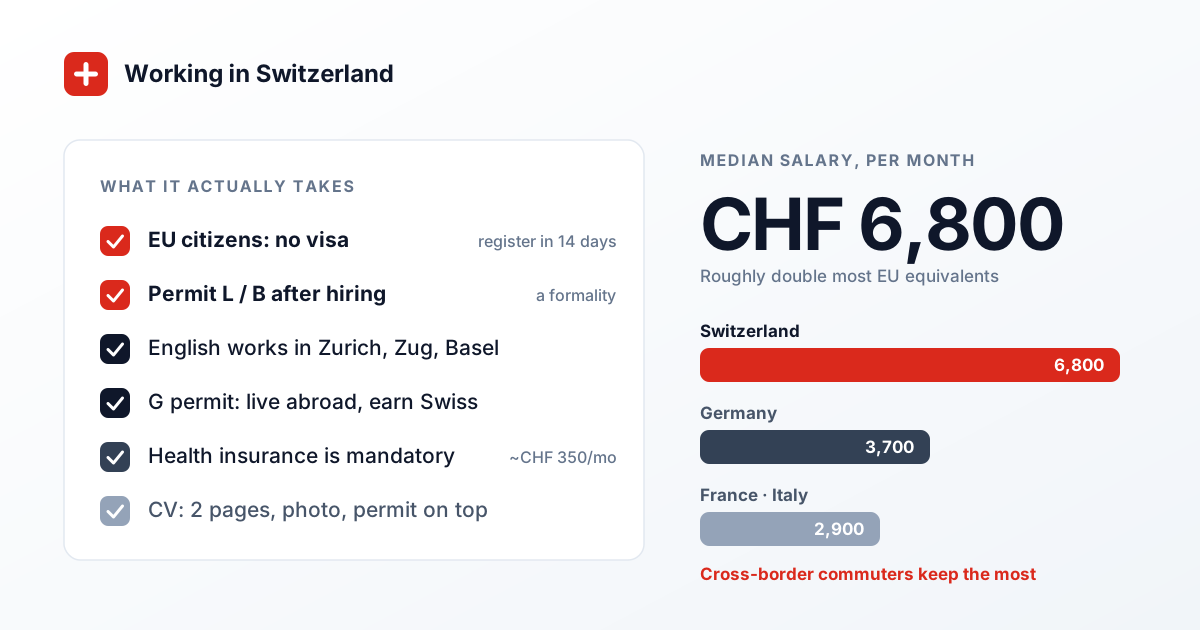
Switzerland pays some of the highest salaries in Europe, and for EU citizens working here is far simpler than most people assume: no visa, no sponsorship, no permit lottery.
This guide covers the four things that actually matter: which permit you need (EU vs non-EU is a very different story), what is left after Swiss living costs, where to actually find the jobs — and how the cross-border commuter route works.
Short version
- Do I need a visa to work in Switzerland?
- EU/EFTA citizens: no. Free movement lets you enter, job-hunt on the spot and sign a contract; the permit (L or B) is registered after hiring — a formality, not a selection. Non-EU citizens: yes — the employer must sponsor you under an annual quota and prove no EU candidate was available, which in practice means mostly specialists and senior roles.
- How much do people earn in Switzerland?
- The gross median is around CHF 6,800 per month — roughly double most EU equivalents. Deduct mandatory health insurance (CHF 300–400/month, paid separately, not from payroll) and significantly higher rent. For most professionals the net difference is still strongly positive.
- What are the best job sites in Switzerland?
- SwissJobs.app (ours — AI matching and a free CV check), jobs.ch for the German-speaking market, jobup.ch for the French-speaking part, and LinkedIn for international roles. Search by city and role rather than applying broadly.
- Can I work in Switzerland without speaking German?
- Yes. International companies in Zurich, Zug, Basel and Geneva work in English — tech, pharma, finance and hospitality hire English speakers routinely. The French-speaking west works in French. German becomes decisive mainly for local SMEs and client-facing roles.
- How does cross-border commuting (G permit) work?
- If you live in a neighbouring country (France, Germany, Italy, Austria) and return home at least weekly, you qualify for a G permit. Hundreds of thousands commute daily into Geneva, Basel and Ticino — Swiss salary, home-country living costs.
- Is Switzerland really that expensive?
- Yes: a one-bedroom flat in Zurich or Geneva starts around CHF 1,500–2,000, health insurance is mandatory, and day-to-day prices run about double the EU average. That is why salaries must always be read net — the balance still favours Switzerland, and cross-border commuters keep the most.
Working on your CV right now? ATS CV checker: free, against a real Swiss job ad
See what a Swiss recruiter checks first
Upload your CV and get a score against a specific job ad in about 30 seconds — language levels, work permit, photo, how your achievements are phrased.
ATS CV checker, freeWhich permit do you need?
EU/EFTA citizens just register after being hired; non-EU citizens need employer sponsorship under a quota.
With a signed contract, an EU citizen’s employer registers an L permit (up to a year) or B permit (five years, renewable). It is an administrative act, not a hurdle — the only real rule is registering with your commune within 14 days of arriving.
Non-EU citizens face a genuinely selective system: annual quotas, and the employer must show no suitable EU candidate existed. Realistic mostly for specialists, senior managers and academics — if that is you, target international companies used to sponsoring.
One thing the permit question changes is who is even reading you. Outside the staffing agencies, the biggest direct employers on the platform are Coop with 1,167 open roles, Luzerner Kantonsspital with 346 and On Running with 275 — large organisations with HR departments that handle permits routinely, which is generally easier than a ten-person firm doing it for the first time.
SwissJobs.app inventory, 28 September 2026.
Write a custom CV for every job you apply to
Most people send the same CV everywhere. The AI editor rewrites yours per application — Swiss format, the right language, in about a minute.
CV maker & resume builder: tailor it to this jobWhat do people really earn?
Median gross pay is about CHF 6,800 a month — always read it net of Swiss living costs.
Engineering, pharma, finance and IT sit above the median; hospitality and retail below it. Compared with most EU countries, 60–100% more for the same role is common.
From gross pay, deductions take roughly 13–15%, and health insurance is paid separately. Zurich and Geneva rents weigh heavily. The remainder is still clearly positive — and largest for cross-border commuters.
A warning about salary figures, including anyone else’s: of the 28,856 postings we track, almost none states a range. Swiss employers very rarely put pay in the advert, so any site promising you a precise figure per occupation is computing it from surveys and self-reported data rather than from what is actually being advertised.
Practically: treat published ranges as an order of magnitude rather than a negotiating position, and ask for the band in the first conversation. That is normal here and is not read as pushy. Treating a number you found online as settled means negotiating against something nobody offered.
See what a Swiss recruiter checks first
Upload your CV and get a score against a specific job ad in about 30 seconds — language levels, work permit, photo, how your achievements are phrased.
ATS CV checker, freeWhere to look for jobs
A few good sites searched by city and role beat a hundred scattered applications.
jobs.ch dominates the German-speaking market, jobup.ch the French-speaking west, LinkedIn the international roles. Search the way locals do — “marketing jobs Zurich”, “nurse Geneva”.
And apply where you meet most of the requirements: the Swiss first screen takes thirty seconds, and permit status and languages are checked first.
Volume is concentrated in a way that should shape where you look first. The city of Zurich alone carries 5,083 of the 28,856 openings we track, more than Bern and Geneva together, and the tail drops quickly after the top few cities.
Another helpful search habit to pick up: filter by what the job needs rather than by the language of the listing. These are separate questions, and the difference between them is significant. Around one in six English-language ads still demand professional German.
28,856 published postings, counted by the city named in the advert. SwissJobs.app inventory, 28 September 2026.
Three places to start
1. SwissJobs.appOurs
Jobs from company career pages and Swiss job sites in a single search, filterable by language, and a free review of your CV against any listing.
The biggest Swiss job board overall, strongest for German-language and small to medium-sized enterprise (SME) roles.
The primary job board for French-speaking Switzerland, operated by the same company behind jobs.ch.
Do you need German?
Not for international companies — but the local language decides for SMEs and client-facing work.
Zurich, Zug and Basel host hundreds of companies operating in English; Geneva adds the international organisations. Tech, pharma and finance hire English speakers every week.
Note that spoken Swiss German differs sharply from standard German — even fluent German speakers need time. For local SMEs, healthcare and public administration, the regional language is usually non-negotiable.
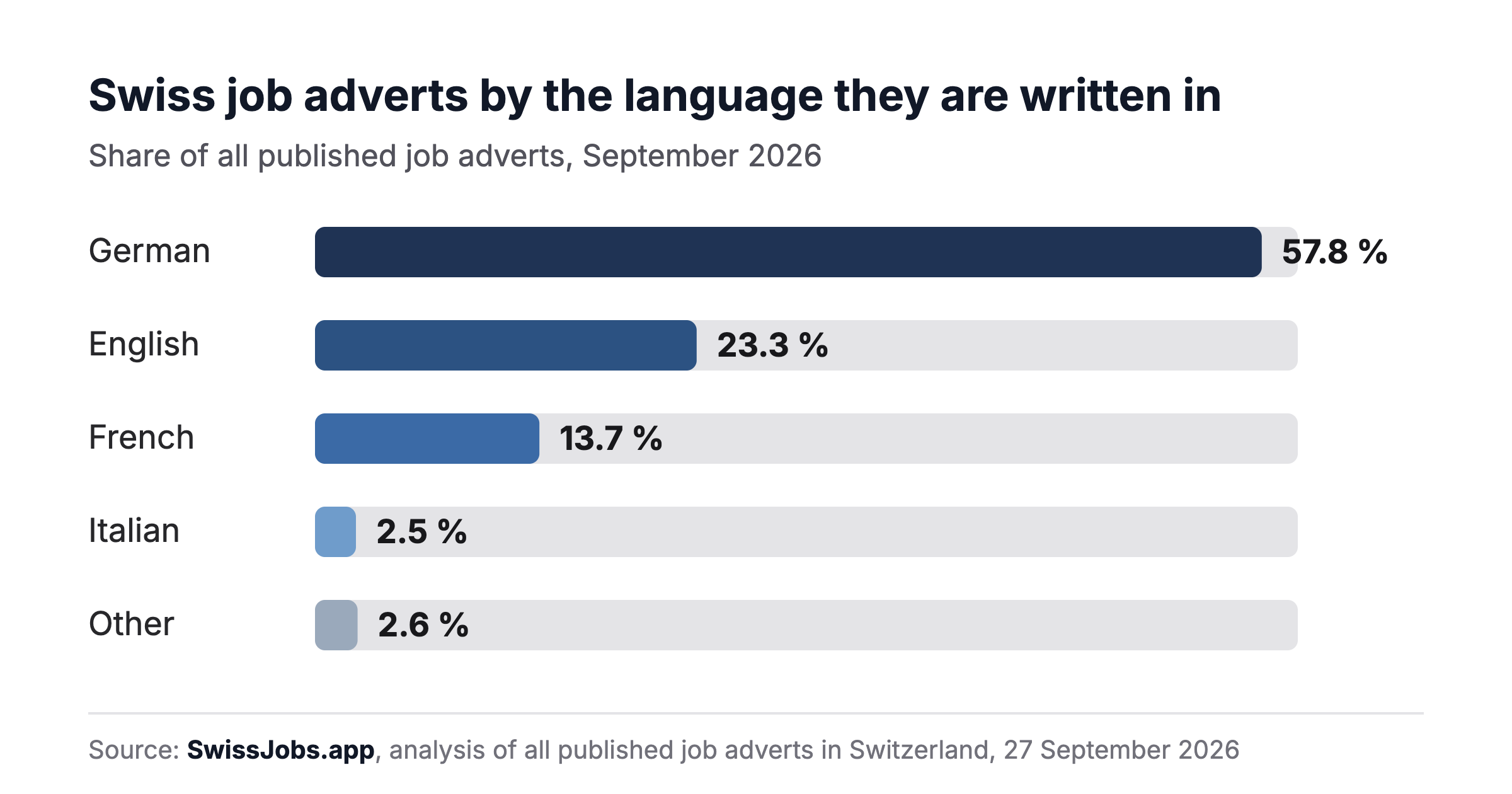
The truth is, almost six out of ten of the job ads we monitor are in German, and nearly a quarter are in English. Around one in ten only require English, and these are mostly found in Geneva, Zurich, and Zug. So, deciding if you need German mostly comes down to which canton you're considering.
The cross-border route
Swiss salary, home-country costs — the G permit makes it possible from all four neighbours.
Geneva, Basel and Ticino run on cross-border commuters: live in the border zone, return home at least weekly, and the G permit follows your job contract.
Taxation depends on the canton and the bilateral treaty with your home country — check it before signing. Done right, it is one of the best salary-to-cost ratios in Europe.
A word on expectations before you run the numbers: the Swiss market is smaller than the salaries suggest. 28,856 openings for the whole country is roughly what a single large metropolitan area posts elsewhere, and in any one field the number of serious employers is countable.
Two consequences follow. Care pays, because you meet the same recruiters more than once and a badly handled interview costs more than it would in an anonymous market. And patience is structural rather than personal — at any given moment there are simply few roles that genuinely match a given profile.
Applying the Swiss way
Two-page CV with photo, work certificates attached, permit status and languages near the top.
The Swiss application file is formal: CV with photo, complete work certificates (Arbeitszeugnisse), and a short, concrete cover letter. Recruiters check permit and languages first — put both in the top third of page one.
And results beat duties: “managed a CHF 400k budget, cut CAC 22%” outperforms ten lines of responsibilities.
Timing matters more than most guides admit. 5,073 of the 28,856 postings we track were published in the last seven days and 15,371 within thirty, so roughly one posting in six is new each week. Applying steadily to fresh listings beats perfecting an application for a role that will be filled before you send it.
SwissJobs.app inventory, 28 September 2026.
The right tools to get started
Three Swiss-specific tools to go from reading to applying:
- SwissJobs.appour tool
Ours. Every Swiss job with AI matching, pages built for people arriving from abroad, and a free CV check.
SwissJobs.app SwissJobs.app CV Check our tool
Ours, free: scores your CV against a specific posting and Swiss screening criteria, then rewrites it into Swiss format with AI.
Try it free- EURES
The EU mobility portal — useful for permit and social-security questions between your country and Switzerland.
Visit site
For EU citizens, Switzerland is one of the most accessible high-paying job markets in the world; for non-EU citizens it is selective but far from closed. The real filter is not the permit — it is language fit and the quality of your application file.
Start from live openings in your field, get your CV into Swiss format, and apply where you genuinely match.
The tools compared
We checked 16 Swiss and international application tools on their own pages — prices, free tiers, and what is actually included.