Are free CV checkers any good?
Updated:
In short
Yes for document hygiene, no for fit. A free checker reliably finds what is wrong inside the file — a missing section, a layout a machine reads out of order, the same tired adjective six times. The vendors say so themselves: Kickresume grades "design, content and structure". None of its three criteria mentions the job. That is where a Swiss decision is made: 79.1 per cent of open adverts state at least one condition that is nowhere in your CV.
The useful split is not free against paid. It is document quality against fit. Document quality asks whether your file is complete, ordered, parseable and readable. Fit asks two different questions: may you take this job at all, and do you bring what this one employer asked for. Both matter. Only the second earns an interview, and only the first is available for nothing in thirty seconds.
The gap between the two is measurable. Across the open adverts on this site, 72.8 per cent state a language requirement and 22.4 per cent state a workload percentage, with driving licence, shift and weekend work, start date, permit and diploma recognition behind them. At least one such condition appears in 79.1 per cent of adverts and two or more in 17.9 per cent. None of them is inside your document. They are inside the advert, and a tool that only reads your file cannot test any of them.
Share of open adverts whose title or short description states the condition. Counted: language requirement, workload percentage, driving licence, shift or weekend work, start date, on-site presence, permit and diploma recognition. Rolling analysis, 23 August 2026; the figures are lower bounds because only the title and short description are read.
- Kickresume states the boundary of its free tier: "Kickresume's Resume Checker reviews your resume for free and scores it across three categories: design, content and structure." Word analysis sits behind premium.
- Its three grading questions are listed on the same page: "Does the resume contain everything it should? Are you using the space effectively? Any overused expressions? Action verbs?" No advert appears in any of them.
- Resume.io is built the other way: "Run 16 essential checks on your resume. It's fast, and free", followed by "Paste in a job description and it will fine-tune your resume for the role." It accepts "PDF & DOCX only (max 2MB)".
- The same page promises an outcome: "80% Or above — Nice job! You're headed for an interview. Get 90% and your chances double..." The basis for that doubling is not stated anywhere.
- In our index, 14.9 per cent of adverts name something a machine can actually match — a named tool, a norm, a licence, a diploma. 22 per cent name a generic quality instead: team player, flexible, resilient, communicative.
- arbeit.swiss describes a Swiss CV differently from most tools: "A CV should be no longer than three pages", it lists "personal details, including photograph", and work references "must not contain any gaps" and belong in the same PDF.
Judge a checker by whether it changes what you do
A tool is worth using when its output changes your behaviour. For a free CV checker that means one concrete thing: does it name at least one fault you would not have caught, and can you fix it in fifteen minutes? The score, the progress ring and the encouragement are packaging.
Measured that way, free checkers do better than their reputation. The faults they surface are real faults. A section is missing. Dates have holes. The file is built so a parser reads the right-hand column first. The same phrase appears six times. This is precisely the layer arbeit.swiss asks you to check before sending: "spelling and formatting errors", "completeness of documents", "clear and correct file names", and the whole dossier saved and sent as PDF. A machine is more thorough at that than you are at half past eleven at night.
What the layer cannot do is answer the question you actually asked. You do not want to know whether your document is tidy. You want to know whether it is enough for this job. The two feel like one question and have different answers.
Three grading questions, none of which mentions the job
There is no need to assume bad faith here — the vendors publish their scope. Kickresume: "Our AI resume checker grades your resume based on three different types of criteria", listed as "Does the resume contain everything it should? Are you using the space effectively? Any overused expressions? Action verbs?" The FAQ names the same three as design, content and structure.
Read those questions again. None refers to a vacancy. The reference point is other CVs — the tool "puts your resume up against other resumes from our database". A score built that way tells you how your document compares with other documents. That is a real piece of information; it is simply not the one you apply with.
The other build exists too. Resume.io runs a completeness pass first and then invites the advert in: "Paste in a job description and it will fine-tune your resume for the role." Now there is a reference to the vacancy, but it is a text comparison — words against words. Whether you can start on the first of the month, whether you hold the licence, whether your diploma is recognised in Switzerland: no text comparison answers that.
Kickresume is admirably flat about its own ceiling: "Being a relatively simple AI resume review tool, it does not try to compete with professional human resume writers or editors. No resume checker can do that."
Four in five Swiss adverts state something your CV does not contain
We counted how often an open advert states a condition that cannot be tested from a document alone: a language requirement, a workload percentage, a driving licence, shift or weekend work, a start date, mandatory on-site presence, a permit, a recognised diploma. At least one appears in 79.1 per cent of adverts, two or more in 17.9 per cent, and only 20.9 per cent state none at all.
The individual shares are lopsided. Language leads at 72.8 per cent, workload follows at 22.4 per cent, driving licence at 1.6 per cent, shift and weekend work at 0.7 per cent, diploma recognition at 0.6 per cent. Treat these as floors rather than totals: only the title and the short description are read, and the body text of an advert routinely adds more.
The point is not that these conditions are hard to satisfy. The point is that they are gates rather than gradings. A sixty per cent workload you cannot work makes an excellent dossier worthless, and so does a language level you do not have. A tool that looks only at your file sees none of these gates — not through poor engineering, but because the information never enters its input box.
The score claims more than it can know
The number is the part that earns the most trust and carries the least weight. Resume.io publishes its bands: "80% Or above — Nice job! You're headed for an interview. Get 90% and your chances double...", and below it "60% Or below — Your chances of passing the ATS are 50/50." Kickresume writes that "A good resume score is usually considered to be 75%–100% or higher."
Those sentences make a claim about your probability of being invited. To support it, the tool would have to know who else applied for the same role and what this employer selects on. It knows neither. It knows your file and a comparison set, which yields a similarity number, not a chance.
The employer side is also more fragmented than a single score suggests. In our index 12.3 per cent of employers hold 69.1 per cent of the open adverts — the large houses with structured processes. At the same time 45 per cent of employers have exactly one advert open, and together they account for 6.8 per cent of the vacancies. There, no system reads first; a person does, often the owner. A score tuned for a machine's first filter is talking past that half of the market.
So read the number as what it is: the fault list compressed into a bar. The list is the useful part.
Keywords are thinner on the ground than the advice assumes
The other standard instruction is to mirror the advert's vocabulary — "Keywords unlock doors. Always use keywords from the job listing", as Resume.io puts it. That assumes the advert contains checkable keywords. In the Swiss stock, it often does not.
We counted how often a title and short description name something a machine can genuinely match: a named tool such as SAP or Python, a norm, a driving licence, an EFZ apprenticeship certificate, a degree. That holds for 14.9 per cent of adverts. A generic quality — team player, flexible, resilient, communicative, self-reliant — appears in 22 per cent.
The split by field is where it gets instructive. In retail, 43.4 per cent of adverts name a generic quality against 10.9 per cent naming something checkable; in care and health it is 34.9 against 15 per cent; in hospitality 29.8 against 15.6 per cent. Logistics and transport run the other way at 28.5 per cent checkable — usually the licence — and construction and trades at 27.7 per cent. In IT, the field most of these tools were built around, it is 19.1 per cent.
That has an uncomfortable consequence for keyword logic. In the occupations with the most jobseekers, the advert mostly offers words that nearly every applicant already writes. Copying them makes you resemble the majority rather than stand out. Mirroring pays where an advert names something hard — and there the right move is not the keyword but the evidence: the certificate, the licence category, the year of the diploma.
The tool arrives with a foreign rulebook
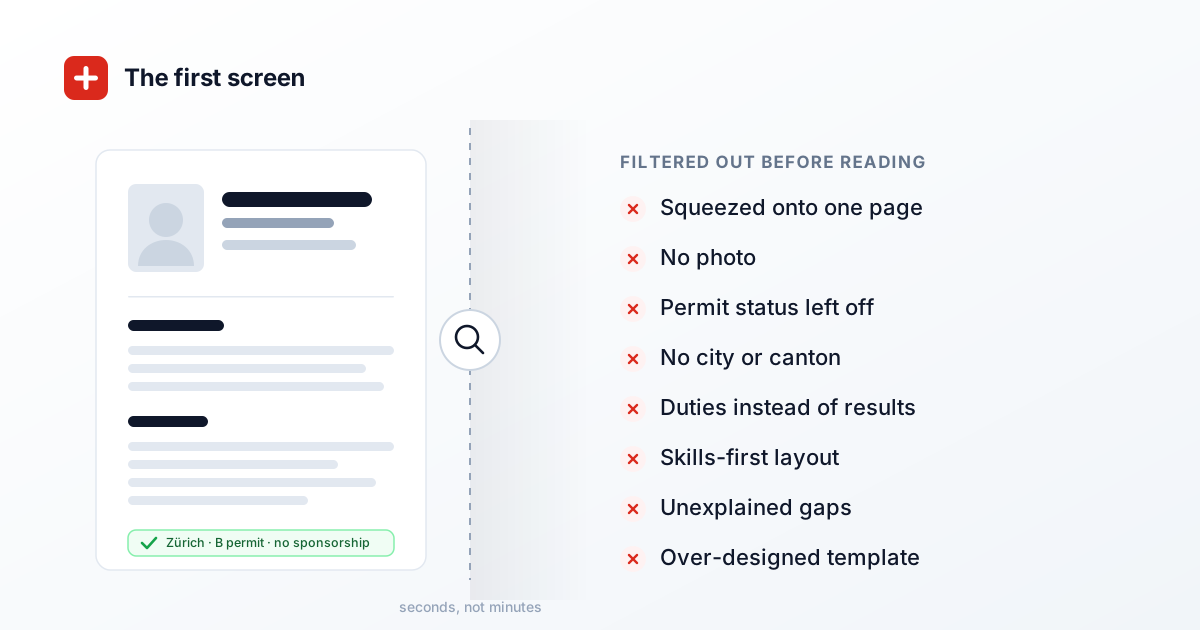
Most free checkers were built for the Anglo-American market, and their rules come from there: keep it to one page, no photograph, no personal details, strong action verbs. The official Swiss description is a different document. arbeit.swiss writes that "A CV should be no longer than three pages", lists the contents as including "personal details, including photograph", and requires that work references "must not contain any gaps and must be organised chronologically" inside the same PDF.
A tool that enforces the Anglo-American rulebook therefore marks three ordinary Swiss choices as defects: the second page, the photograph, the reference note. In the other direction, it never notices that a Swiss dossier has gone out without its work references, because that document does not exist in its reference market.
So the first question to ask a free checker is not how good it is, but which market it measures against. A tool that squeezes you onto one page is not broken; it is correctly configured for somewhere else. Take its formatting findings and ignore its national conventions.
Three probes that test any free checker in five minutes
Probe one, language. Upload your CV in the language you are applying in. If the tool refuses the file, or returns a visibly poorer report than for the English version, it is measuring against a different market — and that matters here, because 72.8 per cent of Swiss adverts state a language requirement and German is the most common of them.
Probe two, reference point. Run the same file twice, once against an advert from your field and once against something unrelated. If the verdict does not move, the tool is grading document quality, not fit. That is not a flaw as long as you know it — you simply cannot read a good score as evidence that you match this vacancy.
Probe three, concreteness. Walk the findings and count how many you could act on in a single sentence. "Use stronger action verbs" you cannot. "No CEFR level given for French" you can. A report where fewer than half the items are concrete will cost you more time than it saves.
The three probes take five minutes together, and they settle the question for each tool individually — including ours.
When free is enough, and when it is not
Free is enough when your document is new or has not been touched for years and you want to know whether the form holds up. It is also enough when you are choosing between two versions and want an incorruptible second look at completeness and readability.
Free is not enough when your question is biographical. A career change, a gap that needs explaining, a foreign diploma, a return after family years: those are questions of order, selection and justification, and they need someone who knows both the market and your story. Kickresume says as much about its own tool: "if you're looking for a real person to review your resume, this is not it."
And free is never enough for the question of whether you will get the job. A person decides that after a conversation for which your CV was only the occasion.
What is free here
So the same standard applies to us: matching your CV against a specific advert, the CV builder and the export are all in the free tier. What it takes is an account with an email address, no card. What is paid for is the extent of use, not the check: CHF 15 a month or CHF 95 a year, with seven days free first.
What we deliberately do not do is issue a grade for "your CV" that holds without a vacancy attached. And what we cannot do either is promise the outcome. A check tests how a document fits an advert; everything after that belongs to the people running the process.
If one thing survives this page: use the free checker for the form, and ask the fit question again for every application. The form you fix once. The fit you re-answer each time.
Market figures come from the rolling analysis of adverts open on SwissJobs.app, as of 23 August 2026; only the title and short description are read, so every share is a lower bound. The statements about Kickresume, Resume.io and arbeit.swiss were read on their own pages on 23 August 2026 and quoted verbatim. Our own prices come from the code, not from the marketing.
Check how your CV fits a job — and the Swiss market
Free checker: languages, work permit, skills and more — scored against a specific posting.
ATS CV checker: against a specific advert, freeSources
Related questions
What our job index says about the Swiss market
Computed live from our own index, not quoted from a study. Shares only, as of today.
Language the advert is written in
- Deutsch
- 60%
- English
- 23%
- Français
- 13%
- Italiano
- 3%
Of adverts that state a language requirement, the share asking for
- Deutsch
- 70%
- English
- 43%
- Français
- 21%
- Italiano
- 3%
19% posted in the last 7 days · Largest markets: Zürich 18% · Bern 10% · Genève 5% · Basel 5%