What does a recruiter check first on a CV?
Updated:
In short
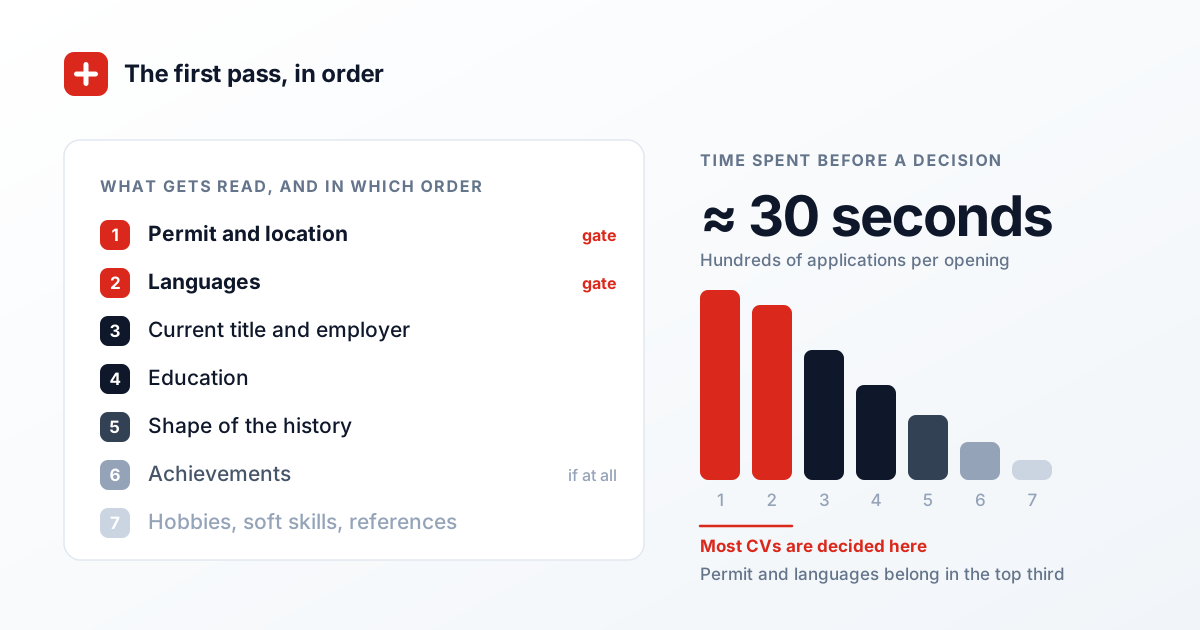
Two things before anything else, and both are gates rather than judgements: first permit and location, second languages. Both answer the same question — can this person actually take the job? Only once both gates are open does anyone read what you can do.
Then comes the quick pass: current position and employer, education, and the shape of your history — whether the roles follow on from each other coherently. Achievements get read if you wrote any down; hobbies and soft skills practically never.
The first pass takes seconds, not minutes. It does not decide whether you get the job, only whether your file joins the pile that actually gets read.
Share of analysed advert descriptions using each phrasing. One advert can contain both. Ongoing analysis, as of August 2026.
- Permit and location are the first gate — and adverts almost never mention permits, so you have to.
- Languages are the second gate: roughly three in four adverts state a language requirement explicitly.
- About 45 percent of adverts use phrasing like "an advantage" — those points differentiate, they do not exclude.
- Only about 8 percent quantify required experience in years; most year figures are a wish, not a barrier.
- Hobbies and soft-skill lists are practically not read on the first pass.
Gate one: permit and location
The first question is not how good you are but whether you can start. Do you live in Switzerland or would you have to move? Are you allowed to work here, and would the employer have to run a process for it?
The catch: adverts say practically nothing about this. In our analysis only about one advert in a thousand mentions a permit or sponsorship requirement at all, while roughly three in four state a language requirement. The subject is not negotiated but assumed.
Which is exactly why you have to answer it yourself. One line at the top of your CV — location, permit, and whether the employer would need to sponsor you — opens this gate before anyone has to guess. What you do not state gets assumed, and with a foreign name and no Swiss address the assumption rarely falls your way.
If you are not here yet, state your willingness to relocate explicitly. "Relocating to Switzerland, available immediately" is information; its absence is a question mark.
Gate two: languages
Roughly three in four Swiss adverts explicitly state a language requirement. That makes the language line the second filter — and one of the few details genuinely checked on the first pass.
So the form of that line matters. Write grades from A1 to C2, not adjectives: "German C1, English B2, French A2" is readable in two seconds, "good German" is not — and a reader forced to guess guesses downwards.
Separate spoken from written where the levels differ. That happens more often than CVs admit, and stating them separately reads as precise rather than weak.
And reassuringly, the bar sits lower than most assume. Four in five stated language requirements ask for professional level; native level appears in under three percent. Anyone with B2 to C1 passes this gate almost everywhere.
What gets read in the seconds after that
With both gates open, the eye jumps to your current position and current employer. That is the fastest possible placement: level, sector, size of organisation. Keep that line clean and free of invented job titles — a title nobody recognises costs you time precisely here.
Then education, which carries more weight in Switzerland than in many neighbouring markets: qualification, institution, year. Only about nine percent of adverts explicitly name a completed qualification as a requirement, but it gets read almost every time.
Then the shape of the history — not the content but the silhouette. Do the roles follow on? Are there unexplained gaps? Are the responsibilities growing or shrinking? A person answers that in seconds, and it decides more often than any individual role does.
Achievements come after that, and only if you wrote some down. "Responsible for purchasing" describes a role; "expanded purchasing from two suppliers to five and cut lead time by a third" describes a person. Last of all, if at all: hobbies, soft-skill lists and references.
Why almost half the requirements are not requirements
This is the finding that rescues most applications which would otherwise never get written. About 68 percent of adverts use hard phrasing — mandatory, prerequisite, required. But about 45 percent simultaneously use soft phrasing: an advantage, desirable, ideal, a plus.
So most adverts contain both, and the soft half is not a filter but a tie-breaker. It decides between two otherwise equal files and excludes nobody. Anyone who skips applying because of an "an advantage" line is skipping an application nobody would have rejected.
The same goes for years. Only about eight percent of adverts quantify experience in years at all. Where a number appears it usually describes the wish rather than the barrier — the question behind it is "can you do this without training", and an example answers that better than a year count.
Practically: when reading an advert, separate the hard requirements from the soft ones before letting yourself be discouraged. Meet the hard ones and some of the soft ones and you are in the running.
What that means for your first half page
The order of reading should set the order of your document. At the very top: name, location, contact, nationality and permit, languages with grades. Those are both gates, answered before anyone has to ask.
Directly below, three to five lines of personal summary saying what you are and what you are looking for — not what you wish for. Then the career history, in reverse, current position at the top, two to four lines per role of which at least one names a result.
Everything not read on the first pass belongs further down, not deleted: further training, IT skills, references if you include them. Hobbies are not a mistake, but they are not an argument either — one line is enough.
And check that first half page against the specific advert rather than against a general ideal. The two requirements that weigh heaviest in the advert should already be visible there. That is the entire difference between a CV that gets read on and one that does not.
What people report
Typical mistakes named for international applicants recur: not stating nationality and permit status clearly, omitting location or willingness to relocate, hiding language skills, and listing responsibilities instead of measurable outcomes. That is exactly the order in which a file is read on the first pass.
Recurring observation in LinkedIn posts by hiring professionals on the Swiss application file, reviewed August 2026.
It is also described that language details are expected as CEFR grades rather than as "good" or "fluent" — and that this specific correction is what marks a file as local.
Convergent pattern across German- and English-language LinkedIn posts on Swiss application documents, reviewed August 2026.
Shares from our ongoing analysis of the Swiss job adverts we track, as of August 2026. The basis is the advert descriptions we hold; we count whether each phrasing occurs, and one advert can contain hard and soft phrasing at once. Condensed versions can omit individual mentions, so the shares are more of a lower bound. We publish shares, not absolute inventory figures.
Check how your CV fits a job — and the Swiss market
Free checker: languages, work permit, skills and more — scored against a specific posting.
ATS CV checker: against a specific advert, freeSources
Related questions
What our job index says about the Swiss market
Computed live from our own index, not quoted from a study. Shares only, as of today.
Language the advert is written in
- Deutsch
- 60%
- English
- 23%
- Français
- 13%
- Italiano
- 3%
Of adverts that state a language requirement, the share asking for
- Deutsch
- 70%
- English
- 43%
- Français
- 21%
- Italiano
- 3%
19% posted in the last 7 days · Largest markets: Zürich 18% · Bern 10% · Genève 5% · Basel 5%