What is the best CV builder for Switzerland?
Updated:
- What is the best CV builder for Switzerland?
- Is there a genuinely free CV builder?
- Which CV maker is free with no watermark?
- Is a paid CV builder worth it?
- Which CV template works for Switzerland?
What is the best CV builder for Switzerland?
In short
There is no single best CV builder — there is one that fits Switzerland and many that do not. Four things decide it: the tool has to read the actual advert rather than fill a template, it has to produce the CV in the language the advert is written in, it has to know the Swiss lines (permit, language levels stated as levels, workload percentage, three pages maximum), and it must not invent anything. The SwissJobs.app CV builder does all four and is free to try.
The reason advert-reading matters so much is measurable in our own adverts. We compared pairs of live postings that carry exactly the same job title but come from two different employers. The median pair shares only 15 per cent of its requirement vocabulary, and for three titles in four the overlap sits below 20 per cent.
So the job title tells you almost nothing about what this particular employer wants. No template can close that gap, because a template never sees the advert. That is the line between a builder that produces a good-looking document and one that makes your application fit.
Median pairwise word overlap in the requirement text of our live adverts, measured on 21 August 2026.
- Does it read the advert? Without the posting text, every "tailored" edit is guesswork.
- Can it switch language? German, French, Italian and English are not an add-on here — they are the market.
- Does it know the Swiss lines? Nationality and permit, languages as levels, workload percentage, work references, referees on request.
- Does it respect the official format? No more than three pages, reverse chronological, sent as a PDF.
- Does it invent? A tool that adds a role, a tool or a certificate you never had costs you the interview, not the employer.
How to judge an application tool for Switzerland
| Criterion | What to look at | Why it matters |
|---|---|---|
| Swiss fields | photo, permit, language levels, workload | international tools do not have them |
| Languages of the interface and the output | DE, FR, IT, EN | 65.6% of adverts want German, 21.9% French |
| Export without a watermark | test it before signing up | the most common hidden catch |
| Usable without an account | how far you get without one | shows where the wall is |
| What costs what | on the pricing page, not in the small print | unclear limits are a warning sign |
| Your data | export and deletion possible | you will need the document again later |
| Sourced figures rather than claims | does the tool cite anything | this page included |
Instead of a ranking that is wrong next week: the points on which a tool succeeds or fails for the Swiss market. Use them on us too.
The four questions that separate a Swiss CV builder from a generic one
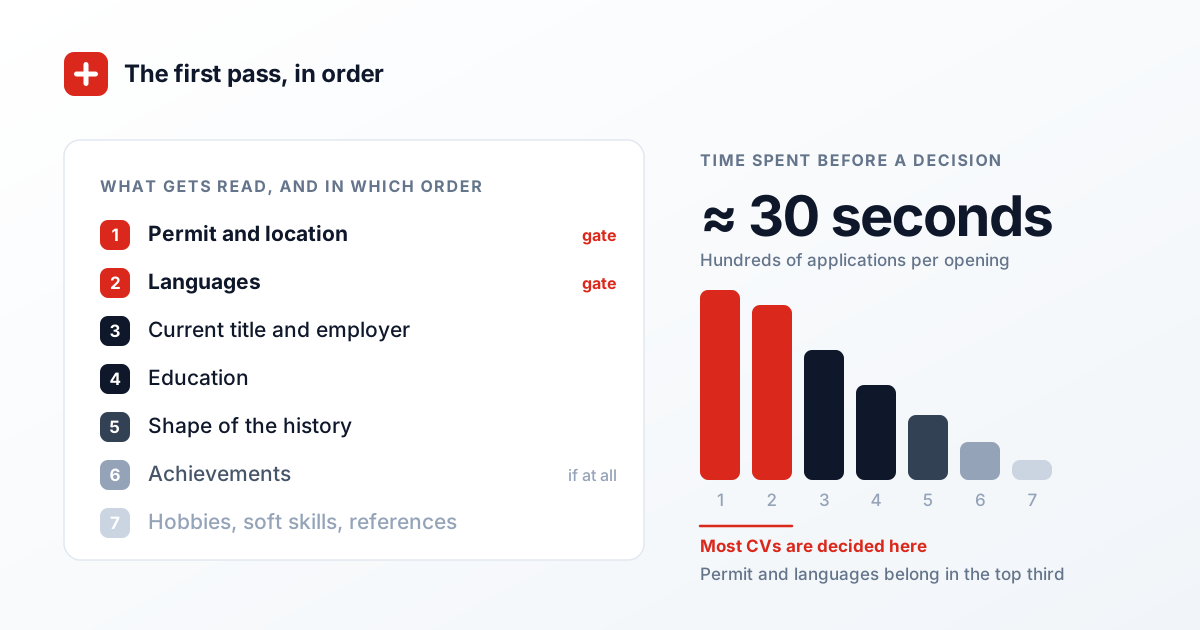
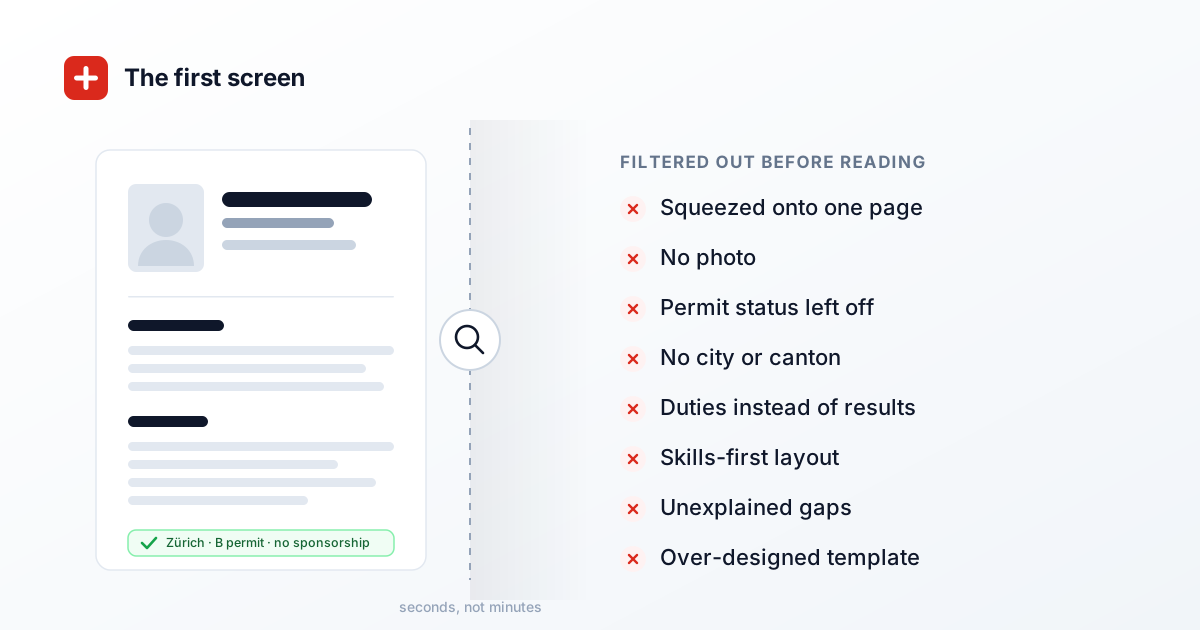
Most people arrive at this question after a rejection streak, carrying a CV that worked perfectly well somewhere else. A US one-pager, a UK two-pager with no photo, a Europass form from an EU country: the content is fine, the frame is wrong. Swiss screening reads the frame first — where you live, what permit you hold, which languages at what level, how much of a week you are offering — and a builder designed for another market has no field for any of it.
So turn "best" into four tests you can run yourself in five minutes. Load the same CV into two tools, paste the same advert into both, and look for two things. First: does the output name a requirement that appears only in that advert? That is proof it read the posting. Second: does it state any fact you never wrote? That is a reason to close the tab immediately.
Those two checks do more than any review score, and they cost nothing. Everything below is the evidence behind them.
What the adverts themselves say: a 15 per cent overlap
The measurement: for every live advert carrying a readable summary — roughly three quarters of what we hold — we pulled out the content-bearing words, dropped the filler, and kept one advert per employer per job title so that retail chains reposting identical text could not distort the result. Then we compared every pair sharing a title.
The answer is awkward for template libraries: a median of 15 per cent shared vocabulary. For scale, two unrelated adverts share 4 per cent, and two different roles at the same employer share 13 per cent. Knowing the job title therefore buys you barely more than knowing the company name. Around 85 per cent of the requirement words differ either way.
The Swiss market compounds this by being wide rather than deep. Only 5.8 per cent of distinct job titles are advertised by two or more different employers at all, and 45.4 per cent of the employers advertising with us have exactly one open role. The ten largest employers together account for 21.4 per cent of adverts. In a field that fragmented, a standard CV "for the industry" rarely lands anywhere in particular.
Which language should the CV be in?
A builder that speaks one language is a tool for a slice of this market. Of our live adverts, 41.6 per cent are written in German, 20.2 per cent in English, 9.7 per cent in French and 1.6 per cent in Italian; for about a quarter the language cannot be determined cleanly, and we deliberately leave those out of the four figures rather than round them in.
Requirements tell the same story from the other side. Across all live adverts, 49.6 per cent name German, 30.2 per cent English, 14.8 per cent French and 2.8 per cent Italian. A further 27.2 per cent name no language at all — which means the text leaves it open, not that nothing is expected. Where a level is given, 84 per cent of mentions are at professional working level rather than conversational.
The practical rule follows: write the CV in the language of the advert, and state your own languages as levels rather than as adjectives. Among adverts that name any language, 27.6 per cent name at least two, so the language line is rarely a footnote. English-only applicants are not locked out — one advert in five is written in English — but they are choosing a fifth of the market, and should know it.
What the official Swiss guidance actually requires
The application guidance published by arbeit.swiss, the federal employment portal run by SECO, is the one source worth treating as authoritative here. It states that a CV should be no longer than three pages, structured chronologically with the most recent position first, titled "CV", and containing personal details, previous professional experience, education and further training, language skills, special knowledge, personal interests and a note on references.
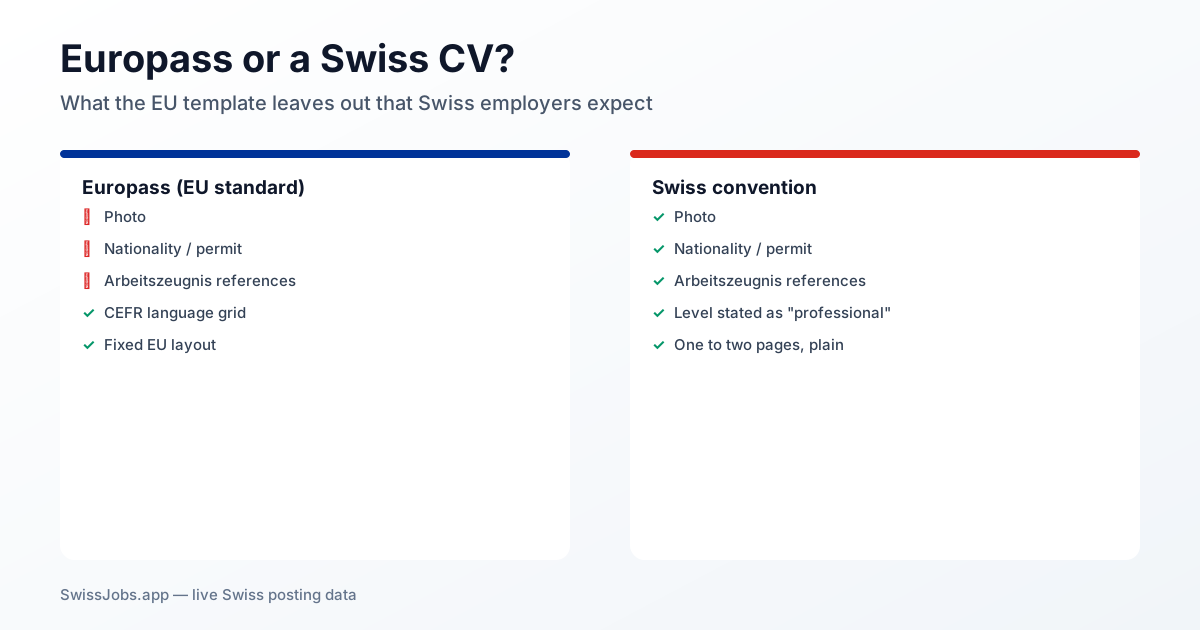
Two details are worth reading closely, because advice sites routinely present them as stricter than the authority does. First, page count: the requirement is a ceiling of three pages, not an obligation to hit exactly two. Second, the photograph — the English version of the page lists "personal details, including photograph" as part of the standard CV, while the German version words it as optional ("gegebenenfalls"). A photo is genuinely customary in Switzerland; a builder that leaves no room for one is a bad fit, and so is a claim that omitting it disqualifies you.
Also on that page, and directly relevant to picking a tool: work references must be complete, in chronological order with the most recent first, and every document should be combined into a single PDF. A builder that exports an image or an unwieldy layout is creating work rather than removing it.
When you do not need a builder at all
Honest answer: if your CV is stable and you apply for one carefully chosen role a year, a clean Word document plus the official checklist is entirely enough. A tool earns its place through volume and variation — ten to forty applications, several role types, two languages, each advert emphasising something different.
Creative fields are the other exception. Where the layout is itself a work sample, a design tool is the right choice — but alongside a plain, readable document for the screening stage, not instead of one.
For everything in between, our CV builder is built for exactly this job: paste the advert, upload the CV you already have, and about a minute later you get a version rewritten against that advert in Swiss format, as PDF or Word, with every fact still the one you supplied. Free to try, available in four languages, and it does not ask you to retype your career into someone else’s form first.
What people report
When Swiss practitioners write publicly about CVs, two topics dominate almost every post: the photograph, and the line stating nationality and work permit. Each appeared in roughly half of the posts we collected.
A count across 33 public LinkedIn posts about the Swiss CV, collected in August 2026. We publish the pattern, not the text.
Applicant tracking software barely registered in the same set — it came up in exactly one post. The Swiss conversation is far less machine-anxious than the American one; it argues about form, completeness and relevance to the specific role.
The same set of 33 posts; every mention of screening or tracking software was counted.
From the employer side one image recurs: the scattergun CV — the same file sent to very different roles with no visible connection to the advert. That is precisely the gap our 15 per cent measurement puts a number on.
Several posts by hiring managers in the same collection, summarised rather than quoted.
Market figures from live adverts on SwissJobs.app, measured on 21 August 2026; shares are of all live adverts, while the vocabulary overlap covers the roughly three quarters that carry a readable summary. Format requirements from the arbeit.swiss (SECO) application guidance, retrieved on 21 August 2026.
Write a custom CV for every job you apply to
Most people send the same CV everywhere. The editor rewrites yours against the posting — Swiss format, the right language, in about a minute.
CV maker & resume builder: for a specific advertIs there a genuinely free CV builder?
In short
Yes, but “free” means four different things in this market. Europass is free with no conditions attached, run by the European Commission. Novorésumé’s free Basic plan is real but capped at one page and a single version, and its own pricing page states that “downloading a document with Premium features is not possible in the Basic account”. Enhancv’s free plan reads “€ 0” but also “Valid for 7 days” with “Enhancv branding”. Our own CV builder exports without an account at all on the first download — no email, no card; a second export asks for a free account.
The question that settles it is not what the plan is called but where the payment gate sits. A tool that lets you type for an hour and asks for a card only at the download button is not free; it is paid with the invoice moved to the end. That is why the useful move is to reverse the order — export first, write second.
For a Swiss application there is a second problem that has nothing to do with money. The most common cap on a free plan is one page. The official application guidance from arbeit.swiss (SECO) says the opposite: a CV “should be no longer than three pages”, complete, with no gaps, and “all documents should be summarised in a PDF file”. If you have work references and further training to fit in, you hit the free limit long before you hit the Swiss one.
Median age of the adverts currently live on SwissJobs.app by occupation, measured on 21 August 2026. The seven days come from Enhancv’s own pricing page, read on 22 August 2026.
- Test the export first. Type three lines, hit download, and watch what happens — that single click answers the price question completely.
- Look at the format of the free download. A PDF is usable; a text file or an image hands you extra work.
- Check the finished page for a vendor name in the footer. Someone else’s branding on your CV is a form of payment.
- Ask whether a card is required. If “free” needs card details up front, it is a trial, not a free plan.
- Count the versions and pages you are allowed. One version and one page rarely cover a Swiss application file.
- Note the expiry date. “Valid for 7 days” runs out while the adverts you are applying to are still open.
The four things “free” can mean
The first meaning is the only one that fully earns the word: free to use, free to download, no expiry. The second is the capped free plan — you may do everything, but on one page, in one version, or within a fixed number of sections. The third is the timed window that closes after a few days. The fourth is the free editor with a paid exit: writing costs nothing, leaving with the file costs money.
None of the four can be told apart from the price label, because all four carry the same word. They separate at exactly one point: where the finished file leaves the service. That makes the order in which you try a tool more informative than any comparison table — export first, then decide whether to invest an hour of typing.
There is a fifth variant that is rarer and, in a way, the most expensive: the free download that carries someone else’s name on the document. The payment there is not money but a line of advertising on a page a hiring manager reads. It is also the only form of payment you cannot undo once the file has been sent.
Figures about other tools come from those vendors’ own pricing pages, fetched on 22 August 2026, and are reproduced as quotes; zety.com did not respond and Canva refused our requests, so no figure appears here for either. Format requirements from the application tips on arbeit.swiss (SECO), read on 22 August 2026. Our own prices come from the code rather than from marketing copy. Advert ages were measured on 21 August 2026 across the live adverts on SwissJobs.app.
Write a custom CV for every job you apply to
Most people send the same CV everywhere. The editor rewrites yours against the posting — Swiss format, the right language, in about a minute.
CV maker & resume builder: for a specific advertWhich CV maker is free with no watermark?
In short
Of the builders checked today, only FlowCV states it outright: its free plan lists "No watermarks or branding", alongside "Free forever" and "No credit card required" — in exchange for exactly one CV. Enhancv labels its free plan "Enhancv branding" and reserves "No branding" for the paid tier. resume.io gives you a TXT file and nothing else. Novorésumé does not mark the document, it refuses the download. Our own export runs through the browser print dialog and carries no vendor name, but it does need a free account.
Look closely and the watermark question splits in two. The first half is visible: is somebody else’s name on the page? The second half almost never gets asked: if it is not, what does the free plan take instead? Every free plan we read today had an answer to the second question, and in every case it sat in the same box as the promise.
How much a credit line actually weighs can be measured rather than asserted. We printed the same two-page sample CV twice — once as our editor produces it, once with an invented vendor line in the page footer — and then read the text back out of both finished files. The difference is ten words, five per page. They do not sit at the end of the document. They sit in the middle of it.
Our own test on 22 August 2026: a two-page sample CV from our editor, printed twice on A4 and read back out of the finished file both times. The vendor line in the second run is invented and carries an example name.
- FlowCV lists "No watermarks or branding" in the free plan — and "1 resume and 1 cover letter" in the same box.
- Enhancv is honestly labelled: the free plan says "Enhancv branding", the paid tier says "No branding".
- resume.io has no watermark on the free plan because it has no layout: "Downloads only in TXT format".
- Novorésumé does not mark, it blocks: a document using Premium features cannot be downloaded from a Basic account.
- Kickresume charges for the design rather than the download — free stays free as long as you stay on the free customization options.
- Our printout carries no vendor name; the sheet is A4 with a zero page margin, and the file names your browser’s print output as its producer.
Not every watermark is a watermark
In everyday speech a watermark is the grey diagonal lettering across the page. In this market that is the rarest form by far. Four others are far more common: a footer line with a vendor name and address, a small logo next to your contact details, an entry in the file properties that never shows on paper at all, and the quietest variant of all, where the page has stopped being text and has become an image.
These cost you very different amounts. A logo beside your address costs attention in exactly the strip a human reads first. A footer costs one line per page. An entry in the file properties costs close to nothing, because almost nobody opens that panel. A page that is secretly an image costs the most: it cannot be corrected, cannot be searched, and as far as any automatic reading of the document is concerned, the text in it does not exist.
That is why "does it have a watermark?" is too blunt a filter on its own. It becomes useful in three parts: is somebody else’s name on the sheet, in which of those forms — and if it is not, what does the free plan claim somewhere else instead?
What the free plans actually said on 22 August
FlowCV is the cleanest case in the set. Its free plan sits there as "$0 /month", "Free forever", "No credit card required", and lists both "Unlimited PDF downloads" and "No watermarks or branding". That settles the headline question with the vendor’s own words. The consideration sits in the same box: "1 resume and 1 cover letter". The FAQ is blunter still — come back down from the paid tier and only the first CV stays editable, because "additional versions remain safely stored in your account but are locked until you upgrade again".
Enhancv sells the brand openly. Its free plan shows "€ 0" next to "Valid for 7 days", "Enhancv branding" and "Maximum 12 section items"; the paid quarterly tier lists "No branding" as a feature you buy. That is the most honest construction in the field: the vendor name is the currency, and both sides know it. The price tiles themselves are computed in the browser and read "€ NaN" when we fetched the page, so the only figure we quote is the "Starting from $16.50" in the page title, not a monthly number we never saw.
resume.io avoids the problem by not handing over a document at all. Its free plan appears in the row as "$ 0.00 free plan" with three lines under it: "Only one resume and cover letter", "Downloads only in TXT format", "Limited resume sharing and analytics". A plain text file cannot carry a watermark because it cannot carry a design — no layout, no typeface, no page breaks. Beside it sits an entry offer at "$ 2.95" for seven days which, in the same line, "auto-renews to $29.95 billed every 4 weeks".
Novorésumé marks nothing and blocks instead. The free plan is called "Basic Free Unlimited", is described as "Ideal for students", and lists "Single version", "Max 1-Page Resume", "Predefined Layouts", "No Cover Letter". The decisive sentence is in the FAQ: "The only difference is that downloading a document with Premium features is not possible in the Basic account." Use a paid element while writing and you do not get a marked document, you get no document. The format question at least is settled on the same page: "all the documents are saved as PDFs".
Kickresume moves the boundary somewhere else again. The free plan lists four basic CV templates, four matching cover letter templates and "Unlimited downloads", and the FAQ adds: "Can I download it for free? Yes, you can as long as you stick to free customization options." What you pay for is neither the exit nor the branding but the design — with the awkward side effect that you have to keep checking, while you build, which element has just moved you into the paid category.
Figures for other vendors come from their own pricing pages, fetched on 22 August 2026, and are quoted verbatim; Enhancv’s price tiles are computed in the browser and stayed empty for us, so only the figure from the page title is quoted. The print test was run the same day using our own CV template and our own print stylesheet; what was counted is the words that can be read back out of the finished file. Our export’s behaviour is taken from the source code, not from marketing copy.
Write a custom CV for every job you apply to
Most people send the same CV everywhere. The editor rewrites yours against the posting — Swiss format, the right language, in about a minute.
CV maker & resume builder: for a specific advertIs a paid CV builder worth it?
In short
Usually not. Across five major builders, 36 features sit behind the paywall today, and only five of them change a single word of your CV: 13 change how it looks and 15 change how many documents or which file format you may take away. You are also not buying a product but a period of time. SECO puts the median elapsed Swiss job search at 5.0 months in July 2026, the mean at 7.0. Five months on resume.io costs about CHF 148 by the route the page offers first, and about CHF 81 on the same provider’s quarterly plan.
That gap between two prices for the same access is the finding that matters most. Every one of the five pages leads with the billing period that costs a Swiss jobseeker the most, and the wording is honest about it in small print: resume.io states, verbatim, «After 7 days, auto-renews to $29.95 billed every 4 weeks». Four weeks is not a month. It is thirteen charges a year rather than twelve.
For the record, we sell a subscription too, so weigh this accordingly. The CV builder on SwissJobs.app sits inside the free account and costs nothing to use or export. What we charge for is the layer above it — scoring your CV against a specific advert, the detailed check, same-day matches and alerts — at CHF 15 a month or CHF 95 a year. The builder itself is not the paid part.
Our own arithmetic: the amounts printed on each pricing page on 22 August 2026, extended over 5.0 months — the median elapsed duration of registered unemployment in July 2026 per SECO — and converted at the Swiss National Bank monthly average for July 2026 (USD 0.81002, EUR 0.92538). Card fees for foreign-currency transactions are not included.
- Count what is actually gated. Of 36 paid-only features on five pricing pages, five touch the wording of the CV: Enhancv’s «Real-time content suggestions» and «ATS check», Kickresume’s «AI Writer» and «ATS Resume Checker», FlowCV’s «AI features».
- Read the billing period, not the price. «Billed every 4 weeks» means 13 charges a year; at $29.95 that is $389.35 rather than $359.40, with no larger number printed anywhere.
- Kickresume tips over at exactly four months. Monthly is €24 and the yearly plan is €96, so from month five onwards the monthly plan costs more for less access.
- Novorésumé is the only one of the five that prints «Pay once. No recurring billing» and «There Is No Automatic Subscription» — the only one where forgetting to cancel costs nothing.
- FlowCV’s free tier already includes «All resume templates» and «Full design customization», which is a useful benchmark for what design alone is worth: on that page, nothing.
- None of the five bills in francs. Your card converts at the day’s rate and adds a foreign-currency fee on top, so the francs above are a floor, not a ceiling.
What thirty-six paid features actually change
We read the pricing pages of resume.io, Enhancv, Novorésumé, Kickresume and FlowCV on 22 August 2026 and counted every feature listed only in a paid column. A feature that also appears in the same page’s free column does not count. That gives 36 items, and sorting them is the whole answer to the question.
Thirteen change appearance: templates, colour themes, typefaces, backgrounds, photo styles, icons, rating graphics, layout freedom. Fifteen change quantity or format: more documents, more pages, more section types, PDF instead of a text file, imports, mobile apps, removal of the vendor line. Three are something else — an application tracker, a career map, priority support. Five touch the words on the page.
Novorésumé shows the pattern most clearly. Of the eleven differences between Basic and Premium, seven are purely visual: custom layout, 12 typefaces instead of 3, 74 colour themes instead of 30, creative backgrounds, four picture styles, creative rating styles, icons for interests. A Swiss recruiter will not see six of those seven as an improvement, and several of them — rating dots, decorative icons — actively work against a plain, parseable document.
This is not an accusation. Selling design is a legitimate business and in some markets it is the right one. It is simply a statement about what that money is competing against here.
When paying genuinely is worth it
Three cases justify the money. First, volume: if you are running dozens of applications and genuinely need many stored versions, that is the real paid feature at FlowCV and resume.io, and about CHF 49 a year is a fair price for it. Second, wording: if writing is the part you struggle with, you are buying one of the five content features — check first that it works usefully in German, French or Italian rather than dropping in English boilerplate. Third, a market that expects a designed document; Switzerland is not one of them.
If you do subscribe, do it in the least expensive shape: take the longest billing period you are willing to commit to, put the cancellation date in your calendar the same day, and note the refund window. At Enhancv the difference between «monthly, forgot to cancel» and «six-month plan, date noted» is a factor of two; at resume.io it is nearly the same.
The most common case is the one where paying is not worth it: you need a clean, single-column Swiss CV in the language of the advert, with permit, language levels and workload in the right places. Nobody should charge you for that, and we do not — the builder is in the free account, exports without a vendor line and asks for no card. If you later want the layer above it, that is CHF 15 a month or CHF 95 a year, which works out at CHF 7.92 a month. It is a subscription with a seven-day trial that converts on day eight, and we print that here because we asked the other five for the same.
Prices and wording come from the pricing pages of resume.io, Enhancv, Novorésumé, Kickresume and FlowCV, retrieved on 22 August 2026, and are quoted verbatim; Enhancv’s price tiles are computed in the browser and stayed empty for us, so its amounts are taken from the structured data the same page publishes. zety.com did not answer our requests, so no figure for it appears here. The count of 36 covers features listed only in a paid column on those five pages; anything that also appears free in the same table was not counted. Search duration: SECO, «The labour market situation», July 2026, tables 6 and 7. Conversion to francs at the Swiss National Bank monthly average exchange rate for July 2026. Occupation shares measured across the active adverts on SwissJobs.app on 21 August 2026. Our own prices come from the code, not from the marketing.
Write a custom CV for every job you apply to
Most people send the same CV everywhere. The editor rewrites yours against the posting — Swiss format, the right language, in about a minute.
CV maker & resume builder: for a specific advertWhich CV template works for Switzerland?
In short
Switzerland has an official template and it is published by arbeit.swiss: the title ‘CV’, personal details, professional experience to date, education and training, language skills, special knowledge or activities, personal interests, references. Structured chronologically with the most recent job first, no longer than three pages, sent as a PDF. The template that works is the one carrying those eight blocks in that order, leaving room for permit status and employment level, and reporting languages as levels rather than adjectives.
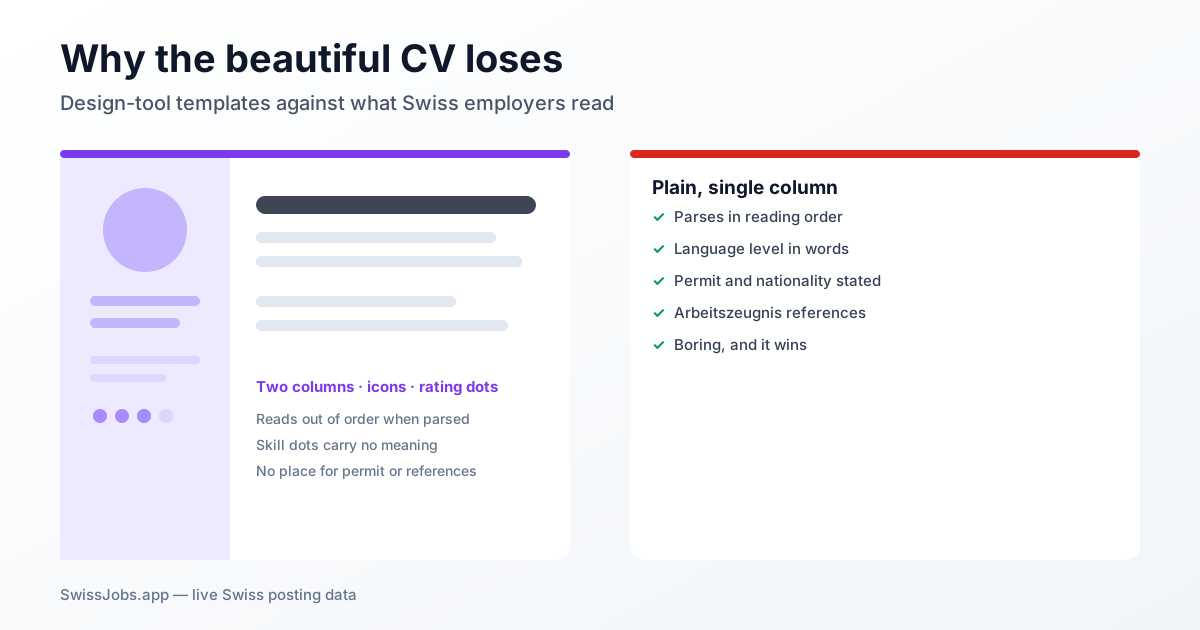
That makes the choice narrower than it looks. Anything that groups your history by competence instead of by date contradicts the official instruction outright. Anything that opens with a profile paragraph and a row of skill bars is spending the top third of page one on elements the official list never mentions. And anything designed to end at one page has nowhere left to put training, languages and references once the work history is in.
The gaps are measurable rather than a matter of taste. Across the live adverts on SwissJobs.app on 21 August 2026, 22.1 per cent carried an employment level as a percentage in the job title, and 62.7 per cent of those stated a range rather than a fixed figure. Among the adverts we hold a language analysis for, 6.6 per cent required three languages or more, and the commonest multilingual demand — German together with English — accounts for 13.2 per cent of every advert that names a language at all. A template with a single languages line and no availability field is not minimal — it is short of fields.
Own count of the live adverts on SwissJobs.app on 21 August 2026: the share of job titles containing a percentage figure for the employment level. Each bar is measured against its own language group. The Italian-language group is by far the smallest, so its bar shows a direction rather than a measurement.
- A document title. The official list literally opens with the title ‘CV’. Most imported templates use your name as the masthead and have no concept of a document heading at all.
- An availability line. When the advert negotiates ‘80 – 100%’ in its own headline, your CV needs a line that answers it. Templates from markets without a part-time culture do not have one.
- A languages block sized for three entries with levels — not ‘fluent’ and ‘good’, and not one line squeezed into a sidebar. 6.6 per cent of analysed adverts demand three languages or more.
- A place for permit status and your canton, inside the personal details. The official list only says ‘personal details’; the space for that line is yours to plan.
- A references block. arbeit.swiss says you should generally note in the CV that references can be provided on request — that is its own line, not a footnote.
- Three pages as a ceiling, not a target. A one-page grid forces you to cut exactly the blocks the official list asks for last.
There is an official Swiss template, and it is a list rather than a design
Most template advice treats the question as a matter of taste, which is odd, because the federal answer is public and specific. Under ‘Tips on applying for jobs’, arbeit.swiss — run by SECO together with the cantonal labour market authorities — says your CV ‘should: be complete, clear and not contain any gaps’ and ‘should be no longer than three pages’, then lists the contents: title, personal details, professional experience to date, education and training, language skills, special knowledge or activities, personal interests or hobbies, references.
The ordering instruction is the part that eliminates whole template families: ‘Your CV should be structured chronologically, with your most recent job mentioned first.’ Functional and skills-first layouts, which group achievements by theme and push dates into a narrow margin, are a recognised device elsewhere for smoothing a broken run of employment. Here they work against the reader, and they contradict the guidance a Swiss reader is most likely to have been trained on.
What is absent from the list matters just as much. No profile summary. No skill meters. No competence wheel. No personal-brand statement. If the template you are about to download spends its first third on those, it is not a Swiss CV template with different fonts — it is a different document that happens to be the same size.
The official instructions also run past page one. Work references must be complete and chronological, most recent first; everything belongs in a single PDF; file names must be clear and correct; the sending address should ideally contain your first name and surname. A template solves the CV. It does not solve the dossier, and in Switzerland the dossier is what gets judged.
A résumé and a Swiss CV are not the same document
The single most common mistake is downloading a template built for the North American market. It is not a formatting difference. A résumé is optimised to be one page and to omit personal data on purpose; a Swiss CV is capped at three pages and opens with personal data. The fields do not line up, so the layout cannot be reused by simply relabelling it.
The photo is the sharpest example, and it has an unexpected wrinkle. We read all four language versions of the same arbeit.swiss page on 22 August 2026 and compared them line by line. English says ‘personal details, including photograph’. French says ‘données personnelles avec photo vous mettant en valeur’. Italian says ‘dati personali, inclusa la vostra fotografia nell’apposito formato’. German is the only one that hedges: ‘Persönliche Daten, gegebenenfalls mit Bewerbungsfoto’ — where appropriate.
So the federal advice is not uniform across the country’s languages, and a template has to be flexible in exactly that spot. Practically: pick one where the photo sits in a frame you can delete without the grid collapsing, and where deleting it does not leave an empty column. If you are applying in English to an international employer in Zurich, the same file should work with the photo removed.
A second divergence sits in the same paragraph. The English, French and Italian versions all insist the CV contain no gaps; the German version speaks only of completeness and clarity. If you are applying in any language other than German, choose a template with a fixed date column rather than free-floating years, because the reader has been told explicitly to look for the holes.
The line your template almost certainly lacks
In Switzerland the employment level is often settled before the job description begins. On 21 August 2026, 22.1 per cent of live adverts on SwissJobs.app carried a percentage in the job title itself — headlines of the shape ‘Solutions Architect (Hybrid; 80-100%)’ or ‘Physiothérapeute-Hospitalier - Mission à 80-100%’.
The shape of that figure is what makes it a question rather than a statement. Of the titles carrying a percentage, 62.7 per cent give a range, 26.4 per cent give a plain 100 per cent, and 10.9 per cent give a single figure below full time. A range is the employer telling you the band they can move within and waiting for your number. If your CV has no availability line, that question travels unanswered into the interview you may not get.
How often you need the line depends on where you are applying. Among German-language adverts, 29.1 per cent put a percentage in the title; among French-language adverts, 18.5 per cent; among English-language adverts, only 9.1 per cent. The Italian-language group sits at 3.6 per cent on a base small enough that it should be read as a direction. So the field is close to compulsory for German-speaking Switzerland and optional — never wrong — for an English-language application.
There is also a quieter part of the market: 5.5 per cent of live adverts are recorded as part-time, and many of those never mention a percentage in the title. Taken together, roughly 9.2 per cent of all live adverts signal availability below full time one way or the other. One line of your CV covers both cases.
Applying in English does not mean the job is in English
The assumption behind ‘I only need one good English template’ is that the language of the advert is the language of the job. Our own cross-tabulation says otherwise, and this is the number most worth knowing before you commit to a design.
Among adverts written in English, 24.0 per cent still require German. Among adverts written in French, 26.8 per cent require German and 21.6 per cent require English. Among adverts written in Italian, 31.7 per cent require German. The English-language advert is often an international employer writing to a wide audience about a role that is still embedded in a German-speaking workplace.
The geography behind that is unusually sharp, and it only shows up city by city. In Zurich the live adverts split 51.5 per cent German against 47.7 per cent English. In Basel it is 70.4 to 28.7, in Lucerne 91.0 to 8.2, in Winterthur 92.5 to 6.7. Geneva runs 56.7 per cent English and 40.6 per cent French, Lausanne 66.1 per cent French, Lugano 55.4 per cent Italian. Two cities in the same part of the country can therefore demand different document languages.
The practical consequence for template choice: you are not picking a document, you are picking something you will duplicate into a second and third language. Headings baked into an image, column widths tuned to short English words, and a display typeface with no accented characters all make that duplication painful. Test a candidate template with the longest heading you will actually need — ‘connaissances linguistiques’ is a fair benchmark.
Shares are counted from the live adverts on SwissJobs.app, measured on 21 August 2026. Employment-level figures are measured against the whole live index; required-language figures against the adverts carrying a language analysis, which is about three quarters of it. Per-language bars are each measured against their own group, and the Italian-language group is the smallest and correspondingly uncertain. The wording of the official requirements is quoted from arbeit.swiss, with all four language versions read on 22 August 2026. The five-skill, six-level self-assessment grid is from Europass. We deliberately publish no share for photos, cover letters or work references: our stored summaries do not carry the formal section of an advert, and a share drawn from that source would be a wrong number.
Sources
- arbeit.swiss (SECO) — Tips on applying for jobs: ‘structured chronologically’, no longer than three pages
- Novorésumé — pricing page («Pay once. No recurring billing»)
- Enhancv — pricing page (PRO monthly, quarterly, semiannual)
- Europass — European Commission homepage
- FlowCV — pricing page (free plan and Pro)
- resume.io — pricing page («auto-renews to $29.95 billed every 4 weeks»)
- Kickresume — pricing page (monthly, quarterly and yearly plans)
- SECO — The labour market situation, July 2026 (tables 6 and 7)
- Swiss National Bank — foreign exchange rates, monthly average July 2026
- arbeit.swiss (SECO) — German version of the same page (‘gegebenenfalls mit Bewerbungsfoto’)
- travail.swiss (SECO) — French version (‘avec photo vous mettant en valeur’, ‘Évitez les lacunes’)
- lavoro.swiss (SECO) — Italian version (‘inclusa la vostra fotografia nell’apposito formato’)
- Europass — Common European Framework of Reference self-assessment grids
Related questions
What our job index says about the Swiss market
Computed live from our own index, not quoted from a study. Shares only, as of today.
Language the advert is written in
- Deutsch
- 60%
- English
- 23%
- Français
- 13%
- Italiano
- 3%
Of adverts that state a language requirement, the share asking for
- Deutsch
- 70%
- English
- 43%
- Français
- 21%
- Italiano
- 3%
19% posted in the last 7 days · Largest markets: Zürich 18% · Bern 10% · Genève 5% · Basel 5%