Applying to Swiss jobs from abroad: 13 adverts out of 17,103 mention a permit
I pulled the inventory at 08:19 this morning. 20,024 live Swiss postings. Then I went looking for the one thing everybody applying from outside the country wants the advert to answer: will they take someone who isn't here yet?
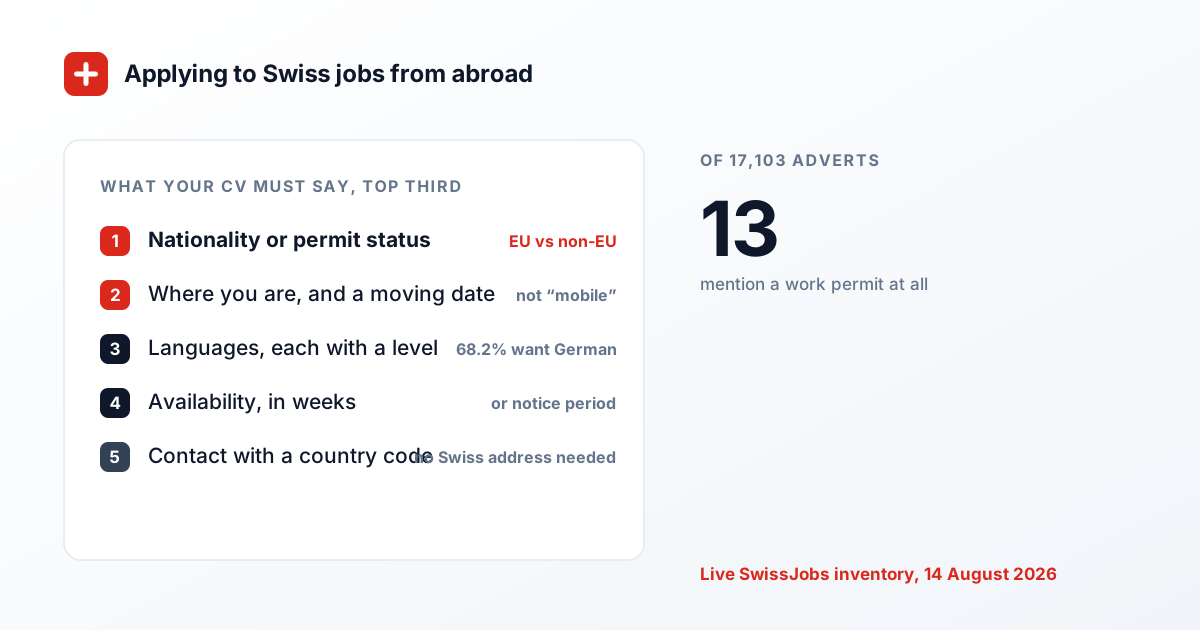
Thirteen. Out of 17,103 postings where I have a summarised advert text, thirteen mention a permit, a work authorisation or a visa at all. Eight of those thirteen are cleaning and security jobs.
So the advert won't tell you. And here's the thing — the recruiter has the identical gap from the other side. They open your CV and they don't know where you are, whether you're allowed to work here, or when you could start. If the top third of page one doesn't answer that, they don't investigate. They move on to the next dossier. That screen takes about thirty seconds and I've watched it happen more times than I can count.
Which is annoying, because the market itself is far more open than the silence suggests. Let me show you both halves.
Short version
- Can I apply to Swiss jobs from abroad?
- Yes, and it's normal. Of the 16,888 live postings whose requirements I could parse today, 3,327 (19.7%) ask for English and no other language, and 5,363 (31.8%) don't mention German at all. Those adverts are not written for people already living in Zurich.
- Do I need a work permit before I apply?
- No. In Switzerland the employer applies for the permit once they've decided to hire you — you can't get one on your own in advance. What you owe them on the CV is the fact that determines how hard that is: your nationality, or your existing permit if you already hold one.
- Does the EU/EFTA distinction really matter that much?
- Yes, more than anything else on your CV. EU/EFTA nationals get a permit through a registration procedure that a Swiss HR department handles routinely. Third-country nationals need a quota permit the employer must justify to the cantonal authority, which is why a recruiter who can't tell which one you are will assume the harder case.
- How many Swiss jobs don't require German?
- 5,363 of 16,888 parsed postings — 31.8% — state no German requirement at all. And where German is required, the bar is usually working proficiency, not perfection: 91.4% of the 11,525 German-requiring postings ask for a professional level, only 2.2% ask for native.
- Where are the jobs I can do in English?
- Concentrated in four cantons. Of the postings that state a canton, Geneva runs 51.8% English-language adverts, Zurich 49.6%, Zug 48.8% and Basel-Stadt 32.5% — against 6.8% in Lucerne and 7.2% in Graubünden.
- Will a Swiss employer pay to relocate me?
- Rarely stated, so don't plan on it. 137 of 17,103 summarised adverts (0.8%) mention relocation in any form. Assume you're moving on your own budget and say so — a stated relocation date reads as commitment, not as a cost.
Working on your CV right now? ATS CV checker: free, against a real Swiss job ad
See what a Swiss recruiter checks first
Upload your CV and get a score against a specific job ad in about 30 seconds — language levels, work permit, photo, how your achievements are phrased.
ATS CV checker, freeDoes the advert tell you whether they'll hire from abroad?
No. Thirteen of 17,103 summarised adverts mention a permit, work authorisation or visa at all, and half of those are cleaning and security roles.
I ran every summarised advert in the inventory against every wording I could think of: work permit, Arbeitsbewilligung, Aufenthaltsbewilligung, permis de travail, autorisation de travail, permesso di lavoro, work authorization, visa sponsorship, EU/EFTA. 28 adverts came back containing one of those word-shapes. Then I read all 28, and most were false hits — Visa the payment network at a bank, permitting processes in a construction role, a clinical-trial Sponsor at a CRO.
Genuine right-to-work requirements: 13, and eight of them are cleaning or security work. ISS and Splendida Services want an Aufenthaltsbewilligung for cleaning shifts, MénageSimple and Juggers Sécurité want a permis de travail, a couple of small tech firms ask for a Swiss work permit outright. That's it. Out of 17,103.
One honesty note, because this measurement has a real limit. What I search here is a summarised advert, not the full original text, and summaries drop things — only 15.4% of them name a language, while the full-text parser found a language requirement in 16,888 adverts. So the true rate of permit mentions in full adverts is higher than 13. It is not, however, anywhere near the rate at which candidates worry about it.
The practical reading is the same either way: the advert is not going to resolve your status, so don't wait for permission to apply, and don't leave the question hanging on your CV either. Nobody is going to email you to ask.
Live SwissJobs inventory, 14 August 2026. Base: the 17,103 published postings carrying a summarised advert text. Summaries compress, so these are floors, not ceilings — the ranking is the point.
Write a custom CV for every job you apply to
Most people send the same CV everywhere. The AI editor rewrites yours per application — Swiss format, the right language, in about a minute.
CV maker & resume builder: tailor it to this jobHow many Swiss jobs can you actually do without German?
5,363 of 16,888 postings with parsed requirements — 31.8% — ask for no German at all, and 3,327 of them ask for English and nothing else.
This is the number that should decide whether you bother. Not the vague sense that Switzerland is international, but 3,327 live postings, from 1,022 different employers, that want English and list no second language. 489 of them landed in the last seven days.
German is still the big one: 11,525 postings, 68.2% of the parsed base. French 3,364, Italian 632. But look at the level being asked for rather than the language, because that's where the panic is misplaced. Of the German-requiring postings, 91.4% want a professional working level and 2.2% want native. Two hundred and fifty-four adverts in the whole country insist on native German. Your B2 with an accent is not the disqualifier you think it is.
The base matters here, so let me be explicit about it. I'm counting against 16,888 postings whose advert text produced structured requirements — not all 20,024. The remaining 3,136 have no parsable text and therefore no extracted requirements, and counting them as “no language required” would inflate every German-free figure by roughly a fifth. Same rule I've used since the CV-mistakes piece.
Twenty-seven percent of adverts ask for more than one language, most often German plus English (3,095 postings). That combination is the actual Swiss default, and it's why listing your languages with a level next to each — not a row of flags, not “fluent” on everything — does more work on a Swiss CV than any other line.
Live SwissJobs inventory, 14 August 2026. Base: 16,888 published postings whose advert text yielded structured language requirements. Postings can require more than one language, so the shares don't sum to 100%.
See what a Swiss recruiter checks first
Upload your CV and get a score against a specific job ad in about 30 seconds — language levels, work permit, photo, how your achievements are phrased.
ATS CV checker, freeWhich cantons are worth applying to from outside?
Four of them carry the English-language market: Geneva, Zurich, Zug and Basel-Stadt, where between a third and half of all adverts are written in English.
Advert language is the honest proxy for how international an employer is willing to be. Nobody writes a job advert in English and then screens out everyone who answers in English.
Zurich has the volume: 2,356 located postings, 1,169 of them in English, and 841 that require English and no other language. Geneva has the highest share — 51.8% English adverts, and only 10.1% of Geneva postings ask for German at all, which surprises people who assume the German requirement is national. Zug is small but 48.8% English, exactly what you'd expect from the commodity-trading and crypto cluster. Basel-Stadt sits at 32.5%, pharma doing most of the lifting.
Then the other side of the country. Lucerne: 6.8% English adverts, 90.5% of postings requiring German. Graubünden 7.2% and 91.9%. St. Gallen 10.6% and 91.5%. Solothurn 92.3% German. These are not markets where a German-free application gets read; they're markets where you'd be the eleventh CV in a pile of ten local ones.
So if you're applying from abroad and your German isn't there yet, the geography does more for your odds than any rewrite of your CV. Aim at the four. Widen later, once you're in the country and the permit question has answered itself.
Live SwissJobs inventory, 14 August 2026. Base: the 10,012 published postings that resolve to a canton, by detected advert language.
What exactly does the CV have to say?
Five lines in the top third of page one: nationality or permit, where you are and when you'd move, languages with levels, availability, and a contact block that works internationally.
Line one, status. “EU citizen (Italian passport) — permit B via registration procedure” or “Swiss C permit holder” or “Indian national, requires quota permit”. Yes, write it even when it's the harder case. A recruiter who can't tell assumes third country anyway, so the ambiguity costs you exactly what the honest line costs you, minus the goodwill.
Why it matters this much: for EU/EFTA nationals a Swiss HR department runs a registration procedure it has run a hundred times. For third-country nationals the employer has to justify the hire against a quota and show they couldn't fill it locally — that's a real decision, made by a person who needs to know it's coming. Silence doesn't buy you a first interview, it buys you a discard.
Line two, location and intent. “Currently in Lisbon, relocating to Zurich, available from 1 October.” A date beats a sentiment. “Willing to relocate” is what everybody writes; a date is what a hiring manager can put in a plan. And it quietly kills the assumption that you're spraying applications across five countries.
Line three, languages, each with a level — German B2, English C1, French A2. Not a bar chart, not five flags. The Swiss screen looks for the level, and since 91.4% of German-requiring adverts want professional rather than native, B2 stated plainly outperforms “fluent” stated vaguely. Line four, availability or notice period, in weeks. Line five, a contact block with a country code and a professional email; no Swiss address needed, and inventing one is worse than not having one.
What doesn't belong: a photo you took for a different market's CV standard, six pages of everything, and — I'll fight about this one — a personal statement explaining how passionate you are about relocating. Nobody screens on passion. They screen on whether you can legally start in October.
Do you need a Swiss address, phone number or bank account to apply?
None of the three. 3,700 live postings — 18.5% — apply straight into an employer's own international recruiting system, which is built for exactly this.
Workday carries 1,881 of the live postings, Greenhouse 588, SmartRecruiters 393, Ashby 275, Lever 260, plus a tail of Personio, Recruitee, BambooHR and softgarden. Those forms take a foreign address and a +country-code phone number without blinking, because the companies using them hire across borders as a matter of routine.
The rest apply through Swiss portals or straight to an inbox, and those are just as fine — a foreign phone number has never disqualified anybody. What does disqualify you is a blank where the location should be. 353 postings state their own location as nothing more than “Switzerland”, so vagueness clearly runs in both directions, but only one of you is being screened.
One thing worth doing before you send anything: read the advert's language, not just its title. An English title on a German advert body is common — and if the body is in German, the application probably should be too, whatever the title suggested.
What I'd actually use
Two of ours, honestly labelled, and the federal source for the permit rules — because I'm an analyst, not an immigration lawyer, and neither is the recruiter reading your CV.
- SwissJobsour tool
Ours. All 20,024 live Swiss postings, and where every number in this article came from. Applying from abroad: search in English and set the canton to Zurich, Geneva, Zug or Basel-Stadt first — that's where the 3,327 English-and-nothing-else roles sit.
SwissJobs SwissJobs CV Check our tool
Ours, free. Run your CV against one specific posting. It looks for the things a Swiss first screen needs and usually can't find in the top third: permit status, location, availability and language levels — the five lines above, checked against the actual advert.
Try it free- State Secretariat for Migration (SEM)
Neutral, federal, and the only source that's actually authoritative on permits. Read the EU/EFTA versus third-country pages before you write your status line, so the line you write is the right one.
Visit site
The gap between what the market looks like and what it feels like from abroad is mostly an information gap, and it runs in your favour. 31.8% of postings don't want German. 3,327 want English and nothing else. Almost nobody is screening for a permit in the advert, because at the advert stage they aren't thinking about it yet.
They think about it the moment they open your CV. That's the thirty seconds this whole thing turns on, and it's the one part you control completely.
So put the five lines in the top third, aim the first fifty applications at four cantons, and stop waiting for an advert to invite you. It won't. Thirteen out of 17,103 — that was the entire invitation list this morning.
The tools compared
We checked 16 Swiss and international application tools on their own pages — prices, free tiers, and what is actually included.