How to write an ATS friendly CV in Switzerland: which words are worth copying
Keyword lists for CVs sell well. Copy these forty terms, the pitch goes, and the software will let you through.
We went looking for the Swiss version of that list this morning, across 19K+ live adverts on our own search. It is not there. Three out of four adverts carry a job title that appears on no other advert — not a variant, not a close cousin, a title used exactly once in the whole open market. Strip out the (m/w/d) and the workload percentage and it is still about seven in ten.
That kills the keyword-list idea before it starts. A list built from the market matches nothing in particular, because the market does not repeat itself. What does repeat is narrower and much more useful: within one advert, a handful of words carry the whole requirement, and they are almost always the same four kinds of word.
So the question is not which terms to stuff in. It is which lines to mirror, and where they go.
Short version
- Does keyword stuffing work on Swiss job applications?
- No, and the numbers say why. Three in four live Swiss adverts carry a job title that no other advert uses, so a generic list of terms matches almost nothing. Mirroring one advert works because a search runs on literal words: if the advert says Projektleiter and your CV only says Project Manager, a literal match fails. Copy that advert's wording, do not paste in forty synonyms.
- Which words should I copy from a Swiss job advert?
- Four. The job title as the employer writes it, the qualification abbreviation exactly as printed (EFZ, HF, FH, CFC), the language with its level, and the workload if the advert names one. Those four lines carry the screen. Everything else on your CV should be what you actually did, in your own words.
- Should my CV headline be in German or in English?
- It depends on the field, and the gap is huge. Among live Swiss software adverts, 90% put the English word in the title. In care work it is 0% — every advert uses the German or French term. Write the headline in the language the advert uses, and name the other version once further down.
- Is a machine reading my CV before a person does?
- Often, though less often than the advice industry suggests. About three in ten Swiss adverts apply through a named tracking system we can identify from the application link. Another half sit on employers' own careers software, which usually is a tracking system too — that part is inferred from the link, not confirmed vendor by vendor.
- How many languages does a Swiss job advert ask for?
- Usually one, but not always. Among adverts that state a language requirement at all, 71% name a single language, 22% name two and 7% three or more. The level matters more than the count: where German is asked for, nearly nine adverts in ten want it at professional level, not conversational.
Working on your CV right now? ATS CV checker: free, against a real Swiss job ad
See what a Swiss recruiter checks first
Upload your CV and get a score against a specific job ad in about 30 seconds — language levels, work permit, photo, how your achievements are phrased.
ATS CV checker, freeIs there a keyword list Swiss job adverts repeat?
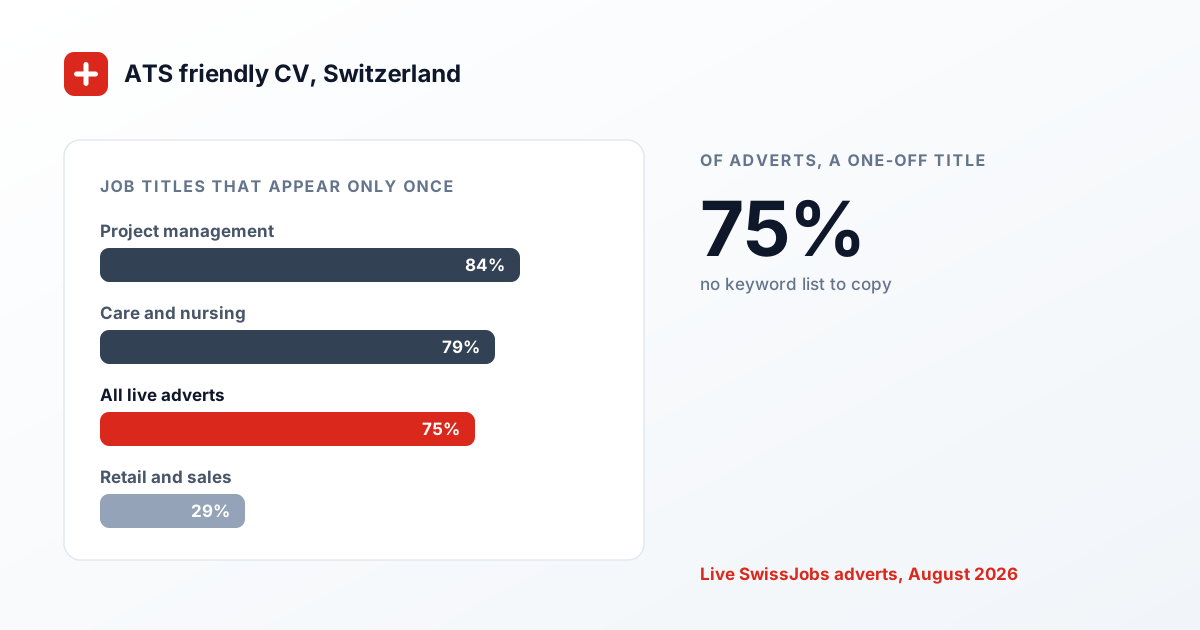
No. Three out of four live adverts carry a job title that appears on no other advert, and in project work it is more than four in five.
Three quarters of the exact job titles on our own search are one-offs. And that is not a quirk of spelling: take out the gender markers and the workload figures and the picture barely moves.
The exception is retail, where big chains post the same standardised title dozens of times, so only three adverts in ten are one-offs. Everywhere else the numbers run the other way. Project management is the extreme: 84% of those adverts have a title nobody else in the market uses.
The practical consequence is blunt. A CV built from a generic keyword list is aimed at an average advert that does not exist. A CV whose headline repeats this employer's own words hits the one advert you are actually applying to — and that is the only match that has ever mattered.
Measured across live Swiss job adverts on SwissJobs.app, August 2026.
Write a custom CV for every job you apply to
Most people send the same CV everywhere. The AI editor rewrites yours per application — Swiss format, the right language, in about a minute.
CV maker & resume builder: tailor it to this jobShould my CV say Projektleiter or Project Manager?
Whichever one the advert says — and which that is depends almost entirely on the field, from 90% English in software to 0% in care.
Swiss adverts are inconsistent about this in a way that is very consistent by profession. Nine out of ten live software adverts use the English word in the title. Accounting leans the same way. Project work does not: only a quarter go English there, the German Projektleiter still wins, and chef de projet holds the Suisse romande.
And in care work not a single advert we counted uses an English job word. Pflegefachfrau, infirmier, FaGe: the local term is the qualification, so there is no English version to reach for.
For the CV this decides one line, the headline under your name. Write it in the advert's language, then let the other version appear once in the experience or skills block. Not five times. A search box matches literal strings, so one occurrence is enough to be found — and the person who opens the file afterwards is reading your last three employers, not counting terms.
Job titles of live Swiss adverts, SwissJobs.app, August 2026.
See what a Swiss recruiter checks first
Upload your CV and get a score against a specific job ad in about 30 seconds — language levels, work permit, photo, how your achievements are phrased.
ATS CV checker, freeWhat else is in a Swiss job title, and what should you copy?
Copy the role noun and the qualification abbreviation. Leave the gender marker and the workload percentage where they are.
Swiss job titles are packed. Roughly a quarter carry a gender marker — (m/w/d), (w/m), h/f — and a fifth carry a workload figure right there in the title, 80-100% or 60%. Both are employer bookkeeping. Neither belongs in your headline, and copying them across reads as a paste job.
The abbreviation is the opposite case. Only about one advert in twelve puts a qualification into the title, and where it appears it is doing real work: EFZ, HF, FH, dipl., CFC. Those are not decorations, they are Swiss qualification levels, and an employer who writes HF means HF. If you hold it, write it in exactly that form, in the headline and again next to the education entry.
Same for seniority. Where the advert names a level — Senior, Lead, Leiter, Head — and your CV says nothing, a literal search for the word comes up empty, and you have made a human reader work out your level from dates.
Job titles of live Swiss adverts, SwissJobs.app, August 2026.
How many languages does a Swiss advert actually ask for?
Usually one — 71% of adverts that state a requirement name a single language — but the level is where applications quietly fail.
Among live adverts that state a language requirement at all, seven in ten name exactly one, a fifth name two, and the rest want three or more. So the multilingual Swiss stereotype is real but narrower than it looks: most jobs want one language done properly, not four done passably.
Where German is the one named, 88% of those adverts want it at professional level. That is the line people misjudge. Conversational German and professional German are two different applications, and writing "good knowledge" on a CV lands you in neither.
So the language block is not a decorative bar chart with four half-filled circles. It is a level and, where you have one, a certificate: German C1, telc 2024. French B2. English fluent. A recruiter reading that knows in one second whether to keep going, and a literal search for the language word finds you at the same time.
Live Swiss adverts stating a language requirement, SwissJobs.app, August 2026.
Is a tracking system really reading my CV first?
Often — about three adverts in ten apply through a system we can name, and about half more sit on the employer's own careers software.
Three adverts in ten go to a tracking system we can identify by name from the application link. That figure is measured. Roughly half of the rest sit on the employer's own careers software, which is usually a tracking system wearing a company domain — that half is inferred from the link, not confirmed vendor by vendor, and we would rather say so than round it up.
What follows for the document is dull and worth doing anyway. One column, no text boxes, no tables, no headings that live inside an image, real dates, a file with selectable text. The parsing failures we see are almost never exotic: two-column layouts that interleave into nonsense, a name that exists only in the header image, a scanned PDF with no text at all.
Then keep the two readers apart in your head. The system matches literal strings, which is why the advert's own wording matters. The person who opens it afterwards looks at previous employers, what you delivered there, the portfolio, the gaps. Nothing in that second reading improves by adding more terms — and quite a lot of it gets worse.
Application links on live Swiss adverts, SwissJobs.app, August 2026. The middle band is inferred from the link, not confirmed vendor by vendor.
So what goes in the CV?
Four lines mirrored from the advert, everything else in your own words, and one CV per advert rather than one CV per market.
The headline under your name is the advert's job title, in the advert's language. The qualification abbreviation is copied character for character. The language line carries a level and a certificate where you have one. The workload goes on its own line if the advert names one — 80% is a normal Swiss career, and saying nothing forces someone to guess.
That is the whole mirroring job, and it takes about ten minutes per application. Everything below it is yours: what you were responsible for, what changed because you were there, numbers where you have them. That part cannot be optimised into existence, and it is what the second reader is actually buying.
If you want to see what survives the first thirty seconds of your current version, our CV Check reads it the way a Swiss screen does and shows you what lands. And if you are starting from a blank page, the CV builder lays out the Swiss structure so the title line, the qualification, the languages and the workload end up where a recruiter here looks for them.
What we used, and what you can use
Every share above was counted across the live Swiss adverts on our own search. These are the tools we would point a job seeker at, ours marked as ours.
- SwissJobs job searchour tool
Ours, free. The live Swiss adverts every share in this article was counted across — useful for reading how your own field words its titles.
SwissJobs job search SwissJobs CV Check our tool
Ours, free. Shows what a Swiss reader takes from your CV in the first thirty seconds — title line, qualification, languages, workload.
Try it freeSwissJobs CV builder our tool
Ours, free. Swiss structure, one column, selectable text — the format questions above answered by default.
Try it free- Europass
Neutral, from the EU. Useful for listing language levels on the CEFR scale — but the Europass layout itself is not the Swiss convention.
Visit site
The finding that surprised us is how little the market repeats itself. We expected clusters of standard titles with a long tail of odd ones; what we got was a long tail with a small cluster of supermarket chains at the front.
Which is oddly good news. It means there is nothing to memorise. The words worth having are printed in the advert in front of you, four lines of them, and the rest of the page is meant to sound like a person who did the work.
Counted across the live Swiss job adverts on SwissJobs.app, August 2026. Language shares counted across the adverts that state a requirement.
The tools compared
We checked 16 Swiss and international application tools on their own pages — prices, free tiers, and what is actually included.