How to write language levels on a Swiss CV
The language block is the smallest part of a Swiss CV and one of the few a recruiter reads properly. It decides whether you are in the pile or out of it, usually before anyone looks at your experience.
The standard advice is to state CEFR levels — A1 to C2. That advice is right, but for a reason nobody explains: employers themselves mostly do not use CEFR. We counted the wording across 21,235 job postings, and an explicit B2, C1 or C2 appears in only 872 of them. "Gute Kenntnisse" — good knowledge, a phrase that could mean anything from B1 to C1 — appears 2,260 times.
So the two sides are speaking different languages about language. Your job is to be the precise one.
Short version
- Should you use CEFR levels on a Swiss CV?
- Yes. Employers rarely use CEFR themselves — only 872 of 21,235 postings name a level explicitly — which is exactly why stating yours removes the guesswork a recruiter would otherwise resolve against you.
- What German level do Swiss employers want?
- Professional, almost always. Of 11,106 postings requiring German, 10,797 want it at working level. Only 926 accept conversational German and 54 accept basic.
- Does "von Vorteil" mean the language is required?
- No. It means an advantage. The phrase appears in 2,230 postings, and candidates who read it as a requirement rule themselves out of jobs they would have got.
- Should you list German on an English-language application?
- Yes. 22% of postings written in English still require professional German, so leaving your German level off an English application leaves the recruiter to assume you have none.
Working on your CV right now? ATS CV checker: free, against a real Swiss job ad
See what a Swiss recruiter checks first
Upload your CV and get a score against a specific job ad in about 30 seconds — language levels, work permit, photo, how your achievements are phrased.
ATS CV checker, freeWhat do Swiss employers actually write about language?
Vague words far more often than levels: "gute Kenntnisse" appears 2,260 times across our postings, an explicit CEFR code only 872 times.
This is the finding that should shape your language block. The CV guides assume a shared vocabulary that does not exist — most Swiss employers describe language in ordinary adjectives, not in CEFR bands.
The ranking, across 21,235 postings: "gute Kenntnisse" 2,260, "sehr gute Kenntnisse" 1,225, an explicit B2/C1/C2 872, "fliessend" 312, "verhandlungssicher" 267, "Muttersprache" 222, "Grundkenntnisse" 127.
The practical consequence is not to copy their vagueness. It is the opposite: when a recruiter compares ten CVs against an ad asking for "gute Deutschkenntnisse", the candidate who wrote "German — C1 (verhandlungssicher)" is the only one who has answered the question. Everyone else has left it to be guessed, and a guess about a stranger is rarely generous.
Across 21,235 Swiss postings. SwissJobs.app inventory, 15 August 2026.
Write a custom CV for every job you apply to
Most people send the same CV everywhere. The AI editor rewrites yours per application — Swiss format, the right language, in about a minute.
CV maker & resume builder: tailor it to this jobWhat level should you claim?
The level the job actually needs is almost always C1 — 10,797 of 11,106 German requirements are at working level, and only 926 accept conversational.
There is very little middle market. If a posting asks for German, it nearly always asks for German you can work in, and the gap between B2 and C1 is where most applications quietly fail.
That cuts both ways. Overstating is the more expensive error — a C1 claim is tested in the first ten minutes of a phone screen, and being caught costs the application and the referral. Understating is expensive too, because a recruiter filtering for C1 will not stop to wonder whether your B2 is a modest B2.
The honest way through: state the level you can defend in an interview conducted in that language, and add the qualifier employers themselves use. "German — C1, verhandlungssicher" reads as a claim you have thought about. "German — good" reads as one you have not.
See what a Swiss recruiter checks first
Upload your CV and get a score against a specific job ad in about 30 seconds — language levels, work permit, photo, how your achievements are phrased.
ATS CV checker, freeHow should the language block be laid out?
Its own short block near the top, one line per language, level stated in CEFR with the employer’s own word in brackets.
Give it a heading of its own rather than burying it in a skills list. On a Swiss CV the recruiter is looking for it, and making them hunt is a small tax on every read.
One line per language, strongest first, and your mother tongue labelled as such — "Muttersprache" is the term used by 222 postings and understood by all of them. Then CEFR, then the plain-language equivalent: German — C1 (verhandlungssicher). English — C2. French — B1 (Grundkenntnisse in Konversation).
Two things to leave out. Skip the five-dot rating bars: they mean nothing consistent and a recruiter cannot map them onto the level in the ad. And skip languages below A2 entirely — a line saying "Italian — basic" adds nothing and invites a question you cannot answer well.
Which languages belong on a Swiss CV at all?
German, English and French carry almost the whole market — German is named in 11,106 postings, English in 6,283, French in 2,761 and Italian in 447.
List the four national-market languages you have at A2 or above and stop there. A Swiss recruiter is matching your block against a requirement list, and every extra line is noise between them and the answer.
The proportions are worth internalising because they are lopsided in a way that surprises people. German is named more often than English and French combined. Italian, despite being a national language, appears in 447 postings — roughly one in forty of the market — so it belongs on your CV if you have it and is not worth a course if you do not.
Languages outside these four are worth a line only when the role names them: a posting for a Portuguese-speaking client desk is the reason to list Portuguese, not the fact that you speak it.
Postings can require more than one language. SwissJobs.app inventory, 15 August 2026.
What if your German is not C1 yet?
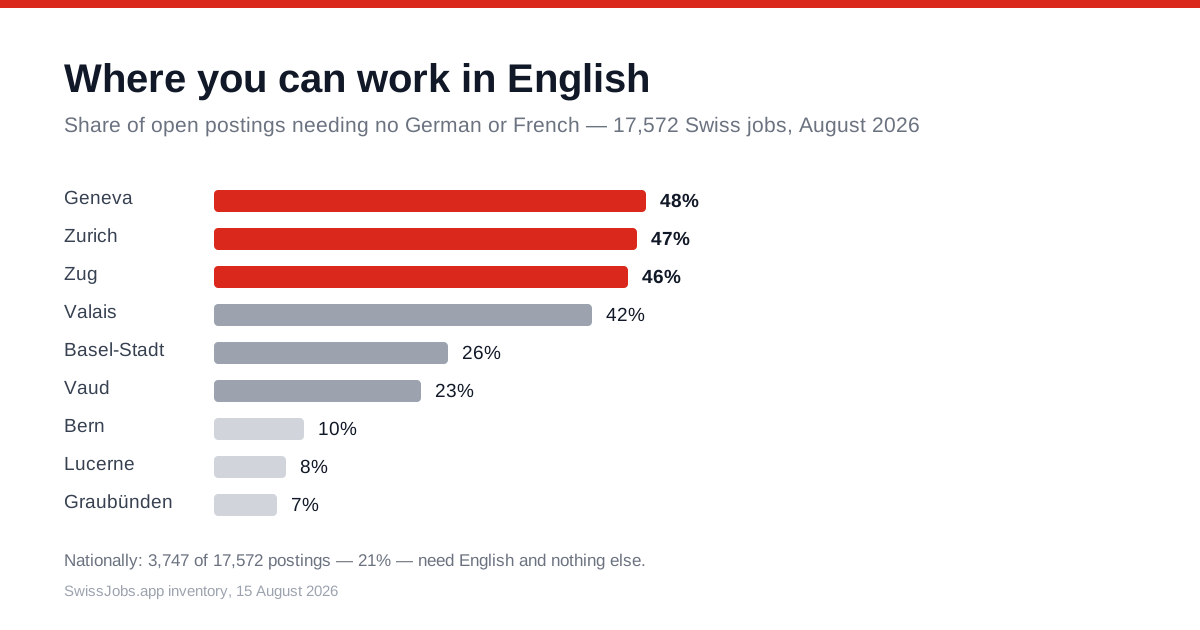
Apply where the language is not the barrier: 3,747 postings need English and nothing else, and they cluster in Geneva, Zurich and Zug.
The level distribution is brutal about the middle. Of postings requiring German, 10,797 want professional level, 926 accept conversational and 54 accept basic — so B1 opens very little that B2 does not, and neither opens much that C1 does.
The productive response is not to inflate the CV. It is to change the target list. One posting in five in our inventory can be done in English alone, and the share reaches 48% in Geneva, 47% in Zurich and 46% in Zug against 7% in Graubünden. The same CV that fails everywhere in central Switzerland is competitive in three cantons.
Write the level you have and let the filter do the work. A CV claiming C1 that meets a German-speaking hiring manager loses more than the job — recruiters remember, and the Swiss market is small.
SwissJobs.app inventory, 15 August 2026.
What does a good Swiss language block look like?
Four lines, CEFR plus the employer’s own word, mother tongue labelled — and nothing below A2.
A block that answers the question outright looks like this: "German — C1 (verhandlungssicher). English — C2. French — B1. Italian — Muttersprache." Four lines, strongest claim first, every level checkable.
Compare it with the version most CVs carry: "Languages: German, English, French (good)". Nothing there can be matched against a requirement. A recruiter filtering for verhandlungssicheres Deutsch has to decide what "good" means for a stranger, under time pressure, against a stack of CVs where somebody else was specific.
Two refinements that cost nothing. If you hold a certificate — Goethe, TELC, DELF, CAE — name it and its year, because a dated certificate converts a claim into evidence. And if your level is rising, say so plainly: "German — B2, C1 course completing March 2027" is credible, where an unqualified C1 twelve months early is not.
Where does your German level matter least?
In Geneva, Zurich and Zug, where 46-48% of postings need no German at all — against 7-10% in Graubünden, Lucerne and Bern.
A language block is read against a local market, and the same block reads very differently depending on which canton the recruiter sits in. If your German is B1 and honest, the cantons below the middle of this chart will screen you out no matter how well the block is written.
That is not an argument for inflating the level. It is an argument for spending your applications where the level you actually have is competitive — and for saying so plainly rather than hoping nobody checks.
Note the shape of the top of the list: Geneva leads at 48% despite being French-speaking, because the international organisations there recruit in English by default. A CV with strong English and weak German is better placed in Geneva than in Lucerne, which is the opposite of what most people assume.
Cantons with at least 200 postings. SwissJobs.app inventory, 15 August 2026.
Are you ruling yourself out unnecessarily?
"Von Vorteil" appears in 2,230 postings and means an advantage, not a requirement — reading it as a requirement is one of the most common self-eliminations we see.
A Swiss job ad often lists two or three languages, and the difference between them is one small phrase. "Deutsch verhandlungssicher, Französisch von Vorteil" is a German-language job that would like you to have French. Candidates without French frequently skip it.
The mirror-image error is applying to a posting written in English and assuming the work is done in English. 22% of English-language postings require professional German somewhere in the requirements, which is why your German level belongs on an English CV even when the ad never asks in German.
If you want the shortcut, we built the check into our CV tool: it compares your language block against the specific posting and tells you which requirements you meet, which you are missing, and which are merely an advantage.
Check your CV against a real posting
The language block is one of the things a Swiss screener resolves fastest — and one of the easiest to get wrong in a way you never hear about.
Free Swiss CV check our tool
Scores your CV against a specific job ad, including whether your language levels match what the posting asks for.
Try it free- English-speaking jobs in Switzerlandour tool
Postings that genuinely need no German — filtered on the requirement, not the ad language.
English-speaking jobs in Switzerland - How many Swiss jobs can you do in English?our tool
The full language breakdown across 17,572 postings, by canton and occupation.
How many Swiss jobs can you do in English?
The language block takes four lines and decides more screenings than the four lines above it. State CEFR, add the word the employer would use, put it where it can be found, and do not eliminate yourself over a language the ad called an advantage.
The wording counts here come from a scan of our own inventory on 15 August 2026 and will move with the market.
The tools compared
We checked 16 Swiss and international application tools on their own pages — prices, free tiers, and what is actually included.