How many Swiss jobs can you actually do in English?
If you are looking for work in Switzerland without fluent German, you have probably been told two contradictory things: that Switzerland is full of international companies where everyone speaks English, and that you will get nowhere without German. Both are repeated confidently and neither comes with a number.
So we counted. This is every job posting on SwissJobs.app that was open on 15 August 2026 — 20,752 of them — with the language requirement read out of each advert. 17,572 state or clearly imply what you need. The rest say nothing at all, and we have left them out rather than guess.
The short version: you can do about one job in five in English alone. Which one in five depends almost entirely on where it is.
Short version
- How many Swiss jobs can you do without German?
- 6,466 of 17,572 postings — 37% — do not require German at working level. A narrower 3,747 (21%) need English and no other language at all.
- How many Swiss jobs require German?
- 11,106 postings, 63% of those with a stated requirement. Almost all of them want it at a working standard: 10,797 ask for professional-level German, only 926 accept conversational.
- Where are the English-speaking jobs?
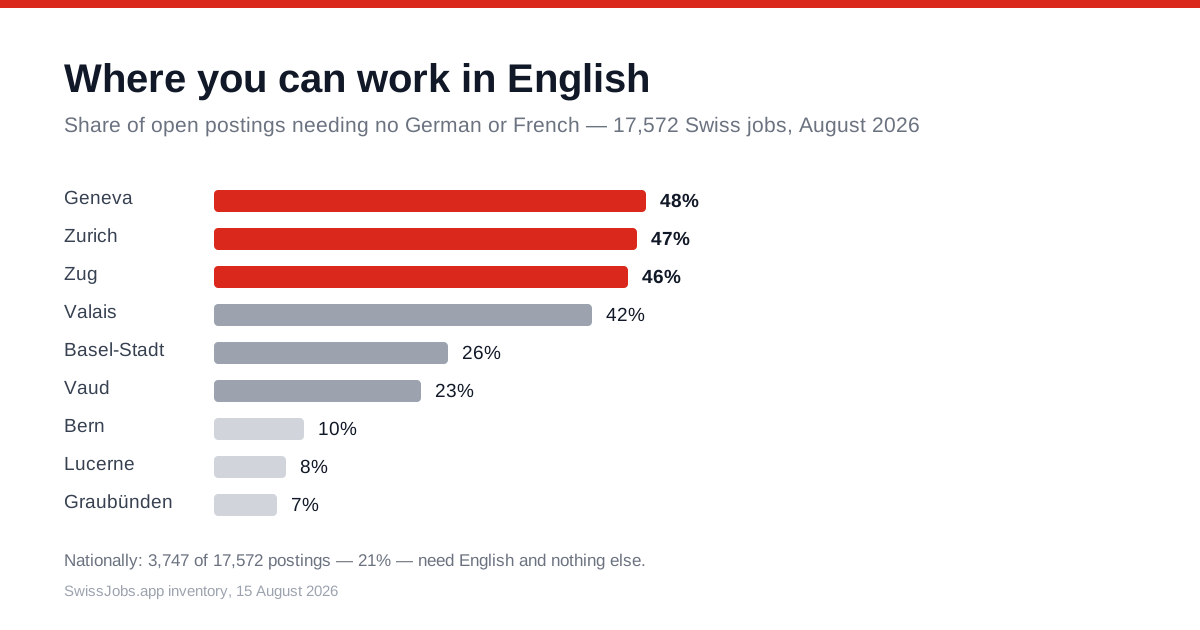
- Geneva (48% of local postings), Zurich (47%) and Zug (46%). In Lucerne, St. Gallen and Graubünden it is under 10%.
- Is a job advertised in English an English-speaking job?
- Often not. 22% of postings written in English still require German at professional level — the advert is in English because the company recruits internationally, not because the work is done in English.
Working on your CV right now? ATS CV checker: free, against a real Swiss job ad
See what a Swiss recruiter checks first
Upload your CV and get a score against a specific job ad in about 30 seconds — language levels, work permit, photo, how your achievements are phrased.
ATS CV checker, freeHow many Swiss jobs can you actually do in English?
3,747 of 17,572 postings — 21% — require English and no other language at working level.
That is the strict answer: jobs where English is enough on its own. Widen the question to "jobs that do not require German" and the number rises to 6,466, or 37% — those include roles in French-speaking Switzerland where French is the working language instead.
Both numbers are larger than the pessimists claim and much smaller than the international-Switzerland story suggests. One in five is a real market. It is also four in five that are closed to you, which is why the location of that one in five matters more than its size.
A note on what "require" means here. We count a language as required when the posting asks for it at professional or native level. Languages listed as an advantage, or at conversational level alongside a working language, are not counted — an advert asking for fluent German and conversational English is a German-speaking job.
Postings can require more than one language, so the bars overlap. SwissJobs.app inventory, 15 August 2026.
Write a custom CV for every job you apply to
Most people send the same CV everywhere. The AI editor rewrites yours per application — Swiss format, the right language, in about a minute.
CV maker & resume builder: tailor it to this jobWhere are the English-speaking jobs in Switzerland?
Geneva, Zurich and Zug, where nearly half of all postings are workable in English — against under one in ten in central and eastern Switzerland.
This is the finding that should change how you search. The national average of 21% hides a spread from 48% to 7%, and that spread is far wider than the difference between industries.
Geneva leads at 48%, which surprises people who assume the French-speaking cantons are hardest without French. It is the international organisations: the UN, the NGOs and the multinationals headquartered there recruit in English by default. Zurich follows at 47% on much larger volume — 962 English-workable postings against Geneva's 373 — and Zug at 46% on the strength of its commodity traders and holding companies.
Then it falls away sharply. Basel is 26%, held up by pharma. Bern, despite being the federal capital, is 10%. Lucerne and St. Gallen are 8%, Graubünden 7%. In those cantons the German-speaking labour market is the labour market, and no amount of searching changes that.
The practical consequence: if you are job-hunting from abroad without German, three cantons hold most of what is open to you. Searching nationally mostly produces jobs you cannot apply for.
Cantons with at least 200 postings. SwissJobs.app inventory, 15 August 2026.
See what a Swiss recruiter checks first
Upload your CV and get a score against a specific job ad in about 30 seconds — language levels, work permit, photo, how your achievements are phrased.
ATS CV checker, freeDoes an English job advert mean the job is in English?
No. 22% of postings written in English still require German at professional level.
This is the trap that wastes the most time. A posting written in English feels like an invitation, and on a job board that filters by advert language it will be presented as one. But the advert is a recruiting document, and large Swiss employers write in English because they hire internationally — not because the team works in English.
We measured this directly. Of the postings whose text is written in English, more than a fifth name German at a working standard somewhere in the requirements. Apply to those and you are competing for a German-speaking role with a CV that says you do not speak German.
It is the reason our own English-speaking pages filter on what the posting requires rather than what language it is written in. The two answers differ by a factor of more than two, and the difference is entirely made up of applications that were never going to succeed.
What level of German do Swiss employers actually ask for?
Almost always a working level: 10,797 postings ask for professional German, against 926 that accept conversational and 54 that accept basic.
If you are learning German in the hope that partial fluency opens the market, this is the number to weigh. Swiss employers overwhelmingly ask for German they can work in — C1 in CEFR terms, or the wording "verhandlungssicher", negotiation-proof.
Only 5% of postings that mention German will take conversational German, and 310 want native-level. There is very little middle ground: the jump from "no German" to "employable in German" is close to the jump from A2 to C1, and the market prices it that way.
The implication is not that learning German is pointless — it opens 11,106 postings, three times what English alone reaches. It is that a year of evening classes does not open a third of them. Until German is at working level, the 3,747 English-workable postings are the realistic market, and they are concentrated in the three cantons above.
SwissJobs.app inventory, 15 August 2026.
Which employers actually hire in English?
A short list carries much of it: On Running alone accounts for 240 English-workable openings, ahead of Roche at 105 and CERN at 45.
The concentration is worth knowing before you spread applications thinly. A handful of employers — sportswear, pharma, private banking, the research institutions and the Big Four — produce a large share of everything open to an English speaker in Switzerland.
They fall into two recognisable types. Companies international from the start, like On Running and CERN, work in English by default. Pharma and finance — Roche, Union Bancaire Privée, Vontobel, Julius Bär, PwC — run English as the corporate language while the canton around them works in German, and that is exactly where the earlier trap lives: an English advert from a Zurich bank may still want German for client-facing work.
The flow is steadier than the totals suggest. 715 of the 3,865 English-workable postings we hold were published in the last seven days, so about one in five is under a week old. This is a market that refreshes rather than a backlog you exhaust in a fortnight.
Staffing agencies excluded. SwissJobs.app inventory, 15 August 2026.
Which jobs are realistic in English?
Engineering, software, research and specialist technical roles — where the working language follows the discipline rather than the canton.
The English-workable share is not spread evenly across occupations either. Engineering roles carry the largest count by a distance, followed by general management, technical specialists and software. Research is strong for the same reason as Geneva: the institutions are international by design.
At the other end, the roles that involve talking to the Swiss public all day are effectively closed. Nursing has essentially no English-workable openings in our inventory, and that is correct rather than a gap in the data — you cannot nurse a German-speaking patient in English. Retail, care work and customer service behave the same way.
This is worth internalising before you retrain. The advice "go into healthcare, they are desperate" is true about demand and false about access: the shortage is real and the language requirement is absolute.
Search by what the job actually requires
Filtering by the language an advert happens to be written in produces roughly twice as many results as you can apply for. These pages filter on the requirement instead.
- English-speaking jobs in Switzerlandour tool
Every posting workable without German or French, updated daily.
English-speaking jobs in Switzerland - English-speaking jobs in Zurichour tool
47% of Zurich postings — the largest pool in the country.
English-speaking jobs in Zurich - English-speaking jobs in Genevaour tool
The highest share of any canton, at 48%.
English-speaking jobs in Geneva - English-speaking engineering jobsour tool
The occupation with the deepest English-workable inventory.
English-speaking engineering jobs - English-speaking software jobsour tool
Where the working language follows the discipline.
English-speaking software jobs Free Swiss CV check our tool
Scores your CV against a specific posting, including whether your language levels are stated the way Swiss recruiters expect.
Try it free
One in five Swiss jobs is open to you in English, and they sit overwhelmingly in Geneva, Zurich and Zug. That is a smaller market than the optimists describe and a much larger one than the "you need German" advice implies — and knowing which is which saves you the applications that were never going to land.
The figures here come from a single scan of our own inventory on 15 August 2026 and will drift as the market does. The pages linked above recalculate daily, so they will always be closer to today than this article is.
The tools compared
We checked 16 Swiss and international application tools on their own pages — prices, free tiers, and what is actually included.