Your Swiss CV is only half the dossier — the Arbeitszeugnis is the other half
If you moved here from almost anywhere else, the Swiss application dossier holds one document you have never produced before. Not the CV. Not the cover letter. The Arbeitszeugnis — the written work reference your employer owes you when you leave, and at any point before that.
It is not a reference letter in the Anglo sense, where a former manager writes something warm because you asked nicely. It is a legal obligation, it follows a standard structure, and it has to be two things at once: true and benevolent. A Swiss employer may not wreck your prospects, and may not write anything false either.
Those two duties pull against each other, and out of that tension a coded register grew. Criticism does not disappear. It moves into the choice of words, where a single missing adverb is a grade — and where an unprepared reader sees a compliment.
There is a second layer now, and it is newer. Roughly a third of the live Swiss adverts whose language we can identify are written in English. In those processes the code often goes unread, which cuts both ways.
Short version
- What does "always endeavoured to" mean in a Swiss work reference?
- It is the politest available way of saying the results were not there. Endeavour describes effort, not outcome. If a paragraph only ever describes how hard somebody tried and never names what they delivered, the assessment is complete — and a Swiss reader will take it that way.
- Am I entitled to a work reference in Switzerland?
- Yes. Article 330a of the Swiss Code of Obligations gives every employee the right, at any time, to a reference covering the nature and duration of the employment plus performance and conduct. At any time includes while you are still working there — that is the Zwischenzeugnis, the interim reference.
- What is the difference between a full reference and a confirmation of employment?
- The confirmation names your function and your dates and stops there. The law provides for it as an exception, granted on the employee's own request. Receiving one you did not ask for is itself a statement, and the answer is to ask for the full reference.
- Do I need to translate my Arbeitszeugnis into English?
- For an English-language process a plain translation helps, but attach the original as well. About a third of Swiss adverts are written in English and the coded register is lost there anyway. What you never do is improve the document while translating it.
- What if a sentence in my reference downgrades me?
- Ask for a correction in writing, name the individual sentence, and propose the replacement yourself along with the fact it rests on. A reference has to be true, and a coded downgrade is expensive to defend against a concrete achievement. If there is no agreement, a union or a lawyer is the route.
Working on your CV right now? ATS CV checker: free, against a real Swiss job ad
See what a Swiss recruiter checks first
Upload your CV and get a score against a specific job ad in about 30 seconds — language levels, work permit, photo, how your achievements are phrased.
ATS CV checker, freeWhat are you actually entitled to in Switzerland?
A written reference covering the nature and duration of the job plus your performance and conduct — at any time, not only on your last day.
Article 330a of the Code of Obligations is short, and the important word in it is "at any time". You do not have to resign to get a reference. You can ask for an interim one when your manager changes, when a reorganisation is announced, when you move into a different role — in short, whenever the person who can actually judge your work is about to be gone.
That is the most common avoidable mistake for people new to the system. Stay three years, go through two managers, and the final reference gets written by somebody who never saw the first two and a half. What comes out is not malicious. It is just thin.
Two duties run in parallel: the reference has to be truthful, and it has to be worded so it does not needlessly damage your prospects. None of this is legal advice — a real dispute belongs with somebody qualified. For everyday purposes it is enough to understand that those two duties together are what forced the coded language into existence.
Write a custom CV for every job you apply to
Most people send the same CV everywhere. The AI editor rewrites yours per application — Swiss format, the right language, in about a minute.
CV maker & resume builder: tailor it to this jobWhich phrases quietly downgrade you?
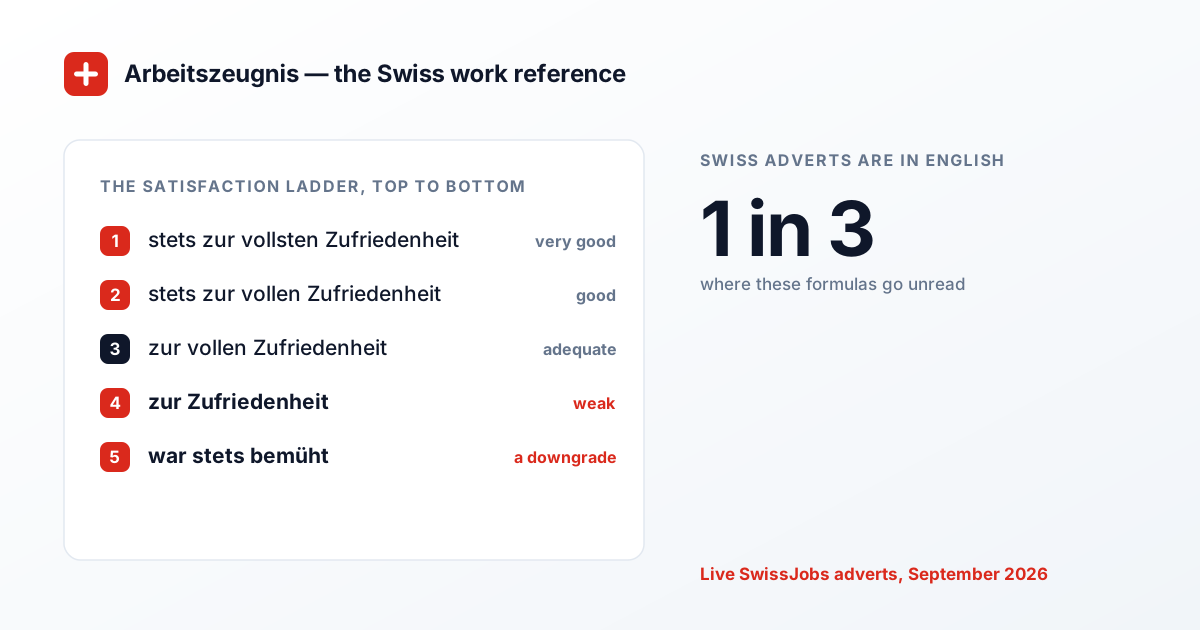
The satisfaction formula is a grading scale, and every word left out of it is one step down.
"To our fullest satisfaction" sits at the top — stets zur vollsten Zufriedenheit. Drop "fullest" for "full" and you have dropped a grade. "To our satisfaction", with no qualifier at all, is the bottom of what anyone writes down. The little word stets, meaning consistently, carries its own weight: it says the performance held throughout rather than in patches.
Then there is the verb layer. Endeavoured, sought to, was committed to — all of them describe effort rather than result. A paragraph made entirely of effort words, with no outcome named, is a finished judgement however friendly it sounds. Misplaced praise does the same job: commended for punctuality and a pleasant manner, and not for the work.
And the closing formula. Regret at the departure, thanks for the work, good wishes for the future — normally all three are there. If they are missing, that is the loudest sentence in the document, because leaving out courtesy is never an oversight. Read your own reference once for what is absent: the main responsibility that never appears, the project that is not mentioned, the last paragraph that simply stops.
See what a Swiss recruiter checks first
Upload your CV and get a score against a specific job ad in about 30 seconds — language levels, work permit, photo, how your achievements are phrased.
ATS CV checker, freeWhich language will your reference actually be read in?
About half of the adverts whose language we can identify are in German, but close to a third are in English — and the coded register does not survive that crossing.
This is the number that surprised us most. The Swiss market advertises far more internationally than it documents. The dossier stayed Swiss; the process around it did not.
Two practical consequences. Apply to a German-language advert and every nuance gets read, so every hour you spend getting a sentence corrected pays for itself. Apply to an English-language advert and the other side usually takes the reference at face value, with no second floor underneath it. Attach a plain translation, keep the original with it, done.
What you do not do is upgrade the document in translation. If anybody later reads the original, the gap between the two versions is a far bigger problem than the original wording ever was.
Measured across the live Swiss adverts on SwissJobs.app, September 2026 — counted across the adverts whose language can be identified.
Does the advert even say which language it wants?
Often not: close to a third of live adverts state no language requirement at all, and then the language of the advert is the requirement.
German is asked for explicitly in a bit over four adverts in ten. Close to a third say nothing about language at all — which a lot of people read as good news, and which is not. The rest splits across English, French and, far more rarely, Italian.
The rule of thumb that follows is unglamorous and it works. If the advert states no requirement, treat the advert's own language as the requirement. That decides your CV, your covering message, and whether you attach a translated reference.
If you want to know what the stated levels really mean in Swiss adverts — fluent, business fluent, good knowledge — we took those apart separately.
Shares of the live Swiss adverts on SwissJobs.app, September 2026. One advert can ask for several languages.
Why does no Swiss advert name a salary — and what has that to do with the reference?
Not one live advert names a pay figure, which leaves exactly one document in the whole process where somebody other than you judges your work.
Zero per cent. That figure comes back every time we look, and it is the reason Swiss hiring leans so heavily on the dossier. Employment type is usually stated. A language requirement usually is. Pay never.
Because the outside of the process tells you nothing, what you send in carries more weight — and the reference is the only part of it written by a third party. A CV claims; a reference confirms. That is why a coded downgrade is expensive, and why the second check matters more than it sounds: function, dates and workload in the reference have to match your CV month for month.
Contradictions there cost more than any formula. "Team lead" on the CV against "Sachbearbeiter" in the reference is not a wording problem, it is a credibility problem, and it surfaces in the first minute.
Shares of the live Swiss adverts on SwissJobs.app, September 2026.
When does the reference need to be in the folder?
Before you start looking — roughly one live advert in ten is under a week old, and those are the ones with the short pile of applicants.
About half of the live adverts are more than a month old. Those are the hard ones: long advertised, many applications in, often an internal favourite already. The fresh tenth is the part of the market where your application is still being read against a handful of others.
A reference takes time. The employer has a reasonable period to produce one, and reasonable means weeks in practice, especially when a manager drafts it and HR reviews it afterwards. Asking only once you have found the right advert is asking too late.
So ask for the interim reference while everything is calm. It costs nobody anything, it is entirely normal here, and it is the only moment when you can discuss a sentence without the discussion looking like a fight.
Shares of the live Swiss adverts on SwissJobs.app, September 2026.
What do you do when a sentence downgrades you?
Ask for a correction in writing, name the single sentence, and write the replacement yourself.
The sequence that works in practice is undramatic. First, read the reference against the satisfaction ladder and mark the places that sit lower than what was said to you in review meetings. Second, send a short, factual message naming two or three sentences — not the whole document. Third, propose a replacement for each one, together with the fact it rests on.
It works because the reference has to be true. Defending a vague downgrade against a specific, evidenced achievement is a lot of work, and most HR departments would rather correct the sentence. If no agreement comes, a union or a lawyer is the route — but that is its own project and no reason to pause your applications.
And if it comes up in an interview: answer once, calmly, in a sentence, without running down the old employer. People who explain the line rather than defend it are usually through it in twenty seconds.
What we used
Every share above is counted across the live Swiss adverts on our own search. Three of our own tools and one neutral source.
- SwissJobs job searchour tool
Our tool, free. The live Swiss adverts all the shares are counted across — sortable by date if you want the fresh part of the market.
SwissJobs job search SwissJobs CV Check our tool
Our tool, free. Checks the lines a Swiss reader looks for first — function, dates, workload, languages. Exactly the lines that have to match your reference.
Try it freeSwissJobs CV builder our tool
Our tool, free. Useful for lining the dates on your CV up cleanly with the dates in the reference.
Try it free- Fedlex — Swiss Code of Obligations
Neutral, from the federal government. The reference provision is Article 330a — short, readable, and the basis for everything above.
Visit site
The thing that stayed with us after running the numbers: the market advertises internationally now, and the paperwork behind it did not move. A German reference with a second floor built into it lands in an English-language process where nobody is looking for a second floor. Sometimes that is an advantage. Sometimes it is a correction you never got round to making.
The practical part is the same whichever language you apply in. Read your reference once for the satisfaction formula, once for the verbs, and once for what is missing. Ask for the interim reference while the person who can judge your work is still in the building. And reconcile the dates against your CV before somebody else does.
Counted across the live Swiss adverts on SwissJobs.app, September 2026. The advert-language shares are counted across those whose language can be identified.
The tools compared
We checked 16 Swiss and international application tools on their own pages — prices, free tiers, and what is actually included.