Why is it so hard to get a job in Switzerland?
Applying for a job in Switzerland? The market has its specificities, and most of them are not written down anywhere. Here is what is actually going on.
The short version: the bar is higher than the job ad suggests, and it is higher in ways that have nothing to do with how good you are.
Short version
- Why is it so hard to get a job in Switzerland?
- Because almost every Swiss job has a dedicated education path behind it, so the baseline for any role is already very high — and because the local talent pool is deep enough that companies can afford to wait for a candidate who matches the profile exactly.
- What do Swiss employers require for competitive roles?
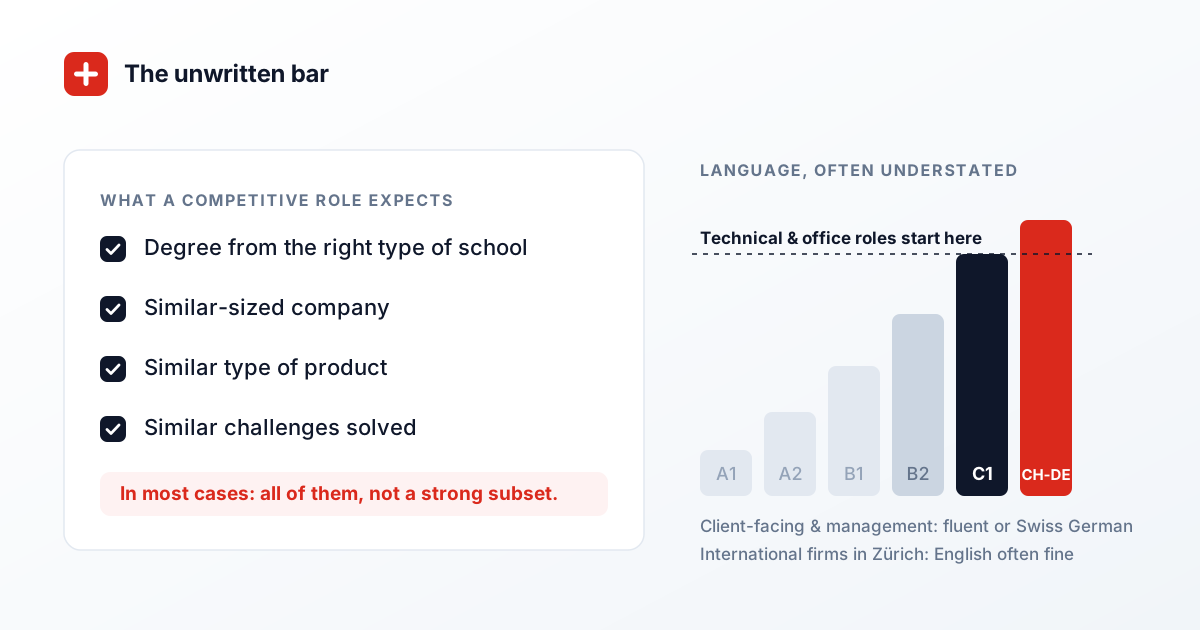
- For engineering, product, finance and tech roles, employers typically expect a degree from the right type of school, experience at a similar-sized company, experience on a similar type of product, and experience solving similar problems — in most cases all four, not a strong subset.
- How much German do you need for a job in Switzerland?
- Technical and office roles typically require at least C1 German. Management and client-facing roles often require fluent German or Swiss German. The level required is frequently higher than the job ad states.
- Can you work in Switzerland with only English?
- Yes, at international companies and scale-ups in Zürich, Geneva and Zug, where English is often the working language. At SMEs and outside the major cities the language bar is considerably higher than the job ad suggests.
- Why do Swiss job ads list three languages?
- Swiss ads commonly ask for one language at native level, a second at fluent level and sometimes a third at basic level, reflecting the multilingual market. That combination catches a lot of international applicants off guard.
- What works better than cold applications in Switzerland?
- Warm referrals, being visible before you need a job, targeting scale-ups and international companies with English-first cultures, and applying where you already match most of the stated requirements rather than a few of them.
Working on your CV right now? ATS CV checker: free, against a real Swiss job ad
See what a Swiss recruiter checks first
Upload your CV and get a score against a specific job ad in about 30 seconds — language levels, work permit, photo, how your achievements are phrased.
ATS CV checker, freeWhy does Switzerland expect such a specific background?
Because almost every job here has a dedicated education path behind it.
Receptionists completed an apprenticeship. Accountants have their Berufsmaturität. Even logistics roles come with certified training tracks.
That structure means the baseline for any role is already very high, and everyone reading your application has a mental template of what the "right" background looks like. If you did not come up through that system, you are being compared against people who did.
The market is shaped for people already doing the job. Titles containing senior, lead or head of outnumber junior, graduate and apprentice titles by nearly four to one across the 21,407 postings we track — so the narrow ideal profile you keep running into is not fussiness, it is what most of the openings are actually for.
There is a second reason the bar looks so high, and it is structural rather than cultural. Swiss employers hire slowly and expect people to stay, so a vacancy is usually replacing somebody who was there for years rather than filling a seat that turns over annually. That makes them conservative about anything they would have to train, and it is why adjacent experience gets discounted more sharply here than in larger markets.
Title keywords across 21,407 postings. SwissJobs.app inventory, 15 August 2026.
Write a custom CV for every job you apply to
Most people send the same CV everywhere. The AI editor rewrites yours per application — Swiss format, the right language, in about a minute.
CV maker & resume builder: tailor it to this jobWhat do Swiss companies actually require for competitive roles?
For engineering, product, finance and tech, usually all four of these at once — not a strong subset.
A degree from the right type of school. An engineering role means an engineering school, not an adjacent degree that taught you the same things.
Experience at a similar-sized company. Scale-up experience and corporate experience are not treated as interchangeable.
Experience on a similar type of product.
Experience solving similar challenges.
In most cases they want all of them. Not because any single one is essential, but because the local talent pool is deep and companies are not in a rush. When there is a candidate who ticks everything, the one who ticks most of it does not get the call.
Location narrows it further. Zurich alone carries 2,344 of the open postings, more than Bern and Geneva together, and the tail falls away quickly after the top handful of cantons. A search that is not anchored to where the volume is will feel much harder than the market actually is.
It is worth separating two things that get blamed together. Some of the difficulty is genuine — the language bar, the preference for local experience, the small number of employers in any one field. The rest is a search problem: applying nationally to a market whose volume sits in three cantons, and applying to agency listings that route back to the same recruiter. The first kind you plan around. The second you simply stop doing.
21,407 published postings. SwissJobs.app inventory, 15 August 2026.
See what a Swiss recruiter checks first
Upload your CV and get a score against a specific job ad in about 30 seconds — language levels, work permit, photo, how your achievements are phrased.
ATS CV checker, freeHow much German do you really need?
At least C1 for technical and office roles, and fluent or Swiss German for anything client-facing.
This is a real barrier, and it is not always stated clearly in the ad. A role listed as "German an advantage" can turn out to mean German in every meeting.
For international companies in Zürich, English often works fine. For SMEs, or anything outside the major cities, the language bar is meaningfully higher than the job ad suggests.
Swiss ads can also ask for one native language, another at fluent level, and sometimes a third at basic level. That combination catches a lot of people off guard, especially applicants from single-language markets.
Here is the honest distribution. 11,106 postings require German and 10,797 of those want it at professional level, while only 926 accept conversational — so the gap between B2 and C1 is where most applications quietly die. The upside: 3,747 postings need English and nothing else, and they concentrate in Geneva, Zurich and Zug.
Across 11,106 postings requiring German. SwissJobs.app inventory, 15 August 2026.
What actually works when job hunting in Switzerland?
Referrals and visibility beat volume. Cold applications are the weakest tool here.
Warm referrals over cold applications. A single internal referral outperforms a large number of cold submissions, because it moves you past the profile-matching screen entirely.
Being visible before you need a job. Building a presence while you are still employed is far easier than starting from zero when you need something quickly.
Targeting scale-ups and international companies with English-first cultures, where the language and career-path expectations are looser by default.
Applying where you match most of the requirements in the ad. Given how the screen works here, a smaller number of well-matched applications beats a large number of hopeful ones.
One structural fact makes persistence pay here more than polish does: 5,614 of the 21,407 postings we track were published in the last seven days, and 12,961 within thirty. Roughly a quarter of the market turns over weekly, so the openings you were not quite right for last month are not the openings on the board today.
SwissJobs.app inventory, 15 August 2026.
Who is actually doing the hiring?
Far fewer employers than the volume suggests — and a large share of what looks like the open market is staffing agencies re-advertising the same roles.
The single biggest poster on our platform is a staffing agency with 2,178 live listings, which is more than ten percent of everything open. Strip the agencies out and the largest direct employers are Coop with 725 roles, Luzerner Kantonsspital with 268 and On Running with 253.
That matters for how you spend your time. An agency listing is often a pipeline advert rather than a specific vacancy, and the same role can appear three times under different agency names. Applying to all three does not triple your odds; it usually reaches the same recruiter.
The direct employers tell you what this market really is: retail, hospitals, cantonal administrations and a handful of internationals. It is a less glamorous mix than the Zurich-finance story suggests, and it is where most of the actual openings are.
SwissJobs.app inventory, 15 August 2026.
Where to browse open Swiss roles
A few places worth checking regularly:
- SwissJobs.appour tool
Ours. Swiss roles with AI matching against your profile, plus a free CV check against any specific job ad.
SwissJobs.app
None of this means the market is closed. It means the filter is specific, and it is worth aiming at the roles where you already clear it rather than spreading applications thin.
If you are going through this too, I would be curious whether your experience matches.
The tools compared
We checked 16 Swiss and international application tools on their own pages — prices, free tiers, and what is actually included.