How do I check a CV after a career break?
Updated:
In short
Run five passes, in this order: the dates against the free statement from your AHV compensation office, the top third of page one for a single entry dated in the present, every tool and certificate line for expiry, the top line for the level you are claiming, and the finished page against three adverts open today. Check the break itself last. The break is the part you can explain. A date that contradicts a reference letter, or a certificate that lapsed while you were away, is the part you cannot.
What makes this different from any other CV check is the first pass. Someone in continuous employment has their own dates to hand, printed on the reference letters of the last few years. Someone who has been out for two or three years reconstructs them, and reconstruction rounds: a six-week assignment becomes a year, a leaving date drifts by a quarter. Those roundings show up, because the enclosures behind the CV do not round with you.
Switzerland has a document that settles it, and almost nobody uses it for job applications: the account statement held by the compensation office that collects your old-age insurance contributions. It is free, available at any time, and lists what was actually declared for you. After a break it gives you a timeline you did not invent — and only once that is straight is it worth arguing about wording.
Share of the advert descriptions available to us in each field that name at least one product, software or system by name. Ongoing analysis of the vacancies open on SwissJobs.app, 23 August 2026.
- Order the account statement before you open the CV file. It costs nothing, it needs only your social insurance number and a postal address, and you can request it from any compensation office that holds an account in your name. The federal InfoRegister tells you which offices those are.
- Expect a gap at the top of the statement that is not a gap: income for the current year is only recorded on the statement issued the following year. The most recent year still has to be evidenced with a payslip or a contract.
- Compare the employer names. The statement lists them for at least the four preceding years — which is usually exactly the window a break sits in, and the fastest way to recover a short assignment you had forgotten.
- If an entry is wrong, you are on a clock: a correction can be requested from the office holding that account within 30 days of the statement being delivered. After that it gets harder, which is a good argument for ordering it now rather than at retirement.
- Put one line carrying a current date into the top third of page one. A course in progress, an assignment, a mandate, a volunteer role, or an availability date: the first pass looks there for a current title and employer, and after a break it otherwise finds a year that has ended.
- Walk every line that names a product, a version or a certificate, and write the year next to it. The line you would rather not date is the line that catches you in the interview. Anything since replaced either goes, or is labelled as the predecessor version it was.
- In a regulated occupation, check the registration itself and not only the diploma. Qualifications do not expire; entries in a register and refresher requirements can. What applies in your case comes from the body that governs your profession, not from your CV.
Pass one: check the timeline against a register, not against memory
The individual account is the ledger the Swiss old-age and survivors insurance uses to calculate pensions. Leaflet 1.01 from the AHV/IV information service describes it plainly: the account records all income, contribution periods and care credits used as the basis for calculating an old-age, survivors or disability pension. For a job application only one property matters — it is an official record of what was actually declared over a working life.
Getting it is quick. Anyone wanting to check whether their contribution record is complete, or whether an employer really reported a salary, can order a statement free of charge from a compensation office or through the AHV/IV website; the social insurance number and a postal address are enough. The first statement contains every entry, later ones at least everything since the last. Employer names appear for at least the four preceding years.
You do not turn the statement into a CV line. It is not an enclosure, and it records annual income rather than month-level dates. It is a cross-check: is a year missing that the CV claims? Is there an employer on it that the CV leaves out? Does the order match? Answer those three questions once and the dates never need revisiting.
Pass two: is anything in the top third dated in the present?
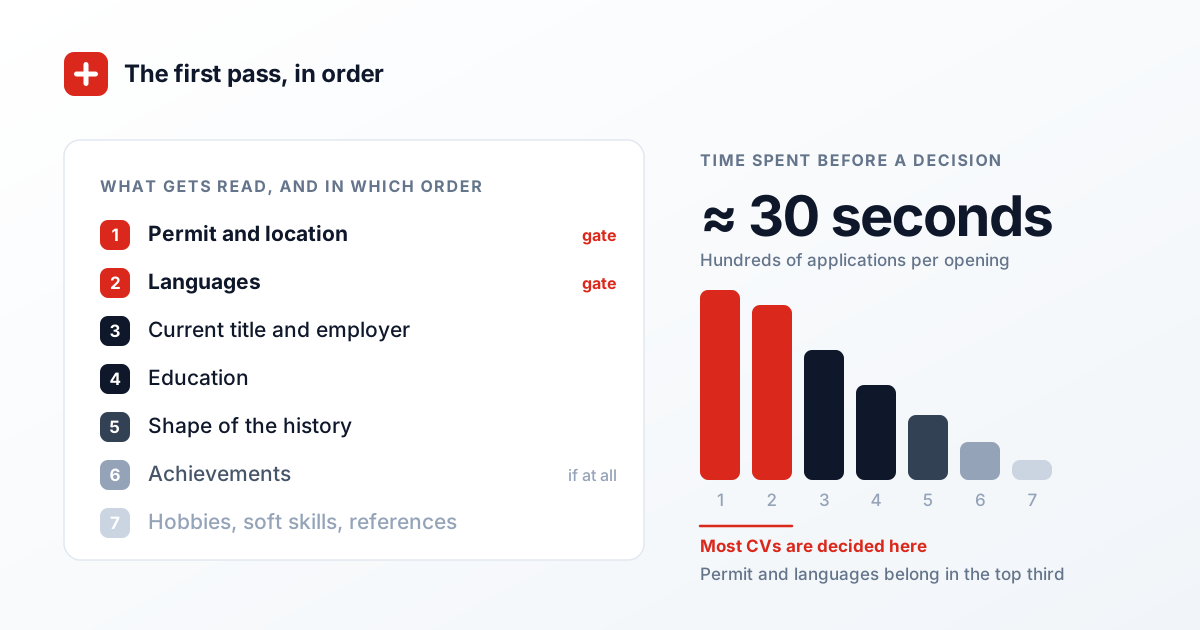
The first pass through an application follows a fixed order, and the point where it stalls after a break is called current title and employer. In a continuous career the top line answers that by itself. After two years out it answers with a year that has ended, and the reader has to turn the page to find out what is true now.
The test is mechanical. Cover the bottom half of page one. Is there a date in what remains that reaches into this year? If not, what is missing is the entry, not the experience. A course in progress with provider and completion date, a part-time assignment, a mandate, an unpaid role, at worst a line reading available from — any of them turns a finished history into a running one.
Position matters more than size here. The line does not have to impress; it has to be near the top. Anything filed under a closing section headed "other" is not read on the first pass at all, while what sits in the first few centimetres decides whether there is a second pass.
Pass three: work out what on your CV can actually age
The standard worry after a break is that everything is out of date. That is only testable where the market names names. Across the advert descriptions available to us, 11.1 per cent contain at least one product, software or system name. The field decides how much: IT and engineering 23.2 per cent, finance and fiduciary 17.4, commercial and administrative roles 17.0, logistics and production 14.6 — against retail at 2.3 per cent and hospitality at 0.9.
The work is therefore unevenly distributed. If you come from one of the upper fields, your CV has a block that genuinely expires — versions, systems, dated certificates — and refreshing it is the highest-value thing you can do with the last weeks of a break. If you come from retail, hospitality or care work, the adverts barely name a product at all, and time spent rebuilding a tool list is time spent on something the text never asks about.
The mirror image holds too. A certificate, licence or registration is named in 5.0 per cent of descriptions overall, but in 13.3 per cent of health and care adverts against 2.7 per cent in IT. In care work the thing with an expiry date is the proof, not the toolset. Test the field you are actually returning to rather than the one most articles are written about.
Pass four: what level does your top line claim?
After a long break the common reflex is self-demotion: the team leader applies as a case handler, the specialist as a contributor. There is not much in the market to justify it. 69.1 per cent of advertised job titles carry no level marker at all — no junior, no senior, no head, no deputy. The title names an occupation and stops.
Where a marker does appear it points upwards rather than down: 16.4 per cent of titles say head, lead or manager, 9.3 per cent say senior, 4.7 per cent describe a deputy role — and only 4.0 per cent say junior, trainee or intern. A market that almost never advertises the entry rung is not a market in which stepping down is the natural move.
For the check that means your top line sets the level, not the break. State the function your reference letters support, with the field beside it on the same line. Writing yourself smaller as a precaution means negotiating from the smaller line later, and then having to explain why the letters say something else.
Pass five: test it against three adverts open today
The last pass is the only one that starts with the market rather than the document. Anyone coming back from a break carries a picture of their own field that is roughly as old as the break. The stock you are applying into is not: half the open adverts are younger than 20.4 days, 58.9 per cent appeared in the last 30 days, and only 16.4 per cent are older than 90 days.
So take three adverts open today for the job you want and lay them beside the CV. Does every required term appear somewhere in your lines? Is the language level stated the way the advert states it? Is the function named with the same word that is in the title? That is a check with an outcome, unlike the question of whether the break is "bad", which has none.
And do not count on finding the same employer. 45.4 per cent of the employers in the index currently have exactly one advert open. The company you left three years ago is statistically not the company hiring today — which incidentally defuses the fear that everyone still remembers the month you walked out.
What this check does not do
It does not tell you how to narrate the break. That belongs in the covering letter and the interview, where different rules apply than on a CV. These five passes only make sure that the document being discussed holds together — that no date discrepancy, expired certificate or empty present drowns out the story you came to tell.
It is not legal advice either. If the break went on caring for a relative, the Code of Obligations grants a specific entitlement: under Art. 329h an employee is entitled to paid leave to care for a family member or life partner with health problems, limited to three days per event and ten days per year. Whether an employment relationship kept running in your case is a question for your contract, and if in doubt your compensation office.
And the market shares above are a floor, not a ceiling. They are measured on the advert descriptions available to us rather than the full advert texts, so a tool named only in the requirements block of the original page is not counted here. The ranking between fields is robust; any single figure is less so.
Market figures come from the ongoing analysis of the vacancies open on SwissJobs.app, 23 August 2026. Shares for tools and certificates are measured on the advert descriptions available to us and are therefore a lower bound; figures on job titles and posting dates are measured on the whole open stock.
Check how your CV fits a job — and the Swiss market
Free checker: languages, work permit, skills and more — scored against a specific posting.
ATS CV checker: against a specific advert, freeSources
- AHV/IV information service — leaflet 1.01 on the extract from the individual account: free of charge, social insurance number and postal address suffice, employer names for at least four years, correction within 30 days (published in German, French and Italian)
- InfoRegister of the Central Compensation Office — which compensation offices hold an individual account in your name
- Code of Obligations Art. 329h — paid leave to care for family members, no more than three days per event and ten days per year
- AHV/IV information service — leaflets, general section
Related questions
What our job index says about the Swiss market
Computed live from our own index, not quoted from a study. Shares only, as of today.
Language the advert is written in
- Deutsch
- 60%
- English
- 23%
- Français
- 13%
- Italiano
- 3%
Of adverts that state a language requirement, the share asking for
- Deutsch
- 70%
- English
- 43%
- Français
- 21%
- Italiano
- 3%
19% posted in the last 7 days · Largest markets: Zürich 18% · Bern 10% · Genève 5% · Basel 5%