How do I check a CV with overseas experience?
Updated:
In short
Check five places where a career built abroad stops being readable here: whether the profession is regulated, whether the qualification is placed against a Swiss level, whether a reader can tell what your former employers actually were, whether the language line answers this advert, and what replaces the Swiss employment reference you never received. The one thing you do not have to defend is the overseas part: of the Swiss adverts whose text we hold, 0.2 per cent ask for experience in Switzerland.
That share changes what the check is for. People arriving from abroad look for the line where foreign experience counts against them, and it is almost never on the page. What is on the page is a requirement about training and language: 31.4 per cent of adverts name a qualification or a course of training, 14.1 per cent name a Swiss abbreviation such as EFZ, CFC, AFC, HF or FH, and 66.7 per cent require German. Your dossier is not being judged by its passport. It is being read in a vocabulary it was not written in.
Nor will the advert do that translation for you. Only 0.8 per cent of the advert texts we hold open the door with a clause like "or an equivalent qualification"; among adverts that name a Swiss abbreviation at all, 2.4 per cent add one. The rest state a Swiss level and stop. The sentence that places your degree beside it has to come from your document.
Share of the English-language adverts whose text we hold. Ongoing analysis of the vacancies open on SwissJobs.app, 23 August 2026.
- Look your profession up on recognition.swiss before you touch a single line. The platform tells you whether your qualification has to be recognised at all and which body decides. Regulated and unregulated lead to two completely different CVs.
- If the profession is regulated, the status of the procedure belongs under the qualification, with a date rather than an intention: "recognition application filed 06/2026, first decision expected by 11/2026" is information; "recognition in progress" is not.
- If it is not regulated, nobody will place your qualification for you — so place it yourself: "Ingeniero Técnico Industrial (Spain, four years), comparable to a Bachelor FH". Alongside recognition, SERI issues a level certificate for exactly this purpose.
- You need an official translation less often than you expect. SERI asks for one only where the qualification was issued in a language other than French, Italian, German or English; passport or ID and the qualification in its original language are always part of the application.
- Give every foreign employer a bracket with place, country and what the organisation is: "regional hospital, public, 620 staff, Porto (PT)". A Swiss employer name carries its size with it; a foreign one carries nothing, and readers do not guess upwards.
- Test the language line against this advert, not against your self-image. Of the adverts that name German, 88.8 per cent want it at professional level and 8.4 per cent at conversational level. For recognition in the health professions the Swiss Red Cross accepts B2 certificates in German, French or Italian.
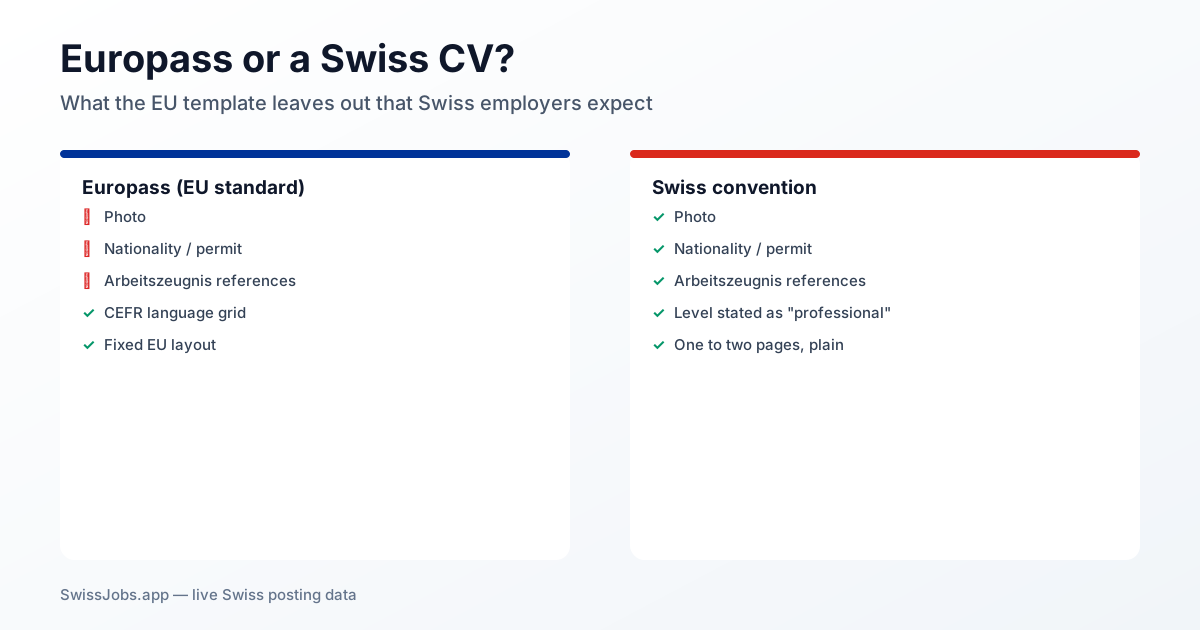
- Replace the employment reference you were never given. Under Art. 330a of the Swiss Code of Obligations an employee here may at any time request a reference covering the nature and duration of the employment relationship, the quality of the work and the conduct — your former employer abroad had no such duty, so two reachable referees with role, language and permission to be called have to carry that weight.
The fear, and what the adverts actually say
The question behind the question is usually: does my experience count here at all? The market answers by omission. Of the open adverts whose text we hold, 0.2 per cent explicitly ask for experience gained in Switzerland. In the English-language adverts the demand does not appear at all; in German-language adverts it appears in 0.1 per cent, in French-language adverts in 0.8 per cent and in Italian-language adverts in 1.1 per cent.
That distribution is the useful part. Where the demand does appear, it tends to sit in a trades, construction or healthcare advert from French-speaking Switzerland or Ticino, usually next to a CFC and a start date. If you are applying for an English-language role in Zurich or Zug, you will effectively never meet it. You cannot arm your CV against this sentence in general; you can only read the individual advert that contains it.
The reverse is almost as quiet. International experience or an international environment is mentioned in 0.9 per cent of adverts overall, and in 1.7 per cent of the English-language ones. Working abroad is neither a penalty nor a selling point in this market. It is a circumstance your document has to explain, because nothing else in the process will.
Place one: is your profession regulated?
SERI states the rule plainly: recognition is required to practise certain professions in Switzerland, several bodies run those procedures, and which one applies depends on your qualification. So the first step is not a writing step. You search your profession on recognition.swiss and learn whether your qualification must be recognised and who decides.
If the answer is "regulated", recognition is not an extra — it is the condition of being hired. In healthcare the procedure runs through the Swiss Red Cross, which recognises foreign diplomas and registers qualifications in the national register; anyone who wants to practise a regulated health profession needs a recognised diploma. In that case your CV needs exactly one line: the stage of the procedure, with a date. It answers the question that decides everything else, which is when you can actually start.
If the answer is "not regulated", the whole burden moves to you, because no authority is obliged to place your qualification. This is what SERI's level certificate is for: its online portal takes applications for recognition or for a level certificate of a foreign qualification. And if the work is short-term, a separate rule applies — providing a service in Switzerland for up to 90 working days per calendar year has to be notified to the authorities.
Place two: putting your qualification next to a Swiss level
Swiss adverts describe training in abbreviations that mean nothing outside the country. 14.1 per cent of the advert texts we hold contain one of them — EFZ, CFC, AFC, HF, FH, dipl. or the word "eidgenössisch". The same federal certificate is written differently in each language region: EFZ in 10.1 per cent of German-language adverts, CFC in 18.7 per cent of French-language ones, AFC in 17.2 per cent of Italian-language ones. In English-language adverts these abbreviations are essentially absent, at 0.1 per cent, which does not make the placing easier; it only makes it silent.
The check is to make every education line two-part: on the left the qualification exactly as your certificate names it, in its original language; on the right the Swiss level you place it against, using the word "comparable" and no inflation. "Licenciatura en Enfermería (Spain, four years) — nursing at HF/FH level, Swiss Red Cross recognition pending" answers both questions a reader has: what you studied, and where it sits here.
The missing right-hand side is the most common quiet failure in dossiers written abroad, and the advert rarely compensates for it. An "or equivalent" clause appears in 0.8 per cent of all advert texts, and in 2.4 per cent even of those adverts that name a Swiss abbreviation. The others name a level and say nothing further. Leave the gap and you hand it to someone who has twenty other applications in front of them.
Place three: employers nobody here has heard of
A Swiss employer name carries its size, sector and reputation with it. A foreign one carries none of that, so the same career reads completely differently depending on where it happened. The same role in an organisation of nine hundred people looks substantial when the name is known and vague when it is not. Go through every station and ask one question: does the document say what kind of organisation this was?
Four facts are enough and they fit in a bracket: place and country, type of organisation, size, sector. "Regional hospital, public, 620 staff, Porto (PT)" tells a reader more than three lines of duties. For groups with a Swiss presence, name the entity rather than only the group, or the order of magnitude lands wrong. And where a company no longer exists, write that down — a dissolved employer is not a gap, but an unexplained one is.
One market signal belongs in this pass too. Relocation support is mentioned in 1 per cent of adverts overall, in 3.3 per cent of the English-language ones and in 0.2 per cent of the German-language ones. Those are the employers who have hired from abroad before and for whom your CV is not an exception. When you are applying from outside the country, that word in the advert text is a better filter than any self-assessment inside your CV.
Place four: the language line, tested against one advert
Language is the requirement this market states most reliably. Of the adverts whose text we hold, 66.7 per cent require German, 40.2 per cent English, 20 per cent French and 3.8 per cent Italian. Even among the English-language adverts, 24.4 per cent also require German and 30.1 per cent name two or more languages. An English-language advert is an invitation to apply in English, not a guarantee that English is enough.
The level matters more than the language. Of the adverts naming German, 88.8 per cent want professional level, 8.4 per cent conversational and 2.5 per cent a native speaker. The distance between "German B1, course ongoing" and "German B2, certificate 05/2026" covers the majority of all vacancies in that distribution. Write the level, the evidence and the date — and where you have no evidence yet, write the exam date instead of an adjective.
In the regulated health professions the language level is part of the recognition procedure itself: the Swiss Red Cross accepts certificates at B2 in German, French or Italian, and they may have been obtained abroad. Anyone in that procedure therefore knows their target level officially, and can state it in the CV with the same precision the advert uses.
Place five: the employment reference that does not exist abroad
A Swiss dossier contains employment references, and there is a legal reason for it. Under Art. 330a of the Code of Obligations, an employee may at any time request from the employer a reference concerning the nature and the duration of the employment relationship, the quality of their work and their conduct; at the employee's express request it is limited to nature and duration. Because that right applies to every job here, readers expect the document — and stumble over a dossier without one.
Your former employer abroad had no such obligation, so the information has to arrive another way. Three pieces together do the job: a letter from the employer confirming the nature and duration of the employment, the contract or termination date, and two reachable referees with their role, their language and their permission to be contacted. Say in the CV what you can supply; silence is read as absence.
A second document belongs in the same line for regulated health professions. The recognition procedure requires proof that you are entitled to practise your profession without restriction — a Certificate of Current Professional Status or Letter of Good Standing — issued by the authority of the country where you last worked, and no more than three months old when you file. Anyone planning that procedure plans it backwards from that issue date.
What the check cannot do
Two limits are worth stating. First, there is no such thing as international recognition. SERI says so directly: there is no "international recognition" and no procedure valid for all countries, because every state decides on its own regulation and its own procedure. What counted in your last country counts here only as far as Swiss rules adopt it.
Second, procedures take time, and the dossier has to bridge that time rather than hide it. SERI confirms receipt of an application by email and sends a second email within four weeks with the next steps; in healthcare the first decision depends on a complete file. A CV that names the stage and the date keeps applying while the procedure runs. One that waits loses those months.
And the check cannot tell you whether this particular advert is worth your time. For that, put the document and one real advert side by side and read both against the same five places — profession, qualification, employers, language, evidence — in that order, because each later place becomes pointless once an earlier one is closed.
Market figures come from the ongoing analysis of the vacancies open on SwissJobs.app, 23 August 2026. The topic shares are based on the advert descriptions available to us rather than the complete advert texts, so they are a lower bound rather than an upper one. Language requirements come from the structured language field of the adverts and refer to those adverts that state a requirement at all. Splits by advert language cover the adverts whose language can be determined; the Italian-language group is the smallest, so its shares are the coarsest. We publish shares, never absolute index sizes. The statements on recognition, level certificates, documents and deadlines come from the State Secretariat for Education, Research and Innovation; those on the health professions from the Swiss Red Cross; and the wording on the employment reference from the Code of Obligations.
Check how your CV fits a job — and the Swiss market
Free checker: languages, work permit, skills and more — scored against a specific posting.
ATS CV checker: against a specific advert, freeSources
- SERI — Foreign professional qualifications in Switzerland: recognition is required to practise certain professions, and the responsible body is found via recognition.swiss
- SERI — Recognition procedure: application for recognition or a level certificate, required documents, official translation only outside French, Italian, German and English, reply within four weeks
- recognition.swiss — look up your profession: whether recognition is required and which body is responsible
- Swiss Red Cross (page in German) — recognition of foreign diplomas in regulated health professions, B2 language certificates, Certificate of Current Professional Status no older than three months
- Code of Obligations Art. 330a — the right to a reference concerning the nature and duration of the employment relationship, the quality of the work and the conduct
Related questions
What our job index says about the Swiss market
Computed live from our own index, not quoted from a study. Shares only, as of today.
Language the advert is written in
- Deutsch
- 60%
- English
- 23%
- Français
- 13%
- Italiano
- 3%
Of adverts that state a language requirement, the share asking for
- Deutsch
- 70%
- English
- 43%
- Français
- 21%
- Italiano
- 3%
19% posted in the last 7 days · Largest markets: Zürich 18% · Bern 10% · Genève 5% · Basel 5%