How do I check an English CV for Switzerland?
Updated:
In short
Check it in three passes, in this order. First the language: an advert written in English is not a promise that English is enough, because 28.8 per cent of English-language adverts also require a national language. Second the answer to the advert: 34.4 per cent of English adverts state a level in the job title and 20 per cent name a number of years of experience, against 6.7 and 0.5 per cent of German-language adverts. Third the form: even in its English version, arbeit.swiss expects a photograph, a three-page ceiling and reverse chronology. Proofreading comes last.
The order is not tidiness, it is arithmetic. Pass one can make the whole document irrelevant — if this advert wants to be answered in German, the best English CV is the wrong document. Pass two decides whether it gets read at all. Pass three takes twenty minutes and removes the things a Swiss reader recognises instantly as foreign. Start at the other end, polishing sentences, and you often perfect a document that pass one would have retired.
So the usual verdict on an English CV written for Switzerland is not «the English is weak». It is «this answers another market». A document built for London or Boston is tuned to a reader who has never seen an Arbeitszeugnis, does not read workloads as percentages, and cannot place a Swiss vocational title. A CV translated out of German has the opposite problem: formally clean, yet silent on precisely the things English-language adverts ask for out loud.
Share of English-language adverts that state each item explicitly. Rolling analysis of the Swiss adverts open on SwissJobs.app, as at 22 August 2026.
- Pass one, one minute: does the requirements block name a national language? 28.8 per cent of English-language adverts do — German in 24 per cent of all English adverts, and where German appears it is at professional level in 60.3 per cent of cases. Only about one per cent of English adverts state no language requirement at all.
- Pass two, level: 34.4 per cent of English adverts carry a level word in the title — Senior in 17.6, Lead in 6.4, Director in 4.2, Head of in 2.8 per cent. Across German-language adverts the same words together reach 6.7 per cent. An English CV with no visible level leaves an explicit question unanswered.
- Pass two, years: 20 per cent of English adverts name a number of years of experience. Five years is the most common demand, in 34.9 per cent of those adverts, then three years at 16.6 and ten years at 9 per cent. German-language adverts state such a number in 0.5 per cent of cases. Your total has to be readable without mental arithmetic.
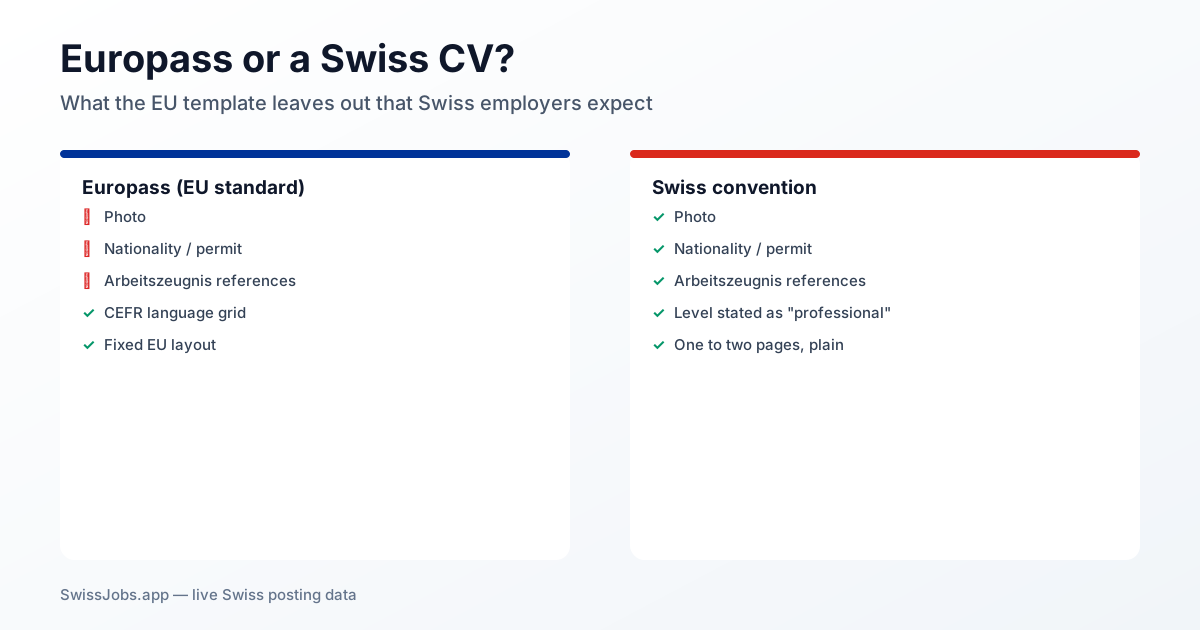
- Pass three, form: the English version of the arbeit.swiss application tips lists «personal details, including photograph», caps the CV at three pages, wants reverse chronology, expects the note that references are available on request, and asks for all documents in one PDF file. A US-style résumé breaks four of those five.
- What you must state yourself, because the advert does not: 39.9 per cent of English adverts name no employment type, against 2.1 per cent of German ones, and only 9.1 per cent put a percentage workload in the title. Availability, workload and start date belong in the document, not in the interview.
- The work pays off more than once: 27 per cent of English adverts share their job title with at least one other open advert, and they stay open for a median of 37 days against 18 days for German-language adverts.
Pass one: is English the right language for this particular advert?
About one in five of the Swiss adverts we hold is written in English. That reads like a straightforward invitation, and it is the single most misread figure in the whole application process. The language an advert is written in and the language it requires are two separate fields, and in almost three cases out of ten they disagree.
In numbers: 28.8 per cent of English-language adverts name a national language in their requirements. Across all English adverts that is German in 24 per cent, French in 9.4 and Italian in 1.2 per cent. The demand is rarely soft. Where German is required it is set at professional level in 60.3 per cent of cases and at native level in a further 5.9 per cent; conversational level covers barely a third.
So before you check a single line, read the requirements block and answer two questions. Is a national language named, and at what level? If it is, and at professional level, the English CV is not the problem — the application is. That advert belongs on a second list, and your evening belongs to one that does without the requirement.
The mirror case catches people just as often. When an advert is written in German and asks for English, the right answer is not an English dossier but a German one carrying a precise English language line. The language of the advert stays the most reliable rule this market offers. Only an explicit instruction inside the advert itself — «please submit your application in English» — beats it.
Pass two: does the document answer the questions this advert actually asks?
English-language adverts in Switzerland are noticeably more specific about the person they want, and that specificity is what makes them checkable. The clearest difference sits in the title. 34.4 per cent of English adverts state a level there: Senior in 17.6 per cent, Lead in 6.4, Director in 4.2, Head of in 2.8, plus Principal, Junior, Graduate and Trainee. In German-language adverts all of those words together account for 6.7 per cent, and Director practically never appears.
For the check this means: if the advert says Senior, your first ten lines have to earn the word — through your current title, through scope of responsibility, through team size or budget. An English CV built as a neutral list of duties leaves that question open although it was asked out loud. The same applies downwards. Applying to a graduate programme with twelve years of responsibility on display answers the question just as wrongly.
The second explicit question is a number. 20 per cent of English adverts state a minimum quantity of experience — five years by a wide margin, in 34.9 per cent of those adverts, then three years at 16.6, ten years at 9 and eight years at 8.3 per cent. German-language adverts state such a number in 0.5 per cent of cases. This convention belongs almost exclusively to the English-language part of the market, and it has an immediate consequence for your document: a reader who has to add your years up usually does not add them up at all.
The third is the qualification. 18.4 per cent of English adverts name a degree or a course of study, mostly in general terms; master's appears in 4.2 per cent, doctorates in 2.5, bachelor's in 1.6. An apprenticeship or vocational training shows up in 0.5 per cent. The person reading your English dossier is therefore likely to place academic titles and unlikely to place Swiss vocational ones. Your education line has to close that gap itself: year, institution, place, a comprehensible English name, and the original title in brackets behind it.
Pass three: is it still a Swiss dossier, or already a résumé?
This is where foreign templates reliably introduce errors, and it can be checked against an official source that exists in English on purpose. The English version of the arbeit.swiss application tips lists the components: the title «CV», «personal details, including photograph», professional experience to date, education and training, language skills, special knowledge or activities, personal interests or hobbies, and references. Then three hard rules: no longer than three pages, structured chronologically with the most recent job first, and all documents summarised in one PDF file.
One detail across the language versions is worth noticing. The German version writes «Persönliche Daten, gegebenenfalls mit Bewerbungsfoto» — personal details, with an application photo where appropriate. The English, French and Italian versions list the photograph as part of personal details without that qualifier. Build your English document photo-free out of Anglo-Saxon habit and you are departing from the English-language official recommendation, not merely from a German-speaking custom.
References are the second item. arbeit.swiss records that a CV normally notes that references can be provided on request, and that a separate sheet of referees may be handed over at the interview. Swiss work references themselves are not translated: they stay in their original language and go into the same PDF file, arranged chronologically with the most recent first. An English dossier that drops them because the template has no field removes the evidence for everything above it.
The third item concerns qualifications obtained abroad, which English dossiers carry far more often than German ones. The State Secretariat for Education, Research and Innovation states that recognition is required to practise certain professions in Switzerland, and the official portal recognition.swiss lets you look up, profession by profession, whether recognition is needed and which body handles it. For your document that translates into one line: if your profession is listed there, say where the procedure stands — under way, completed, or not yet filed.
What an English CV has to spell out, because the advert stays silent
English-language adverts leave more unsaid than German ones, and everything they leave unsaid your document has to answer. The starkest case is the employment type: 39.9 per cent of English adverts name none at all, against 2.1 per cent of German-language ones. Where a type is stated it is almost always full-time — part-time accounts for 2.8 per cent of the English adverts that state one, against 7.8 per cent of the German-language ones.
Workload behaves the same way. Only 9.1 per cent of English adverts put a percentage in the title, where German-language adverts do so in 29.1 per cent of cases. The Swiss notation — 80 per cent, 60 to 80 per cent — is not a given in the English-language part of the market, so it is something you supply if the workload you want is not a hundred. Keep the percentage notation rather than converting it into full-time equivalents, because that is the form Swiss employers plan in.
The same holds for two entries that are routine in a Swiss dossier and absent from most international templates: where you live, with a realistic commute, and the status of your residence or work permit. Both are points a reader has to be able to settle without writing to you. An English document that omits them produces exactly the follow-up question that rarely gets asked when two hundred applications are waiting.
Why the check earns its time back
A carefully checked English CV is not a one-off. 27 per cent of English-language adverts share their job title — with gender markers, workload figures and punctuation stripped out — with at least one other open advert. English titles also run slightly longer: an English advert uses a median of five words for its own job title, a German-language one four. Check the document properly against one of these recurring titles and the next application usually needs nothing beyond the top ten lines.
The second reason is the time you have. English-language adverts stay open for a median of 37 days, German-language ones for 18. 36 per cent of English adverts are more than two months old, against 23.5 per cent of German-language ones. That cuts both ways: more calm for a thorough check, and more applications already stacked ahead of yours. A document that only becomes clear on a second reading loses precisely in that situation.
This is why the order of the three passes pays twice. It stops you spending evenings on applications that the language requirement was always going to end. And it points the remaining time at the two things the English-language part of this market genuinely asks about: a legible level and a countable quantity of experience. Language polish, after that, is a question of consistency — one tense throughout, one date format, one name for the same thing — and not of accent-free English.
Market figures come from the rolling analysis of the Swiss adverts open on SwissJobs.app, as at 22 August 2026. «English-language» refers to the language the advert text is written in; requirement shares are calculated across all English-language adverts, of which about one per cent state no language requirement at all. For the title analysis, gender markers, workload figures and punctuation were removed. Statements about level words, year counts and qualifications are read from the advert title and its short summary, so they undercount rather than overcount. Advert age is measured from the publication date.
Check how your CV fits a job — and the Swiss market
Free checker: languages, work permit, skills and more — scored against a specific posting.
ATS CV checker: against a specific advert, freeSources
- arbeit.swiss (SECO) — Tips on applying for jobs: the official English version, with «personal details, including photograph», three pages, reverse chronology, references on request and one PDF file
- arbeit.swiss (SECO) — Bewerbungstipps: the same list in German, where the photo carries the qualifier «gegebenenfalls»
- SERI — Recognition of professional qualifications: recognition is required to practise certain professions in Switzerland
- recognition.swiss — official portal: look up your profession to see whether recognition is required and which body to contact
Related questions
What our job index says about the Swiss market
Computed live from our own index, not quoted from a study. Shares only, as of today.
Language the advert is written in
- Deutsch
- 60%
- English
- 23%
- Français
- 13%
- Italiano
- 3%
Of adverts that state a language requirement, the share asking for
- Deutsch
- 70%
- English
- 43%
- Français
- 21%
- Italiano
- 3%
19% posted in the last 7 days · Largest markets: Zürich 18% · Bern 10% · Genève 5% · Basel 5%