Creating a CV online in Switzerland — from the empty field to the finished PDF
Updated:
What actually happens when you build a CV in a browser: what to gather before you type, which language to write in, how to spin off a version per advert, and what has to come out at the end as a file. Grounded in the SECO guidance on arbeit.swiss, in the Federal Act on Data Protection, and in what the live adverts on SwissJobs.app really ask for.
How do I create a CV online?
In short
Six steps: gather your facts, pick the language, fill in the Swiss structure, tailor it to the one advert in front of you, export a PDF, name the file properly. Building it online does not make the CV prettier — it makes it reusable, because you enter your history once and spin off a version per application. That matters here: 68.3 per cent of the live adverts on SwissJobs.app carry a job title that appears exactly once in the whole index. Whatever tool you use, the end product is a file. SECO is explicit: “Save and send your application documents as PDF files.”
The real difference between a CV in a word processor and a CV in a browser is not the layout, it is what kind of object you end up holding. In a word processor you hold a document, and every new version is a copy you maintain by hand; by the third copy you are no longer sure which one is current. In a browser you hold a record with a view on top of it: dates, employers and language levels live in one place, and you generate as many finished versions as you send applications.
That is not a matter of taste, and the index says why. The median employer on SwissJobs.app has two open roles, and 45.4 per cent of all employers have exactly one. You will almost never apply to the same company twice, and practically never to the same job title twice. One standard version sent everywhere is, by construction, precisely right for none of them.
And the last step is always the same: a file somebody else has to open. Whether you email it or upload it into a form changes nothing. Which is why the export is not an afterthought — it is the step at which most tools either ask for money or drop a line with their own name into your document.
Shares among the live adverts on SwissJobs.app that state a readable language requirement — about three quarters of the stock. Measured on 21 August 2026. More than a quarter of them want two or more languages, and German paired with English is by far the most common combination.
- Collect first, type second. Month and year for every role, the employer name exactly as your reference letter spells it, the town, your job title, the workload. Those five fields are what stall you mid-form.
- Write in the language of the advert. Where that is ambiguous, the requirement decides: 27.4 per cent of adverts ask for at least one language that is not the language the advert itself is written in.
- Plan for a second version. Among adverts with a readable language requirement, 27.6 per cent want two or more languages — and 30.3 per cent of employers with three or more open roles advertise in more than one language.
- Copy the advert's job title into your CV word for word. The median title runs four words, and two out of three appear only once in the entire index, which is exactly what makes them worth copying.
- Languages as levels, not adjectives. A form field tempts you into “good”; what belongs there is “C1” or “mother tongue”.
- Three pages maximum. SECO: “A CV should be no longer than three pages.” A template that forces you onto one page is working against the official guidance, not for it.
- Export the PDF and then open it yourself, on a laptop and on a phone. What the editor shows you is a preview; the page breaks only happen at export.
- Name the file after yourself, not after the tool, and send it from an address that contains your first name and surname — both instructions come straight from the SECO application tips.
- Before you type the first field, check how you get out again: export, account deletion, right of access. Swiss data-protection law gives you those rights; only you can check in time whether the provider makes them easy.
Three different things all get called “online”
Before you click anywhere, it is worth separating three routes that all go by the same word. Only one of them produces a file you can take with you.
The first is an editor in the browser: you fill in fields, watch a preview, and download a PDF at the end. That is the route this question is about, and the only one whose output belongs to you. Everything that follows — an application form, a portal, an email — assumes that file already exists.
The second is the employer's own application form. You type into the boxes and submit. Convenient, but nothing survives it that you can reuse on the next advert, and most of those forms ask for a document upload anyway, because internally a file still has to be filed. Rely on this route alone and you retype your entire history for every application.
The third is a profile on a platform. A profile is useful for being found, but it is not an application: it has no cover page, no order you control, and no three pages anyone can print. If a specific role becomes concrete on a Tuesday afternoon, a profile leaves you with nothing to attach.
Step one: gather before you type
The most common reason a CV started online is never finished is mundane: halfway through the form, a date is missing. When exactly did the Winterthur job start, what was the company called after the merger, was it 80 or 90 per cent? You get up to find the reference letter and you do not come back.
So lay out five facts per role in advance: start and end month with year, the employer's exact legal name as your reference letter spells it, the town, your job title, and the workload. Add your qualifications with the year completed, and — if your diploma is foreign — where its recognition stands.
Which blocks must eventually be filled is not a matter of opinion. SECO lists them: title “CV”, personal details including a photograph, professional experience to date, education and training, language skills, special knowledge or activities, personal interests or hobbies, references. If your tool has no field for one of those blocks, it was not built for Switzerland.
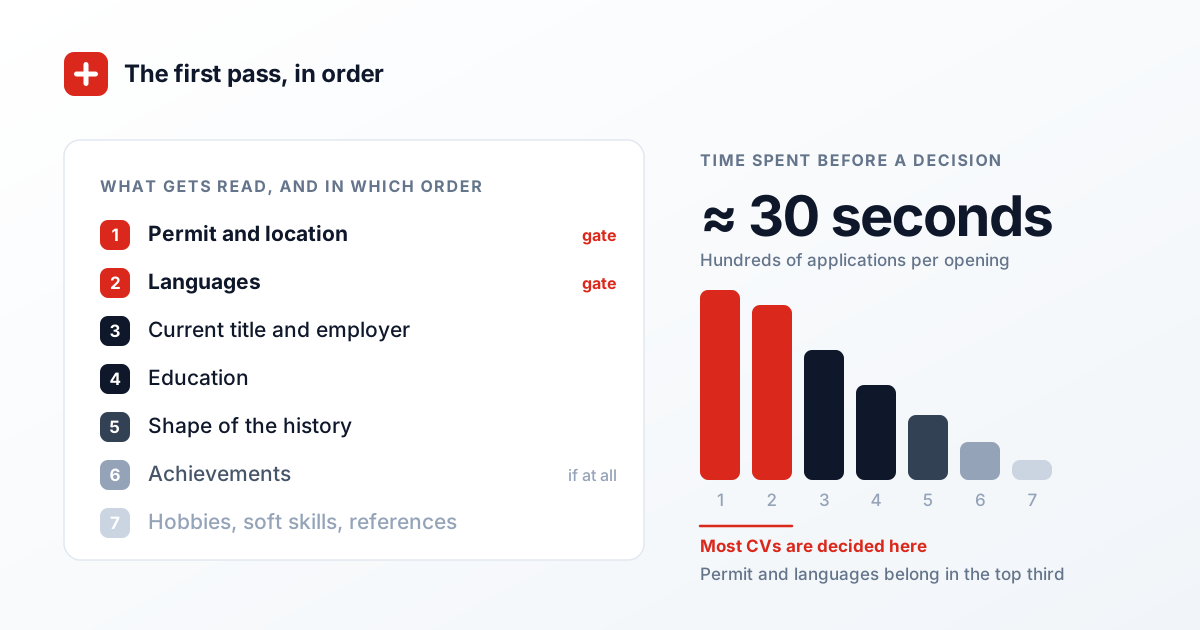
Then there are three lines no international template provides and that get read first anyway: where you live, your permit status, and the workload you can take on. They belong in the top third of page one, not on page two — which is also the order the illustration above sets out.
Step two: the language, and why it is often two
You do not settle the language question once for your career; you settle it per advert. The base rule is simple — write in the language the advert is written in, because that is the language the work is read and done in.
The catch is that the language of the advert is not always the language demanded. Among live adverts on SwissJobs.app where both the text language and the requirement are readable, 27.4 per cent ask for at least one language other than the one they are written in. An English-language advert from a Zurich employer that expects German at a professional level is not an edge case; it is a routine one.
How often that turns into a genuine second version is in the chart: of adverts with a readable requirement, 72.4 per cent name one language, 20.9 per cent two, 5.8 per cent three, and 1.0 per cent four or more. Within the group asking for two or more, English together with German is the dominant pairing at 47.8 per cent; German, French and English together account for 15.9 per cent, and French with German for 13.8.
This happens inside single companies too: 30.3 per cent of employers with three or more open roles advertise them in more than one language. Working online, the second language is a duplicate whose text you replace. Working in a word processor, you now maintain two files, and from that day they drift apart.
Step three: tailoring — the one step that is genuinely faster online
Tailoring is not rewriting. It means changing three to five places in the document so that the person who wrote the advert recognises their own vocabulary: the target title in the header, the order of the bullet lines under your most recent role, the special-knowledge block, and — if it fits — one line in your profile summary.
The highest-yield change is also the cheapest. Copy the advert's job title verbatim. The median title runs four words, and one advert in ten runs eight or more — short enough to actually retype. And it is remarkably specific: 68.3 per cent of live adverts carry a title that appears exactly once in the whole index, even after percentages and gender abbreviations are stripped out.
Turn that around and it is a warning. A CV headed “Accountant” going to an advert for “Accounts Receivable Specialist, dunning focus” has skipped the easiest available match. Online, that edit costs a minute, because you duplicate the version and change three fields. In a word processor it costs twenty, because changing the heading moves every page break after it.
You have time for this, but not unlimited time. The live adverts are a median 18.8 days old, the freshest quarter under 9.4 days, and 14.3 per cent went up within the last seven days. A CV that sits in draft for three weeks does not miss the market — it misses precisely the adverts it was being tailored for.
Step four: the export is where it goes wrong
A CV is not finished until the file is on your device and you have opened it. The instruction comes from the federal employment service rather than from any vendor: “Save and send your application documents as PDF files.” The length is equally unambiguous: “A CV should be no longer than three pages.”
Open the exported file twice — once on a computer, once on a phone. The editor preview is a preview; pagination only happens when the PDF is generated. The usual surprises are a fourth page carrying three lines, a photograph that softens on export, and accented characters in place names that were fine in the editor.
The second trap is the filename. Exports default to the name of the tool, or to “Document 1”. An HR inbox then holds twenty identically named attachments. Use your own name and the document type, and send it from an address that “ideally contains your first name and surname” — again, straight from the official application tips.
The third trap is commercial: with many providers the export is precisely the paid step. You build for an hour and meet a payment window, or a vendor line in the footer, at the moment of download. How often that happens and what it costs are counted in two other questions on this page. For the order of your own work it means one thing only: test the export with a half-filled document before you fill the whole thing.
What happens to your data once you type it into a form
A CV is the densest collection of personal data most people ever assemble about themselves: address, date of birth, nationality, permit status, every employer since your apprenticeship, usually a photograph. Build it online and that collection now sits with a company — and the question of how you get it back out tends to arrive only when it has become awkward.
Two rights in the Swiss Federal Act on Data Protection (SR 235.1), in force in its revised form since 1 September 2023, apply exactly here. Article 25 paragraph 1 gives anyone the right to ask a controller whether personal data about them is being processed; the answer has to cover the data itself, the purpose, how long it is kept and who receives it, and it is generally due within thirty days and free of charge.
Article 28 adds the handover. Where a controller processes your data by automated means and you supplied it with your consent or in connection with a contract, you can ask to receive it in a commonly used electronic format — or have it transferred to another controller, provided that does not require disproportionate effort.
In practice that is three checks, all better done before than after. Does an export give you the underlying details rather than just a picture of your CV? Can you delete the account without writing to support? Does the privacy notice say how long data is retained after deletion? A tool that is silent on all three is not one you hand your complete employment history to.
When you do not need a tool at all
If you already have a current CV in the right language, carrying the eight blocks SECO lists, three pages or shorter, and stored as a PDF, then your next application needs twenty minutes rather than a new tool: change the target title, reorder the bullets under your most recent role, check the language levels, export. Adopting a builder at that point costs more time than it saves.
Three situations argue for one. A genuine restart, where you have no CV or one older than your current job. A language switch, where you need the same facts in English and German on an ongoing basis rather than translated once. And volume, where you are applying in series and every version should carry the title of its own advert.
Our own position belongs here so you can weigh it. The CV builder on SwissJobs.app is part of the free account, the export costs nothing and carries no vendor line. What we charge for is the layer above — scoring a CV against one specific advert, the detailed check, and same-day matches. So we sell a subscription too; we just do not sell the export.
One closing caution about expectations: no tool turns a thin CV into a substantial one. What counts at the end are the facts you assembled before the first click — dates, employer names, workloads, levels. The rest is arrangement, and arrangement is the part a machine can genuinely take off your hands.
All market shares are counted from the live adverts on SwissJobs.app as at 21 August 2026. The denominators differ and are named in the text each time: language figures are shares of the adverts with a readable language requirement — about three quarters of the stock; figures on job titles, advert age and employers are shares of all live adverts. Job titles were normalised before comparison by removing percentage figures, gender abbreviations and punctuation. None of these numbers is a survey; they are counts of the adverts themselves. The content list, the PDF instruction, the page limit and the note on the email address are quoted from the “Tips on applying for jobs” page on arbeit.swiss (SECO), read on 22 August 2026. The rights quoted come from the Federal Act on Data Protection (SR 235.1) as in force since 1 September 2023, Articles 25 and 28, read on Fedlex; the German, French and Italian texts are the legally binding versions.
Write a custom CV for every job you apply to
Most people send the same CV everywhere. The editor rewrites yours against the posting — Swiss format, the right language, in about a minute.
CV maker & resume builder: for a specific advertWord template or online builder?
In short
Either one produces an acceptable application, because what you actually send is a PDF in both cases: SECO tells jobseekers to save and send the application documents as PDF files. The choice is therefore about editing, not about sending. Word suits you if you keep one CV and change it rarely. An online builder suits you if you need a different version for each advert. In a test, the same CV in five different file shapes gave back every word in the right order, so machine readability is not what decides this.
That removes the argument the marketing leans on hardest. "Word does not get read" and "only our format survives the scan" describe a failure that did not appear in the test — not with the two-column table almost every Word CV template uses for its date column, and not with the floating text box that designer templates put the name and contact details into. What is left is the question that genuinely costs or saves you hours: how often will you need to reissue the same career history in a different arrangement?
The adverts answer that, not the software. Seven in ten live adverts carry a job title that occurs exactly once across the whole index. And where the same title is advertised by three or more different employers, those employers disagree about which languages they want 62.1% of the time. One saved file rarely fits twice. If you apply once a year, Word gets you there faster; if you send ten applications a month, every manual edit is paid for in time you do not have.
Share of job titles where the languages demanded differ from one employer to another. Counted from the live adverts on SwissJobs.app on 22 August 2026, once per title and employer — a chain advertising the same shop role ninety times counts once. Only adverts with a readable language requirement are included. The five-or-more group holds fewer than two dozen titles, so read that bar as a direction rather than a precise figure.
- Choose on the number of versions you will need, not on the file extension. One application a year: Word is fine. Several a week: you need something that issues many outputs from one stored history.
- Send a PDF either way, and follow the official instruction to gather all the documents into a single PDF file. The CV itself should not run past three pages.
- Check your own file in two minutes instead of guessing. Open the PDF, select all, copy, paste into a plain text editor. If the text comes back complete and in the order you read it on the page, the file is readable. If it comes back scrambled, the template is the problem, not the route you took.
- Before sending a Word file, open File → Info → Properties once and look at the author name stored in it. On a downloaded template that name is not always yours.
- If someone explicitly asks for an editable file, send an editable file. That is the one case where Word is the right answer, and it is not a reason to move the rest of your application back into it.
- Whatever template you open, check first that it has a place for permit and nationality, workload and availability. If those lines are missing, the beautiful layout costs more than it gives.
Word template or online generator
| Criterion | Word template | Online generator |
|---|---|---|
| Usable without an account | yes | partly |
| You own the file | yes, permanently | requires an export |
| Layout survives editing | no, it shifts | yes |
| Maintaining several versions | manual and error-prone | the actual advantage |
| Swiss fields provided | only if the template has them | if the tool knows the market |
| Offline | yes | no |
| When to use which | one application, text already written | an ongoing search, many variants |
A Word file is yours and works without an account or an internet connection. A generator takes the layout off your hands. Which is better depends on whether you need one document or keep adapting one.
The format question is settled before the tool question starts
The official tips page on arbeit.swiss, run by SECO, states it without qualification: "Save and send your application documents as PDF files." A few lines above sits the second instruction — "All documents should be summarised in a PDF file" — with reference letters complete, in chronological order, most recent first, and the same treatment for diplomas and certificates. On length: "A CV should be no longer than three pages."
That makes the opening question smaller than it looks. Word is not a delivery format, it is a writing program. An online builder is not an application, it is a form with a print function. Both produce the same kind of file the moment you click export or save as PDF. Framing the decision as "Word versus PDF" compares a tool with a result.
In practice, the last step is identical whichever route you take: export as PDF, name the file the way arbeit.swiss asks for — it calls explicitly for "clear and correct file names" — and send it from an address that carries your first name and surname.
The test: one CV, five file shapes
To check the claim that gets repeated most often, a fictional Swiss CV of 236 words was written out: a header with name, address, year of birth and permit status, a short profile, four roles with dates and duties, then education, languages, IT and references. The identical wording was then poured into five different files.
Three of them are Word files: one as plain paragraphs, one using the two-column table that nearly every CV template relies on for its date column, and one with the header block inside a floating text box, the way designer templates handle the name bar. Two are PDFs printed from a browser: one single-column, one with a two-column sidebar layout.
Each file was then read back with widely used text extractors — the same way a receiving system sees the content. The result: all five returned all 236 words. In every file the date still sat immediately next to the role it belongs to, and the name block was present throughout. Nothing was dropped and nothing was reordered.
Two limits belong with that. The Word files were written directly to the Office format rather than saved out of Word, so what was tested is the format and not every quirk of the program. And a file exported from a graphics tool was not part of the test. The finding is therefore not "everything always parses" — it is that you can look at your own file instead of believing either sales pitch.
What a template really decides is which fields exist
The difference that matters in practice is not the file extension but which lines the template offers you at all. Most freely available Word templates are built for an international or American CV. They have a row for the job title and one for the school, but none for nationality and permit, none for the workload you are looking for, none for your availability, and none for the line saying references are available on request.
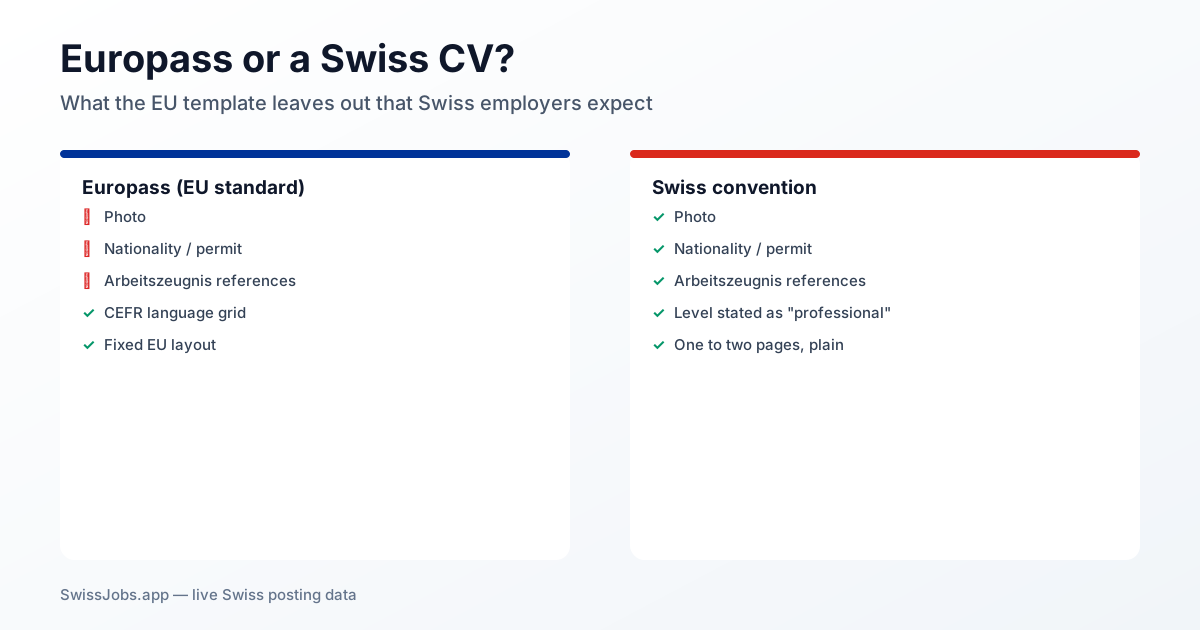
Those are exactly the lines a Swiss reader expects to find. The EU Europass form leaves them out as well: it brings a language grid but no place for a photo, for nationality and permit, or for the reference letters the rest of the file rests on.
Download a template and you inherit its idea of what an application contains. The counter-check takes a minute: open it and look for somewhere to put permit, workload and availability. If there is nowhere, you will have to build it yourself — at which point it is no longer a finished layout but a building site full of somebody else’s styles.
How often you will have to reassemble the same CV
This is where the two routes genuinely part company, and it can be measured in the adverts. Seven in ten live adverts carry a job title that appears exactly once in the whole index; counted across distinct titles rather than adverts, 88% occur only once. The advert in front of you is usually a one-off, even when the occupation is a common one.
It gets sharper where the same title does repeat. Counting each title once per employer, titles carried by at least two different employers show a different language demand in 35.1% of cases; from three employers onwards it is 62.1%. Behind the title "HR Business Partner" sit eight different employers and seven different language demands, from German alone through German with English to German, Italian and Romansh.
Time pressure comes on top. The median live advert is 19 days old and about a quarter are no more than 10 days old. You have days, not weeks, to produce a version that fits. Duplicating a document, renaming it and rewriting it by hand each time spends that time exactly where it is scarcest.
And the language question is not a fringe case: among the adverts that state a readable requirement — roughly three quarters of the index — 27.6% want more than one language. Which ones only the individual advert can tell you.
When Word is the better answer
Word wins when you are already there. A well-kept CV that has lived in one file for years and gains a line once a year does not need to move. Transferring it into a form only pays off once you are producing several versions.
Word wins, second, when you want to work without an account and without a connection. The file sits on your machine and nowhere else. If that matters to you, it is a substantive argument, and not a small one.
Word wins, third, when someone explicitly asks for an editable file. That happens when an agency reformats a dossier before passing it on. The right response is to send exactly what was asked for, and to keep sending PDFs everywhere else.
The price is maintenance. Any structural change — one line more, one role fewer — can move the page breaks, and in templates built on tables and text boxes it moves the layout too. Plan on looking at page two again after every edit.
When the online route is the better answer
A builder wins as soon as one application becomes many. You enter your history once and then issue a separate arrangement per advert without touching the layout again: a different order of emphasis, a different language line, a workload that matches what the advert asks for. That is precisely the work the counts above say comes up regularly.
It wins, second, because the skeleton is already standing. A form that asks about permit, workload and language levels prevents the gaps you overlook in an empty template. And it wins, third, wherever Word is not installed — on a phone, on someone else’s computer, in a library.
Two costs sit against that, and both are worth settling first. Your details then live on somebody else’s server, so check whether you can delete the account and the data again. And before investing an hour, check that the export really is free and comes out without a vendor line at the foot of the page. The quickest way to find out is to click all the way through to the download once.
The hybrid is legitimate and common: keep the versions online, send the PDF from there, and hold a Word copy for the rare request for an editable file. What does not work is maintaining both stores in parallel — then two versions of the truth exist, and sooner or later the older one goes out.
The quotations on PDF, file naming, page count and email address are taken verbatim from the "Tips on applying for jobs" page on arbeit.swiss (SECO), retrieved on 22 August 2026; the same instructions were checked the same day in the German, French and Italian versions of that page. The readability test was run on 22 August 2026 with a fictional CV of 236 words: three files in the Word format — plain paragraphs, two-column table, header in a floating text box — and two PDFs printed from a browser, single-column and two-column, all read back with widely used open-source text extractors. The Word files were written directly to the Office format rather than saved out of Word, and a file exported from a graphics tool was not part of the test. All market shares are counted from the live adverts on SwissJobs.app as at 22 August 2026. The denominators differ and are named in the text: language figures are shares of the adverts with a readable language requirement, roughly three quarters of the index; title and advert-age figures are shares of all live adverts. Job titles were normalised before comparison — percentages, gender tags and punctuation removed — and counted once per title and employer. None of these figures is a survey; they are counts of the adverts themselves.
Write a custom CV for every job you apply to
Most people send the same CV everywhere. The editor rewrites yours against the posting — Swiss format, the right language, in about a minute.
CV maker & resume builder: for a specific advertCan I build a CV on my phone?
In short
Yes. A phone produces a complete CV as long as the last step is a PDF file — SECO tells jobseekers to assemble all documents into one PDF. The difficulty is not the writing, it is the sending. Every live advert on SwissJobs.app hands you off to somebody else’s application form, and when we opened the fifty largest of those systems on 22 August in a phone browser, 49 out of 50 served a page built for a phone screen. The route is mobile-ready almost everywhere; what has to be ready is your file.
The Swiss context makes this less of a niche question than it sounds. The Federal Statistical Office reports that 98.8 per cent of people in Switzerland used a mobile device to go online in the three months before the survey — behind only the Netherlands and Denmark in Europe, and well above the EU-27 average of 92.6 per cent. For a large share of jobseekers the phone is not the second device. It is the device.
The part that genuinely changes on a small screen is how many different forms you have to pass through. The live adverts route into more than two thousand four hundred distinct application systems. The biggest single one carries 10.6 per cent of adverts, the ten biggest 32 per cent, and 45.1 per cent of all systems appear exactly once in the whole set. Apply to twenty adverts and you meet, on average, 17.3 different forms. That is why the finished file matters so much more than the form-filling: it is the only thing that works identically in all seventeen.
- Write on the phone, export to PDF immediately. A CV that exists only inside a browser tab or a notes app does not exist for any application form. The file is the deliverable, not the text.
- Save it where the phone file picker can see it. An upload field in a mobile browser offers you the Files app and your connected storage, not your chat history. A CV sitting as an attachment in a messenger has to be saved out first.
- Do not photograph a printed CV. Two of the large international systems we opened list exactly .pdf, .doc, .docx, .txt and .rtf as accepted — no image format at all. A camera picture is refused by the form before a human ever sees it.
- Watch the size ceiling. The visible limits on the forms we checked ranged from 5 MB to 100 MB, several of them at 5 or 10 MB. Full-resolution camera images of reference letters blow past that; a scan saved as PDF stays well under.
- Expect no camera shortcut. None of the upload fields we inspected offered to open the camera directly. You always pick an existing file — so the file has to exist before you start.
- English is not the exception here. 20.2 per cent of live adverts are written in English, and in the Zurich area that rises to 35.5 per cent of adverts whose language can be identified. The systems behind English-language adverts are the international ones, which is exactly where the strict format lists appear.
- Use the speed you gain. 18.3 per cent of live adverts are at most seven days old and 8.7 per cent at most three. An application sent from a platform bench still lands in the first pile.
What we actually tested, and what came back
The honest answer to this question does not depend on what any CV tool can do. It depends on what happens after you press apply, because that part is out of your hands and out of ours. So on 22 August we took the fifty largest application systems sitting behind the live adverts on SwissJobs.app — together they carry 51 per cent of all adverts — and opened one real advert on each from a phone browser.
Fifty answered. Forty-nine of those fifty served a page explicitly laid out for a phone-sized screen; one did not. That is a stronger result than the question implies: applying from a phone is no longer an edge case that employers tolerate, it is the case their systems are built for. What is not built for you is the file itself, and that is where phone applications fail.
Five of the fifty exposed their upload field in the page itself, which is where the accepted formats are written down in plain text. Two large international boards accept .pdf, .doc, .docx, .txt and .rtf — no image types are on the list. One Swiss system additionally takes .jpeg, .jpg and .png, capped at 15 MB. Others published ceilings of 5 MB, 10 MB and 100 MB. Not one of them set the field to open the camera directly.
You do not learn one form, you meet seventeen
Switzerland does not have two or three dominant portals that everyone applies through, and that shapes the whole experience of applying from a phone. The live adverts lead into more than two thousand four hundred separate application systems. The largest covers 10.6 per cent, the ten largest 32 per cent, the fifty largest 51 per cent, the hundred largest just under 60 per cent. Everything else is a long tail in which 45.1 per cent of systems appear exactly once. On the employer side the picture matches: 45.4 per cent of employers with a live advert have exactly one.
Translated into an ordinary job hunt, that gives the number that answers this question. Ten applications put you in front of 9.2 different systems on average, twenty in front of 17.3, thirty in front of 24.8. There is effectively no learning curve to climb — each form asks in a different order, labels the attachments differently and validates differently.
So the thing to optimise is not your speed at filling forms. It is the readiness of what you attach: one CV as a PDF, one letter as a PDF, references collected into a third. Twenty minutes of preparation, once, that pays back on every single application regardless of which of the seventeen systems you land in.
The English-language slice, and why it has the strictest rules
If you are applying in English in Switzerland, the systems you meet are not the same ones a German-language applicant meets. Among adverts written in English, the leading destinations are the big international applicant platforms — Greenhouse-hosted boards together account for the largest share, followed by Ashby and Lever. Among German-language adverts the leaders are Swiss systems instead. The English-language slice is substantial: 20.2 per cent of all live adverts, and in French-speaking Switzerland English accounts for 33.9 per cent of adverts whose language can be identified, second only to French.
This matters for a phone user because the international platforms are precisely the ones that publish a closed list of accepted file types. That is not an obstacle; it is a specification. Produce a PDF and every one of them takes it. Produce anything the phone generates by default from a camera and roughly half of them will not.
It also means the language question and the device question are independent. Nothing about applying from a phone changes which language you should write in — that is decided by the advert. What the phone changes is only whether the file you attach is a document or a picture of one.
Who asks this question — and why the market agrees with them
The assumption that a CV is naturally written at a desk fits the Swiss labour market badly. Add up the fields where almost nobody spends the working day in front of a screen — retail and sales, care and nursing, construction and trades, hospitality, logistics, cleaning and building services — and you get 20.7 per cent of all live adverts. Sales alone is 7.4 per cent, care 6.3 per cent.
These are exactly the occupations where writing a CV on a phone is not a convenience but the only realistic option. Shift workers do not apply between nine and five from an office computer. And the market rewards moving quickly: the median live advert is 19 days old, 18.3 per cent are a week old or less, 8.7 per cent three days or less. In hospitality and care 18.2 per cent of adverts are under a week old; in construction only 12.6 per cent.
Nothing on the receiving end reveals the device. An application form records the file, not the hardware that selected it. What is visible is the document — its name, its structure, its length.
Reference letters, scans and the single PDF
The part of a Swiss application where a phone is genuinely the better tool is not the CV. It is the attachments. SECO states that reference letters must be complete and in chronological order with the most recent first, and that all documents should be summarised in one PDF file — the same for diplomas and certificates. If those papers exist only on paper, the skill you need is scanning, not typing.
A phone is a good scanner as long as you use the scanning function rather than the camera. Google documents this for Drive on Android: scan documents and save them as searchable PDFs. The difference is not cosmetic. A photo is an image, and image formats are refused outright by a share of the application forms above. A scan is a PDF with squared-off edges and a file size that stays under every ceiling we found.
Do it once, in the right order, into a single file, and name it so it is identifiable without opening it — surname, document type, year. From then on each further application is a matter of minutes, wherever you happen to be standing.
The three things a bigger screen still does better
There are exactly three moments where a phone is the worse place, and all three are about seeing rather than typing. First, pagination: whether your CV runs to one page or two, and whether the break falls in the middle of a role, is invisible in a shrunken preview. Second, column widths, if your layout has two columns. Third, comparing two versions side by side.
All three are solved by one pass at any larger screen before you send the first application, or by opening the PDF full-screen on the phone and zooming in deliberately. After that the file is settled and each advert only changes the content, not the layout.
If no computer is available at all, public libraries, the regional employment offices and many municipalities provide workstations. A single visit is enough to fix layout and page breaks permanently. Everything after that — tailoring, exporting, uploading — stays on the phone.
Market figures computed on 22 August 2026 from the live adverts on SwissJobs.app. The application-form check was run the same day: the fifty largest application systems behind those adverts were opened in a phone browser and checked for a page explicitly built for phone widths, plus whatever their visible upload fields declare. Mobile internet figures are from the Swiss Federal Statistical Office.
Write a custom CV for every job you apply to
Most people send the same CV everywhere. The editor rewrites yours against the posting — Swiss format, the right language, in about a minute.
CV maker & resume builder: for a specific advertSources
- arbeit.swiss — tips on applying for jobs (all documents in one PDF file)
- Fedlex — Federal Act on Data Protection (FADP), SR 235.1
- FDPIC — Federal Data Protection and Information Commissioner
- Swiss Federal Statistical Office — devices used to access the internet
- Google Drive Help — scan documents and save them as PDFs
Related questions
What our job index says about the Swiss market
Computed live from our own index, not quoted from a study. Shares only, as of today.
Language the advert is written in
- Deutsch
- 60%
- English
- 23%
- Français
- 13%
- Italiano
- 3%
Of adverts that state a language requirement, the share asking for
- Deutsch
- 70%
- English
- 43%
- Français
- 21%
- Italiano
- 3%
19% posted in the last 7 days · Largest markets: Zürich 18% · Bern 10% · Genève 5% · Basel 5%