Should I apply directly to the company or through a job board?
Updated:
- Should I apply directly to the company or through a job board?
- Apply on the company site or through the job board — which is better?
Should I apply directly to the company or through a job board?
In short
In the overwhelming majority of cases you apply directly to the employer anyway — even when you found the advert on a job board. About half of Swiss adverts lead you to a page belonging to the company itself, roughly a third into an applicant tracking system, and about one in six to a job board or agency portal. The question of "direct or via a board" describes a contrast that barely exists in practice.
The Swiss job portals at a glance
Click an image for the full-size view. What each portal actually is stands beside it.
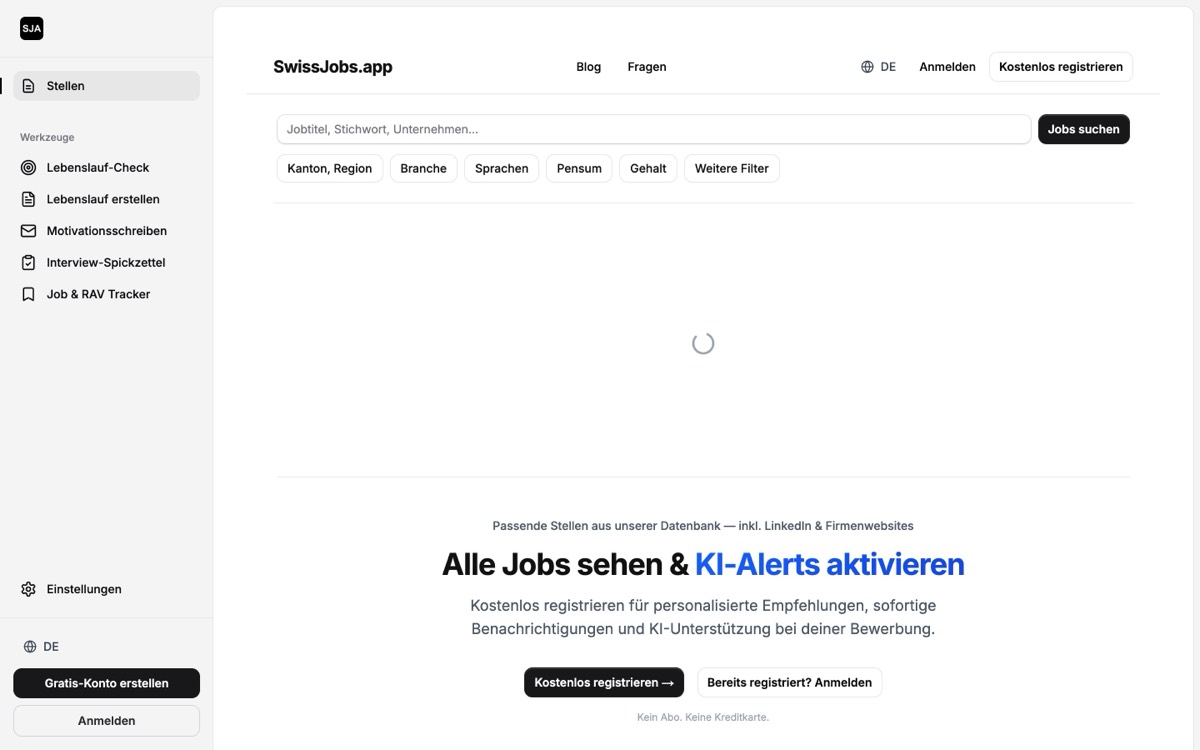
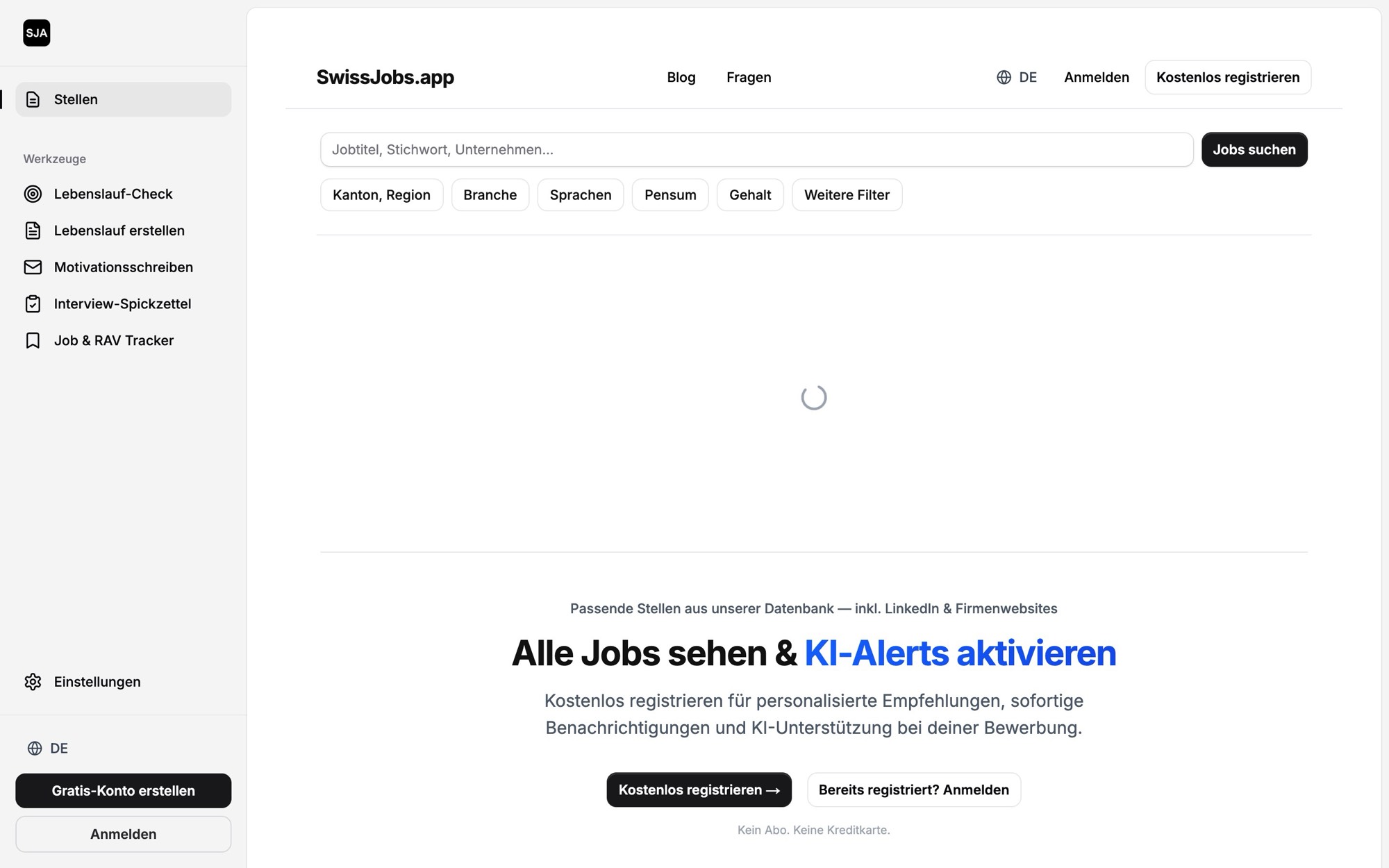
1. SwissJobs.appOur app
Over 21,000 open Swiss roles from ATS systems, company sites and LinkedIn in one place — and from any advert, straight into a CV, a motivation letter, a CV check and interview prep. The RAV job-search-efforts form fills itself from your application tracker. Free to use; the account is asked for at save.
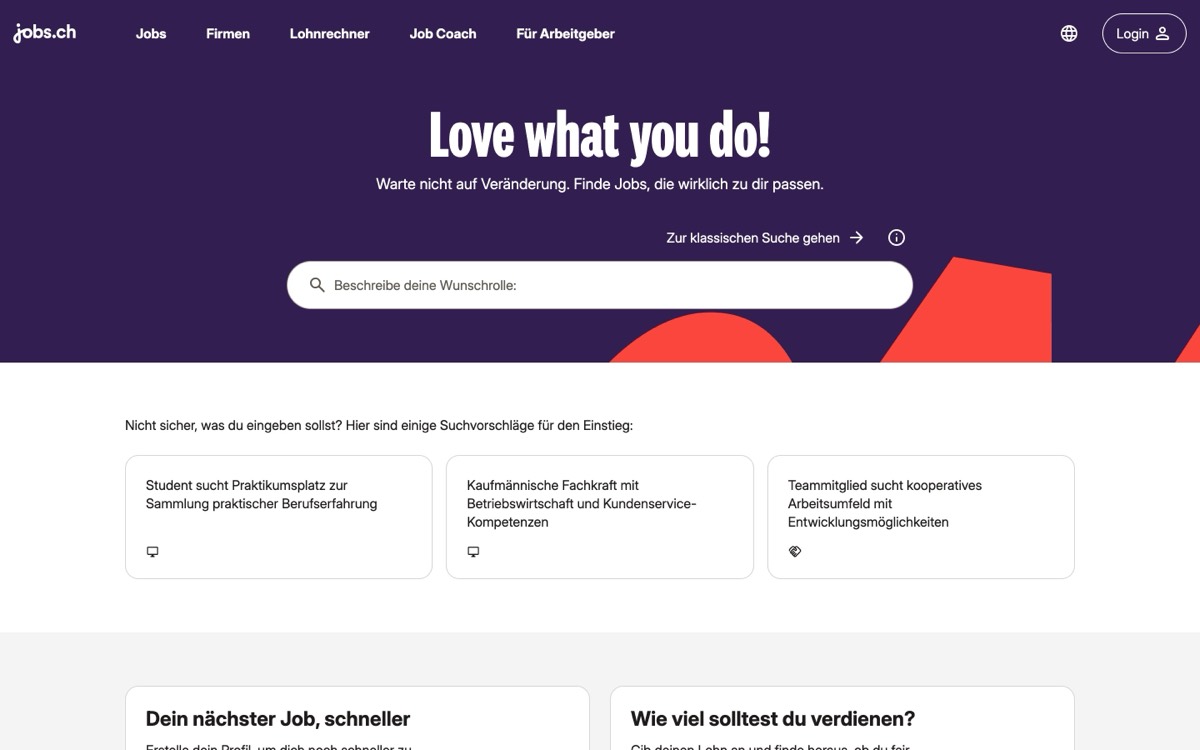
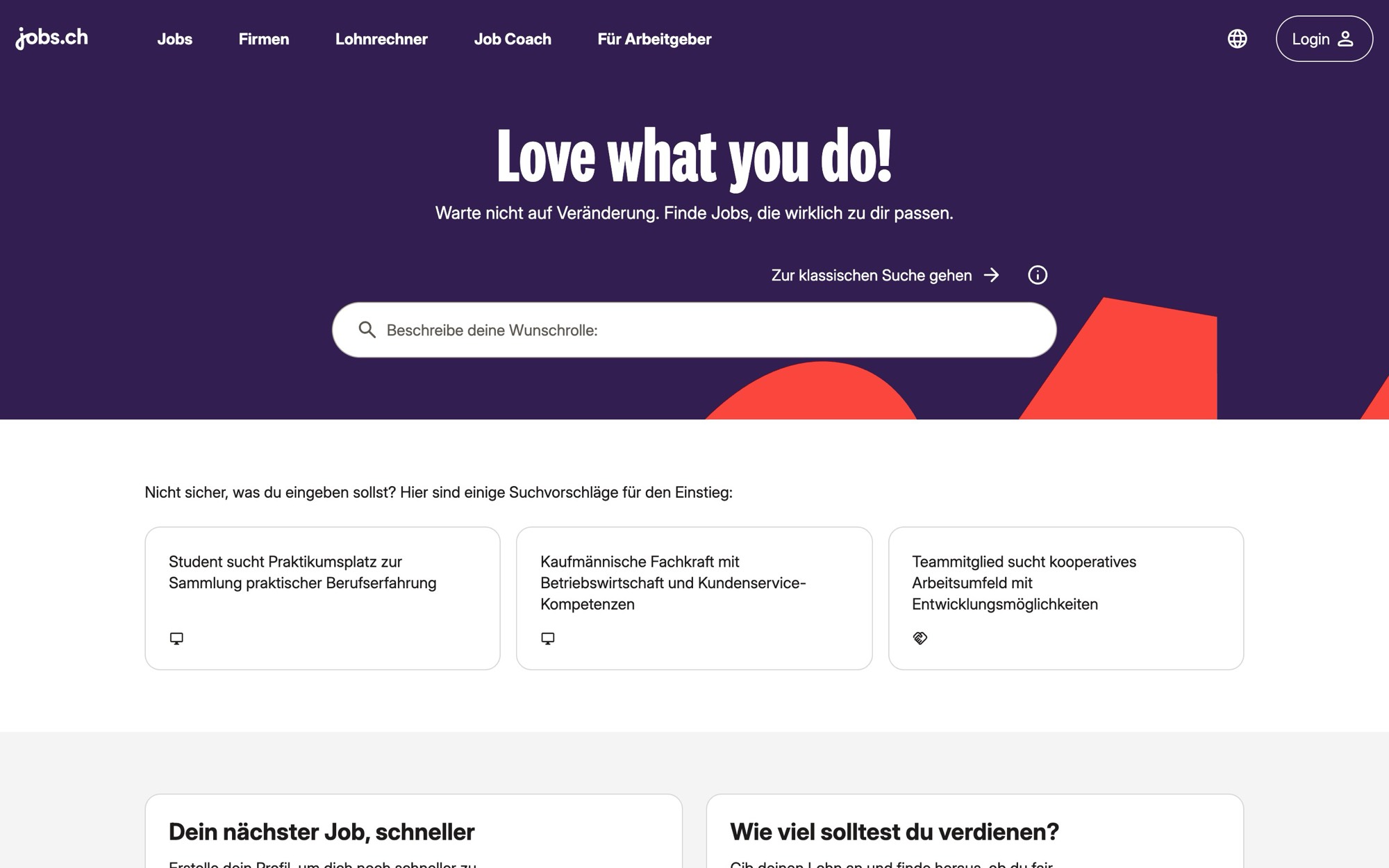
The best-known board in German-speaking Switzerland and the largest index in the country. Owned by JobCloud AG — as are jobup.ch and JobScout24.
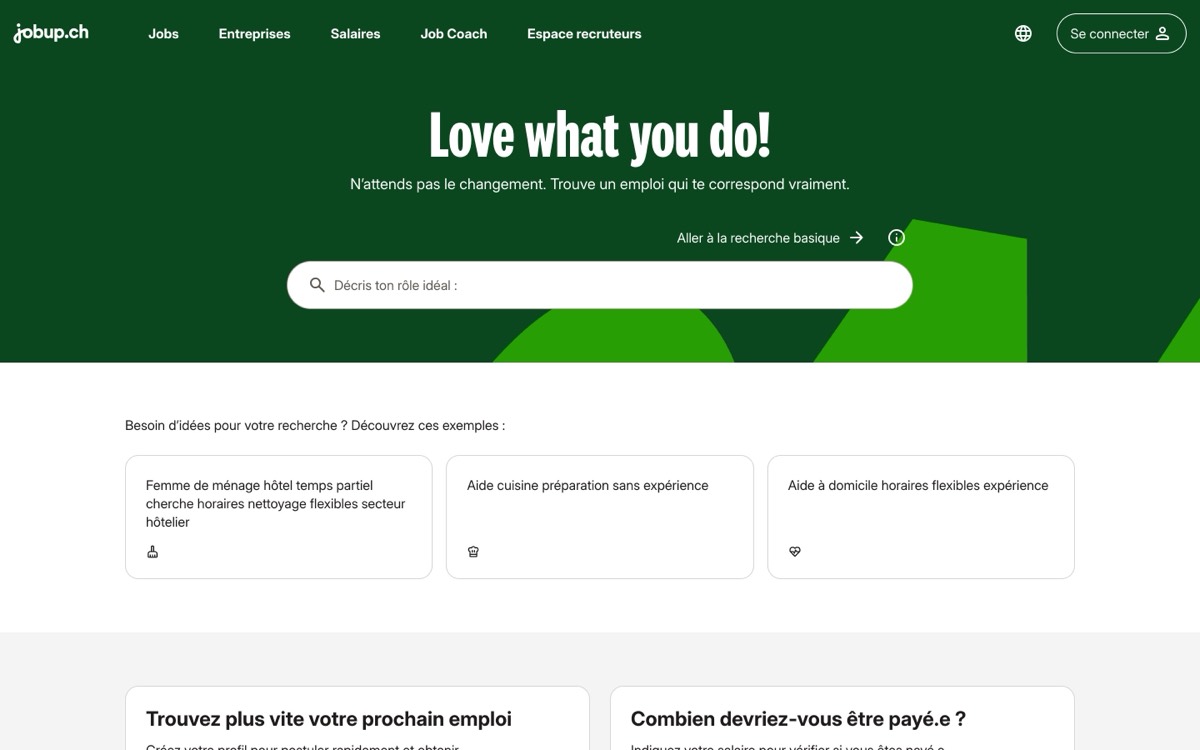
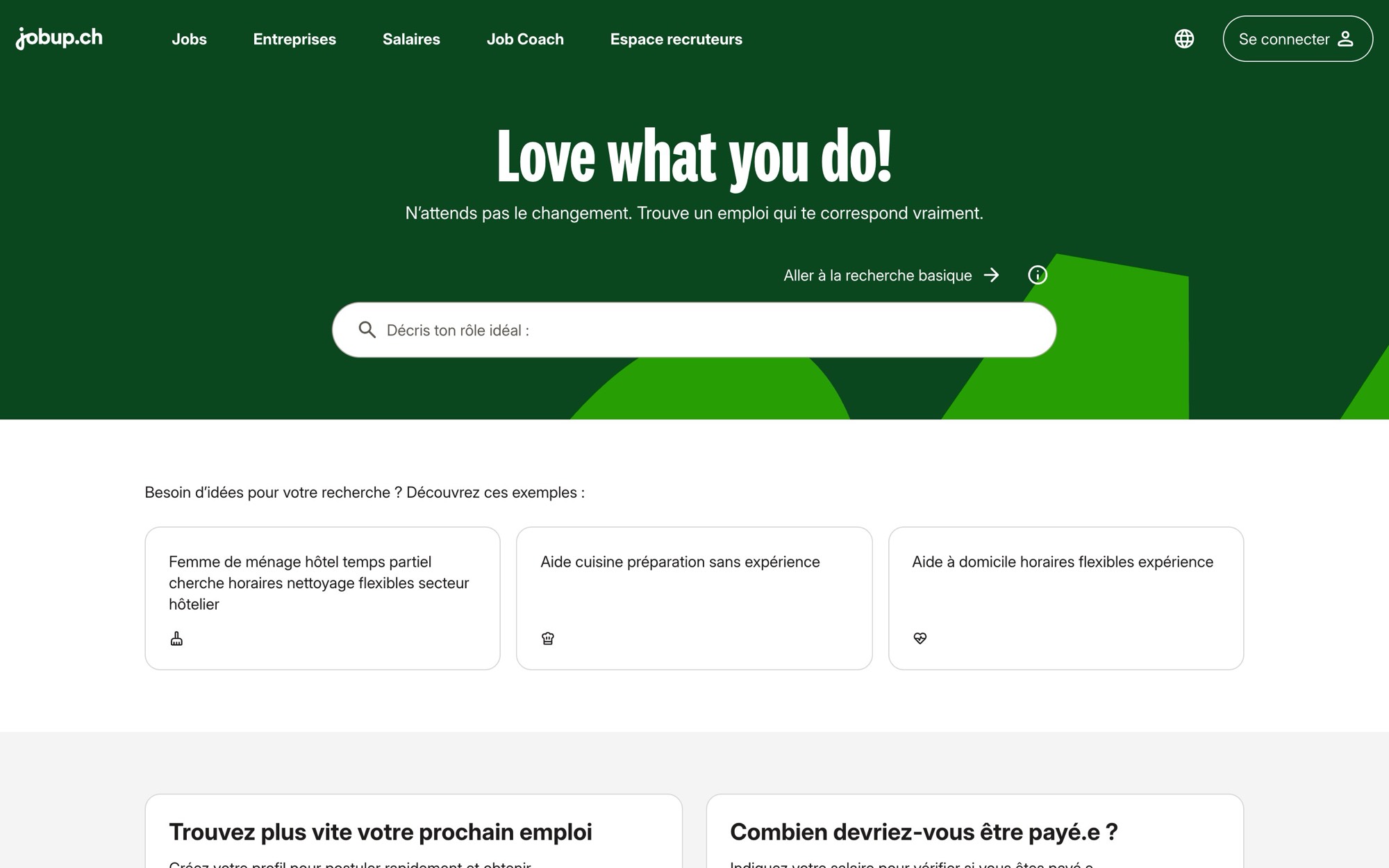
The standard in French-speaking Switzerland and the first place to look for the Romandie — but the same JobCloud AG as jobs.ch.
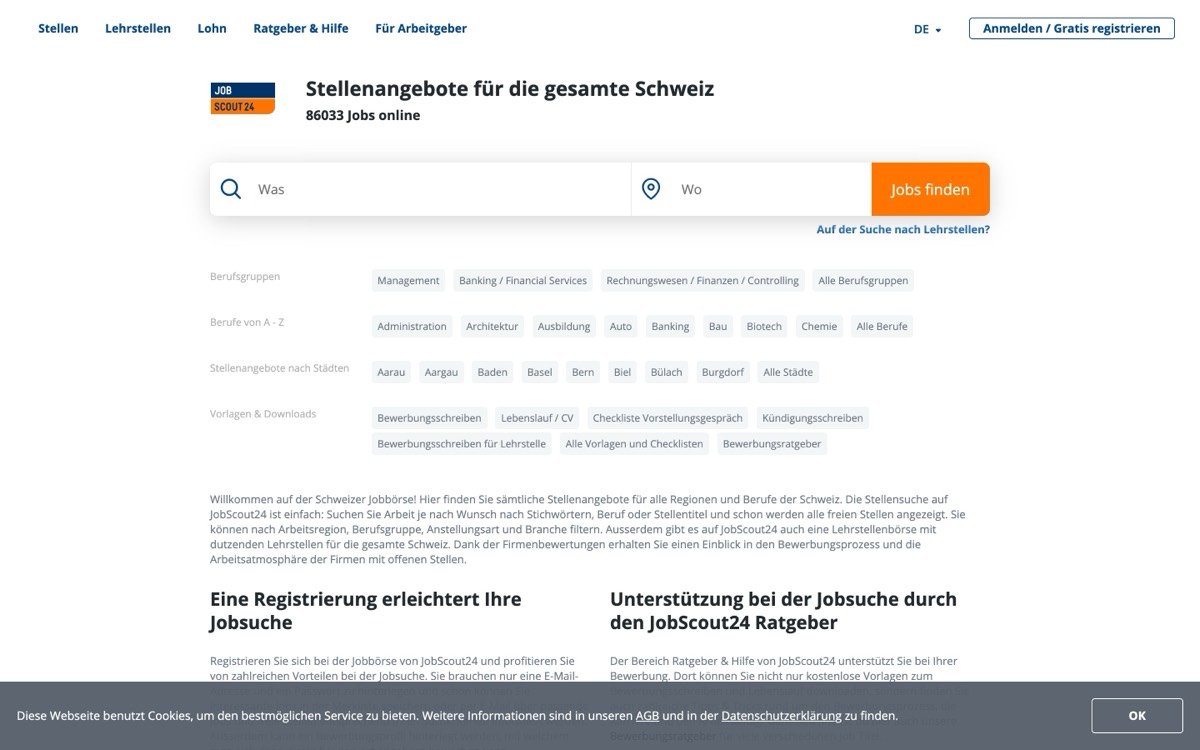
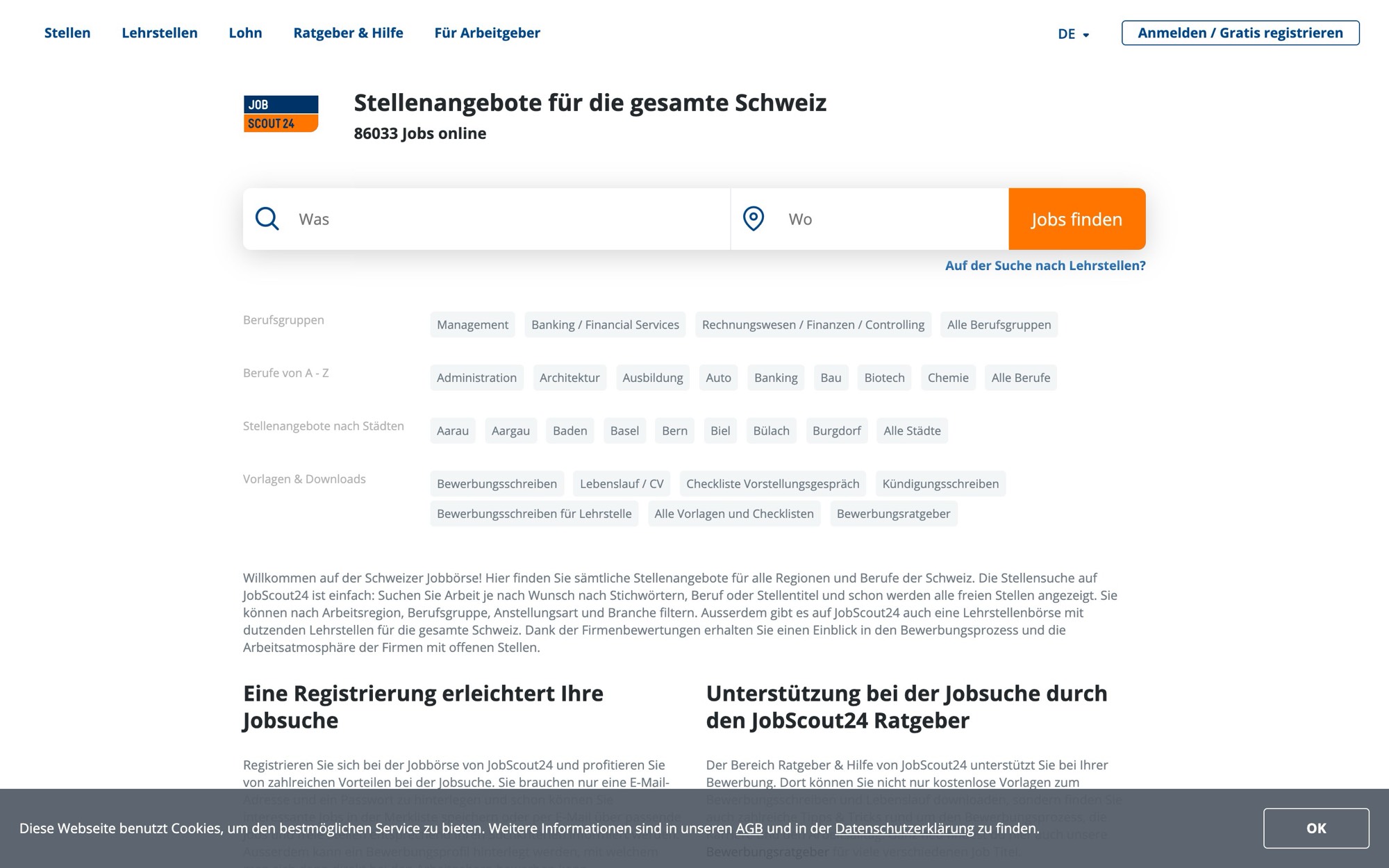
A third brand from the same company. Searching all three to widen your search means searching one provider three times.
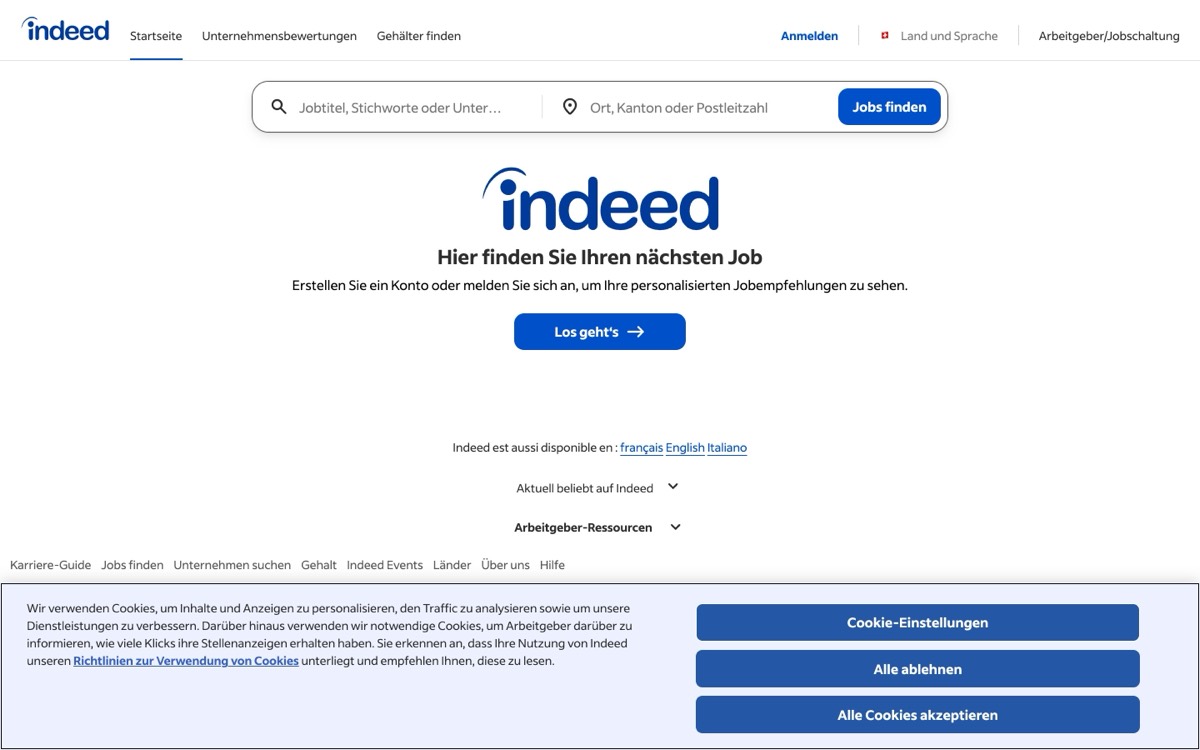
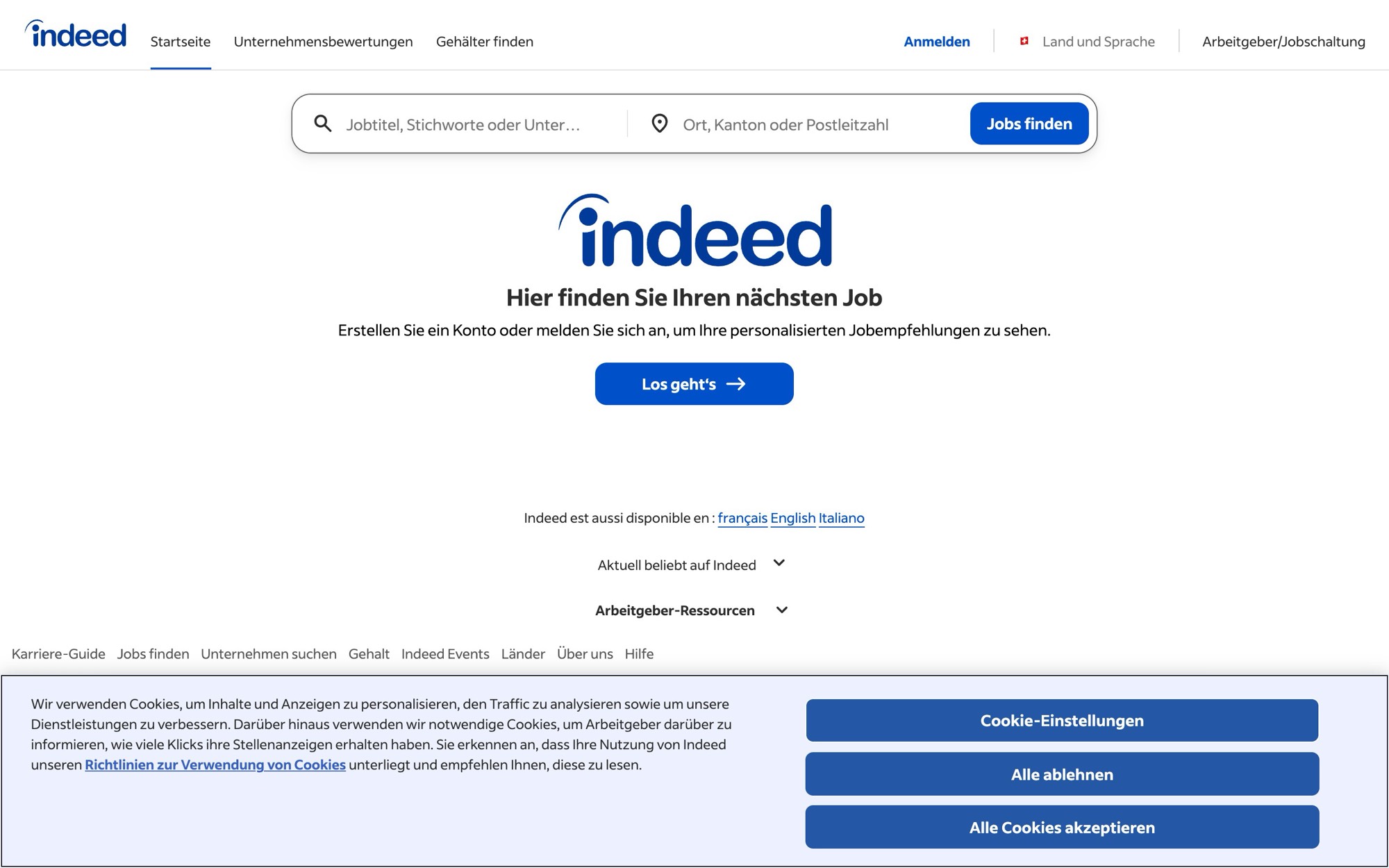
The broadest aggregation, because Indeed also collects from other boards — at the cost of many duplicates of the same advert.
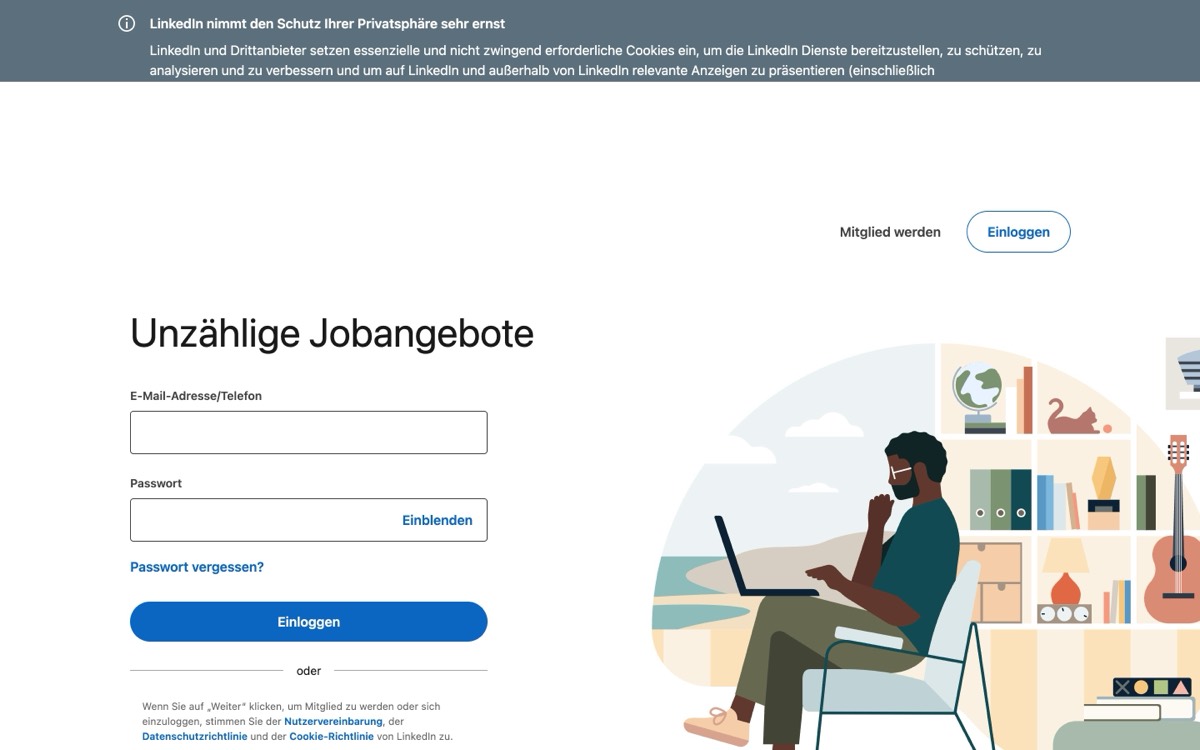
The best reputation for English-speaking and international roles in Switzerland. Considerably thinner for trades, care and commercial roles.
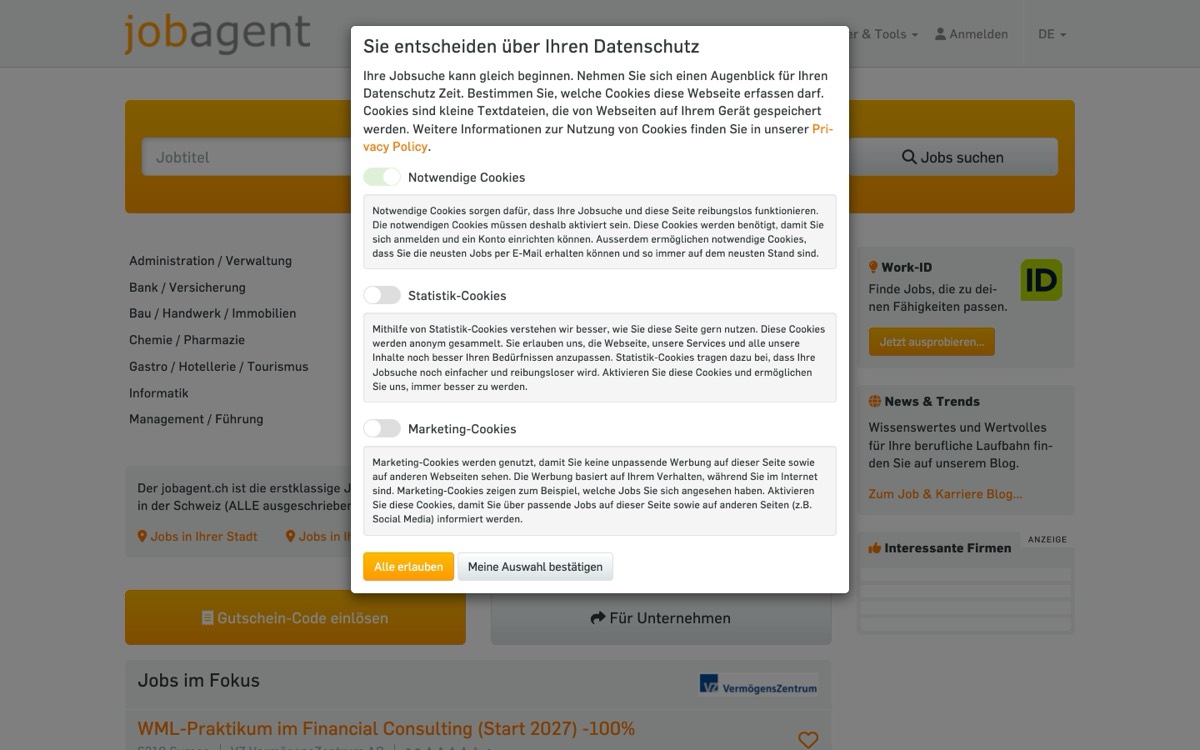
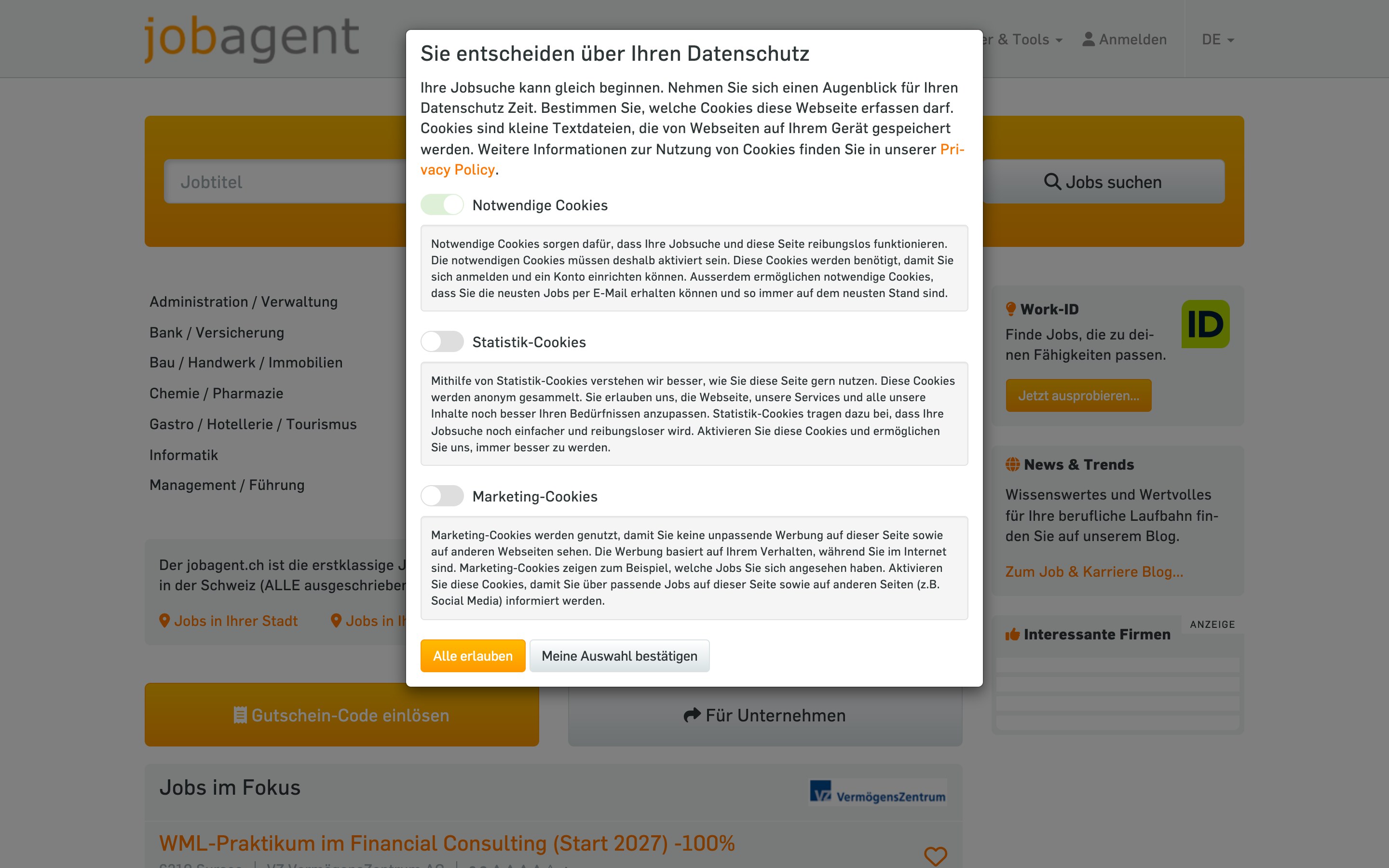
A meta-search across the Swiss job boards, "every job in Switzerland at a glance". Its strength is the Job-Abo: a saved search that mails you new adverts from every portal it covers. Salary calculator and application guides alongside.
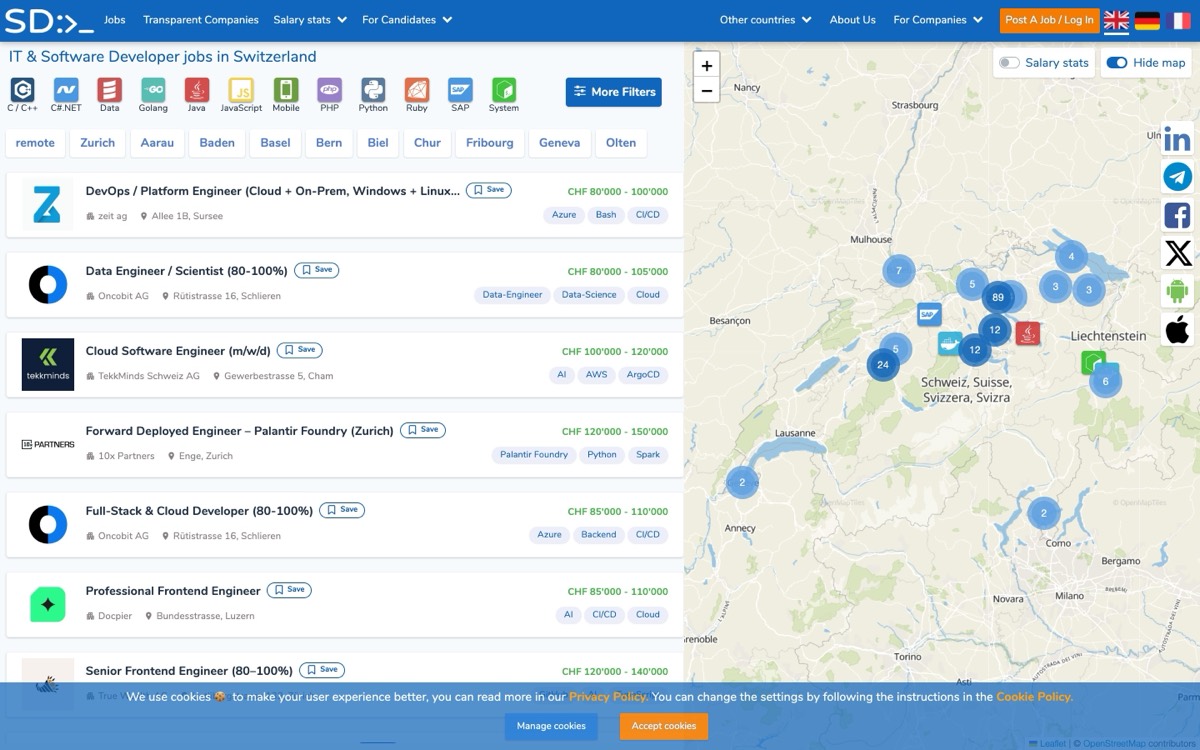
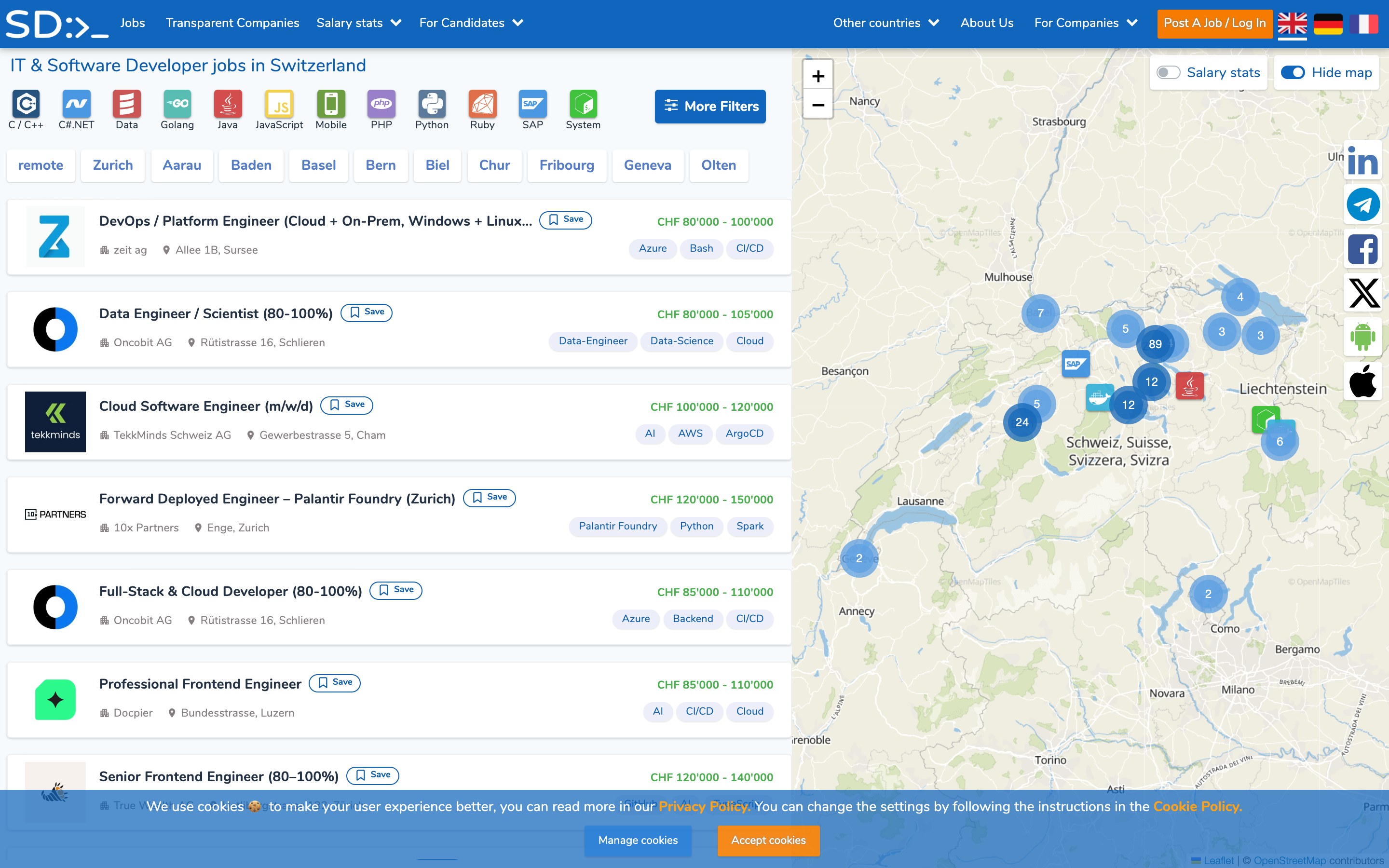
IT and software only, and thorough about it: "183 IT & Software developer jobs in Switzerland", filtered by technology (C#, Java, Python, DevOps, ML) rather than by industry. Publishes salary statistics and lists the companies that disclose their ranges. The site itself is in English.
Jobs by profession, city or language
Type a profession, a city or a language, the page shows the adverts currently open for it.
By profession
- Consultant
- Project Manager
- Retail Sales
- Nurse
- Nursing & Care
- Administrative Assistant
- Account Manager
- Software Engineer
- Public Administration
- Architect
- Insurance
- Chef
71 more — narrow the search
By work type
In Switzerland, the job board is mostly where you find a role — not where you apply for it. That distinction matters, because it explains why applying so often takes longer than expected: at the end of most adverts sits somebody else's form that wants your details all over again.
Practically: use whatever shows you the most to find roles, and expect to land in the employer's own system to apply. The thing that genuinely moves your odds is not the channel but whether your documents are tailored to the specific role.
Share of adverts by type of application destination. Agency and sector portals count as a portal, not as an employer site. Ongoing analysis, as of August 2026.
- About one application in six is submitted on a job board or agency portal — the rest lead to the employer or into its system.
- Applications are spread across more than two thousand different destination systems — no single account covers the market.
- Roughly a third of adverts lead into an applicant tracking system; those systems parse your CV automatically.
- A noticeable share of destinations are Swiss systems barely known internationally — anyone expecting only the familiar foreign portals underestimates the effort.
- The channel rarely decides anything; tailoring your documents to the role does.
Through a job board or straight to the company
| Criterion | Via a job board | Direct to the employer |
|---|---|---|
| What you reach | every published vacancy | unadvertised roles as well |
| Speed | immediate; 21.9% are new within 7 days | slower, reply uncertain |
| Competition per role | high — everyone sees the same list | low to none |
| Effort per application | low | high — research required |
| Hit rate | low but predictable | high when the timing is right |
| Counts for the RAV | yes | yes, speculative applications too |
| When to use which | as the weekly baseline | on top, for target employers |
Both work, but not at the same speed. Our index shows 21.9% of adverts went up in the last seven days — so the board is the faster route to what is NEW, and the direct approach the better route to what has not been advertised yet.
Where an application really goes
We analysed where the apply buttons of the Swiss adverts we track actually lead. The result is clearer than the usual debate about job boards suggests: roughly 51 percent lead to an address belonging to the company itself — a careers page, a company portal, or a direct contact. Roughly 32 percent lead into an applicant tracking system, the specialised software an employer uses to run its hiring. Roughly 18 percent stay on a job board or agency portal.
That makes the original question the wrong one. In Switzerland there is hardly a choice between "direct" and "via a board", because the route through a board almost always ends at the employer anyway. The board is a visibility layer, not an application channel.
It also explains a common frustration. Many people expect a short form after clicking "Apply now" and instead find a registration, a profile, and a series of fields they just filled in on their CV. That is not the fault of the board they arrived through — it is because they have just crossed over into an employer's system.
For the one case where the application does stay on the board, the opposite note applies: those processes are usually deliberately short, and shortness means less room to differentiate yourself. When a quick apply sends nothing but your CV, the CV alone carries the entire argument.
Why it takes so much effort
Applications are spread across more than two thousand different destination systems. That is the real hardship of the Swiss application market, and the reason ten applications a month cost more time than the number suggests.
Some of them are the internationally familiar applicant tracking systems. At least as large a share are Swiss solutions that practically nobody outside the country has heard of. Add the portals of large retailers and corporate groups, plus sector platforms for healthcare, social work and education. People searching for Swiss roles from abroad routinely underestimate this part.
No single account covers this market. There is no provider where you maintain one profile and become able to apply everywhere — and promises along those lines founder on exactly this fragmentation.
The practical consequence is a workflow rather than a tool: one maintained master version of your CV from which you produce a tailored version per role, and your own record of where you have applied. The second half matters especially if you are registered with the RAV, because that record is precisely what is required there.
What an applicant tracking system does with your CV
Roughly one advert in three leads into such a system. The software parses your uploaded CV automatically and builds a structured profile from it — positions, dates, titles, qualifications. Whatever is not cleanly recognised is missing from that profile, even though it is right there in the document.
A few very concrete rules follow. Use a clear, single-column base structure for the content that needs to be recognised. Write dates fully and consistently. Avoid putting essential information solely in graphics, headers or icons — language levels shown as bars without text are the classic case where information simply does not exist as far as the machine is concerned.
At the same time, do not inflate the issue. These systems screen candidates out automatically far less often in Switzerland than the advice literature implies; mostly they structure and make things searchable. A CV that contorts itself for a machine and becomes unreadable to people loses more than it gains.
The sensible middle ground is a document a person enjoys reading and a machine can take apart without difficulty. That is not a contradiction — in the vast majority of cases it is simply a cleanly built, conventional Swiss CV.
When going direct genuinely helps
There are situations where bypassing the advert helps more than any choice of channel. The most important is a personal contact inside the company. If you know someone internally, still go through the official route — but let them know as well, so the application is not sitting anonymously in the inbox.
The second is the phone call before applying. Many Swiss adverts name a contact person with a phone number, and that offer is meant sincerely. A short, well-prepared conversation clarifies whether the role actually fits and turns your application into one with a name and a face. If you are registered with the RAV, that call also counts as a documentable job-search effort.
The third is the speculative application to a company with no matching advert. It takes more effort and the hit rate is lower, but it meets no field of competing candidates. It makes most sense where staff shortages are known — healthcare, education, hospitality, parts of the trades.
What does not work in any of the three cases is circumventing the process. An application sent by direct message to a manager when the advert specifies a form usually gets referred back to the form in Switzerland — and leaves the impression that someone considers the rules not to apply to them.
What to do with this
Separate finding from applying. To find, use the search with the broadest coverage and have new roles reported to you automatically. To apply, expect to end up in the employer's system and budget time for it — twenty to forty minutes per application is realistic, not five.
Maintain a master version of your CV and generate a tailored version per role. Tailored does not mean rewritten: changing the order, the emphasis, and the opening lines to match the role covers most of the effect.
Keep your own record of applications with date, company, function, channel and status. Because destinations are so scattered, that is the only place you keep an overview — and with the RAV, that record is the proof.
And do not measure success by the number of applications sent. Hiring managers reliably recognise scattergun applications, and an application with no connection to the role costs you time without raising your odds. Fewer but tailored is clearly the better strategy in the Swiss market.
What people report
Hiring professionals describe the same pattern repeatedly: applications to advertised specialist roles without the required qualification, without relevant experience, and with a standard letter that could equally well have gone to a completely different organisation. That the pressure of a long search often lies behind it does not change the effect.
Recurring theme in German-language LinkedIn posts from recruiting professionals, reviewed August 2026.
The administrative effort of applying is described as a burden in its own right — copying adverts, entering the same details repeatedly, losing track when an advert goes offline in the meantime. That matches how heavily fragmented application destinations are.
Recurring theme in German-language LinkedIn posts by jobseekers and advisers, reviewed August 2026.
A widely repeated claim holds that a large share of roles are never openly advertised, making a personal network the decisive route in. The magnitudes quoted vary considerably and are not substantiated — but as an indication that direct contact plays a role of its own alongside the advert, the observation is remarkably consistent.
Recurring claim, inconsistent in the magnitudes given, in German-language LinkedIn posts on job hunting, reviewed August 2026.
Shares from our ongoing analysis of the Swiss job adverts we track, as of August 2026. We analysed the destination of each advert's application link, classified by type of destination system. We publish shares, not absolute inventory figures.
Check how your CV fits a job — and the Swiss market
Free checker: languages, work permit, skills and more — scored against a specific posting.
ATS CV checker: against a specific advert, freeApply on the company site or through the job board — which is better?
In short
Usually the employer has already decided for you. On 4 September 2026 we ran 27 occupation searches on jobs.ch: only 31,8 per cent of the 573 adverts shown could be applied to on the board itself, and every other one handed us to the employer’s own page or applicant system. Among employers with three or more open adverts in our index, 91,1 per cent send all of them to the same destination. Where both routes exist the choice changes little — but for English-language adverts the destination is a different animal.
That last point is the one worth planning for. Of the English-language adverts we hold, 63,0 per cent lead into an international applicant system — Workday, SuccessFactors, Greenhouse, SmartRecruiters and their peers — against 16,4 per cent of the German ones. Applying "on the company site" in English therefore usually means creating an account, setting a password and re-entering a CV you have already attached.
The compensation is that the case which complicates German and Italian adverts barely touches you: only 0,3 per cent of English-language adverts are published under a staffing agency’s own name, against 38,3 per cent of the Italian ones.
Share of open adverts whose apply link points into an international applicant system (Workday, SuccessFactors, Greenhouse, SmartRecruiters, Lever, Ashby, Workable and comparable platforms), by the language the advert is written in. Our index, 4 September 2026.
- 91,1 per cent of employers with three or more open adverts send every one of them to the same destination host — the route belongs to the employer, not to the job.
- On jobs.ch, 31,8 per cent of the adverts checked offered an application on the board itself; on jobup.ch, the Romandie board, 55,5 per cent did.
- English-language adverts: 63,0 per cent point into an international applicant system, against 16,4 per cent (German), 16,1 per cent (French) and 4,0 per cent (Italian).
- Of 39 outbound apply links we opened, 3 carried the board’s name in the URL itself — the employer can see which door you came through.
- Not one advert in our index gives an email address as the way to apply; every apply button leads to a web form.
The two routes side by side
| Criterion | Through the job board | Direct on the employer’s site |
|---|---|---|
| Who receives the application | The board takes it and forwards it to the employer | The employer or its applicant system, with nobody in between |
| How often the route was open at allFirst page of results per search term, 4 September 2026. | 31,8 % of the jobs.ch adverts checked, 55,5 % on jobup.ch | For all the others it is the only route — the board links to it |
| Account required | A board account is offered and fills the form from your profile | Depends on the system; the large international ones require one |
| Typical destination for an English advert | The board’s own form | An international applicant system in 63,0 % of cases |
| Where the application ends up afterwards | In your board profile, under "applications" | In the employer’s candidate portal, where one exists |
| Can the employer see the route you tookOne destination address simply read source=jobs.ch. | Yes, the source is part of what it receives | 3 of 39 redirects we opened named the board in the URL |
| Effort per application | Shorter once a profile and documents are stored | Longer, because each system has its own mandatory fields |
| Swiss fields you will meet either way | Workload as a percentage, language levels, permit status | Workload as a percentage, language levels, permit status |
| Proof for the RAVThe effort itself still has to be declared the way your RAV requires — through Job-Room or the cantonal form. | Keep the board’s confirmation email | Keep the system’s confirmation email |
| What it changes about your chancesNobody can see inside an employer’s shortlisting; per-channel success rates are not evidence. | Nothing measurable | Nothing measurable |
As at 4 September 2026.
What the destination looks like, by advert language
| Language of the advert | International applicant system | Published under a staffing agency’s name |
|---|---|---|
| English | 63,0 % | 0,3 % |
| German | 16,4 % | 12,3 % |
| French | 16,1 % | 13,0 % |
| ItalianAlmost all of the Italian figure comes from one temporary-work agency with branches in Ticino. | 4,0 % | 38,3 % |
Shares of the open adverts we hold, 4 September 2026.
The route is a property of the employer, not of the job
A Swiss employer sets up its application inbox once and then sends everything there. That is measurable in our index: of the employers with three or more open adverts, 91,1 per cent point every single one at the same host. At two or more adverts it is 92,5 per cent, at five or more still 89,4 per cent. The apply route is not chosen advert by advert, and it is not chosen by you.
This is useful rather than depressing. If the first apply button from a company took you into a slow portal, the second one will almost certainly do the same, so you can plan the time. And if you want to know how a particular employer takes applications before you invest an evening in the dossier, open any other advert of theirs and look at where the button goes.
One limit on the figure: we see the destination attached to the advert we hold. An employer that also advertises on a board we do not carry does not show up twice in this calculation. So the number describes how consistently an employer runs its inbox, not how many platforms it appears on.
How often the board is actually the recipient
This can be counted, and we counted it on 4 September 2026. We opened 27 occupation searches on jobs.ch — 18 in German, 9 in French — and checked each of the 573 adverts shown for the quick-apply marker that means the application is submitted on the platform. The result was 31,8 per cent. For the remaining two thirds the button leads out, mostly into an applicant system or onto a careers page.
The language split inside that number is larger than the number itself. German searches returned 37,5 per cent, French searches 20,8 per cent — same platform, same method, same day. On jobup.ch, the board for French-speaking Switzerland, eight searches gave 55,5 per cent. So "can I just apply here?" has a different answer depending on which Swiss board you are standing on, and the English-speaking reader who defaults to LinkedIn or Indeed is usually in the leave-the-site case regardless.
The method has a caveat: we read the first page of results in the default sort order for each term. That is not a random sample of everything a board holds, and paid placements sit high on a first page. The gaps between 20,8, 37,5 and 55,5 per cent are wide enough to survive that; the decimal point is not worth arguing about.
What "the company site" means when the advert is in English
For English-language adverts in Switzerland, applying direct rarely means a small form on a Swiss company’s website. It means an international applicant system: 63,0 per cent of the English-language adverts we hold point into one, against 16,4 per cent of the German ones and 4,0 per cent of the Italian ones. Those systems ask you to create an account, verify an email address, and then re-key your work history into fields even though you have just uploaded a CV that contains it.
That is worth knowing before you start, for two reasons. The first is time: an application that looks like a five-minute task is a twenty-minute one, and a batch of five in an evening is not realistic. The second is that these systems keep your profile, so the second application to the same employer is genuinely quick — which makes it worth completing the profile properly the first time rather than abandoning it half-filled.
The Swiss part of the form is where a CV written for another market runs out of answers. Expect a field for the workload as a percentage rather than "full time", language levels stated as A1 to C2 rather than "fluent", and, if you are not Swiss and do not hold a C permit, a question about your permit status. A Swiss dossier also normally carries employer references — Arbeitszeugnisse, the written references a Swiss employer issues on leaving — and a photo is conventional here rather than discouraged. None of that changes with the route; it changes with the country.
Your route is visible, and that is not a problem
We opened 64 individual advert pages on jobs.ch and read the application method recorded on each: 25 used the board’s own form, 39 redirected outwards. Of those 39 destination addresses, 3 carried the board’s name openly in the link — one of them simply reads source=jobs.ch, another repeats the same value in four separate parameters. The employer’s system therefore records which door you came through, and the board can bill for the placement.
It is not hidden from you either: the parameters are visible in your browser’s address bar the moment you click Apply. What it does not do is disadvantage you, because the direct route ends up in the same system. It only answers the question people actually worry about — yes, they can usually tell.
Five of those 39 redirects led to jobup.ch, the French-language sister board. Someone who believes they applied "through jobs.ch" filled in a form on a different platform in those cases. It is a small reminder that the channel you think you chose is not always the one you used.
The case where the route genuinely decides: a staffing agency
There is one situation in which "apply on the company site" is not available at all, because the company is not named: when the advert is published by a recruitment or temporary-work agency under its own name. About one in ten of the open adverts we hold is published that way, and that is a floor — an agency without an agency-sounding name is not counted here.
The largest single publisher in our index is not an employer hiring for itself but a placement platform, which describes itself on its own home page as connecting people and companies and advertises several thousand partner companies. The job you apply for belongs to one of those partners. In that situation you apply to the agency, the agency presents you to its client, and the client’s name often appears only once a conversation has started.
This is not a worse route — agencies know vacancies that are never advertised, and in construction, industry and healthcare a substantial part of the market runs through them. What matters is a question of fact rather than of channel: whether the role is a permanent placement or a temporary assignment, and who your contractual employer would be. In a temporary assignment the agency is the employer, with its own contract and conditions, even though you work on the client’s premises.
For English-speaking readers this case is mostly theoretical: 0,3 per cent of English-language adverts are published under an agency name. It concentrates in the Italian-language market, at 38,3 per cent.
If you are registered with the RAV
Both routes count as a job-search effort. What matters is not where you filled in the form but that the effort can be evidenced and that you declare it the way your own RAV requires — through Job-Room or on the cantonal form. Any tool, ours included, is help with filling that form in and never a substitute for submitting it; the consequence of not declaring efforts is suspension days, however many applications you actually sent.
Practically: keep the confirmation email whichever route you took, and note the date, the company, the role and the channel. Applying through a board leaves you a second copy inside your board profile; applying direct does not. That is the only point at which the channel makes any difference to the paperwork, and a list of your own closes the gap.
The rule, in four sentences
Take the route the advert gives you, because for roughly two thirds of adverts there is only one. Where both are open, take the shorter one — a stored profile and an up-to-date file make the board route a matter of minutes, and the employer receives the same documents either way. Before you send, check that the attachment is the version you tailored for this advert and not the default file sitting in your profile; that substitution is the one real risk of the fast route.
And when the advert names an agency rather than an employer, stop deciding about channels and ask about substance: who the role is for, whether it is permanent or temporary, and who would sign your contract. That answer changes more than any choice of route.
Shares from our continuously updated analysis of the open Swiss adverts we hold, as at 4 September 2026, plus 27 searches on jobs.ch and 8 on jobup.ch the same day. On the boards we read the first page of results in the default sort order for each search term, which is not a random sample of the whole listing stock. We publish shares, never absolute stock figures.
Sources
Related questions
What our job index says about the Swiss market
Computed live from our own index, not quoted from a study. Shares only, as of today.
Language the advert is written in
- Deutsch
- 60%
- English
- 23%
- Français
- 13%
- Italiano
- 3%
Of adverts that state a language requirement, the share asking for
- Deutsch
- 70%
- English
- 43%
- Français
- 21%
- Italiano
- 3%
19% posted in the last 7 days · Largest markets: Zürich 18% · Bern 10% · Genève 5% · Basel 5%