Structuring a Swiss CV — the eight blocks, the order, and how much room each one gets
Updated:
Which sections a Swiss CV carries, what order they go in, and how much of your three pages each deserves. The block list is official; the weighting comes from what the English-language adverts on SwissJobs.app actually screen on.
- How should I structure my CV?
- What order should the sections go in?
- How do I write the personal summary?
- How do I describe a job properly?
- How do I list language skills on a CV?
How should I structure my CV?
In short
Eight blocks, reverse chronological, three pages maximum. arbeit.swiss lists them in order: the title 'CV', personal details including a photograph, professional experience to date, education and training, language skills, special knowledge or activities, personal interests or hobbies, references. Which sections exist is therefore decided for you. What is not decided is their weight — and that follows the adverts: across the English-language adverts on SwissJobs.app, experience is named in 83.4 per cent and a degree or diploma in 18.9 per cent.
That gap between list and weight is the whole difference between a CV that is complete and one that is read. Most international templates deliver the eight blocks somewhere on the page and then hand the space to the wrong ones: half a page of skill bars, three lines for the job you have held for four years. Allocating space by how often something is screened on inverts that.
English-language adverts in Switzerland have one habit the German-language ones do not: 20.8 per cent of them name a specific number of years. That single figure decides more about your structure than any font choice, because a reader has to be able to add your years up without arithmetic. Month and year on every entry, no unexplained overlaps, no bare years that could mean January or December.
One block is almost always answering a live question: 99.1 per cent of the English-language adverts we can evaluate state at least one required language, and 29.9 per cent of those want two or more. The official order puts language skills fifth. That is a suggestion, not a rule — and it is the one place where deviating pays.
Share of the active English-language adverts on SwissJobs.app whose condensed description names each requirement. Counted on 22 August 2026 across the adverts that carry an evaluable description — roughly three quarters of the listings. A condensed description keeps what the advert emphasises, so a requirement buried in the small print can be missing from it. The rows overlap: one advert can count in several bars.
- Keep the eight arbeit.swiss blocks and the reverse-chronological order — 'structured chronologically, with your most recent job mentioned first'. It is the only order a Swiss reader expects.
- Give experience more room than everything else combined. It is named in 83.4 per cent of English-language adverts here, a degree in 18.9 per cent; your line count should sit somewhere near that ratio.
- Date every entry with month and year. One advert in five names a specific number of years, and a reader who has to work out whether '2019–2021' is eighteen months or thirty-five will assume the shorter one.
- Pull languages up out of fifth place. They are stated as a requirement in 99.1 per cent of the adverts, and 29.9 per cent of those ask for two or more. Levels, not adjectives: C1, B2, native.
- State your permit and your canton in the header. Adverts almost never ask — under one per cent of the English-language descriptions mention a permit — which is exactly why leaving it out generates an email instead of an interview.
- If you manage people, say how many and at what level, in the header line of the role. Leadership is named in 11.5 per cent of English-language adverts, more than double the German-language rate, and 'led a team' without a number is not an answer.
- Keep 'special knowledge' to two lines. Software appears in 6.0 per cent of adverts, a certification or licence in 5.7 per cent. A skills grid with rating dots spends a quarter of page one on the smallest bars in the chart.
- Do not translate a Swiss qualification into a foreign one, or the reverse. Give the original title and, in brackets, the local equivalent — and say plainly if recognition is still pending.
- Finish with the line arbeit.swiss suggests: references available on request, with a separate sheet you can hand over at the interview.
What is fixed: the eight blocks
In Switzerland the structure question has an official answer, and it is shorter than the advice industry suggests. The arbeit.swiss page on applying states that a CV should usually contain the title 'CV', personal details including a photograph, professional experience to date, education and training, language skills, special knowledge or activities, personal interests or hobbies, and references.
Two constraints frame it. 'A CV should be no longer than three pages,' and it 'should be structured chronologically, with your most recent job mentioned first.' That is the entirety of the official guidance, and it is enough to settle which headings belong in your document.
What is missing from the list is as informative as what is on it. No professional summary, no competency matrix, no timeline graphic, no tiles. That does not make a three-line summary forbidden; it means nobody is looking for one, and it has to win its space from one of the eight blocks rather than being added on top of them.
Use the list as a completeness check rather than as a table of contents. Read it top to bottom against your own document and ask, for each item, whether the section exists and whether it can be found in two seconds. Anything you cannot find, a reader will not find either.
What you decide: the weighting
The list tells you which blocks appear. It says nothing about how much of your three pages each one gets, and that is where two formally correct CVs part company.
The adverts settle it. Across the active English-language adverts on SwissJobs.app, professional experience is named in 83.4 per cent of descriptions and a degree or diploma in 18.9 per cent — a factor of more than four. This is the widest experience-to-education gap of the four advert languages we can measure, and it has a plain explanation: the English-language segment here skews towards roles in Zurich, Basel and Zug where the qualification is assumed and the track record is the variable.
It also skews academic in a way the German-language market does not. Of the English-language adverts that mention education at all, 95.1 per cent name a university-level qualification and 1.8 per cent an apprenticeship or vocational route. If you hold a Swiss vocational qualification and you are applying in English, the education block is where you spend one extra line explaining the level — not three.
Translated into page space over three pages: a little over half for the roles, a quarter for education and training together, the rest for the header, languages, special knowledge, interests and references. When you have to cut to two pages, compress the oldest roles to a single line each; never compress the most recent one.
The top third of page one
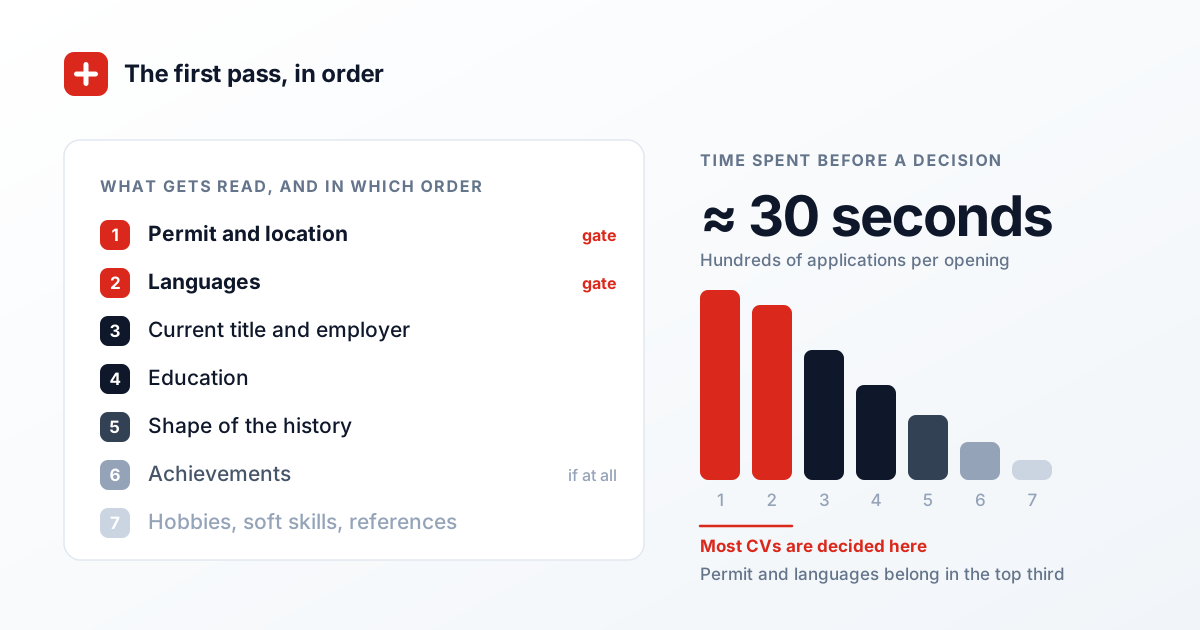
One part of the document is certain to be read, and that is the beginning. Everything a reader needs in order to put you on the shortlist should therefore sit above the midpoint of page one.
Six items: your name and the role you are targeting, your city and canton, your permit status, the workload you can offer, your current or most recent title with employer, and your languages with levels. The chronology starts underneath that.
Two of those lines are not on the official block list and still belong there. Adverts almost never ask about a permit — under one per cent of English-language descriptions mention one. That silence is the reason to volunteer it: an unasked question that has to be answered anyway costs you one line or costs the reader one email, and only one of those outcomes is in your favour.
The workload line is the same argument in a different currency. Only 2.8 per cent of English-language adverts with a stated employment type are part-time — the lowest of the four advert languages here. If you are looking for anything other than a full-time position, that is a deviation from the norm and it reads much better as a stated preference at the top than as a discovery at the interview.
How one role is built
Inside the largest block, the structure question repeats in miniature. A role consists of a header line and a body, and both should look identical across every role you list.
The header carries four things in a fixed order: dates with month and year, job title, employer with location, workload. Month and year matter more than they look. One English-language advert in five names a number of years, and a reader adding up bare years will round against you — a role running February to December of the following year is twenty-three months, and '2024–2025' invites someone to read it as one.
The body runs three to five lines, five for the most recent role and one for something a decade old. The first line describes the remit; the rest show outcomes. What was different after you were there? Numbers help but are not compulsory — 'rolled out the new checkout system across four sites' is an outcome, 'responsible for checkout systems' is a job description.
Keep the line order movable. The cheapest useful tailoring is to promote, within your most recent role, the line closest to the advert. It changes nothing about the truth of the document and a great deal about what survives the first pass.
Education, languages and the small blocks
Education takes one line per qualification: year, award, institution, location. Module lists, grade averages and semester counts stay out unless you have just graduated. If your qualification is foreign, give the original title and add the local equivalent in brackets where you can support it, and state openly if recognition is still in progress.
Then languages, and this is the block worth moving. It is stated as a requirement in 99.1 per cent of the English-language adverts we can evaluate, and 29.9 per cent of those name two or more. Write levels rather than adjectives — 'German B2', not 'good German' — and give the exam with its year if you have one. If you are working in English in Switzerland and your German is at A2, say A2; a vague claim gets tested in the first phone call.
'Special knowledge or activities' is the block for anything verifiable that is not a language: sector software, professional registrations, a driving licence where the role needs one. The counts argue for restraint. Software is named in 6.0 per cent of adverts and a driving licence in 0.3 per cent — the lowest of any advert language here, because this segment is overwhelmingly office-based. Two lines is almost always enough.
Interests are not filler. They are the only place where a personal quality is evidenced rather than asserted, and 16.4 per cent of English-language adverts ask for qualities such as being a team player, proactive or reliable. A committee role, a coached team or a long-distance sport says more than any adjective in a summary. References stay a single sentence: available on request.
Three cases where the order changes
Reverse chronological is the default, not the law. Three situations justify moving blocks around, and in all three the chronology inside each block stays intact — only the order of the blocks changes.
First, the recent graduate. Education goes above experience because that is where the most recent thing is. Internships, part-time jobs and substantial project work then follow as full entries with dates and locations, not as a bulleted afterthought.
Second, the career changer. Three or four lines above the chronology, explaining which part of your previous work points in the new direction, do the job that a rearranged CV cannot. The chronology underneath stays complete and gap-free — which arbeit.swiss also requires of the reference letters in the dossier, 'organised chronologically, with the most recent reference coming first'.
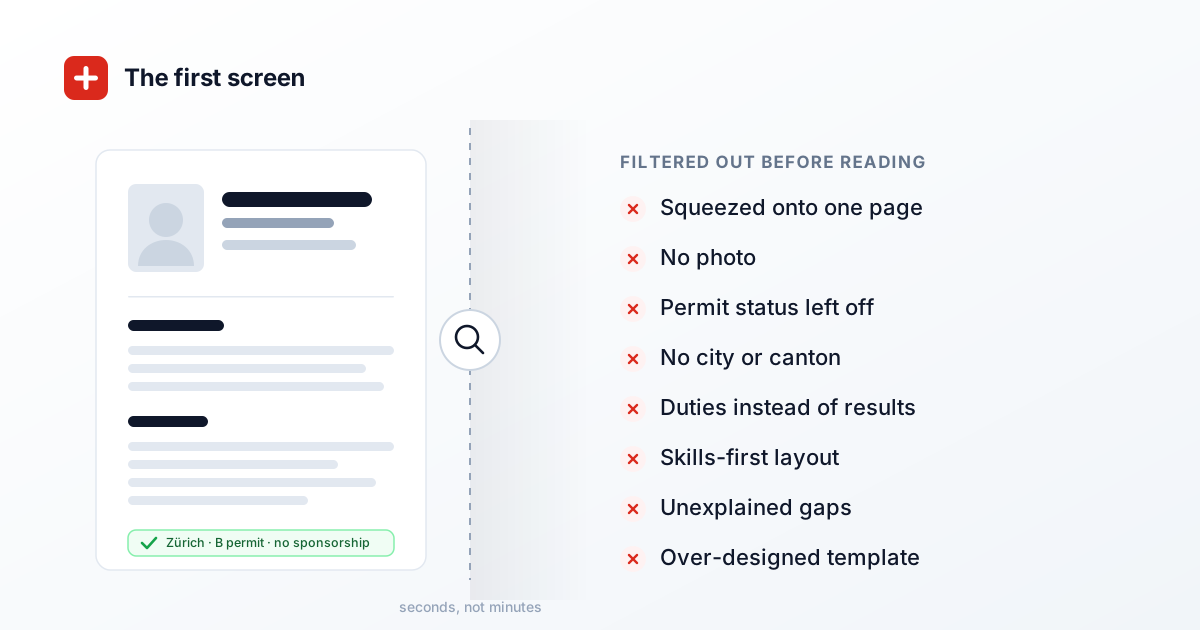
Third, arriving from another market. If your last three roles are abroad, the reader's first question is not about your work but about whether you can take the job. Answer it in the header — permit status, notice period, whether you are already in the country — and then let the chronology run normally. This is the single most common structural failure among people applying to Switzerland in English.
The final check
When the document looks finished, read it as somebody who did not write it. Print page one, or open it on a phone, and put it away after twenty seconds. What stayed with you?
It should be: which role you are after, where you live, whether you may work here, in which languages, and where you worked last. If one of those five is missing, it is not a content problem, it is a structural one — the information is too far down.
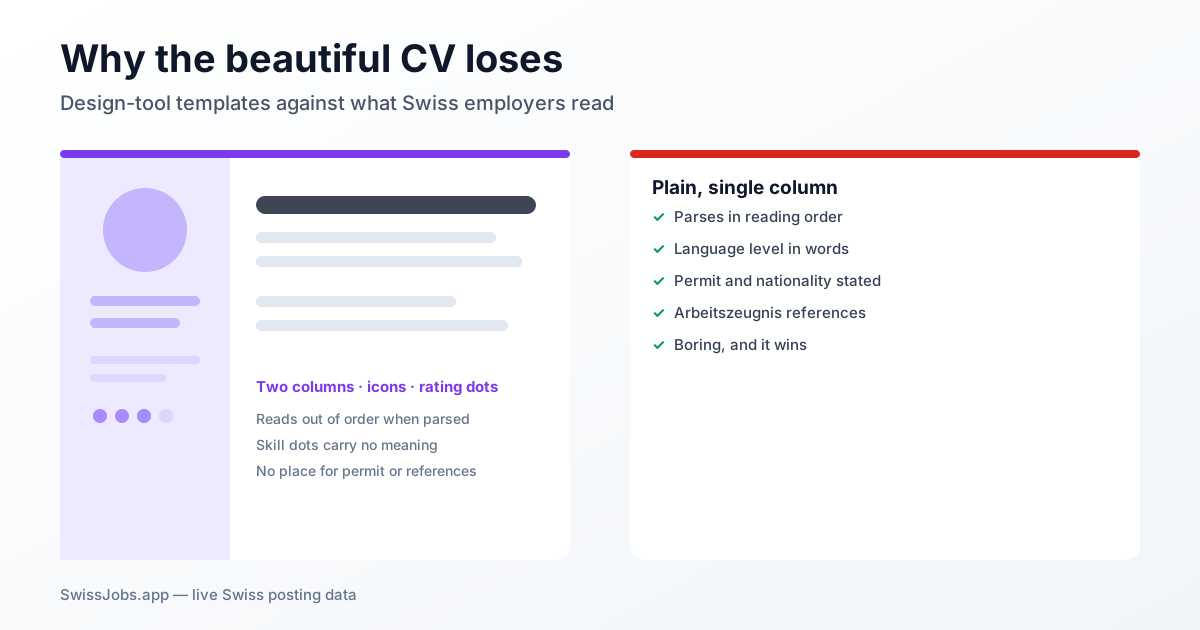
The second test takes the same twenty seconds. Select everything in the PDF, copy it, paste it into a plain text editor. If the text comes back in the order you read it, then your structure is also the structure a machine sees. If the header and footer land in the middle of a role, or the columns interleave, the template is doing that, not your writing.
Then the simplest question of all: does the whole thing fit in three pages, and is the third page more than half full? A third page carrying four lines is not a page, it is an uncontrolled break — and it is the easiest thing on this list to fix.
The shares are counted from the active adverts on SwissJobs.app on 22 August 2026 and refer only to the English-language adverts carrying an evaluable condensed description — roughly three quarters of the listings. Each advert is counted once per requirement type. A condensed description keeps what an advert emphasises, so a requirement mentioned only in the small print may be absent; the shares are therefore a floor, not a survey. Language requirements are read from the structured field on the advert rather than from the text. The part-time share refers to English-language adverts with a stated employment type. The block list, the three-page limit, the chronological order and the references wording are quoted from the 'Tips on applying for jobs' page on arbeit.swiss (SECO), retrieved on 22 August 2026.
What order should the sections go in?
In short
Header, work experience, education, languages, specific skills, interests, references — in that sequence. arbeit.swiss lists professional experience to date ahead of education and training, and inside every block the rule is most recent first. Two departures are defensible: languages move up when the advert's language is not your first, and education moves above experience while you have none. What belongs in the header depends on the language you are applying in. English-language Swiss adverts name a seniority level in the job title 33.8 per cent of the time; German-language ones do it in 8.8 per cent.
That gap is the practical difference between an English CV written for Switzerland and a translated German one. An English-language advert here leads with rank. Senior, Lead, Principal, Head of, Associate, Director — one of those words sits in a third of the titles, and it is doing screening work before the body text starts. So the first line under your name is not a summary sentence. It is the level you are applying at, in the vocabulary the advert used.
The same adverts are conspicuously vague about the thing German adverts state first. Only 60.1 per cent of English-language adverts on SwissJobs.app carry any employment-type field at all, against 97.9 per cent of German ones, and just 9.1 per cent put a workload figure in the title. Nobody is going to tell you whether the role is 80 or 100 per cent, which means your own availability line has to say it — one short line in the header, not a negotiation three emails in.
The block that has to climb is languages. Of the English-language adverts stating a language requirement, 30.1 per cent want at least one language other than English, and 24.2 per cent want German. An English CV that leaves its German at position five, below education, is answering the second-most-common question last.
Share of active adverts on SwissJobs.app whose job title contains an explicit rank word — Senior, Junior, Lead, Principal, Head of, Director and their equivalents in each language. Counted on 22 August 2026 across all adverts in each language. The Italian bar rests on the smallest base of the four and should be read as an indication rather than a measurement.
- Follow the official sequence: title, personal details, professional experience to date, education and training, language skills, special knowledge, interests, references. arbeit.swiss puts experience ahead of education — that settles the question most templates get wrong.
- Order every block most recent first. The official wording is that the CV should be structured chronologically, with the most recent job mentioned first. The same direction applies to the reference letters in your dossier, which go into one PDF, newest on top.
- Put the level in the top line if you are applying in English. A third of English-language Swiss adverts state a rank in the title, so «Senior Data Engineer, Zurich» does more work in that position than any summary sentence.
- State your availability in the header. Only 60.1 per cent of English-language adverts specify an employment type at all — if you do not name the workload you can take, nobody will name it for you.
- Move the languages block up when English is not the only language you need. 30.1 per cent of English-language adverts stating a requirement want a second language, and 24.2 per cent want German.
- Use CEFR levels, not rating dots. 87.5 per cent of the language requirements in these adverts sit at professional working level — «German B2» can be checked against that, four dots out of five cannot.
- Flip experience and education only until you have experience. Graduate, intern, trainee and working-student adverts make up 6.7 per cent of the English-language postings; everywhere else, education stays where the official list puts it.
- Keep the last three blocks short. Specific skills in one line each, interests in two lines, references as a single sentence saying they are available on request — the names belong on a separate sheet you hand over at interview.
- Test the order by reading the document from the bottom up. If the block you would delete first is at the bottom and the one you would never delete is at the top, the sequence is right.
The part of the order that is already decided
Half of this question has an official answer in Switzerland, and it is easy to miss because it is expressed as a list rather than as a rule. The arbeit.swiss page on applying for jobs sets out what a CV usually contains, in a particular order: the title CV, personal details including photograph, professional experience to date, education and training, language skills, special knowledge or activities, personal interests or hobbies, references.
Read that as a sequence and it answers the argument most people are actually having. Experience comes before education. Not because education matters less, but because the list is ordered by what a reader needs first, and the federal employment service is the body whose opinion on Swiss conventions counts.
There is one further rule, and it operates inside each block rather than between them: the CV should be structured chronologically, with the most recent job mentioned first. It sounds obvious and is broken constantly, usually by templates that draw a left-to-right timeline and therefore start with the oldest entry. A reader looks for the current role at the top. Put it at the bottom and you have spent the entire first screening on navigation.
The same direction applies to the attachments. Reference letters go into a single PDF, complete and in chronological order, most recent first. A dossier where the CV runs backwards and the certificates run forwards forces the reader to change gear halfway through.
Why an English-language CV orders its header differently
The official list stops at «personal details», which leaves the most consequential part of the order — what the first six lines say — entirely to you. The adverts answer it, and they answer it differently depending on the language they are written in.
Job titles are the honest place to look, because a title is what an employer thought important enough to hoist above the body text. Across the English-language adverts on SwissJobs.app, 33.8 per cent contain an explicit rank word. Across the German-language ones, 8.8 per cent do. That is close to a factor of four, and it is not a quirk of translation: the English-language segment of the Swiss market is weighted towards international employers who band their roles and screen on the band.
The practical consequence is that your first line should carry the level. «Senior Compliance Officer — Zurich — available from November» is a header. «Motivated professional with a passion for excellence» is not, and it wastes the one line that gets read regardless of what follows.
The mirror image is what English-language adverts leave out. Only 12.8 per cent carry a gender tag, only 3.7 per cent repeat the town in the title, and only 9.1 per cent name a workload — against 29.1 per cent in German. Of the English-language adverts that do name a workload, 41.8 per cent state a flat 100 per cent, so the part-time question is barely on the table in that segment. If you want less than full time, the header is the only place you will get to say so before someone else decides for you.
Availability: the line nobody asks for
There is a striking difference in how much the two segments commit to in writing. 97.9 per cent of German-language adverts carry an employment-type classification. Among English-language adverts, 60.1 per cent do. Two out of five simply do not say.
This is not an oversight so much as a different drafting culture — the role is described, the terms are settled later. But it changes what your CV has to do. When the advert states 80–100 per cent, you can match it. When the advert states nothing, the first concrete number in the conversation is whichever one of you writes it down.
Put it in the header, one line, factual: available from a date, at a workload, in a location. Not as a demand — as the answer to a question the reader will otherwise have to ask by email, which costs a week.
This is also where a work permit line belongs if it is relevant to you. Swiss adverts almost never raise the subject themselves, so the reader assumes nothing and has to check. A four-word line — «Swiss B permit, no sponsorship required» — removes an entire category of doubt from the top of page one.
Where the languages block goes
The official list puts language skills fifth, after education. That position is right for a native speaker of the advert's language and wrong for almost everyone else, which is why it is the most commonly justified departure from the sequence.
The numbers say why. Among English-language adverts on SwissJobs.app that state a language requirement, 70.1 per cent want one language, 24.1 per cent want two, and 5.8 per cent want three or more. Of the second languages, German dominates at 24.2 per cent, French follows at 9.5 per cent. Roughly one English-language advert in three is quietly a bilingual role.
So if you are applying in English but the role sits in the German-speaking part of the country, your German level is not a footnote — it is the swing factor between two otherwise equal applications. One line under the header, levels only, and the full block can stay at position five where it does no harm.
The notation matters as much as the placement. 87.5 per cent of the requirements in these adverts sit at professional working level, 9.4 per cent at conversational, 2.6 per cent demand a native speaker. An advert asking for professional-level German is asking a question a five-dot rating cannot answer. B2 and C1 mean the same thing to every reader; four dots out of five mean whatever the reader decides.
What belongs at the bottom, and why it stays there
Three blocks close the document: special knowledge or activities, personal interests, references. They sit last because the adverts almost never mention them, which is a measurable fact rather than an aesthetic judgement — references appear in 0.1 per cent of the English-language descriptions scanned.
arbeit.swiss handles that with the shortest possible instruction: note in the CV that references can be provided on request, and hand over a separate sheet at interview. Three names, job titles and phone numbers on page two of a document you email to thirty companies is a data-protection problem with no compensating benefit.
Interests is the block that swells fastest. Two lines, and make them specific. «Alpine club route leader since 2022» is checkable and memorable; «travel, music, sport» appears on every second document and tells a reader nothing they can use.
Special knowledge is where software, licences, certifications and voluntary roles live. One line per kind. A skills matrix in this position consumes the space of half an experience entry and carries no verifiable claim — which is exactly the trade you do not want to make near the end of a three-page limit.
The layouts that destroy the order you chose
The order you designed and the order your document is read in are not the same thing, and two common template shapes break the link.
The first is the two-column layout with a narrow sidebar. On screen it looks organised. When the PDF is parsed — by an application portal, by a preview pane, by a phone held in portrait — the columns interleave, and the sidebar lands either before or after the main body depending on the tool. Your careful sequence no longer exists. A single column cannot make that mistake.
The second is the skills-first layout that opens with a competency grid and pushes the roles down the page. It almost always comes from a defensible motive: a gap, a career change, a run of short contracts. It reliably achieves the opposite, because a reader who cannot find the chronology goes looking for it, and a reader who goes looking finds the gap anyway. The honest version — chronological order with one explanatory line where the gap is — performs better and takes less space.
Between them these two account for most of the CVs that are complete and still do not work. Nothing is missing. The order in which it arrives is.
The check: read it backwards
There is a faster final check than any list. Read your CV from the bottom up and ask, at each block: would I delete this one first if I had to save a page?
The answers should match the order. The bottom block is the one you sacrifice first. The top block is the one you would never sacrifice. If you hit a block in the middle that you would happily delete, it is too high — and whatever sits below it is too low.
Then check page one on its own. Cover everything below the fold and see whether six things are findable: target job title, city and canton, the workload you can take, permit status where relevant, current or most recent role with employer, languages with levels. Anything missing from page one is arriving too late.
Last, check direction. Is the newest entry at the top of every block — the roles, the qualifications, the certificates in the dossier? Three passes, and the structure is finished. Everything after that is content, not order.
Shares are counted from the active adverts on SwissJobs.app on 22 August 2026. Title and employment-type figures cover all adverts in the language named; language-requirement figures cover the adverts in that language with a parsed language requirement; the reference figure covers the adverts with a readable short description. A title or a short description records what an advert emphasises, so a detail stated only in the body text can be missing from it — the shares are therefore lower bounds, not a survey. The block sequence, the chronological rule and the references-on-request wording are taken from the «Tips on applying for jobs» page on arbeit.swiss (SECO), retrieved on 22 August 2026.
Write a custom CV for every job you apply to
Most people send the same CV everywhere. The editor rewrites yours against the posting — Swiss format, the right language, in about a minute.
CV maker & resume builder: for a specific advertHow do I write the personal summary?
In short
Four lines, not a paragraph: the target function in the advert's own wording, your years and the field they were spent in, two or three things a reader could verify, then availability and language level. The official Swiss CV list does not contain a summary block at all — arbeit.swiss names eight sections and none of them is a profile — so the four lines have to buy the space they take. In English-language Swiss adverts the currency is numbers: 21.8 per cent of them state how many years of experience they want.
That figure is the whole difference between the English-language market here and the German-language one. Across the German-language adverts on SwissJobs.app only 1.7 per cent put a number of years on the experience they ask for. The English-language adverts do it roughly thirteen times as often, and 27.3 per cent of them carry a digit of some kind. If you are applying in English in Switzerland you are writing into a market that already quantifies itself, and an unquantified summary reads below its own register.
The second thing the data settles is where the first line comes from. 87.2 per cent of English-language adverts name the role in the very first sentence of their own summary, and 70.8 per cent of English-language job titles on SwissJobs.app appear exactly once in the entire index. There is no standard title for your job to fall back on. Copy the function from the advert, word for word, and put it first.
What the block is not is a place for adjectives. 44.5 per cent of English-language adverts mention a team, 18.8 per cent mention customers or clients, and repeating those words back is not evidence of anything. Every adjective in a summary should be replaced by the object it came from — a team size, a client count, a budget, a cycle time.
Share of active English-language adverts on SwissJobs.app whose own short description contains each item, counted on 22 August 2026 across the English-language adverts with a readable short description. The rows are not exclusive. Read it as a brief for the summary: the employer talks about experience far more than about degrees, and puts a number on the experience roughly one time in five.
- Keep it to four lines. An English-language advert describes an entire role in a median of 53 words across six sentences — a person needs fewer, never more.
- Line one is the function, copied from the advert. 70.8 per cent of English-language titles on SwissJobs.app occur exactly once in the whole index, so there is no generic title to use instead.
- Line two is the years and the field. 82.5 per cent of English-language adverts mention experience and only 21.8 per cent say how much — supplying the scale answers a question the employer left open.
- Line three is two verifiable facts. 27.3 per cent of English-language adverts contain a digit, which means nearly three quarters of the market writes without one; two numbers put you in the smaller group.
- Line four is availability and language level. Only 15.6 per cent of English-language adverts name a language in their summary, even though almost all of them carry a language requirement — stating your own level closes a gap that otherwise stays open until the phone call.
- Do not lead with the degree unless the advert does. Just 21.7 per cent of English-language adverts name a qualification, against 62.9 per cent of the French-language ones — in English the years carry more weight than the diploma.
- Delete every adjective you cannot evidence. 'Team player' repeats the 44.5 per cent of adverts that mention a team; 'managed a team of eight across two sites' does not.
- Leave out anything the header already says. Work permit, location and availability belong in the personal-details block; the exception is applying from abroad, where the permit question is worth answering twice.
- Rewrite the summary per advert or drop it. A summary that fits forty applications unchanged says nothing specific about any of them.
- Run the deletion test. Cover the four lines and read on: if nothing is missing, the block was decoration and your first job entry deserves the space back.
A block nobody in Switzerland asks for
Before writing a summary it is worth knowing that the Swiss authorities never ask for one. The arbeit.swiss page of application tips lists what a CV usually contains: the title 'CV', personal details including a photograph, professional experience to date, education and training, language skills, special knowledge or activities, personal interests or hobbies, and references. Eight items, and none of them is an opening paragraph about yourself.
The national careers portal takes the same line. Its classic application dossier is a cover letter, a CV, reference letters and qualifications — no profile, no summary, no personal statement. Anyone telling you a Swiss CV 'needs' a personal summary is passing on an American convention, not a Swiss rule.
None of which makes the block wrong. It makes it optional, and optional means it competes. On a document that is already tight, four lines of summary push the top entry of your work history physically down the page. The trade has to be worth it: what stands in the summary must be worth more than the four lines of experience it displaces.
So the common failure is not a bad summary but a redundant one. 'Motivated professional with a passion for new challenges, a strong team player seeking a responsible position' says what every second application says and still takes the best space on the page.
Two situations justify the block almost every time. The first is a change of direction — moving from hospitality into retail, or from another country into the Swiss labour market — where the list of positions alone does not explain itself. The second is a career made of many short engagements, contracts or mandates, where the total is more informative than any single line.
The English-language market counts, and the German-language one does not
The most useful thing in the advert data is a contrast between languages, because it tells you what register to write in. Every advert on SwissJobs.app carries a short description of the role, which is the same exercise you are doing for yourself, and those descriptions can be counted.
82.5 per cent of the English-language descriptions mention experience; 21.8 per cent say how many years of it. 27.3 per cent contain a digit somewhere. The German-language descriptions mention experience at 71.0 per cent but quantify it at 1.7 per cent, and 86.6 per cent contain no digit at all. The same country, the same index, two entirely different habits.
The practical reading is straightforward. When you apply in English in Switzerland — which in this index means, disproportionately, international employers, technology, finance, pharma and the large Zurich and Basel headquarters — you are writing for readers who are used to seeing quantities. 'Extensive experience' lands softly there. 'Nine years, six of them in regulated manufacturing' lands where the market already is.
The reverse also holds, and it is worth knowing if you apply in both languages. A German-language summary that is dense with numbers is unusual, and unusual in a helpful way, because almost nothing else in that half of the market is quantified. Either way the number is the asset; the difference is only how surprising it is.
The four lines, in order
Line one is the function, in the advert's words. This is not laziness — it is the only workable choice. 70.8 per cent of English-language job titles on SwissJobs.app appear exactly once in the whole index, and the median title runs five words. There is no canonical name for your job; there is only the name this one advert uses. 87.2 per cent of English-language adverts open their own summary by naming the role, so the employer has already shown you how a text like this starts.
Line two is the years and the field. Not 'extensive experience in finance' but 'seven years in fund accounting, four of them on Swiss-domiciled funds'. Where a qualification genuinely matches the advert it belongs in the same line, though the English-language market weights it lightly: only 21.7 per cent of adverts name a degree, apprenticeship or certificate at all.
Line three is two facts somebody could check. A team size, a caseload, a budget, a number of sites, a defect rate, a lead time. This is where the leverage is. Nearly three quarters of English-language adverts manage a whole role description without a single digit, and 0.7 per cent use a percentage sign. Two plain, checkable numbers are enough to leave the background noise.
Line four is availability and language level. Both are elimination questions, and elimination questions belong at the top of a document rather than the bottom. Only 15.6 per cent of English-language adverts name a language in their summary even though almost every one carries a requirement — the requirement exists, it simply is not in the summarised text. Writing your own level down answers it before anyone has to ask.
For length there is a measure from the same data. An English-language advert describes a complete role in a median of 53 words across six sentences, with a first sentence of ten words. If an employer can frame an entire job in 53 words, you do not need more for yourself.
Turning adjectives back into objects
A handful of words appear in nearly every personal summary and do nothing in any of them, because they are the employer's own vocabulary handed back unchanged. 44.5 per cent of English-language adverts mention a team, 18.8 per cent mention customers or clients, 6.5 per cent ask for flexibility. Echoing those words repeats the question instead of answering it.
The repair is mechanical and takes five minutes: replace each adjective with the object it came from. 'Team player' becomes 'part of an eight-person team, two years of it covering three departments'. 'Flexible' becomes 'shift and weekend rota for four years'. 'Customer-focused' becomes 'forty existing accounts across German-speaking Switzerland'. 'Strong communicator' becomes 'trained twelve new joiners'. The adjective disappears; the quality survives and is checkable for the first time.
The same test disposes of the words nobody questions. 'Resilient' is not a trait but a description of circumstances, and whoever had them can name them. 'Reliable' is measured in attendance, deadlines and tenure — all of it already visible further down the CV, which is exactly why it does not need asserting at the top.
One note on tone. 87.6 per cent of English-language adverts spend part of their short description on what the employer offers: the culture, the development, the benefits. The advert is selling, and it is entitled to. Your summary has the opposite job — not to sell but to evidence. A summary that reads like an advert gets treated like one.
Four checks before you send it
Cover your name and read the four lines aloud. If they would fit another candidate for the same job just as well, they are not yours yet. It is the harshest test and it takes twenty seconds.
Then run the deletion test. Remove the block entirely and read the document from the header down. If nothing is missing, the summary was decoration and your work history takes its place back. That is not a failure; it is the official eight-block list reasserting itself.
The third check is reuse. The first line has to change with every application, because seven in ten English-language titles occur only once in the index. If yours never changes, you invented a title instead of copying one.
The last check is arithmetic. Count the digits in your four lines. Zero, and you write like roughly three quarters of the market. Two or three, and you write like the rest — which is the entire point of a block nobody required you to include.
Shares are counted from the active adverts on SwissJobs.app on 22 August 2026. The English-language figures rest on the English-language adverts with a readable short description; title figures rest on all English-language adverts. A short description records what an advert emphasises, so a requirement that appears only in the full body text can be missing from it — the shares are lower bounds, not a survey. Experience counts as quantified only where a number or number word is attached to a period in years. The eight-block CV list comes from the 'Tips on applying for jobs' page on arbeit.swiss (SECO) and the composition of the application dossier from the national careers portal, both read on 22 August 2026.
Write a custom CV for every job you apply to
Most people send the same CV everywhere. The editor rewrites yours against the posting — Swiss format, the right language, in about a minute.
CV maker & resume builder: for a specific advertHow do I describe a job properly?
In short
Four fields in the header of every position — job title, employer, place, and month-to-month dates — then three to five duty lines beneath, each opening with a verb and carrying a figure where one exists. Those fields are not a style choice. A Swiss reference letter must by law list the important functions and the activities that characterised the employment, together with how long each lasted. Your CV entry mirrors that list. English-language adverts on SwissJobs.app already write duties as verbs — 70.0% open with an -ing form — but only 0.6% attach a number to one.
The part most newcomers miss is what your entry is read against. In Switzerland every employee can request an Arbeitszeugnis — a written reference issued by the employer — and arbeit.swiss expects the set to arrive with the application: «The references must not contain any gaps and must be organised chronologically, with the most recent reference coming first.» A recruiter does not read your CV and then your references. They read them side by side, line by line.
That changes what «properly» means. A duty line is not a claim you are free to phrase as you like; it is a statement a former employer has already made in writing, in a document the reader is holding. Anything you add beyond it — a number, a system name, a scope — has to survive a question in the interview. Anything that contradicts it costs the application, and it costs it quietly, after you have left the room.
Everything else is craft, and the adverts themselves are the best available textbook for it: they describe jobs for a living, in the same market, in the same language, to the same readers.
Share of the duty statements in English-language adverts on SwissJobs.app that contain each verb, counted on 22 August 2026. A duty statement is the clause that explicitly lists what the job involves; it is present in 83.3% of English-language adverts. Rows are not exclusive. Read it as a vocabulary list: these are the verbs the market recognises, in the past tense on your CV.
- Put four fields in the header of every position: job title, employer, town and canton, and dates as month/year to month/year. Year-only dates manufacture gaps you then have to explain.
- Use the job title exactly as your reference letter states it, and add the market's name for it in brackets if they differ. The reader compares the two documents; the discrepancy should come from you.
- Write three to five duty lines for recent positions and two for older ones. The market itself names a median of two duties in five words — five lines is already more detail than an advert gives.
- Open every line with a past-tense verb. English adverts do the same thing in the present: 70.0% of duty statements start with an -ing form, against 30.0% that start with a noun phrase.
- Take the verb from the advert's own list. Collaborating, managing, analyzing, developing, designing and leading between them account for the opening of a large share of duty statements — these are the words the market reads without translating.
- Attach a measurable object to every verb. Only 0.6% of duty statements in English-language adverts contain a digit at all, so a headcount, a caseload, a budget or a number of sites separates a line from the market's default register.
- Do not restate the job title. English adverts are the worst of the four languages for this — 39.5% of duty statements repeat a word from the title above them — which is exactly the redundancy your CV cannot afford.
- Name the systems, standards and tools you used. «SAP MM», «IFRS», «GMP», «Kubernetes» are checkable; «strong technical skills» is not.
- Keep results separate from duties. Two verified outcomes at the end of a position land harder than five duty lines that each hint at one.
- Say which language you worked in when it was not English. In a Swiss dossier that fact is a qualification, and it belongs in the entry rather than only in the language section.
The reference letter defines the fields
Switzerland has an official answer to what must be said about a job, and it lives in employment law rather than in careers advice. SECO's guidance on the Arbeitszeugnis sets out what a full reference letter contains: the identity of employee and employer, the beginning and end of the employment relationship, a detailed listing of the important functions and of the activities that characterised the employment together with how long each lasted, a meaningful assessment of the quality and quantity of the work and of the person's conduct, and finally the employer's legally valid signature and the date of issue.
Four of those five you write yourself. The assessment is the one you do not control — and that is precisely why it disciplines the rest. Your CV entry and the reference letter describe the same months of the same life, and the reader has both.
Three details of that legal list are worth lifting straight into your CV. «Detailed listing» rules out the single-line entry: one sentence per job is not what a complete description looks like in this market. «The activities that characterised the employment» rules out the exhaustive one: you are asked for the defining duties, not for all of them. And «how long each lasted» is the field almost every CV drops — «deputised for the branch manager for 14 months» is complete, «deputised for the branch manager» is half a statement.
SECO also requires the reference to be truthful and complete — the conduct assessment, for instance, cannot simply be left out. You are not bound by that rule, but you are affected by it: the document beside your CV was written under an obligation of accuracy, and yours will be judged against it.
What the adverts already give you
The adverts in this market describe jobs constantly, and their habits can be counted rather than guessed. In the English-language adverts on SwissJobs.app, 83.3% of the short descriptions contain a clause that explicitly lists what the job involves — the highest share of the four languages we publish in. That clause runs to a median of five words, a mean of 5.7, and stays under nine words in nine cases out of ten.
It names at least two duties in 88.7% of cases, but three or more in only 10.3%. The pattern is stable and worth copying: adverts pair duties. «Designing and maintaining transfer pricing frameworks», «shaping sourcing strategies and managing supplier partnerships», «collaborating with clients and global experts». Two verbs, two objects, one line.
Grammatically, English is the outlier among the four languages. 70.0% of English duty statements open with an -ing form; the German equivalents are noun phrases in 99.7% of cases, the French in 93.6%. If you are writing an English CV for Switzerland, the market has already handed you the verb-first sentence shape — you do not have to import it, and you should not abandon it.
The most frequent verbs are a short list. «Collaborating» appears in 10.2% of duty statements, «managing» in 8.8%, «analyzing» in 7.0%, «developing» in 6.4%, «designing» in 5.9%, «leading» in 4.9%, «building» in 4.0%, «ensuring» in 3.4%, «creating» in 3.0% and «planning» in 2.9%. Below those come «overseeing», «optimizing», «supporting», «troubleshooting», «driving» and «coordinating», each between 2.0% and 2.5%. Put your work into those words and it lands without translation.
The half the advert cannot teach you
There is one habit in the adverts you must not copy, and it is the most consequential number in this dataset: 0.6% of English duty statements contain a digit. Not a percentage, not a headcount, not a budget — any digit at all. Employers write about work almost entirely without quantities, because they are describing a job that does not exist yet. You are describing one that did.
So the conversion is mechanical. Take the market's verb, keep it, and force an object with a magnitude behind it. «Managing stakeholder relationships» becomes «managed 12 key accounts across DACH, CHF 4m combined». «Analyzing data» becomes «analysed weekly sales data for 40 stores in two languages». «Leading a team» becomes «led a team of 9, including 2 apprentices, across three shifts». The verb was free; the number is the work.
Where nothing can honestly be counted, substitute a proper noun instead. A system, a standard, a market, a client segment, a language, a regulation. «Ran the accounts receivable ledger in Abacus» is verifiable in a way «handled finance tasks independently» never is, and it costs the same number of characters.
The second habit not to copy is repetition. 39.5% of English duty statements repeat a word from the job title they sit under — a higher share than German (26.8%), French (29.9%) or Italian (34.6%). An advert can afford that, because the title and the body sell the same thing twice. A CV cannot: the title line has already told the reader what you were called, and the duty lines exist to say what that meant.
The third is adjectives. «Strong», «dynamic», «innovative» and «collaborative» all rank in the market's vocabulary, and every one of them is the employer's language for what they want, not evidence of what you did. Reflecting them back is repeating the question.
Gaps, agency work, promotions and moves from abroad
Because the references have to arrive without gaps, every hole in your dates becomes visible the moment the two documents sit side by side. Nobody has to hunt for it. Concealment therefore does not work, and disclosure costs one line: «full-time further education», «family care responsibilities», «job search with temporary retail assignments» — each with month and year, and without justification.
Assignments through a staffing agency belong under the company that employed you, with the client named in the same line: «via [agency], assigned to [client]». Listing the client as your employer creates a mismatch with the reference letter, and mismatches surface at the worst possible moment. Several short assignments are best gathered under one heading with the clients listed beneath — the chronology stays unbroken and the page stays readable.
A promotion with the same employer is one entry with two date ranges, not two entries. The employer appears once; the functions sit beneath it with their own periods. That is exactly the «functions and how long each lasted» formula from the legal list, and it shows something two separate blocks hide: that somebody kept you and gave you more.
If your experience is from outside Switzerland, add one line of context the reader cannot supply. The size of the employer, the market, the regulatory regime: «second-largest private hospital in Lisbon, 620 beds» tells a Swiss recruiter more than the hospital's name ever will. And keep the original job title alongside any translation — the translated one is for the reader, the original one has to match the paperwork.
Finally, age out the old positions. arbeit.swiss puts a ceiling on the document — «A CV should be no longer than three pages» — and anything more than roughly fifteen years back needs only a title, an employer and a date range. The space belongs to the last two or three roles, because those are the ones read against the advert.
Five reads before the dossier goes out
Check one: the reference cross-read. Put the Arbeitszeugnis beside the entry and compare the job titles word for word. If they differ, keep the reference's wording and put yours in brackets. The reader performs this comparison whether or not you do — usually after the interview, when an explanation is no longer available.
Check two: the first-word test. Scan down the left edge of your duty lines. Every line should begin with a past-tense verb. Any line beginning with a noun is a fragment of advert language that has not been converted yet.
Check three: the digit count. Count the numerals in each position. Zero means you are writing like 99.4% of the market's duty statements. Two or three is the target; more starts reading like a report.
Check four: the title-cover test. Cover the job title and read the first duty line. If you could reconstruct the title from it, the line is spending your best space on something the reader already knew.
And one last read of the date column alone, top to bottom. If a year jumps without a line explaining it, you have a gap — the one item on this list that no amount of good wording repairs, and the one the reference letters will expose on their own.
The shares come from the active adverts on SwissJobs.app, counted on 22 August 2026, and refer to the English-language adverts with a usable short description. A «duty statement» is the clause that explicitly lists what the job involves; it could be isolated in 83.3% of those adverts, and every percentage about phrasing refers to that subset rather than to all adverts. A statement counts as verb-opening when its first word is an -ing form. The comparison between duty statements and job titles matches word stems rather than meanings, so it understates overlap rather than overstating it. A short description records what an advert emphasises, so a duty mentioned only in the long body text can be missing; the shares are lower bounds, not a survey. The contents of a full reference letter are taken from SECO's FAQ on the Arbeitszeugnis, the rules on CV structure, length and reference letters from the «Tips on applying for jobs» page on arbeit.swiss; both retrieved on 22 August 2026. The SECO FAQ is published in German, French and Italian only.
Write a custom CV for every job you apply to
Most people send the same CV everywhere. The editor rewrites yours against the posting — Swiss format, the right language, in about a minute.
CV maker & resume builder: for a specific advertHow do I list language skills on a CV?
In short
Give languages their own block, one line each, in the form language, CEFR level, then the certificate and the year it was awarded. Put your first language at the top and call it your mother tongue rather than C2, and order the rest by level. Swiss official guidance treats language skills as a standard CV section and treats diplomas and certificates as annexes, filed in the same PDF as your reference letters. Skip bars, stars and percentage meters: they claim a precision nobody can check.
The block is doing more work than it looks. Across the adverts on SwissJobs.app, German is required in 49.6 per cent of all postings, English in 30.2, French in 14.8 and Italian in 2.8. But 27.2 per cent of adverts name no language at all — and in that quarter of the market your own block is the only statement anyone has about whether you can do the job in the room it is done in.
The rule that matters for writing it: your top line is fixed and every line beneath it is negotiable. In English-language adverts on the site, English is asked at professional or native level in 99.1 per cent of cases — one acceptable answer. German, asked in 24.2 per cent of those same adverts, sits below professional level in 33.7 per cent of them. The German line you were tempted to leave off is exactly the line a third of those employers are asking for.
That leaves the mechanics: what a single line should contain, what the CEFR levels actually promise, and how to write a language you speak fluently but cannot write.
Share of adverts naming each language, counted on SwissJobs.app on 22 August 2026. The base is the adverts that state at least one language requirement — 72.8 per cent of all live postings. Shares add to more than 100 because one advert in four asks for two or more. Measured against all postings instead, the same figures read German 49.6 per cent, English 30.2, French 14.8 and Italian 2.8.
- Head the block Languages and keep it separate from skills, tools and interests. The Swiss official job-seeker guidance lists language skills as one of the CV's own sections, alongside employment, education and references.
- Use one line per language in a fixed pattern: language, level, certificate with year in brackets. German — B2 (Goethe-Zertifikat B2, 2023) answers in six words what good German leaves open.
- Write mother tongue for your first language instead of C2. The framework describes stages of learning, and C2 is the top exam level — it is a claim about a test, not about where you grew up.
- Sort by level, highest first, not by the order you learned them. A reader scanning for one specific language should find it in the first two lines.
- List every language you have beyond a few phrases, even when the advert does not ask. More than a quarter of adverts state no language requirement, which means the reader is working from your block alone.
- Keep the weak language on the list. In English-language Swiss adverts, a third of the German requirements sit below professional level; in German-language adverts, three in five French requirements do. An honest B1 matches those postings, a deleted line matches none.
- Never use bars, dots, stars or percentages. A bar filled to 80 per cent has no published definition; B2 has one, with a description of what somebody at that level can actually do.
- Split speaking and writing where they differ. The CEFR self-assessment grid keeps them in separate columns, so Portuguese — spoken C1, written B1 is a precise line, not a weak one.
- Leave the certificate itself out of the CV. Swiss guidance says the whole application should be assembled into one PDF and that this applies to diplomas and certificates too. The CV carries the level; the annex carries the proof.
- Date every certificate. A language diploma from twelve years ago documents an exam that took place then, and the first interview question about it will be what you have done in that language since.
- Do not inflate. Only 1.1 per cent of adverts put a language in the job title, so the check almost always happens in the interview instead — and it takes about two sentences.
Why the block carries more weight in Switzerland
In most countries the language section of a CV is a courtesy. In Switzerland it is a filter, because the working language changes with the postcode and because a great many employers hire across a language border they do not mention in the advert. The official job-seeker guidance from the Swiss unemployment service reflects this: in its list of what a CV contains, language skills appear as a section of their own, sitting between education and the more general heading for particular skills or activities. They are a line item, not a footnote to the education block.
The same page sets two constraints that shape how the block should look. A CV should not run to more than three pages, and it should be built chronologically with the most recent entry first. Three pages sounds generous until a decade of work has to fit inside them, so the language block earns its place by being compact: four to six lines, one pattern, no prose.
It also settles the most common mistake in this part of a Swiss application. On attachments the guidance is explicit — the documents should be assembled into a single PDF file, and the same applies to diplomas and certificates. A language diploma is therefore an annex. What belongs in the CV is the level plus a short bracket telling the reader the certificate exists.
There is one more reason to keep the block near the top rather than beside hobbies. In a first screening pass, a language is treated as a gate: it is looked for, found or not found, and the reading either continues or stops. A block on page three asks the reader to go hunting during the thirty seconds when nobody is hunting.
What the market actually asks for, and where the give is
Counting the live postings on SwissJobs.app gives a clear shape. 72.8 per cent state at least one language requirement. Of those, 72.4 per cent name exactly one language, 20.9 per cent name two, 5.8 per cent three and 0.9 per cent four or more, which averages out at 1.35 languages per advert. German appears in 68.1 per cent of the adverts that name a language, English in 41.5, French in 20.3 and Italian in 3.9.
The single most useful pattern for an international applicant is what happens to the level as you move down the list. Where an advert names two or more languages, the additional language is asked one rung lower than the advert's own language in 42.7 per cent of cases, at the same rung in 56.1 per cent, and higher in only 1.2 per cent. Employers know they are not going to get two flawless languages; they simply do not put that in the headline.
For someone applying in English, the numbers are concrete. Among the English-language adverts on the site, 24.2 per cent also require German — and of those German requirements, 33.7 per cent are pitched below professional level, at conversational or basic. French appears in 9.5 per cent of English-language adverts, with 30.8 per cent below professional. Meanwhile English itself is required at professional level or above in 99.1 per cent of them. First line fixed, second line open.
The other number worth knowing before you decide what the block should say: 19.3 per cent of the adverts that name a language name English and nothing else. That is close to one in five of the stated-requirement market, concentrated in internationally run employers, and it is the part of the market where a CV with English at the top and German at B1 underneath is a normal application rather than an optimistic one.
And it is worth checking the map before concluding that a partial language is worthless. Among adverts that require Italian, 62.5 per cent also require German. Among those that require French, 48.9 per cent also require German. A candidate with solid German and half an Italian is not competing in Zurich — that combination is being asked for south of the Gotthard, where 34.2 per cent of Italian-language adverts want German too, and where 77 per cent of those German requirements sit below professional level.
The CEFR line, written properly
The Common European Framework of Reference splits proficiency into six levels across three bands: A1 and A2 for basic users, B1 and B2 for independent users, C1 and C2 for proficient users. Each level comes with published can-do statements. At A1, listening is described as being able to understand familiar words and very simple sentences; at C1, as being able to follow extended speech even when it is not clearly structured. That is the whole argument for writing a code instead of an adjective: the code points at a published sentence, and good points at nothing.
The self-assessment grid divides the skill into understanding, split into listening and reading; speaking, split into taking part in a conversation and sustained speaking; and writing. Working through those columns one at a time is the honest way to place yourself, and it very often produces an uneven result. That unevenness is information rather than weakness, and a Swiss CV has room for it: someone who negotiates comfortably in a language but writes it slowly should say so, instead of picking a single level that describes neither.
A usable line therefore has at most four parts: the language, the level, an optional split between spoken and written, and the certificate with its year. English — mother tongue. German — B2 (telc B2, 2024). French — B1. Spanish — spoken B2, written A2. Four lines, no graphics, no sentences.
One local adaptation is worth making. In large organisations, public administration and international firms, the CEFR code is read fluently and needs nothing added. In a smaller trade or hospitality business, a short bracket that translates the level into work can help: French — B1 (customer calls, order taking). The level still carries the claim; the bracket says what it is good for on a Tuesday morning.
Languages beyond the national ones and English are asked for rarely — in 1.3 per cent of adverts that state a requirement, with Spanish the most common at 0.5 per cent — and when they are asked for, 80 per cent of those requirements are at conversational level. The conclusion is not to drop them but to pitch them low and precisely. What is wanted is usability, and the line should sound like it.
Swiss German, courses in progress, and other awkward cases
Swiss German is the case that catches out almost everyone who moves here. It is not a CEFR level and cannot honestly be written as B2, and it barely appears as a stated requirement in adverts. It nevertheless decides how comfortable the first six months in a Deutschschweiz team will be, because meetings and lunch breaks run in dialect while documents run in standard German. The workable line states the asymmetry directly: Swiss German — understand fluently, reply in standard German. It answers a question the advert did not ask but the interview will.
A course in progress belongs on the CV, described as what it is. German — B1, in a B2 course since March, exam in November is checkable and has a date attached. German — B2 (in progress) is a claim with a fig leaf. The difference decides whether that line helps you in the interview or gets picked apart in it.
A rusty language gets a timestamp rather than an apology: Italian — B1, last used at work until 2019. That tells the reader both what you have and what happened, and removes the guess about whether the line dates from school. Deleting it is the more expensive option, because in a business with customers in that language it can be the reason you are called.
Two first languages are a normal case and are written as one: English and Polish — mother tongue. If you grew up bilingual but only ever used one of the two in writing, add that in the same line. The block is describing a current state, not narrating a childhood.
Finally, the check to run before you send anything. Put the advert and your block side by side. If the advert names a language your block does not, that gap is the application, and no phrasing repairs it. If the advert names none — true of 27.2 per cent of them — your block is the only evidence in the room, which is a good reason for it to be four honest lines rather than three flattering ones.
Every market figure here was counted on 22 August 2026 from the adverts live on SwissJobs.app at that moment. The language analysis reads the structured field that records, per advert, which languages are required and at what level; that field is derived from the advert text when the posting is taken in, so it reflects what an advert requires rather than the words it uses. Levels are held in four classes — basic, conversational, professional, native — and below professional level combines the first two. Where an advert names the same language twice, the higher level counts. Eleven entries in which a programming language had been read as a language were removed. Percentages about a single language are always out of the adverts requiring that language; percentages about how many languages a block contains are out of the adverts that state any requirement at all, which is 72.8 per cent of postings, the remaining 27.2 per cent stating none. Language region is taken from the language the advert is written in, not from its location. An advert that silently assumes a language does not appear in this count, so every share here is a lower bound. The CV contents, the three-page limit and the treatment of diplomas and certificates as annexes come from the arbeit.swiss job application guidance; the levels, bands and self-assessment grid come from the Europass page on the Common European Framework of Reference. Both were read on 22 August 2026.
Write a custom CV for every job you apply to
Most people send the same CV everywhere. The editor rewrites yours against the posting — Swiss format, the right language, in about a minute.
CV maker & resume builder: for a specific advertSources
- arbeit.swiss (SECO) — Tips on applying for jobs: CV contents, length, diplomas and certificates
- arbeit.swiss (SECO) — Publications for jobseekers
- arbeit.swiss (SECO) — Publications for jobseekers
- SECO — FAQ on private employment law: the work certificate (Arbeitszeugnis, in German)
- Europass — Common European Framework of Reference for Languages: levels and self-assessment grid
Related questions
What our job index says about the Swiss market
Computed live from our own index, not quoted from a study. Shares only, as of today.
Language the advert is written in
- Deutsch
- 60%
- English
- 23%
- Français
- 13%
- Italiano
- 3%
Of adverts that state a language requirement, the share asking for
- Deutsch
- 70%
- English
- 43%
- Français
- 21%
- Italiano
- 3%
19% posted in the last 7 days · Largest markets: Zürich 18% · Bern 10% · Genève 5% · Basel 5%