CV mistakes that get you rejected in Switzerland — what an advert demands and what it merely likes
Updated:
The mistakes that actually cost you an interview are not stylistic. They are the points a Swiss advert phrases as a requirement rather than as a preference — counted across the live adverts on SwissJobs.app — plus the one situation in which federal law gives a rejected applicant the right to a written reason.
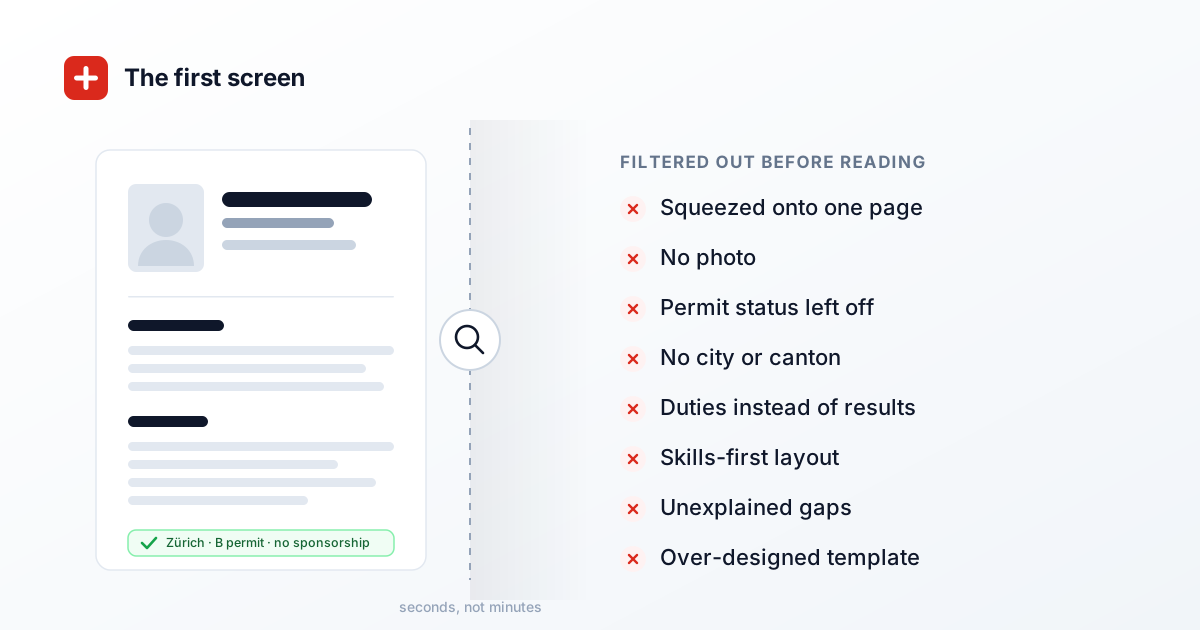
In short
The mistakes that get you rejected are rarely about wording or design. They are the points the advert itself marks as non-negotiable. Across the English-language adverts on SwissJobs.app, a degree or apprenticeship is phrased as a requirement in 80.9 percent of the adverts that mention one, and as merely welcome in 1.4 percent. Being a team player is phrased as a requirement in 3.4 percent. A CV built around adjectives and certificates, with the demanded qualification and experience hard to find, fails at exactly the point where the first cut is made.
"Hard" here means something countable rather than something felt: the point appears in a sentence alongside a requirement word — required, must, essential, mandatory, prerequisite, expected. "Soft" means it appears alongside a preference word — a plus, preferred, ideally, an asset, desirable. That distinction is not a matter of tone. It decides whether a gap in your dossier is a knockout or a position you can offset with something else.
The gate is narrower than most applicants assume. Among the English-language adverts, 43.6 percent name exactly one point in that hard form, 16.9 percent name two, 3.0 percent name three or more, and 36.5 percent name none at all. Most rejections therefore do not come from failing a long checklist. They come from one clearly stated criterion that a reader could not locate on your document in the time they gave it.
- Read the advert once for two word groups and nothing else. Mark everything sitting next to required, must, essential or expected, and everything sitting next to a plus, preferred, ideally or an asset. Among the English-language adverts, 22.2 percent use both groups in the same text and 60.4 percent use only the requirement group — which means the employer has already sorted the list for you, and ignoring that sorting is the cheapest mistake to avoid in the whole process.
- Put the qualification where it cannot be missed. A degree or apprenticeship is the hardest single point in the English-language segment: named in 18.9 percent of adverts and phrased as a requirement in 80.9 percent of those. If your degree is foreign, name the Swiss equivalent next to it. A qualification that a reader has to infer from an employer's name or a job title counts as absent.
- Answer the number when the advert states one. 20.7 percent of English-language adverts in Switzerland name a figure in years — against 0.9 percent of the German-language ones. Where the number is there, it is a filter, and the fix is not to inflate it but to make the years in the relevant field visible: field, function and dates on the first line of each entry, so the total can be added up without effort.
- Do not read a language requirement as a formality. Where English is mentioned in an English-language advert it is a requirement in 76.9 percent of cases, German in 60.3 percent and French in 47.4 percent. In other words, an English-language advert in Switzerland is not automatically a German-free job: when it names German at all, it usually means it. State the level in words on the CV rather than as a bar or a set of dots.
- Move certifications below experience. Certifications appear in only 4.0 percent of the English-language adverts and are phrased as a requirement in 14.6 percent of those. A block of course badges above your employment history swaps a hard criterion for a soft one — and it does so on the part of the page that gets read first.
- Delete the adjectives and show the evidence instead. Being a team player is named in 7.8 percent of adverts and is a stated requirement in 3.4 percent — the lowest figure in the whole table, and not a single mention in the sample was even phrased as a preference. One line describing what you owned alone and whom you had to align with proves more than any list of qualities.
- After a rejection, ask politely — but expect no reasons. arbeit.swiss explicitly suggests getting in touch to ask about the state of the selection procedure. An enforceable right to a written statement of reasons exists only under Art. 8 of the Gender Equality Act, and only where you claim discrimination on the grounds of sex. The claim for compensation lapses unless court action is brought within three months of the refusal being communicated.
What a Swiss advert demands, and what it merely likes
The idea that a CV is sorted on impression or design does not survive counting. Going sentence by sentence through the English-language adverts on SwissJobs.app and recording how each requirement is phrased produces a clear ranking. The qualification comes first: 80.9 percent of mentions of a degree, diploma or apprenticeship sit in a sentence with a requirement word, and only 1.4 percent in a sentence with a preference word. That is the widest gap between hard and soft anywhere in the table, and it is the opposite of how most international CV advice weights the same item.
At the other end of that ranking sit precisely the things applicants spend the most effort on. Certifications are mentioned in one advert in twenty-five, and only 14.6 percent of those mentions are requirements. Named tools and software — SAP, Excel, SQL and the like — are requirements in 38.7 percent of their mentions, with a further 10.5 percent explicitly framed as a bonus. Team-player language is a requirement in 3.4 percent. None of this means those things are worthless; it means they are almost never the reason a dossier is set aside before the interview.
Work experience sits in the middle, and its position is easy to misread. It is named in 87.3 percent of English-language adverts, more than any other item, but only 58.5 percent of those mentions are phrased as a hard requirement. The high visibility and the moderate hardness together explain a common failure: applicants assume experience is the whole test, write their CV entirely around it, and then miss a qualification requirement that was phrased far more strictly.
The English-language advert states a number — and that changes the mistake
One difference between the language segments of the Swiss market is sharp enough to change how you write. 20.7 percent of English-language adverts name a figure in years of experience. In the German-language adverts the share is 0.9 percent, in the French-language ones 14.5 percent and in the Italian-language ones 12.4 percent. If you are applying in English in Switzerland, you are far more likely to be measured against an explicit threshold than a candidate for the equivalent German-language role.
That has a practical consequence for the document. Where a number is stated, the reader will try to add up your years in the relevant field, and they will do it from the dates and the job titles alone. Entries that leave months implicit, that hide a promotion inside a single block, or that describe a role by its projects rather than its function make that addition slow — and a slow addition, on a first pass, tends to be abandoned rather than completed in your favour.
The opposite mistake is just as costly and more tempting. Stretching dates, merging a gap into the adjoining role, or upgrading a title to reach the stated number puts a figure on your CV that your reference letters will not support. In Switzerland those letters travel with the dossier: arbeit.swiss instructs applicants to obtain every one of them and to submit them in chronological order in a single PDF. A number that contradicts the attachment sitting three pages below it is worse than a number that falls short of the advert.
Why you never learn the reason — and the one statutory exception
A Swiss rejection normally gives no reason, and that is the rule rather than an oversight. An employer is free to choose among applicants and owes the unsuccessful ones no explanation. This is precisely why the countable points in the advert matter so much: they are the only thing you can check your dossier against, because the other side will tell you nothing once the decision is made.
Federal law recognises one exception. Art. 8 of the Gender Equality Act provides that "persons whose application for employment has been refused and who claim discrimination may request a written statement of reasons from the employer." The prohibition itself is in Art. 3, and its second paragraph states that it "applies in particular to hiring" — so it covers the application stage explicitly, not only the employment relationship that follows.
The consequences are deliberately narrow, and it is worth knowing that soberly. Where the discrimination consists in a refusal of employment, the person concerned "is entitled only to a compensatory payment" under Art. 5 paragraph 2; there is no right to the job itself. That payment may not exceed the equivalent of three months' salary. And the right lapses quickly: under Art. 8 paragraph 2 it is forfeited unless an action is brought within three months of the employer giving notice of the refusal. For the vast majority of rejections this route does not apply — but it shows how specifically the legislature carved out the one case in which a rejected applicant may demand an answer.
The mistakes that are not mistakes
A good share of the care that goes into applications is spent on points that barely appear as requirements at all. The adjectives that open most profiles are one. Course certificates are frequently another. So is visual design: not one of the requirement sentences analysed asks for a typeface, a colour or a column layout. What is asked for is completeness — arbeit.swiss states that a CV "should be complete, clear and not contain any gaps" and "should be no longer than three pages", and that it must be built chronologically with the most recent position first.
The mirror-image insight matters just as much: not every rejection has a criterion behind it at all. 36.5 percent of English-language adverts state no hard requirement in the analysed text. In that group the decision is made by comparison with the other dossiers, by the order in which applications arrived, sometimes by an internal candidate for a role that was advertised anyway. Reading a personal failing into that outcome leads you to fix something on the next document that was never the cause.
The practical conclusion takes two passes. First pass: mark the hard points in the advert and check that each of them is findable on the first page of your CV, in the same words the advert used. Second pass: cut whatever is only softly requested and is taking space away from those points. If a hard criterion is still unmet after that, the honest move is not to disguise it but to address it in a sentence — or to spend the time on one of the adverts where the same point is phrased as a preference.
Market figures were counted on 22 August 2026 from the adverts live on SwissJobs.app at that moment. The requirement analysis is based on the short summary of the advert text, which is available for around three quarters of the index; the shares quoted here cover the English-language adverts only — a fifth of all live adverts — except where another advert language is named explicitly. A requirement counts as hard when it appears in the same sentence as a word from a fixed list — required, requires, must, essential, mandatory, prerequisite, necessary, expected — and as soft when it appears in the same sentence as a plus, preferred, nice to have, ideally, advantageous, desirable, beneficial, an asset or welcome; sentences containing neither fall into neither group. Each per-requirement percentage refers only to those adverts that mention the point at all, and the bases for French and for certifications are small, so those values should be read as orders of magnitude. Legal references are taken from the Gender Equality Act as published on fedlex.admin.ch, in the English translation provided there, which is not the legally binding version; they are not legal advice.
Write a custom CV for every job you apply to
Most people send the same CV everywhere. The editor rewrites yours against the posting — Swiss format, the right language, in about a minute.
CV maker & resume builder: for a specific advertSources
- Gender Equality Act (GEA), Art. 3, Art. 5 and Art. 8 (fedlex.admin.ch, English translation)
- Gender Equality Act — binding German version (fedlex.admin.ch)
- arbeit.swiss (SECO) — Tips on applying for jobs: the application file, reference letters, asking about the state of the procedure
- berufsberatung.ch (SDBB) — creating and sending an application dossier
Related questions
What our job index says about the Swiss market
Computed live from our own index, not quoted from a study. Shares only, as of today.
Language the advert is written in
- Deutsch
- 60%
- English
- 23%
- Français
- 13%
- Italiano
- 3%
Of adverts that state a language requirement, the share asking for
- Deutsch
- 70%
- English
- 43%
- Français
- 21%
- Italiano
- 3%
19% posted in the last 7 days · Largest markets: Zürich 18% · Bern 10% · Genève 5% · Basel 5%