Which CV rules do not apply in Switzerland?
Updated:
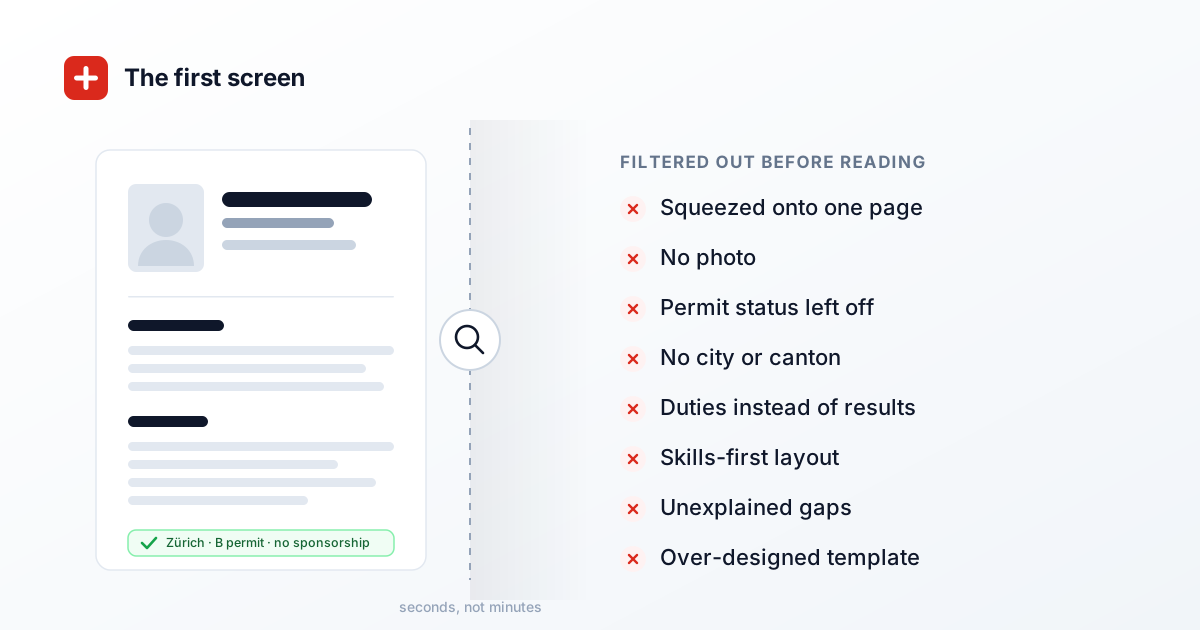
In short
Most of the rules that sink an international CV here were never written for Switzerland. The one-page limit belongs to the American résumé; "no photo, no date of birth" is a by-product of foreign anti-discrimination practice; the cover sheet and the signature come from the German application folder; the consent line at the foot comes from the EU. The official Swiss guidance says something different: no more than three pages, personal details including a photograph, work certificates and diplomas inside the file.
The reason is provenance, not taste. Each of these rules is the compressed form of a problem some other jurisdiction solved in its own way. Import the rule and you import the shortcut without the case that produced it, then apply it to a hiring process that is assembled differently.
One import does survive the crossing. "References on request" is not an Anglo-Saxon tic here: the SECO guidance states that you should generally note in your CV that references can be provided on request. What differs is what it sits next to — the Swiss work certificate, a document the American process has no equivalent of.
So test any rule you are about to follow in three places: against the official guidance of the country you are applying in, against the law that produced the rule, and against the advert in front of you. What survives all three is a rule. The rest is a habit from someone else's procedure.
Shares of open adverts whose advert language is unambiguous, which is 73.7 per cent of all adverts. Rolling analysis of the vacancies open on SwissJobs.app, 23 August 2026. Region is assigned from the place of work given in the advert.
- The one-page limit comes from the US résumé. SECO's guidance says a CV "should be no longer than three pages".
- "No photo, no date of birth" comes from jurisdictions with broad anti-discrimination duties. Swiss guidance lists "personal details, including photograph".
- The cover sheet and the hand-signed CV come from the German application folder; neither appears in the official Swiss list of file components.
- The consent line under a European CV has no addressee here: Art. 328b CO binds the employer's handling of your data, not you.
- "References on request" is the one imported line the Swiss guidance explicitly asks for — alongside the work certificates, not instead of them.
- "Always apply in German" and "English works everywhere" are both wrong: 23.8 per cent of German-speaking-Switzerland adverts are written in English, and 35.5 per cent in French-speaking Switzerland.
A CV rule is a local answer to a local problem
Hiring advice travels far better than the law it grew out of. That is the whole mechanism behind a bad import: the sentence crosses the border, the statute that made it sensible stays home.
In the United States, the federal enforcement agency states that information requested through the pre-employment process "should be limited to those essential for determining if a person is qualified for the job", and that information on race, sex, national origin, age and religion is irrelevant to that determination. Employers reduced their exposure by not asking; applicants translated that into a rule about what a CV may contain.
Germany's General Equal Treatment Act sets out to prevent disadvantage on grounds including ethnic origin, sex, religion, disability, age and sexual identity — which is how the photo became optional there without ever being forbidden. In France, Art. L1221-6 of the Code du travail allows information requested from a candidate only for the purpose of assessing their capacity to do the job.
Switzerland applies a comparable standard, but attaches it to the employer: under Art. 328b of the Code of Obligations, an employer may handle data "only to the extent that such data concern the employee's suitability for his job or are necessary for the performance of the employment contract". The federal data protection commissioner puts the hiring stage plainly: employers may only ask for details showing whether the applicant fits the company and meets the requirements of the post. The limit sits on the questions, not on what you volunteer.
One page: an answer to an American process
The famous page limit exists because in the market that produced it the CV is nearly everything an employer sees in advance. No work certificates, no certified diplomas, references taken by telephone after the interview. A document standing alone has to compress.
The Swiss file is assembled the other way round. SECO lists the usual components as a cover letter, the CV, work certificates, diplomas and certificates, and references. The CV is not the file; it is the contents page of the file, and it carries an explicit ceiling: no longer than three pages.
That does not make length a virtue. The rule that actually operates runs in the opposite direction: the CV has to explain what the attachments prove. Cut a three-year post to a single line so that everything fits on one sheet and you create exactly the gap between CV and work certificate that a screener notices.
So the one-page rule is not false. It is a rule without jurisdiction here — still sound where it came from, and still sound for a short profile, a portfolio or a speculative note, where nobody is expecting a dossier.
The anonymity package, and who it was written to protect
No photo, no date of birth, no nationality: these three omissions travel together, and they are the costliest import, because they remove information the Swiss first screen is looking for.
The official guidance lists, among the contents of a CV, "personal details, including photograph". The other language editions of the same page are blunter still — the French one asks for personal data with a photo that shows you at your best, the Italian one for personal data including your photograph in the appropriate format. Leaving the photo out is permitted; it simply is not the local rule.
The second half of the package matters more than the picture. Where a post depends on a permit, a single line stating your place of residence and permit status removes a query that would otherwise sit between your application and an answer. What is genuinely restricted here runs the other way: the data protection commissioner notes that questions about origin, membership of a group or religion are only admissible where the employer's own orientation justifies them, and that questions about income, debt, illness or pregnancy need particular justification.
Read plainly, the imported rule protects an employer in its home jurisdiction against a claim. It does not protect you inside a process that expects the detail.
The import that does apply: references on request
Not every import is a mistake. The line many people dismiss as filler — references available on request — is exactly what the Swiss guidance asks for: it says you should generally note in your CV that references can be provided on request, with the referee sheet handed over at the interview.
The difference lies in what stands beside it. Art. 330a of the Code of Obligations gives an employee the right to request, at any time, a reference "concerning the nature and the duration of the employment relationship, the quality of his work and his conduct", and, if the employee expressly asks, one limited to nature and duration only.
That produces something the American file does not contain: a written appraisal, drafted by the former employer, that travels with the application. "References on request" is therefore an addition here, not a substitute — the certificates are enclosed, the contact details follow later.
And again there is a limit that binds the other side of the table: according to the commissioner's guidance, approaching current or former employers requires your prior consent and may only cover job-relevant matters.
What arrives from Germany, France and the EU template
From Germany come the cover sheet, the signature with place and date, and the mental image of a bound folder. None of it appears in the Swiss list of components. None of it is an error either — it is an extra sheet answering a question nobody here asked.
From the French-speaking world comes the habit of a very short CV and, in its older form, the handwritten covering letter. Both are conventions of form rather than requirements, and the actual French requirement concerns something else entirely: the purpose for which information may be requested.
It is worth noticing how similar the underlying principles are. France limits requests to assessing capacity for the job; Switzerland limits handling to data concerning suitability for the employment relationship. The principle crosses the border intact. The format does not.
Hence the rule of thumb for anyone arriving here: bring the principles from your home market — evidence, fit to the post, clean structure — and leave the formalities where they belong.
The consent line at the foot of a European CV
Countless European CVs end with a sentence in which the applicant authorises the processing of their personal data. In Switzerland that sentence does no work, not because data protection matters less here, but because the duty sits on the other side of the table.
Art. 328b of the Code of Obligations addresses the employer: data may be handled only where they concern suitability or are necessary to perform the contract, and in all other respects the Data Protection Act applies. Your authorisation neither widens nor narrows that limit.
What the line does achieve, in practice, is to prove that the document was carried over from a different procedure. That is the real cost — not the sentence, but the signal that nobody adapted the file to this market.
The reverse case is the one newcomers forget. A Swiss file complete with photograph, date of birth and nationality performs worse in markets built around anti-discrimination duties. Applying in both directions means keeping two versions, not two translations.
The language rule both camps get wrong
Two imported rules face each other here. One arrives from the German-speaking world — always apply in the local language. The other arrives from multinational offices — everyone here reads English anyway. Measured against the open market, neither holds.
Counting only the adverts whose language is unambiguous, 72.1 per cent of adverts in German-speaking Switzerland are written in German and 23.8 per cent in English. In French-speaking Switzerland it is 57.6 per cent French and 35.5 per cent English; in Ticino, 70.9 per cent Italian and 23.0 per cent English.
So roughly one advert in four in the German-speaking cantons is written in English, and better than one in three in the west — while in every region the local language remains the majority. A blanket language rule is wrong about as often in one direction as in the other.
The rule that does hold is not national but documentary: apply in the language of the advert, and read the requirements line separately. The language a post is advertised in and the language it is worked in are two different facts.
Where a Swiss application actually lands
Some imported rules are about software rather than paper: formatting advice written for American applicant systems. The provenance question is worth asking here too.
In our rolling analysis, 32.6 per cent of open adverts lead into the applicant system of an identifiable vendor. Within that group, 51.9 per cent of the systems were built in the United States and 37.8 per cent in Switzerland, with German and other European vendors sharing the remainder. The larger part of the market does not go there at all: it leads to an address of the employer's own, or to a job platform.
Across all open adverts that works out at roughly 17 per cent landing in American-built software. For the other four fifths, "format it for the American system" answers a question that is not being asked.
What holds in both worlds is dull enough to be reliable: a plain structure read in reading order, facts as text rather than inside graphics, one file that opens without ceremony. Anything beyond that sold as a system rule applies, at best, to a slice of the market.
How to test an imported rule before you obey it
First, ask where it was written and which procedure it describes. Advice that assumes a résumé, a cover letter and reference calls is not describing the file requested here.
Second, hold it against the official guidance of the country you are applying in. For Switzerland that is a short document: the components of the file, the three-page ceiling, personal details including a photograph, references on request.
Third, hold it against the advert. Whatever the advert states explicitly — language, permit, certificates, how many files to attach — beats any general rule, whatever country it came from.
Fourth, test the outcome on the case rather than on the rule. Running your CV against a real Swiss vacancy shows you within minutes which detail is missing and which imported habit costs you nothing, and that is a firmer answer than any list of do's and don'ts.
Market figures come from the rolling analysis of the vacancies open on SwissJobs.app, 23 August 2026. Language shares refer to the 73.7 per cent of adverts whose language is unambiguous; the language region is assigned from the place of work stated in the advert. An advert counts as leading into a named applicant system only where the application link points at the address of an applicant-software vendor. Job platforms, recruitment portals and the employer's own addresses do not count: the software behind them cannot be identified, so those adverts are excluded from the origin comparison. Every figure is a share, never an absolute size of the index.
Check how your CV fits a job — and the Swiss market
Free checker: languages, work permit, skills and more — scored against a specific posting.
ATS CV checker: against a specific advert, freeSources
- arbeit.swiss (SECO) — Tips on applying for jobs: components of the application file, "no longer than three pages", "personal details, including photograph", references on request
- Fedlex — Code of Obligations, Art. 330a: the employee may request a reference on the nature and duration of the employment and on the quality of the work and conduct
- Fedlex — Code of Obligations, Art. 328b: an employer may handle data only where they concern suitability for the job
- FDPIC — Different phases of the employment relationship: which questions are admissible during recruitment
- gesetze-im-internet.de — § 1 AGG (Germany): purpose of the act and the protected grounds it names
- U.S. Equal Employment Opportunity Commission — Prohibited Employment Policies/Practices: limits on pre-employment inquiries
- Légifrance — Code du travail, Art. L1221-6 (France): information requested may only serve to assess capacity for the job
Related questions
What our job index says about the Swiss market
Computed live from our own index, not quoted from a study. Shares only, as of today.
Language the advert is written in
- Deutsch
- 60%
- English
- 23%
- Français
- 13%
- Italiano
- 3%
Of adverts that state a language requirement, the share asking for
- Deutsch
- 70%
- English
- 43%
- Français
- 21%
- Italiano
- 3%
19% posted in the last 7 days · Largest markets: Zürich 18% · Bern 10% · Genève 5% · Basel 5%