Gaps and breaks in a Swiss CV — explain them, don't smooth them over
Updated:
Interruptions, switches and everything that will not fit the shape of a clean job with a start and an end. In Switzerland this is not a matter of taste: the reference letters state the nature and duration of every job by law, and once they are stacked in date order, every month in between is visible. The market figures on this page come from the adverts on SwissJobs.app.
- How do I handle gaps in my CV?
- How do I show part-time roles and workload on a Swiss CV?
- How do I show parental leave on a Swiss CV?
- How do I show a career change on a Swiss CV?
- How do I explain gaps in my Swiss CV?
How do I handle gaps in my CV?
In short
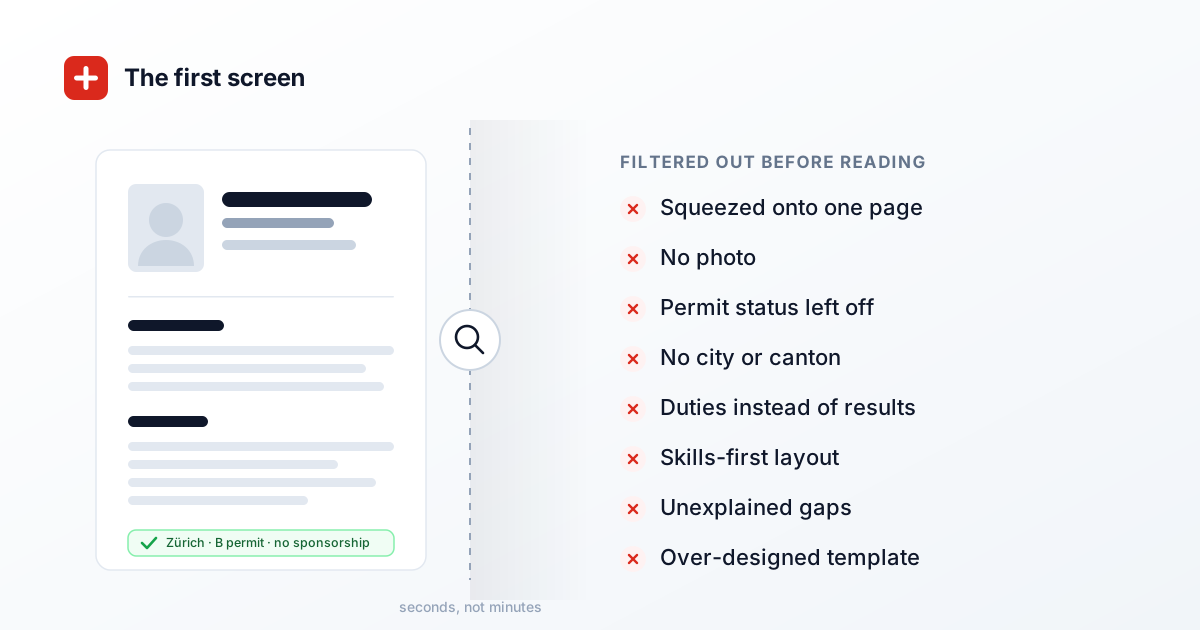
Give the gap its own dated line, formatted exactly like a job: month, year, a plain label, one sentence on what came out of it. Hiding it does not work here. Swiss law entitles every employee to a reference letter stating the nature and duration of the employment, and the official application guidance requires those letters to be complete and in date order. The gap therefore emerges from a subtraction that happens anyway as the file is leafed through. Named, it is a chapter. Unnamed, it is an open question nobody asks and everybody answers.
This answer can contain errors and is not official advice. What your RAV or unemployment fund says is binding.
This is where Swiss practice parts company with most English-language advice on the subject. In the United States and Britain the CV is a marketing document: you may compress, reorder, or dissolve the history into skill clusters, and the reader has no independent way to check the dates. In Switzerland the CV is the table of contents for a stack of evidence that arrives with it — reference letters, diplomas, certificates. The reader is not reconstructing your history from your prose. They are comparing two documents.
So the second half of the answer is vocabulary rather than layout. Swiss unemployment law gives official names to most of the things people actually do during a break — interim earnings, training measures, professional placements, temporary employment programmes. These are statutory terms, not euphemisms, and they have the useful property of being checkable.
Based on the adverts on SwissJobs.app that state a type of employment, which is 90.5 per cent of the set.
- The English version of the official page is the bluntest of the four. arbeit.swiss, run by the State Secretariat for Economic Affairs, says the CV should «be complete, clear and not contain any gaps», and about the attachments: «The references must not contain any gaps and must be organised chronologically, with the most recent reference coming first.» The German text applies the gap-free wording to the reference letters and asks the CV to be chronological; the French version addresses your career itself — « Évitez les lacunes dans votre parcours. »
- Every reference letter carries dates because the Code of Obligations says so. Article 330a paragraph 1: «The employee may at any time request from the employer a reference concerning the nature and the duration of the employment relationship, the quality of his work and his conduct.» Nature and duration are the compulsory part; the assessment is added on top. Twelve years of work therefore arrive as twelve years of dates.
- Put the gap in the same column as a job, not in a footnote. Same date format, same line height, same typeface: «03.2025 – 09.2025 — Job search, registered with the RAV; completed accounting course». A separate «career breaks» box at the end of the CV does the opposite of what it is meant to do: it collects every interruption in one place and invites the reader to add them up.
- The time in between has statutory names, and they can be used verbatim. Interim earnings — «any income from employed or self-employed work that the unemployed person earns within a control period» (Art. 24 para. 1 of the Unemployment Insurance Act). Training measures — courses in retraining, further training or integration, plus placements in practice firms and training internships (Art. 60 para. 1). Temporary employment programmes, professional placements and motivation semesters (Art. 64a). The umbrella term is labour market measures (Art. 59).
- Not every interruption needs a line. Swiss CVs are normally written to the month, which makes anything shorter than a month disappear by itself — that is practice, not a rule. Four to eight weeks between two jobs is ordinary notice period plus holiday and nobody expects a note on it. From roughly three months the distance becomes visible, and from six it gets counted.
- Do not wait for an advert to invite you back. Of the adverts on SwissJobs.app that carry a short description, 0.1 per cent explicitly address career changers or people returning to work, and almost all of those are in care and nursing, often at very small workloads. Everywhere else the invitation is simply not in the text, which means the explanation has to be in your CV.
- If you apply in English in Switzerland, expect the advert to give you less to work with. Only 1.5 per cent of English-language adverts with a short description mention further training of any kind, against 24.7 per cent of the German-language ones. The vocabulary that makes a course during a break sound native to the market is in the German adverts — which is an argument for naming the qualification, the provider and the completion date rather than the fact that you studied.
- For a short job you would rather not have graded, the law provides a separate form. Article 330a paragraph 2: «At the employee's express request the reference must be limited to the nature and duration of the employment relationship.» That is the confirmation of employment. It closes the gap in the stack without carrying an assessment, and it is an entitlement rather than a favour.
The gap is arithmetic, not interpretation
Someone going through a Swiss application file rarely reads it line by line. They leaf through the attachments, because that is where the evidence is, and a timeline assembles itself on the way: letter one ends in May, letter two starts in February the year after next. The gap is not discovered. It falls out of the subtraction.
This is why the common tip of writing years instead of months backfires here. It blurs the timeline in the CV while the reference letters continue it precisely. The effect is not that the gap disappears; it is that two documents in the same file are kept to different standards of precision, and the more precise one wins. What was meant as cover ends up reading as intent.
The sober consequence is that a CV cannot hide a gap. It can name it or leave it uncommented, and that is the whole choice available to you.
What the official guidance actually requires
Trace Swiss application advice back far enough and it tends to end at one document: the application tips published by arbeit.swiss. On structure: «Your CV should be structured chronologically, with your most recent job mentioned first.» On the file itself: «Make sure that your application file includes all work references… The references must not contain any gaps and must be organised chronologically, with the most recent reference coming first.»
The list of what the CV should contain is worth reading alongside it, because it explains the pressure on the timeline: title, personal details including photograph, professional experience to date, education and training, language skills, special knowledge or activities, personal interests, references. Seven of the eight blocks are neutral about time. The one that is not — professional experience to date — is also the one the attachments verify.
For practical purposes the two requirements collapse into one instruction: attach every reference letter you have, and account in the CV for the months the letters do not cover. Do that and the wording differences between the four language versions of the page stop mattering.
What the line looks like
A usable gap line has four parts: the period in the same notation you use for jobs, a factual label, the place or institution where relevant, and an outcome. «08.2024 – 02.2025 — Family caring responsibility, Bern; evening course in bookkeeping, completed 01.2025.» No apology, no exclamation mark, no conditional tense.
The outcome is what carries the line. A completed course, a language diploma, an assignment, a relative cared for, a journey with a destination and a duration — each of these turns a period into an activity. Where there is no outcome, the label still stands on its own: «job search» is an accurate statement and, in a country with registered unemployment and a public placement service, an entirely ordinary one.
What does not work is stretching the neighbouring jobs. Moving an end date forward by four months to make the timeline close creates a contradiction with a document sitting a few pages further back in the same file. Of all the ways to deal with a gap, that is the only one that converts an explainable circumstance into a question of trust.
The official name for what you were doing
Swiss unemployment insurance maintains its own vocabulary for time without a job, and because it is written into federal law it can be verified. Someone who worked while looking for work had interim earnings; Article 24 of the Unemployment Insurance Act defines these as any income from employed or self-employed activity earned within a control period. On the CV that becomes the assignment itself — employer, function, period — in the same format as every other entry, not a vague reference to odd jobs.
Someone who took a course may have been in a training measure. Article 60 lists individual or collective courses in retraining, further training or integration, together with placements in practice firms and training internships. Someone on a placement scheme can point to Article 64a, which covers temporary employment programmes, professional placements and motivation semesters. The umbrella is Article 59, which groups all of these as labour market measures.
Their value is not that they sound impressive; it is that they exist. «Professional placement under a cantonal labour market measure» is something a reader can place, because the scheme is real and the canton administers it. «Various projects» is not. Which measure applied in your case, and what it was formally called, is something your RAV can tell you — take the wording from them rather than inventing it.
What the adverts say about coming back
Two numbers from the adverts currently live on SwissJobs.app say more about returning after a break than any amount of encouragement. First, 0.1 per cent of the adverts with a short description explicitly welcome career changers or returners. The handful that do are almost entirely in care and nursing, sometimes at workloads of ten or twenty per cent. Waiting for the advert to open the door is, nearly everywhere, waiting for nothing.
Second, 14.9 per cent of adverts with a short description raise further training on their own initiative, rising to 24.7 per cent among the German-language ones and falling to 1.5 per cent among the English-language ones. Further training is one of the few subjects where the advert and your gap line can use the same word — which is the practical reason a completed course is the most useful thing to put in a long break. Not because it impresses, but because it connects.
Third, the shapes on offer. Among adverts that state a type of employment, 91 per cent are full-time, 6.1 per cent part-time, 2 per cent temporary or fixed-term and 1 per cent internships. The formats that close an open gap fastest add up to around three per cent of what is advertised. They are filled more often than they are posted, which is an argument for approaching staffing firms and target employers directly instead of refreshing a list.
The short job you would rather not have graded
A common special case is not the gap itself but what sits next to it: a three-month job that ended badly, and the temptation to leave it out altogether. Leaving it out manufactures precisely the gap you were trying to avoid, and it does so at a point in the timeline where a document already exists.
The clean route is in the statute. Under Article 330a paragraph 2 of the Code of Obligations, at the employee's express request the reference must be limited to the nature and duration of the employment relationship. That is the confirmation of employment: it evidences the period without delivering a verdict on it, the entitlement exists at any time, and no reason has to be given.
The job then appears in the CV in the ordinary way, with function, employer and period; the confirmation sits at the chronologically correct place in the file; and the timeline closes. If it comes up at interview, the answer is short and undefended — a working relationship that did not fit is a familiar event, whereas a missing half-year in a file is not.
Counting was done on 22 August 2026 across the adverts live on SwissJobs.app that day. The employment-type shares refer to the adverts that state a type, which is 90.5 per cent of the set. The figures on further training and on adverts addressing career changers rest on the short description, which exists for 74 per cent of the set; they count word stems, which undercounts adverts expressing the same thing in other words. The comparison between posting languages also measures how discursive adverts are in each language, so it is not a pure comparison of employer practice. Requirements for the application file are cited from arbeit.swiss (SECO), in all four of its language versions; the statutory wording comes from the Code of Obligations and the Unemployment Insurance Act as published on fedlex, with the Unemployment Insurance Act available in German, French and Italian only.
Write a custom CV for every job you apply to
Most people send the same CV everywhere. The editor rewrites yours against the posting — Swiss format, the right language, in about a minute.
CV maker & resume builder: for a specific advertHow do I show part-time roles and workload on a Swiss CV?
In short
Write the workload as a percentage on the same line as the job title and the employer — on every position, including the ones that were 100%. The Swiss market shows you the format: of the adverts on SwissJobs.app that name a workload at all, 98 percent carry the figure in the job title itself. Adding it only to the reduced roles turns the figure into a flag on those roles. Adding it everywhere turns it into a column.
This is the single biggest difference between a Swiss CV and the British or American one you may have been writing until now. Those documents never state a workload, because the assumption is full-time and the exceptions are silently smoothed over. Here the figure is part of how a job is named. Leaving it out does not read as modesty; it reads as a missing field.
It matters because nothing else in the Swiss application file has to supply it. The Code of Obligations requires the employer, within one month of the start, to inform the employee in writing of the names of the parties, the start date, "the employee's function", "the salary and any additional benefits" and "the length of the working week" (Art. 330b). The reference letter is a different matter: Art. 330a covers "the nature and the duration of the employment relationship, the quality of his work and his conduct", and the workload is not on the federal list of what a full reference must contain. Your contract knows the number. Your reference letter need not. The CV is where it reaches the reader.
- Title line, not body text. "Registered Nurse, 80%" or "Finance Officer (60%)" — function, workload, employer, place, dates, all at the same height. About 13.5 percent of the adverts that name a workload put it in brackets and the rest attach it with a comma or a slash; both read as normal on a CV. The one format that stands out is a separate bullet further down saying "Workload: 60%", because it promotes a detail into an announcement.
- State the 100% roles too. The moment only the reduced positions carry a percentage, the percentage itself is the marker — it says "something was different here". When every position carries one, it is a column like the dates. Four characters per role, and part-time loses the special status the document otherwise hands it for free.
- Think in tens, but do not round. 99.7 percent of all workload figures in the adverts are multiples of ten; 85 or 95 percent barely exist in the market. If your contract says an odd number, write the odd number and expect the question — an 85% workload is usually the four-and-a-half-day week, and that sentence is the answer the reader is looking for.
- A change of workload is its own line, not a footnote. Going from 100% to 60% with the same employer means two lines with their own date ranges under one employer heading. It is not a job change and will not be read as one as long as the function is identical in both lines. What you gain is that the reduction appears as a dated decision instead of an unexplained break in the chronology.
- Two concurrent part-time jobs are not a contradiction once the figures are there. Two parallel lines at 60% and 40% with overlapping dates add up to an explained full working life. Without the figures, the same two lines look like two simultaneous full-time jobs — which is the point at which a truthful file starts to look implausible.
- For the job you want now, give a range, the way the adverts do. 62.6 percent of the adverts that name a workload give a range rather than a fixed figure, and 72.4 percent of those ranges are exactly twenty points wide; "80-100%" alone accounts for 65.4 percent of all ranges. A line reading "Availability: 80-100%" at the top of the CV therefore speaks the market's own dialect, while a single fixed figure removes you from every advert that does not match it.
Where the figure actually sits in the Swiss market
Count it and the convention is unambiguous. 22.5 percent of the adverts live on SwissJobs.app name a workload in percent, and 98 percent of those name it in the job title rather than in the description. In Switzerland the percentage has become part of how a role is named, in the same way as the location or the abbreviation of the required qualification. It is read before any sentence is read.
The other 76.2 percent say nothing about workload at all — no figure, no word. That silence is worth understanding before you copy it into your CV. In an advert, silence means "full-time unless we say otherwise", because the employer knows what it is offering. In a CV, silence means the reader has to guess what you did, and the guess defaults to full-time, which is exactly the assumption you do not want quietly attached to eight years of your history.
The notation is worth copying too. In job titles the closed form ("80%") appears roughly six times as often as the typographically correct spaced form ("80 %"); in ranges the plain hyphen dominates at about 87 percent, ahead of the en dash, while spelled-out variants such as "80 to 100 percent" stay under two percent. For a CV the practical point is smaller than it sounds: pick one form and hold it across every entry. Switching between "80%", "80 %" and "80 percent" creates precisely the visual noise a clean two-column layout is meant to remove.
Why 90% is full-time here and part-time everywhere else
The Federal Statistical Office draws the line explicitly, and it does not draw it at 100. Its definition reads: "Als Vollzeiterwerbstätige gelten alle Erwerbstätigen mit einem Beschäftigungsgrad von mindestens 90%" — everyone working at 90% or more counts as full-time. Below that it distinguishes two bands: part-time I at a workload of 50 to 89%, and part-time II below 50%.
The same definition states that this is not the international convention: internationally, the threshold is higher, and every workload below 100% counts as part-time. That single sentence explains most of the confusion an international candidate feels here. A 90% job is a full-time job with a free afternoon in Swiss statistics, and a part-time job in the reading you brought with you.
The practical rule that follows is short: write the number, not the category. "90%" is correct under every reading. "Part-time" is not, and "full-time" at 90% is defensible in Swiss statistics but attackable in an international process. The number sidesteps the whole argument because it asserts no category at all.
The federal bands are also a usable self-check on how much context to add. Anything from 90% upwards needs no explanation on a CV. Between 50 and 89 percent the figure carries itself. Below 50 percent, half a sentence of context — studies, a second job, caring responsibilities — is worth the space, because only then is it clear what filled the rest of the week.
What the application file knows about your workload without you: almost nothing
Swiss employment law touches the workload in exactly one place. Art. 330b of the Code of Obligations obliges the employer, within one month of the beginning of the employment relationship, to inform the employee in writing of the names of the contracting parties, the start date, the employee's function, the salary and any additional benefits, and the length of the working week. If any of those change during the relationship, the change must be put in writing within a month as well.
The reference letter is governed by a different article and a shorter list. Art. 330a gives the employee the right to "a reference concerning the nature and the duration of the employment relationship, the quality of his work and his conduct", and on express request the reference must be limited to nature and duration. The State Secretariat for Economic Affairs publishes the requirements for a full reference — the identity of both parties, the beginning and the end of the relationship, a detailed list of the important functions and characteristic activities, an appraisal of performance and conduct, and a legally valid signature with the date. The workload is not on that list.
That asymmetry is the real argument for stating the figure. The proof exists, in your contract or in the written information required by Art. 330b, but it does not travel with the application. If the CV is silent, the reader cannot reconstruct the hours and will assume full-time. That sounds convenient and is not: the number surfaces at the salary conversation or at the reference call, and a full-time career assumed in silence then looks like a corrected one.
The same asymmetry closes the other door. Rounding a 60% role up to 80% because it reads better is refutable with one look at a contract, and a refuted CV costs far more than any missing percentage ever could.
The same 60% reads differently in nursing and in engineering
How much explaining a reduced workload needs depends less on the workload than on the field. Take the adverts of each occupational family that name a workload, and ask what share of them advertise less than 100%: education 60.4 percent, retail 38.9, nursing and care 33.5, human resources 28.4, commercial and administrative roles 27.2, hospitality 26.4, marketing 26.2, IT 20.9, logistics 13.2, finance 8.3, construction 4.0 and engineering 0.8 percent.
A 60% line in a nursing CV is therefore the ordinary shape of that profession and needs no sentence of justification at all. The same line in a construction or engineering CV sits against a market that almost never advertises reduced roles — there, a short clause saying why the workload was reduced and whether it is to stay that way earns its space.
This is also the honest answer to whether part-time "hurts" a CV. It does not hurt where the market itself thinks in fractions, and it creates explaining to do where the market does not. Either way you can check before you write: read twenty current adverts in your field, count how many name a figure below 100, and you know how much context your own document has to carry.
One side observation from the same stock, offered with the caution it deserves: adverts with a workload below 100% have a median age of 17 days against 23 days for the 100% ones. A single snapshot cannot separate faster filling from more frequent reposting. What it does not show is reduced roles sitting around unfilled as rare curiosities.
The one place part-time really does need work: leadership
There is a point at which the number alone is not enough. Count how often a job title carries a seniority word — senior, lead, head, principal, director or the German and French equivalents — and 13 percent of adverts at 100% carry one, against 3.3 percent of adverts whose workload is below 100%. Across the bands the share falls from 13 percent at 100% to 6.3 percent at 90 to 99, 4.8 percent at 70 to 89 and 0.5 percent at 51 to 69 percent.
The market, in other words, advertises leadership almost exclusively at full workload. For a CV in which leadership genuinely happened at 60%, that means the reader's prior runs against you and a job title alone will not turn it around. This is where a line of magnitudes belongs directly under the title: how many direct reports, what budget, what perimeter, over what period. Those are the details that replace an assumption with a fact.
Converting to full-time equivalents helps here too, as an addition rather than a replacement. Five years at 60% is three full-time-equivalent years; writing both — the period, the workload and the equivalent derived from them — saves the reader an arithmetic step they would otherwise take silently and usually badly. Keep the order: the verifiable facts first, the derived figure second.
And one detail that gets missed constantly: a reduced workload in the past says nothing about the workload you want next. If that line is missing from the top of the CV, the last figure in your history is read as your preference. Anyone returning from years at 50% to a full role has to write it exactly once, at the head of the document rather than buried in the cover letter.
Four mistakes one line prevents
First, hours instead of percent. Fewer than one advert in a thousand in the stock states a weekly hours figure — the working language of workload in Switzerland is the percentage. Writing "34 hours per week" forces the reader to divide by a company-specific standard week they do not know. The exception is applying abroad, where the percentage means nothing and the hours figure is the only legible form.
Second, a workload in the education section. Percentages belong to employment, not to qualifications. A degree taken alongside work is named as such; the percentage belongs on the line of the job held in parallel, where it also explains why that job was reduced.
Third, the percentage only on the awkward entries. It is the most common version and the only one that produces the effect it is trying to avoid. A figure that appears only where something would need explaining is itself the explanation.
Fourth, the unexplained jump. Going from 100% to 40% and back to 100% is three lines and no gap — provided all three date ranges are there. Without them the CV produces exactly what the federal application guidance tells you to avoid: a chronology that cannot be read without a follow-up question.
The market figures were counted on 22 August 2026 from the adverts then live on SwissJobs.app. A workload figure means any percentage between 10 and 100 appearing in an advert's job title or short description; ranges are classified by their upper value. The occupational families are assigned from the job title, so they should be read as orders of magnitude rather than as official industry statistics. The legal and statistical definitions come from the federal sources linked below; the reference-letter requirements are published by the State Secretariat for Economic Affairs in German, French and Italian only.
Write a custom CV for every job you apply to
Most people send the same CV everywhere. The editor rewrites yours against the posting — Swiss format, the right language, in about a minute.
CV maker & resume builder: for a specific advertHow do I show parental leave on a Swiss CV?
In short
Switzerland has no parental leave. It has 14 weeks of maternity leave under Art. 329f of the Code of Obligations and two weeks for the other parent under Art. 329g — and during both, the employment relationship keeps running. If you went back to the same employer afterwards, you have no gap at all: your reference letter covers the period. A line on the CV is only needed when you stayed away longer than the paid leave. Write it dated, plainly labelled, in the same column as a job.
That is the part most international advice gets wrong here, because it answers the question for a different country. The phrase usually arrives carrying assumptions Swiss law does not share: a long statutory entitlement, a job held open by law, a recognised CV category with its own etiquette. Swiss law offers a short, precisely counted list of leaves instead — and the words “parental leave” appear nowhere in the Code of Obligations. Everything beyond that list is a private agreement between you and one employer.
So the practical question is not how to phrase parental leave. It is whether your absence produced a period with no employment behind it — and if it did, how long that period was compared with what a Swiss recruiter routinely sees. Both halves are checkable: the leaves are in the statute, and the length employers plan for can be counted in the adverts on SwissJobs.app that exist precisely because someone is on leave.
The first two bars are the statutory leaves under Art. 329g and Art. 329f of the Code of Obligations. The other three are the contract lengths stated in adverts on SwissJobs.app that explicitly advertise maternity cover.
- Do the subtraction before you write anything. From the first day away to your first day back, deduct the paid leaves — 14 weeks of maternity leave, two weeks for the other parent — plus accrued holiday and any overtime taken as time off. Whatever remains is unpaid leave or time with no employer, and only that remainder is a candidate for a CV line. For most returners nothing remains.
- If a line is needed, it goes in the job column, not in a footnote. Same date format, same type size, same indent: "09.2024 – 06.2025 — Family time (unpaid leave, position at Muster AG suspended); completed CAS in Digital Marketing." A separate "career breaks" block at the bottom of the CV does the opposite of what it is meant to do — it gathers every interruption in one place and invites someone to add them up.
- Drop the phrase "parental leave" and name what actually happened. "Maternity leave followed by unpaid leave", "family time", "unpaid leave (childcare)" or "career break — caring responsibilities" all read as statements of fact in a Swiss dossier. The imported phrase does not: it describes an entitlement that does not exist here, so the reader has to convert it before they can use it.
- Keep the line as short as the facts. Start, end, label, one clause about what the time produced professionally. The number and ages of your children are not part of it. They answer no question a Swiss selection process needs answered, and they turn a neutral line into a personal one.
- If you took a cover role, put the word in the line. Among the adverts on SwissJobs.app that explicitly advertise maternity cover, 96.6 percent name it in the job title — the employer says it in the headline. "Payroll Specialist, 80% (fixed-term maternity cover), 04.2025 – 12.2025" therefore explains its own end date before anyone asks.
What Swiss law actually gives a parent
The Code of Obligations lists eight kinds of leave in the relevant section, and none of them is called parental leave. In order: free time, holidays, leave for extracurricular youth work, maternity leave, leave of the other parent, leave to care for a relative, leave to care for a seriously ill child, and adoption leave. Four of those touch new parents, and each is short and exactly counted.
Art. 329f CO: after the birth, the employee is entitled to maternity leave of at least 14 weeks, extended if the newborn has to stay in hospital. Art. 329g CO gives the other parent two weeks, to be taken within six months of the birth, in weeks or in single days. Art. 329j CO gives two weeks of adoption leave in the first year after the child arrives. Art. 329i CO gives up to 14 weeks of care leave where a child is seriously ill or injured — seven weeks each if both parents work, inside an 18-month framework period.
The money is separate from the leave and comes from the loss-of-earnings scheme. The federal information leaflets put it plainly: maternity allowance runs for the first 14 weeks and pays 80 percent of average previous earnings, capped at 220 francs a day. The allowance for the other parent is at most 14 daily allowances — ten days of leave for a full-time job, plus four more to cover the weekends. Nothing in that arithmetic produces a year off.
Everything longer is contractual. Extended unpaid leave, a fourth week for the second parent under a collective agreement, a reduced workload on return: all real, all common, none of it a statutory right. For CV purposes that distinction is the whole story, because statutory leave runs inside the employment relationship and an extension usually runs outside it.
The usual case: there is nothing to write
Take 14 weeks of maternity leave, come back to the same employer, and you were employed throughout. The relationship was never interrupted, so there is no gap for anyone to find. Art. 330a CO requires a reference letter to state "the nature and duration of the employment relationship" — and in this case the duration runs straight through. Inserting a "maternity leave" line anyway creates a break in the document that does not exist in the file.
The statute reinforces that continuity. Under Art. 336c(1) CO an employer may not give notice, once the probation period has ended, during pregnancy and for the 16 weeks following the birth, nor during the leave of the other parent. Notice given inside those protected periods is void. The employment is not merely nominally in place during the leave; it is specifically protected.
And part of the absence is not a choice at all. Art. 35a(3) of the Labour Act: women who have given birth may not be employed during the eight weeks after the birth, and from then until the sixteenth week only with their consent. Eight weeks is a prohibition on employment. Explaining it on a CV means explaining something that was never up to you.
One detail that shapes the dates you write: the maternity allowance ends early as soon as you resume work, in full or in part. The federal leaflet states it explicitly. Returning at a small workload in the middle of the 14 weeks costs the rest of the allowance — which is why real return dates cluster at the end of the leave rather than somewhere inside it, and why the dates on a Swiss CV tend to be round.
When a line does belong — and what it looks like
A line is needed when the absence outlasted the paid leave: unpaid leave tacked on, or the job given up altogether. Then the dossier contains a stretch with no reference letter behind it, and that stretch shows up on a chronological read because it emerges from a subtraction. Naming it costs one line. Not naming it costs a question that nobody asks out loud and everyone answers privately.
Format it exactly like a job: month and year from, month and year to, a label, one clause. The point is that the line should not look different from the lines around it. Smaller type, an indent, or parentheses turn it into a footnote, and footnotes on a CV read as embarrassment.
What belongs in the clause is the professional thread, not the justification. "Completed CAS in Digital Marketing", "treasurer of the parents’ association, budget and annual accounts", "German B2 certificate" are outcomes with dates. "For family reasons" is not an outcome. One extends the professional record by a piece of evidence; the other merely accounts for an absence.
A note on layout, since it is where most people go wrong under pressure: do not solve the problem by switching to years-only dating or a skills-first CV. Both are read in Switzerland as an attempt to make the chronology harder to check, and both make the reader look for the thing you moved.
What Swiss employers assume, measured from their own adverts
The job market answers a question no careers guide answers: how long does the other side think this takes? Counting the adverts on SwissJobs.app that explicitly seek maternity cover, and keeping the ones that state a contract length, the range runs from four to twelve months. The median is nine. 92.3 percent are six months or longer, and every single one is longer than the 14 weeks the law pays for.
That is directly useful. An absence of nine to twelve months is not an unusual quantity to a Swiss hiring manager; it is the quantity they themselves advertise when somebody on their own team is away. The point at which an absence starts to need explaining is well beyond nine months — and even there, the fix is still one line, just a line with something in it.
How openly the word is used is worth noticing too. 96.6 percent of those adverts put the cover in the job title rather than the small print, and 37.9 percent additionally carry an explicit fixed-term marker. When the employer writes the reason for a temporary contract into the headline, a candidate can hardly treat the same word as delicate.
There is also a language finding that matters for anyone writing an English CV in Switzerland: 72.4 percent of those cover adverts are worded in English — "maternity cover", "maternity leave replacement" — against roughly a quarter in German. In an internationally staffed employer, the English phrasing on your CV is the phrasing the vacancy itself used.
What the market talks about instead of leave
Parenthood barely appears in Swiss adverts as leave. It appears as working time. Of the adverts on SwissJobs.app that carry a description, 6.5 percent mention flexible hours or flexitime and 3.2 percent mention home office or remote work; 2.7 percent talk about work-life balance. Childcare or a company crèche appears in 0.4 percent, "family-friendly" in 0.2 percent, and any word for maternity, paternity or parental leave in 0.1 percent.
That is not indifference; it follows from the law. Where leave is short and statutory, an employer has little left to promise. What is actually negotiated is what comes after: workload, when the hours sit, where the work happens. For your CV, this means the absence itself is rarely the real conversation. The conversation is about the terms of the return.
The mirror image is just as thin. Only 0.1 percent of adverts address returners at all, and roughly six in ten of those are nursing posts, with most of the remainder in audit. So if you are coming back from a longer break, do not wait for an advert to invite you explicitly. The invitation is missing from almost every text, which says nothing about whether the application is welcome.
The follow-up question, and the honest answer to it
A dated line does not end the topic; it moves it to the interview, which is where it belongs. The question that follows is almost never "why were you away" and almost always "what does your availability look like now". That is a question about the future, and it has a factual answer: a workload figure, a starting date, and whether childcare is arranged. Answer it in that order and the break stops being the subject.
It is worth knowing that a Swiss CV already carries more personal context than an anonymised British or American one — date of birth and a photo are conventional here — so a reader is not deducing anything from your break that the rest of the page has hidden from them. That is an argument for treating the line as ordinary rather than for adding detail to it.
If the return is at a reduced workload, write the percentage on the line, the same way job adverts do, and write it on your other roles too. A percentage that appears only next to the reduced job is itself the marker; a percentage on every line is just a column.
The market figures were counted on 22 August 2026 from the adverts live on SwissJobs.app at that moment. An advert counts as cover when its title or description names a maternity or pregnancy replacement — "Mutterschaftsvertretung", "maternity cover", "maternity replacement", "remplacement maternité", "sostituzione maternità"; the contract lengths come from those adverts that state a duration in months or years. Percentages for topic words are shares of the adverts that carry a description. This is a count of advert texts, not an official labour-market statistic. All legal statements come from the federal sources linked below; in an individual case only the statutes and the ruling of your compensation office apply.
Write a custom CV for every job you apply to
Most people send the same CV everywhere. The editor rewrites yours against the posting — Swiss format, the right language, in about a minute.
CV maker & resume builder: for a specific advertHow do I show a career change on a Swiss CV?
In short
Show the career change as evidence, not as a story. Keep the chronology, and add two things: one dated line that proves the new occupation, and one result per position written in the target occupation's own vocabulary. How high the bar is at all is decided by the occupation you are moving into, not by taste. Among the adverts on SwissJobs.app, 56.4 percent of nursing and care roles name a formal qualification, while in marketing it is 12.7 percent. Measure that before you touch the layout.
This answer may contain errors and does not replace official information. What binds you is the training ordinance for your target occupation and the vocational training office or entry portal of your canton of residence.
The reason is specific to Switzerland: an occupation here is often a protected title with a documented origin. The Vocational and Professional Education and Training Act is explicit about it — only holders of a federal vocational qualification may use the corresponding title (Art. 36 VPETA). So a career changer cannot simply assign themselves the new occupation. What they can do is put a date on the route towards it, and that is precisely the line missing whenever a change looks unconvincing on paper.
That the route exists is the half of the answer most advice leaves out. Admission to a Swiss final examination does not depend on having done the apprenticeship: the federal act states that admission is independent of whether a particular course of education was followed (Art. 34 para. 2 VPETA). What is required instead is experience — "at least five years of professional experience", in the wording of the Confederation's own English rendering of Art. 32 of the ordinance. A career change is therefore not a break in a CV. It is a procedure, with a registration, a date and a certificate at the end.
Based on adverts on SwissJobs.app that carry a short description. These are the requirements a career changer can bring across from the old occupation.
- The bar differs in kind, not only in height — and the kind decides whether you can still clear it. In construction and the trades, 38 percent of described adverts name an apprenticeship or a federal certificate of proficiency and only 2.5 percent a university degree. In marketing it is the other way round: 0.6 percent want a certificate of proficiency, 11.4 percent a degree. An adult can still earn the federal certificate; a degree is not something you pick up alongside a job. Moving into a trade or into care is formally the easier switch, even though the bar looks higher.
- Two sentences of federal law carry the whole route. Art. 34 para. 2 of the Vocational and Professional Education and Training Act: admission to qualification procedures does not depend on having attended particular courses of education. And Art. 32 of the corresponding ordinance, in the Confederation's own English version: "If competences were obtained outside an established course of study, only candidates who have at least five years of professional experience may be permitted to undergo qualification procedures." Fedlex notes that English is not an official language and the translation has no legal force — the binding texts are the German, French and Italian ones.
- The official careers portal turns the five years into planning detail. You need at least five years of professional experience, of which two to four in the occupation you are aiming at; a good command of the local language, at least B2, including its technical vocabulary; and expressly no apprenticeship contract. Part-time work counts in proportion to the workload. Whether you must be employed at the moment of admission is a cantonal matter, and the cantonal entry portal is the place that answers it.
- There are two procedures and they end in the same certificate. The direct route is preparation — self-study or courses — followed by the final examination. The validation route means writing a dossier that evidences the competences you already have; attendance at an information session is compulsory, the procedure runs in five phases, and access to the tool used to build the dossier costs CHF 90 according to the official portal. The canton offering the procedure usually covers or shares the rest of the cost.
- Until the certificate exists, write the procedure, not the title. "Federal certificate, health care specialist — admitted under Art. 32 VPETO, examination next spring" is a checkable line with a date on it. The bare occupational title without the certificate is not, and Art. 36 VPETA calls that title protected. The distinction costs no space at all and decides whether your education section holds up.
- Never having done the target job is a smaller written obstacle than it feels. Only 1.8 percent of described adverts explicitly ask for experience in a comparable role, function or sector, and 78 percent name no formal qualification at all. The wall a career change runs into is usually the certificate demanded by the remaining 22 percent — not a sentence saying you must already have held this exact job.
- Waiting for an advert that invites you is not a plan. Just 0.4 percent of adverts use any word from the career-change family at all. Of those, 89.9 percent carry the word in the job title, so a title search finds them in two minutes. The catch is who posts them: twenty employer groups, four of which account for 77.5 percent — SBB, Swiss Life, Convit Central and Coop. Insurance and financial advice make up 44.9 percent of that market, transport and infrastructure 25.8 percent, retail and food 21.3 percent.
- Those adverts also tell you what kind of switch employers actually fund: shunting and train driving, traffic control, counter work in fresh food, cooking in system gastronomy, prevention work at Suva, pipe fitting at ewl energie wasser luzern, and — in English, at SR Technics — becoming an engine mechanic. They share one feature: the employer runs its own training programme and substitutes it for the apprenticeship. Outside that short list, the proof has to come with you.
- English-language adverts name a formal qualification least often of all: 12.3 percent, against 22.7 percent of German ones, 22 percent of Italian ones and 41.5 percent of French ones. Read that as market composition rather than as a lower bar. English-language roles cluster in IT, engineering, finance and marketing, where the expected proof is a degree you either hold or do not, and where the checking moves to references and to the interview instead.
- Time is the argument for writing the procedure down early. The median advert on SwissJobs.app is 19 days old and a quarter of the stock is older than 65 days. If you postpone applying until a qualification procedure that takes months has finished, you are not applying to today's openings. So the registered examination belongs on the CV the day it is registered, with its status and its date, not the day it is passed.
The three lines that carry the change
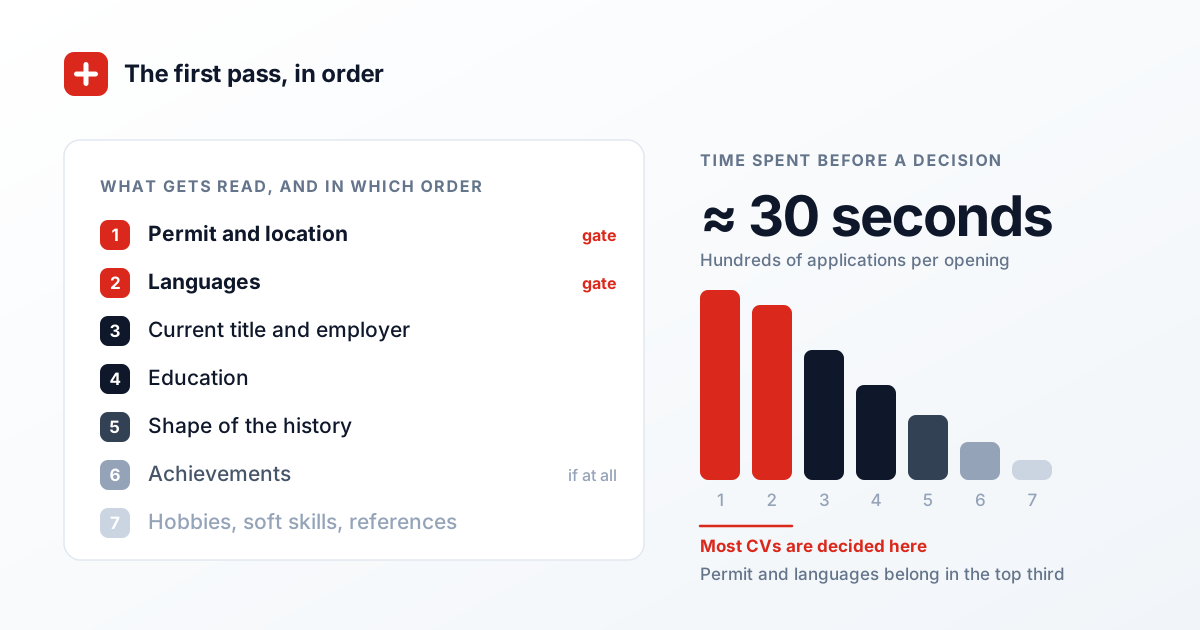
First, the profile block at the top — three or four lines. It names the target occupation, the years you bring to it, and the proof you are working on. "Administrative specialist, ten years of patient administration in health care; admitted to the final examination as a health care specialist, examination next spring" says in one sentence what would otherwise have to be guessed from the whole document. Without it, the first pass reads your current job title and the shape of your history, and both of those describe the occupation you are leaving.
Second, the education section. The procedure goes there with a status and a date, in the same format as a completed qualification, with the status appended: registered, admitted, in preparation, examination in spring. Courses you have already finished go with it, with provider and date. A "further training" heading tucked in at the very end achieves the opposite — it pushes the only evidence for the new occupation behind everything that belongs to the old one.
Third, the positions themselves. They stay chronological and complete, but the result line of each one gets rewritten in the target occupation's language. Not "responsible for the till", but "daily cash reconciliation and float management for a branch of six, discrepancies below one per mille". The second version states the same fact and uses the words that appear in the advert you are answering. That line is the only place on a CV where a career change is actually built rather than announced.
Measure the bar before you rebuild anything
The most useful half hour before writing goes into searching, not formatting. Open twenty adverts in the target occupation and count two things: how many name a formal qualification, and which kind they name. The distribution you get is the blueprint for your education section. If it is one advert in two, as in care, you need the procedure and you need to date it. If it is one in eight, as in marketing, the certificate is not the bottleneck and your result lines decide the outcome.
The second count is the level you are aiming at. Across job titles in the index, 12.3 percent carry a leadership word — head, lead, Leiter, chef, responsable — 9 percent carry «senior», and 7.2 percent carry an operational label such as officer, assistant, clerk or Sachbearbeiter. A career change almost always enters through the third group. That is not a demotion of you as a person; it is the level at which the new occupation actually admits entrants, and it is far easier to justify in writing than a jump into a function whose certificate you do not hold.
The third count is the one people skip: how many adverts in the target occupation promise structured induction. Only 1.1 percent of described adverts mention an induction period, on-the-job training or an internal training programme at all. When one does, it is worth applying even against a stated qualification, because the employer has budgeted for the learning curve. When none of your twenty do, the learning curve is yours to fund, and the CV has to show you have started.
What to leave out
The functional CV — the one that replaces positions with skill clusters — is the most common reaction to a career change and the most expensive one. It dissolves exactly what the first pass follows: the current job title, the employer, and the shape of the history. Removing the chronology does not remove the question, it removes your answer to it, and the reference letters filed behind the CV carry the dates anyway.
Leave out the reasons for leaving the old occupation as well. On a CV, a change needs evidence rather than motivation; motivation has its own page in the cover letter. And leave out any wording that claims the new occupational title before a certificate stands behind it. The protected title is the one part of a Swiss CV where a generous self-description does not read as confidence. It reads as an error, and it is the one an assessor can check in a single search.
The market figures were counted on 22 August 2026 from the adverts then live on SwissJobs.app. A "formal qualification" means any mention of EFZ, EBA, CFC, AFC, a completed apprenticeship or vocational training, a federal diploma of higher education, an advanced federal diploma, a professional education institution or a university degree, in an advert's job title or short description. Occupational families are assigned from the job title, and shares refer to the adverts that carry a short description — 74 percent of the stock. Legal texts are quoted from the versions in force on Fedlex. The age of an advert is counted from the day it was first recorded.
Write a custom CV for every job you apply to
Most people send the same CV everywhere. The editor rewrites yours against the posting — Swiss format, the right language, in about a minute.
CV maker & resume builder: for a specific advertHow do I explain gaps in my Swiss CV?
In short
Leaving a period out and writing a false date are not the same thing in Swiss law. No statute prescribes what a CV looks like: under Art. 320 para. 1 of the Code of Obligations, the individual employment contract "is not subject to any specific formal requirement". An unmentioned stretch of time therefore breaks no rule. A false date is different, because it is a statement the other side relies on, and Art. 28 para. 1 releases a party induced into a contract by the other party's deception "even if his error is not fundamental". Your explanation has to be accurate. It does not have to be complete.
This answer explains what the cited acts say and is not legal advice. Whether a particular statement falls under Art. 28 CO in a given case is for a court to decide. Conciliation authorities are organised by canton; binding information comes from the conciliation authority of your canton, the cantonal data protection authority, or a legal advice service.
That distinction almost never appears in the English-language advice a search returns, which tends to treat a gap as a presentation problem to be smoothed over. Switzerland does not work that way in either direction. There is no legal duty to account for every month, and there is a very precise consequence attached to an untrue entry. Knowing which of the two you are dealing with tells you where you have latitude — over how much you say — and where you have none, over whether it is true.
The other half of the answer belongs to the employer. The moment you explain why you were away, personal data about you exists, and processing it is regulated. Art. 6 of the Federal Act on Data Protection requires processing to be lawful, in good faith, proportionate, and confined to "a specific purpose that the data subject can recognise". Health data — the illness behind the break — sits a level above that and needs explicit consent. In Swiss law, a period of time and a diagnosis are not the same kind of statement.
Share of the adverts in each language whose short description mentions experience at all. Apprenticeships and internships excluded. The Italian-language stock is the smallest of the four, so that figure reads as a tendency.
- There is no statutory Swiss CV. Art. 320 para. 1 CO: "Except where the law provides otherwise, the individual employment contract is not subject to any specific formal requirement." Para. 2 goes further — a contract is deemed concluded where an employer accepts work over a period which in the circumstances could reasonably be expected only in exchange for salary. The application dossier is a market convention, not a legal form.
- The boundary is Art. 28 para. 1 CO: "A party induced to enter into a contract by the fraud of the other party is not bound by it even if his error is not fundamental." The second half matters. For an ordinary mistake the error must be fundamental; for deception it need not be. "The date was not decisive anyway" is not a defence.
- The clock runs from discovery, and it is short. Art. 31 para. 1 CO: if the party acting under error or fraud neither declares that it will not honour the contract nor seeks restitution "within one year", the contract is deemed ratified. Para. 2: the one-year period runs "from the time that the error or the fraud was discovered" — not from the signature.
- Work already done is not unwound. Art. 320 para. 3 CO: where an employee works in good faith under a contract "which is subsequently found to be invalid", both parties must discharge their obligations "as if the contract had been valid" until one of them terminates the relationship on grounds of invalidity. Invalidity operates forwards.
- The reason you give is regulated data. Art. 6 FADP: processing must be lawful, in good faith and proportionate, and personal data "may only be collected for a specific purpose that the data subject can recognise". Para. 4 adds a deadline that recruitment rarely observes: data "shall be destroyed or anonymised as soon as they are no longer required for the purpose of processing".
- Health information is a separate category. Art. 5 lit. c no. 2 FADP counts "data relating to health, the private sphere or affiliation to a race or ethnicity" as sensitive personal data, and Art. 6 para. 7 lit. a requires consent to its processing to be "explicitly given". Art. 6 para. 6 adds that consent is valid only if given voluntarily, for specified processing, and on the basis of appropriate information.
- A gap caused by pregnancy or family sits under its own act, and Art. 13 of the Gender Equality Act decides which route exists. Para. 2: "If a person is discriminated against in the rejection of an application that would establish an employment relationship for the first time, then Article 5 paragraph 2 applies. Compensation may be requested at the same time that a complaint about the decision rejecting the application is made." Para. 5: the proceedings are free of charge. At a cantonal administration or a cantonal hospital the rejection is often a formal decision rather than a letter.
- What the market asks is narrower than the fear suggests. Of the live adverts on SwissJobs.app whose short description mentions experience at all, 13.1 per cent name a number of years — and in the English-language adverts, 22.1 per cent. Not one advert in the whole evaluated stock asks for an unbroken record, and not one names a window such as "in the last five years".
Read the English text, then check which version is binding
One point applies to every article quoted on this page. Federal acts are published in German, French and Italian, and those three versions are the authentic ones. Fedlex also publishes English texts, and they are translations provided for information rather than law. Where the wording carries weight, it is worth knowing what the authentic versions actually say, because on this particular question they do not all say the same thing.
Art. 28 CO is the clearest case. The English translation calls it "fraud", which in an English-speaking reader's ear is a criminal word. The German heading is "absichtliche Täuschung" — intentional deception. The French and Italian use the Roman-law term, "dol" and "dolo". None of the three authentic versions reaches for a word from the criminal law, because Art. 28 is not a criminal provision at all: it is a defect of consent in the general part of contract law, and its consequence is that the contract does not bind the deceived party. Nobody is prosecuted under it.
The practical difference is real. A reader who takes the English heading literally will assume that a wrong date on a CV is a crime, and either panic or dismiss the whole subject as overblown. What the article actually establishes is narrower and more useful: an untrue statement that induced the contract makes the contract non-binding on the other side, whether or not the point was decisive.
What the law requires of a CV — which is nothing
The starting point is a sentence that does not mention CVs at all. Art. 320 para. 1 CO: "Except where the law provides otherwise, the individual employment contract is not subject to any specific formal requirement." If the contract itself is valid without form, there is certainly no prescribed form for the paper you use to apply for it. No Swiss provision requires a CV, regulates its structure or demands that it be complete.
Para. 2 pushes the point further: a contract "is deemed to have been concluded where the employer accepts the performance of work over a certain period in his service which in the circumstances could reasonably be expected only in exchange for salary". An employment relationship can come into being with no dossier whatsoever. In legal terms the dossier is a custom — a strong one, and in Switzerland an unusually uniform one, but a custom.
For someone applying from outside Switzerland this is worth holding on to, because the Swiss dossier convention is stricter than the British or American one and the temptation is to read strictness as regulation. It is not. What is regulated is the truthfulness of what you write, what the employer may do with it afterwards, and what happens if the reason for the gap is one the Gender Equality Act protects.
Omission and misstatement are different legal facts
Art. 28 CO sits in the general part of the Code of Obligations and applies to every contract, not only employment. Its first paragraph makes a party who was induced into the contract by the other's deception not bound by it "even if his error is not fundamental". For an ordinary mistake under Art. 24, the error has to be fundamental. Deception removes that threshold. That is the whole reason a false date is treated differently from an unexplained six months.
Two further provisions limit the consequence. Art. 31 para. 1 provides that where the affected party neither declares within one year that it will not honour the contract nor seeks restitution, "the contract is deemed to have been ratified", and para. 2 starts that year from the discovery of the fraud rather than from the conclusion of the contract. A discrepancy found after eight years opens the period then — and opens only one year of it.
Art. 320 para. 3 answers what happens to work already performed. Where an employee has worked in good faith under a contract later found invalid, "both parties must discharge their obligations under the employment relationship as if the contract had been valid until such time as one party terminates the relationship on grounds of the invalidity of the contract". Salary, notice, the reference letter: none of it is retroactively erased. The invalidity ends the relationship going forward; it does not pretend it never existed.
What an employer may do with the explanation you give
Once the gap is explained, information about an identifiable person exists — personal data within the meaning of Art. 5 lit. a FADP — and the principles in Art. 6 apply. Para. 1: personal data must be processed lawfully. Para. 2: "The processing must be carried out in good faith and be proportionate." Para. 3: data "may only be collected for a specific purpose that the data subject can recognise; personal data may only be further processed in a manner that is compatible with this purpose."
Para. 4 sets a limit that recruitment practice rarely respects: data "shall be destroyed or anonymised as soon as they are no longer required for the purpose of processing". The purpose of an application file is filling one specific post. Once it is filled, the purpose is spent, and with it the basis for keeping the file, unless something else was expressly agreed.
For the commonest cause of a long break the threshold is higher again. Art. 5 lit. c no. 2 FADP classes data relating to health, the private sphere or affiliation to a race or ethnicity as sensitive personal data. Art. 6 para. 7 lit. a requires consent to their processing to be explicitly given, and para. 6 makes consent valid "only if given voluntarily for one or more specific instances of processing based on appropriate information". A dated period with a plain label is an ordinary piece of personal data. A diagnosis is not, and the conditions attached to the second are rarely met in a conversation across a desk.
A break caused by pregnancy or family — and why it matters who the employer is
A separate act applies here and it names hiring explicitly. Art. 3 para. 1 of the Gender Equality Act: "Employees must not be discriminated against on the basis of their sex, whether directly or indirectly, including on the basis of their marital status, their family situation or, in the case of female employees, of pregnancy." Para. 2 records that the prohibition applies "in particular to hiring" — so the rejection of an application is covered, not only an employment relationship already running.
The three binding versions build the same rule with different grammar, which is worth knowing if you ever quote it. The German writes from the protected person outwards — employees "must not be disadvantaged", using the word for disadvantage rather than the word for discrimination. The French addresses a prohibition to everyone: "Il est interdit de discriminer les travailleurs à raison du sexe." The Italian is the only one that opens by naming the sphere and names both sexes: "Nei rapporti di lavoro, uomini e donne non devono essere pregiudicati." The substance is identical; the sentence has a different addressee in each.
The provision that decides the whole route afterwards is Art. 13, and it is rarely read alongside the rest: it separates employment under public law from employment under private law. Para. 1 provides that legal protection in public-law employment relationships "is governed by the general provisions on the administration of federal justice". Para. 2: "If a person is discriminated against in the rejection of an application that would establish an employment relationship for the first time, then Article 5 paragraph 2 applies. Compensation may be requested at the same time that a complaint about the decision rejecting the application is made."
That is a different event from a rejection letter. Applying to a cantonal administration, a cantonal hospital, a school or the federal administration often means applying for an employment relationship under public law, and the rejection is then an administrative decision with an appeal against it. Art. 13 para. 3 additionally allows federal employees to approach a conciliation board within the appeal period, a board that "advises the parties and attempts to bring about a settlement". Para. 5 adds: "The proceedings are free of charge, other than in cases of vexatious litigation."
Which of the two routes exists therefore does not depend on the gap at all. It depends on who is advertising — and whether a given post is constituted under public or private law is settled by cantonal personnel law rather than by the Gender Equality Act. In the private-law case the act points to a narrower route: Art. 8 para. 1 gives a rejected applicant the right to a written statement of reasons, para. 2 sets a three-month forfeiture period running from notice of the refusal, and under Art. 5 para. 2 the claim is to compensation only.
What Swiss adverts actually ask about experience
The expectation a gap seems to run into can be counted in the adverts themselves. The basis is the live stock on SwissJobs.app carrying a short description, with apprenticeships and internships excluded. Of those whose description mentions experience at all, 13.1 per cent name a number of years. Not one advert in the whole evaluated stock names a window of the form "in the last five years" or "over the past three years".
The word behind the whole worry does appear — never in the feared sense. Terms in the "no gaps" family occur in 0.1 per cent of adverts, and every single occurrence, checked by hand, describes the work rather than the applicant: seamless documentation, unbroken traceability, complete care records, uninterrupted food hygiene, gapless quality assurance. Not once does it describe a career. The unbroken CV is an expectation with no written trace in the Swiss job market.
There is one exception and it is sharply bounded. Where an advert does require experience to be current, it comes from acute-care nursing — across the whole stock every such advert is a nursing post, and even within nursing the share is 1.0 per cent. One of them states the condition more precisely than anything else in the market: at least a year of experience in a Swiss acute hospital, and no more than two years since. Where currency genuinely counts, employers write it down. Where it is not written down, it is usually not the condition.
For an English-speaking reader the numbers tilt one particular way. English-language adverts are the ones most likely to mention experience at all, at 83.9 per cent against 79.7 per cent in German, and they name a number of years in 22.1 per cent of cases against 4.1 per cent in German. So an applicant reading the market in English meets the most explicit demand for a quantity of experience — and still, in that segment as in every other, no demand at all that the experience be recent.
Where this ends up if it stops being a conversation
Three of the four acts on this page share a feature: disputes under them cost nothing in court fees. Art. 113 para. 2 of the Civil Procedure Code excludes court costs in conciliation proceedings for disputes under the Gender Equality Act, disputes arising from an employment relationship up to a value of thirty thousand francs, and disputes under the Data Protection Act. Art. 114 repeats the same list for the decision proceedings.
Conciliation comes first. Art. 197 CPC: "An attempt at conciliation before a conciliation authority precedes decision proceedings." For Gender Equality Act disputes Art. 200 para. 2 prescribes a particular composition — a chair plus equal representation of employers and employees and of the public and private sectors, with the sexes equally represented. And Art. 201 para. 2 records that in those matters the authority also acts as a legal advice service.
That last line is the practically useful one, and it is rarely quoted. Every canton has a body that is required by federal law not merely to conciliate but to advise, without court costs and without a lawyer. Under Art. 243 para. 2 lit. a the simplified procedure applies to Gender Equality Act disputes irrespective of the amount in dispute. What the body is called, where it sits and how it is staffed is for the canton to decide — the Civil Procedure Code sets the frame, not the address, which is why an answer to this question has to be stated federally rather than from the practice of one canton.
Why the short statement is the legally stable one
Put the four acts side by side and a pattern appears that has nothing to do with style. Upwards, the explanation is bounded by Art. 28 CO: what is there has to be true. Downwards it is bounded by nothing, because Art. 320 para. 1 CO requires no completeness. Anything you add beyond that falls under Art. 6 FADP and, where health is involved, under the explicit-consent requirement of Art. 6 para. 7 lit. a. The statement that exposes the least legal surface is the accurate, short one.
What this page does not do is tell you what to put in your CV, and it cannot judge whether a particular wording in your case falls under Art. 28 CO. That judgement belongs to a court with the facts in front of it. Nor can it say which questions a given employer may ask: Art. 6 para. 2 FADP makes proportionality the test, and proportionality cannot be assessed without the specific post.
Binding information comes from three places: the conciliation authority of your canton, which under Art. 201 para. 2 CPC advises as well as conciliates in equality matters; the cantonal data protection authority on how your information may be handled; and a legal advice service for anything touching the contract itself. What is set out above is an explanation of the provisions, not their application to your situation.
The market figures were counted on 31 August 2026 from the adverts live on SwissJobs.app that day. Only adverts carrying a short description were evaluated; apprenticeships, internships and trainee posts are excluded on the job title, because such an advert names the qualification it leads to and therefore answers the opposite question. That exclusion removes 6.8 per cent of the described adverts. The percentages about a number of years use, as their base, the adverts whose description mentions experience at all. Counting is by word stems in the title and short description; because the short description is a summary, the method undercounts requirements phrased differently in the original text, so every statement about the absence of a requirement should be read as "appears nowhere in the descriptions" rather than as a statement about every original advert. Every hit in the "no gaps" family and every hit demanding current experience was inspected individually by hand. An advert language is recorded for 89.9 per cent of the evaluated adverts, and the language comparisons refer to that part. The statutory quotations come from the consolidated versions of the Code of Obligations, the Data Protection Act, the Gender Equality Act and the Civil Procedure Code published on Fedlex, read on 31 August 2026; the English texts there are translations for information, and the German, French and Italian versions are the authentic ones.
Write a custom CV for every job you apply to
Most people send the same CV everywhere. The editor rewrites yours against the posting — Swiss format, the right language, in about a minute.
CV maker & resume builder: for a specific advertSources
- arbeit.swiss — tips on applying for jobs
- arbeit.swiss (SECO) — the same page in German: «Die Arbeitszeugnisse müssen lückenlos und chronologisch geordnet sein.»
- Code of Obligations — Art. 28 fraud, Art. 31 ratification, Art. 320 formation of the employment contract (English translation)
- Unemployment Insurance Act (German text) — Art. 24 interim earnings, Art. 59 labour market measures, Art. 60 training measures, Art. 64a professional placements
- Federal Statistical Office — full-time and part-time employment
- Federal Statistical Office — definition of full-time and part-time employed persons
- SECO — FAQ on the employment reference (in German)
- Obligationenrecht — the authentic German version of Art. 28, 31 and 320
- Labour Act, Art. 35a — no employment during the eight weeks after the birth (Fedlex)
- Federal leaflet 6.02 — Maternity allowance: 14 weeks, 80 percent of earnings, ends if work is resumed
- Federal leaflet 6.04 — Allowance for the other parent: two weeks, ten days of leave in a full-time job
- Vocational and Professional Education and Training Act (VPETA, SR 412.10) — Art. 17 para. 5, Art. 34 para. 2, Art. 36 title protection, Art. 38
- Vocational and Professional Education and Training Ordinance (VPETO, SR 412.101), English version — Art. 32: at least five years of professional experience
- Vocational and Professional Education and Training Ordinance (SR 412.101), binding German version — Art. 32
- berufsberatung.ch (SDBB) — sitting the final examination without an apprenticeship: five years, two to four of them in the target occupation
- berufsberatung.ch (SDBB) — validation of prior learning: five phases, dossier, costs
- Federal Act on Data Protection — Art. 5 definitions, Art. 6 principles (English translation)
- Gender Equality Act — Art. 3 prohibition of discrimination, Art. 5 rights, Art. 8 discriminatory refusal of employment, Art. 13 legal protection under public law (English translation)
Related questions
What our job index says about the Swiss market
Computed live from our own index, not quoted from a study. Shares only, as of today.
Language the advert is written in
- Deutsch
- 60%
- English
- 23%
- Français
- 13%
- Italiano
- 3%
Of adverts that state a language requirement, the share asking for
- Deutsch
- 70%
- English
- 43%
- Français
- 21%
- Italiano
- 3%
19% posted in the last 7 days · Largest markets: Zürich 18% · Bern 10% · Genève 5% · Basel 5%