How do I get my CV through an ATS in Switzerland?
Updated:
In short
Find out whether software is reading at all before you optimise for it. Open the advert, click apply, and watch two things: whether the address leaves the employer's own domain, and whether the form makes you retype your CV field by field. In our analysis of the Swiss adverts we hold, about two thirds of English-language postings route into an applicant system, but only about a quarter of German-language ones and slightly under a quarter of French. The ATS advice you have read is written for the first group.
That matters because most people relocating to Switzerland start in the first group and end up in the second. English adverts at international employers behave the way the guides describe. The moment you apply to a German-language advert at a hospital, a cantonal administration or a mid-sized firm, you are in a different market with different software behind it — and often with a person opening your dossier first.
Two things then hold on every route: the file has to arrive as real text in one column, and the wording has to come from the advert in front of you rather than from a generic keyword list. Neither guarantees anything, and nobody can promise you will pass a filter. The honest claim is narrower — a CV that uses the advert's own vocabulary matches a keyword search better than a generic one.
Share of adverts, by the language the advert is written in, whose apply link leads to an applicant system's own address. Own analysis of the open Swiss adverts we hold, 26 August 2026.
- Across all languages, just over half of the adverts we hold send you to an address belonging to the employer, about a third into an applicant system, and the rest to boards and agencies.
- Split by the language of the advert: roughly two thirds of English, just under half of Italian, about a quarter of German and slightly under a quarter of French adverts route into a system.
- Of the forty employer-run career addresses carrying the most adverts, roughly four in five turned out to be running bought recruiting software behind the employer's own domain.
- Within the English-language part of that system segment, about seven in ten adverts sit on Workday, Greenhouse and Ashby — precisely the vendors the English-language guides model.
- Within the German-language part, the largest vendor is Prospective, a Swiss supplier English-language ATS guides do not cover, roughly level with Workday.
- About half of the employer addresses we see carry exactly one advert. In that long tail, a person almost certainly reads first.
The thirty-second check before you apply
Open the advert and press the apply button without uploading anything. Then read the address bar. Do you stay on the employer's own domain, or do you land on a third-party address with a product name in it you have never heard of? Both happen, and each tells you something — but only together with the second signal.
The second signal is the form itself. If it asks for a name, an email and two files, your dossier is being passed to a person. If it asks you to re-enter education, positions, languages and availability one by one although you have already uploaded the CV, then software is filling or checking those fields. That is where the machine reading actually happens: in the fields, not in your PDF.
A third, weaker signal is whether you are made to create an account before you can submit anything. Where that is required, there is nearly always a system behind it holding your application as a record rather than as mail in somebody's inbox. That is not bad news. It also means your application does not sit unread in one person's mailbox while they are on holiday.
This check takes half a minute per advert and replaces any general assumption about how Swiss employers recruit. There is no single answer to replace it with: the routes we see split roughly half to employer addresses, a third into systems and the remainder to boards and agencies.
Why the address on its own proves nothing
Reading only the destination address leads to the wrong conclusion. We therefore opened the forty employer-run career addresses carrying the most adverts in our index and looked in the page source for vendor signatures — product names, stylesheets, parameters. Roughly four in five of them run on bought recruiting software presented under the employer's own domain. You cannot see that from the link in the advert; you see it only once the page loads.
The caveat belongs in the same paragraph. Those are the largest employers we hold. Large organisations buy recruiting software; small ones often do not, and the employer-address group is mostly a very long tail of small career pages — about half of those addresses carry a single advert. The finding applies to the head of that distribution, not to its tail.
In practice: the inference «own domain, therefore a human reads it» is almost never right for a corporation, a hospital or a public administration, and almost always right for a firm with one open position. The size of the employer tells you more about the route your application takes than the shape of the URL does.
It also means a figure like «a third of adverts route into a system» is a floor rather than a ceiling. It counts the cases where the vendor is visible in the link. The white-labelled cases sit on top of it. Draw the boundary differently and you get different shares, which is why the method is stated here alongside the number.
If you are applying from abroad, this is the part that catches you
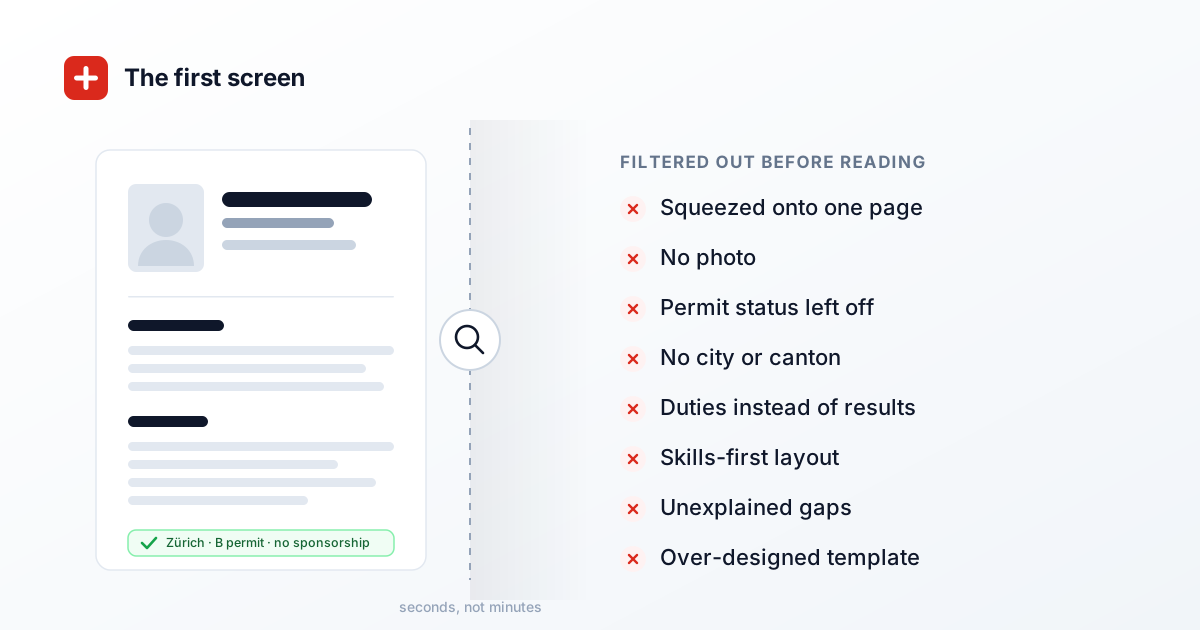
Arriving applicants tend to import a whole set of assumptions with the word ATS. The most expensive one is that a Swiss application is a resume with different spelling. It is not: it is a dossier, and the parts that get you sorted early are the parts a US template has no field for. Two pages are normal rather than a failure of editing.
Four items belong high on the page and are the ones most often left off from abroad. Your city and canton, because location is a first-pass sort. Your permit status or nationality — B, C, G, or Swiss/EU — because it decides whether a recruiter has to think about paperwork. Your languages as CEFR levels, B2 or C1, rather than as «fluent». And your Pensum, the workload in per cent, because Swiss adverts are written in those terms.
The Arbeitszeugnis is the item with no equivalent at all. It is the written employer reference you receive when you leave a Swiss job, and a complete dossier carries the ones you have as separate attachments. If you have never worked in Switzerland you simply do not have them, which is fine and worth saying plainly in the application rather than leaving as a gap somebody has to interpret.
One more contrast that surprises people from the United States and the United Kingdom: a photograph is conventional here rather than discouraged, and leaving it off is not read as caution. None of this is about software. It is about the second reader, and in Switzerland the second reader arrives sooner than the ATS literature suggests.
What «getting through» can honestly mean
Nobody can promise you will pass an applicant system. We cannot see inside any employer's software, no tool can, and a vendor quoting a pass rate is quoting something it has no way to check. What can be stated is a mechanism: a CV using the vocabulary of the specific advert matches a keyword-based search better than a generic one. That is the whole of the claim.
The mechanism has a precondition that comes before any keyword. The text has to arrive as text, in one column, in reading order. A scanned or image-exported PDF contains no words at all as far as the software is concerned, and a two-column layout delivers them in the wrong order. How to test that yourself in two minutes is covered in our answer on whether a CV is ATS-friendly.
Then comes word selection, and the rule is narrow: take the words from the advert in front of you, not from a general keyword list. The qualification exactly as it is named there, the base noun of the occupation, the phrasing of the language requirement, the name of the specialism. That is the only place where an advert and a CV reliably contain the same strings of characters.
Finally, be sceptical of match scores. A percentage produced by comparing two documents tells you how much vocabulary they share, which is worth knowing, and nothing about whether an employer will call you. Treat it as a proofreading aid, not as a verdict — and never rewrite a true sentence into a false one to raise it.
When the form asks for everything twice
Application forms that ask you to re-enter every position after you have uploaded the CV are the most common place where a strong application quietly weakens. The reason is mundane: attention drops after the fifth field, and entries like «see CV» or truncated employer names appear. But the shortlist someone later sorts is built from those fields, not from your PDF.
So treat the form as the real document and the PDF as the attachment. Write employer names out in full, complete the date ranges, enter languages with a level, state the workload you want even though the CV already says it. An empty required field does not get a generous interpretation; it becomes a gap in the record.
Pay particular attention to the fields that only exist here. Many of these forms ask for permit status, earliest start date, canton of residence and desired Pensum. Leaving them blank because they feel like formalities removes you from exactly the sort a Swiss HR department runs first.
And upload the file under a name that reads without context: surname, first name, «CV», the year. That is not a trick against software. It is a courtesy to the person who later sorts twenty files in one folder — and on just over half of the routes we measured, that person is the first reader.
How often a machine really reads first
Put the routes together and the picture contradicts the common assumption. Just over half of the adverts we hold lead to an employer's own address, about a third into an applicant system, and the rest to boards and agencies. Add the white-labelled systems and the middle share rises — but the idea that a machine screens everything before a human sees it remains false for a substantial part of this market.
The routes also differ in age. Adverts routing into an applicant system are, at the median, noticeably older in our index than adverts on an employer address, and board adverts are the youngest. Applying through a system therefore more often means applying to a longer-running vacancy. That figure measures how long an advert has been visible to us, not how far along the employer's process is.
None of this means you can relax when there is no software. There is still a filter; it is just called something else. A human first screen takes seconds and sorts on the same items the software would have written into fields — location, permit, languages, qualification, workload. A CV that makes those five visible in the top third survives both routes.
Which is the real answer to the question. In Switzerland, getting through an ATS is the same work as getting past a person: write in the language of the advert, use its words, do not omit the Swiss-specific facts, and keep the document machine-readable. Only the order in which you check those things depends on where the apply button leads.
What people report
A recurring correction shows up in English-language LinkedIn posts about the Swiss market: applicants arrive with a deliberately plain, «ATS-safe» CV built on Anglo-American advice and are told the opposite by Swiss recruiters — a clearly designed layout is fine, a photo is welcome, and permit type and educational path should be stated explicitly. The conclusion drawn in those posts matches what our routing analysis shows: in Switzerland a person reads first more often than expected.
Recurring pattern across English-language LinkedIn posts about the Swiss labour market held in our existing collection, reviewed in August 2026. Individual opinions, not a representative survey.
All shares come from our own analysis of the open Swiss adverts we hold, as at 26 August 2026. For each advert we examined the destination of the apply link; classifying it as an employer address, an applicant system or a board/agency is a judgement call made from the destination address, and drawing the boundary more or less tightly produces different shares. The finding about software behind employer addresses comes from our own retrieval, on 29 August 2026, of the home page or an advert page of the forty employer-run career addresses carrying the most adverts, searching the page source for vendor signatures; pages that assemble their content in the browser may carry a vendor this retrieval cannot see, so the true share is likely higher. Language shares refer to the detected language of the advert; adverts with no detected language are excluded from the per-language figures. We publish shares, never absolute index figures.
Check how your CV fits a job — and the Swiss market
Free checker: languages, work permit, skills and more — scored against a specific posting.
ATS CV checker: against a specific advert, freeSources
Related questions
What our job index says about the Swiss market
Computed live from our own index, not quoted from a study. Shares only, as of today.
Language the advert is written in
- Deutsch
- 60%
- English
- 23%
- Français
- 13%
- Italiano
- 3%
Of adverts that state a language requirement, the share asking for
- Deutsch
- 70%
- English
- 43%
- Français
- 21%
- Italiano
- 3%
19% posted in the last 7 days · Largest markets: Zürich 18% · Bern 10% · Genève 5% · Basel 5%