Which Swiss employers use no ATS at all?
Updated:
In short
There is no list. Employers with no applicant system give themselves away by size, not by name. We opened the careers pages of 47 small Swiss employers that have one to three roles open and advertise on their own domain: on 26 of the 44 that answered, close to six in ten, we found no trace of recruiting software, and 15 simply named an email address. Among the largest careers sites in the same index the ratio is inverted, with roughly four in five running on bought software. Small usually means no system. It never means certainly.
The same relationship runs through the whole index. Employers with exactly one open advert keep 62.9% of applications on their own address; employers with twenty or more adverts open at once keep 38.1%, and a further quarter of their adverts run through boards and agencies. Across all adverts we hold, 46.5% stay on the employer's own domain, 38.8% lead into an applicant system, and 14.7% to a board or an agency.
One warning specifically for readers searching in English. Among the English-language adverts in our index only 31.7% stay on the employer's own address, while 68.1% lead into an applicant system. The Swiss employers who read applications by hand are overwhelmingly advertising in German, French or Italian. If you search only in English, you are searching the half of the market that is most heavily automated.
Share of adverts whose apply link never leaves the employer's own domain, split by how many roles that employer has open at the same time. Our own analysis of the open Swiss adverts we hold, 29 August 2026.
- Company size predicts the software better than the industry, the canton, or whether the address looks like a careers page.
- Even among the smallest employers we still found recruiting software on 18 of 44 pages: small is an indication, not a proof.
- The vendors at the small end are called Prospective, Umantis, Dualoo, Refline, Solique and Ostendis, not Workday and not Greenhouse.
- Refline sells its entry package at CHF 99 a month for exactly one active position: software is billed per open role, which is why it tracks company size.
- Employers with a single advert are 45.9% of employer names but only 7.4% of the adverts you scroll past.
- English-language adverts are the automated end of this market: 68.1% of them lead into an applicant system.
No ATS is a company size, not a list of companies
The question sounds as though there are two camps, employers with an applicant system and employers without. From the outside that is not a usable division, because nobody can look into an employer's inbox. What can be measured is where the application route leads, and that depends almost entirely on how many roles a business has to fill at the same time.
In our index 45.9% of employers have exactly one advert open. Of their adverts, 62.9% stay on their own address, 35.5% lead into a system, and almost none go through a board. At the other end, employers with twenty or more adverts open at once are only 5.4% of the names but account for 52.8% of all adverts, and there only 38.1% of applications stay on the employer's own domain while 26.5% run through boards and agencies.
In between, the curve is flat: employers with two to four open roles sit at 52.9%, those with five to nineteen at 55.2%. The break does not creep in gradually, it arrives at the point where recruiting becomes somebody's full-time job. Seen from the other side, 56.2% of all employer names in the index send every single one of their adverts to their own address.
What small employers' careers pages actually say
For this answer we looked rather than guessed. On 29 August 2026 we picked 47 employers that have one to three roles open in our index and whose apply link points at their own Swiss address, ranging from a tile merchant in Meilen through the city administration of Olten and an engineering office in Zurich to a car dealership in Gordola. We opened each page once and searched the served source for the traces recruiting software leaves behind.
44 pages answered; two addresses could not be reached at all and one returned a server error. 18 of the 44, or 41%, showed a vendor. 26 showed none: 15 openly named an email address for the dossier, two others had only a simple upload field, and on nine there was no application route visible in the served source at all. The city administration of Olten and the Bern cantonal police both gave an email address; the city of Frauenfeld, by contrast, runs a system.
This is the counterpart to a measurement we made at the other end of the scale for an earlier question in this series: among the forty employer careers addresses carrying the most adverts, roughly four in five run on bought software behind their own domain. Same method, opposite result. Together the two numbers give the only solid answer to the question. It is not the industry and not the fact that the address belongs to the employer that decides, it is size.
One limit belongs with this, and it matters. We only see what a page reveals in its served source. An application form that loads later in the browser can escape us. The 41% is therefore a floor, and no trace found does not mean provably no system.
The software small employers buy is not called Workday
More striking than the ratio is which names turned up. Prospective five times, Umantis or Abacus four times, Dualoo twice, Teamtailor twice, and Refline, Solique, Ostendis, rexx and SAP SuccessFactors once each. Not once Workday, Greenhouse, Lever, Ashby or SmartRecruiters, which are precisely the names the English-language ATS advice is written around. If you have read that the trick is to beat Workday's parser, you have been reading about a different market.
This is not chance, it is pricing, and it is published. Refline, one of these Swiss vendors, lists its packages openly: CHF 99 a month for a single active position, CHF 199 for three, CHF 349 for six, and from CHF 699 for ten or more, all excluding VAT and on annual billing. So the link between size and software is not a cultural difference but arithmetic. The software is billed per position open at the same time, and a business that fills one role a year does not pay for it.
Ostendis, another vendor, based in Boniswil in canton Aargau, calls itself Swiss E-Recruiting on its own site and advertises a pay-as-you-need model costing “less than a coffee a day”, which it says finally makes professional applicant management “affordable for SMEs that do not have positions to fill permanently” (our translation of its German site, read on 29 August 2026). That is the link between company size and software stated by a vendor rather than by us. Its price page itself is password-protected, so no figure is published. Prospective, the most frequent trace in our sample, advertises more than three hundred customers on its own home page and sat behind a city administration, a hospital, a hydro company, a lake shipping operator and a Landi cooperative in our sample. That is the Swiss reality behind the word ATS.
For you the consequence is immediate. Advice tailored to a large American system, meaning formatting rules, scores and ATS-safe templates, often does not touch the software a small Swiss employer actually runs. And when a business rents a system for one position at a hundred francs a month, there is no screening department behind it, there is the person who also does the accounts.
Where in the market the employers without a system sit
The differences between occupational fields are large, and they follow size again. Taking out each field's single largest employer, so that one group does not decide the picture, 77.5% of applications in retail stay on the employer's domain, 64.9% in transport and logistics, 56.1% in hospitality, 54.6% in commercial and administrative roles, and 46.5% in construction and the trades.
At the other end sit two fields you might not expect there. In IT and engineering 55.5% of adverts lead into an applicant system and only 42.8% to the employer's own address. In nursing and healthcare it is 41.7% against 38.4%. Hospitals and care homes are large houses with dozens of simultaneous vacancies, and that is exactly where software pays for itself.
A second view shifts the picture again. What share of a field's adverts comes from a small employer with at most four open roles? In transport and logistics 25.3%, in IT 19.0%, in commercial roles 16.2%, in hospitality 13.8%, but in nursing only 7.3%. If you want to land at employers without a system, you are not looking for an industry, you are looking for small names inside an industry.
The public sector is the special case most people misjudge. Among employers whose name points at a municipality, a city or a canton, 48.2% of adverts lead into a system and 47.2% to their own address. A local administration is about as often running software as not, so the idea that the state still reads everything by hand holds only half the time.
How often you actually meet these employers
The Swiss labour market is overwhelmingly made of small businesses. For 2023 the Federal Statistical Office counts 99.7% of all market-economy enterprises as SMEs; 89.7% are micro-enterprises with at most nine employees, and SMEs together provide around two thirds of all jobs. Large enterprises are 0.3% of firms and employ a good third of all staff. Concluding from this that most applications avoid software, however, gets the arithmetic backwards.
Businesses do not advertise in proportion to headcount, they advertise in proportion to turnover of staff. In our index the 45.9% of employers with exactly one open role account for only 7.4% of adverts, while the largest 5.4% of employers account for 52.8%. Scrolling through a job market, you therefore mostly meet exactly the houses that have software, even though they are the numerical exception in the economy.
There is also a visibility effect that is rarely mentioned. The baker with one vacancy often does not advertise online at all: a sheet in the window, a word in the team, or a notification to the RAV, the regional employment office. A noticeable share of the businesses without an applicant system is therefore not findable at all on the route you normally search. A speculative application and the public Job-Room portal are not fallbacks here, they are the right channel. This matters more if you are applying from abroad, where the shop window is not an option.
One more observation from the data fits the picture. Adverts on the employer's own domain are 28 days old at the median, those in an applicant system 39, those on a board 15. That measures mainly how long an advert stays visible to us rather than how long the process takes, but it matches: the small employer takes the advert down as soon as someone has signed.
When no software reads, a human reads immediately
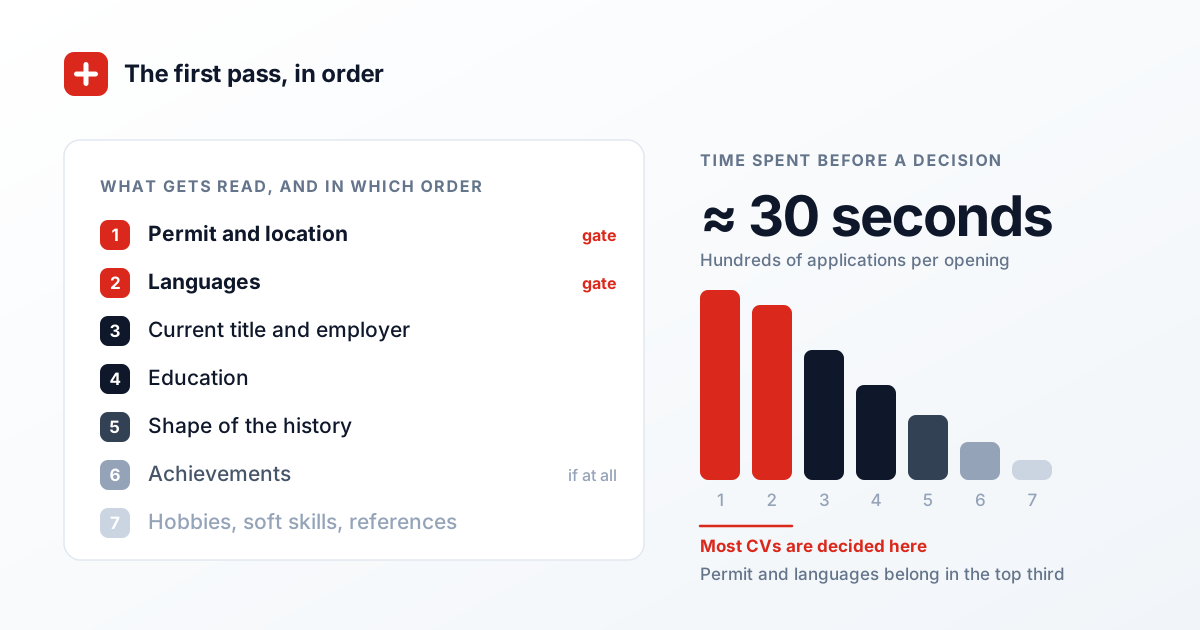
The relief of finding an employer without a system usually lasts a moment. The pre-sorting does not disappear, it just gets faster. Instead of a filter, a person opens the PDF and decides in about thirty seconds, in a fairly fixed order: permit and location, languages, current position and employer, education, the shape of the history. What is a mandatory field in an applicant system has to stand in the top third of the page by itself in an email application.
In practice, for an email application: one single PDF holding the CV, the letter, your Arbeitszeugnisse (the Swiss employer references) and diplomas in that order, with a file name carrying your name and the role. A subject line with the exact job title and the reference number if there is one. And a short mail body that announces the letter rather than repeating it.
The counterpart to keyword work applies here too. Where no filter counts terms, a CV stuffed with keywords does not read as neutral, it reads as bad, because a human reads repetition as padding. The advert's own vocabulary still belongs in the CV, but once, in the place where you would describe the task anyway.
Two Swiss specifics weigh more heavily with a small employer than with a corporation. First the permit: an employer with no HR department does not want to find out whether hiring you is even possible, so a line such as permit B, notice period two months settles the question before it is asked. Second the references: a Swiss dossier without Arbeitszeugnisse looks incomplete, and the small employer has no form that will request them later. State languages as CEFR levels, B2 or C1 rather than fluent, and the workload as a Pensum in per cent rather than in hours per week.
What no ATS does not mean
It does not mean nobody is filtering. It means the filtering is not documented. A system at least sends a confirmation of receipt and shows a status; a mailbox does not. Expect longer silences from small employers, and expect the possibility that a mail landed in spam. A phone call after ten days is normal here rather than pushy.
It does not mean your application is stored nowhere either. A folder on a drive is processing of personal data exactly as a bought system is, with the same rights of access and deletion under the revised Federal Act on Data Protection.
And it does not mean you can know for certain. From the outside, applicant systems are visible only to the extent that they identify themselves: a foreign address, a form that asks you to retype the CV field by field, or a vendor logo in the footer. When all of that is absent, a system is unlikely. Unlikely is as far as honesty goes, and anyone promising you a success rate against a system is promising something they cannot check.
What can be said is narrower and more useful. A CV that uses the advert's own words matches a keyword-based filter better than a generic one, and it reads more precisely to the human behind it as well. Both pull in the same direction, and both hold whether or not there is software at the other end.
What people report
One pattern runs against the standard application advice: newcomers prepare a strictly ATS-safe CV and are then told by Swiss recruiters that a designed layout and a photo are welcome. That suggests automated pre-filtering is less universal here than in large Anglo-Saxon markets — particularly outside the big corporates.
Accounts by incoming professionals comparing notes with Swiss recruiters on LinkedIn, read in August 2026.
The shares come from our own analysis of the open Swiss adverts we hold, as at 29 August 2026. For each advert we classified the destination of the apply link as the employer's own address, an applicant system, or a board or agency. That classification is read from the destination address, it is an assessment and not a statement from the employers. We classify more strictly here than in earlier analyses: addresses that visibly belong to a vendor count as an applicant system even when they carry the employer's name, which is why the own-address share is slightly lower here than on older pages in this series. Employers are grouped by company name, so different spellings of the same house can be counted separately. The sample of 47 small employers was opened once each on 29 August 2026 and checked for vendor traces in the served source; forms that load later in the browser stay invisible, so the 41% found is a floor. Refline's prices were read on its price page on 29 August 2026. The SME figures come from the Federal Statistical Office, business structure statistics, reference year 2023; that page is published in German, French and Italian. We cannot see inside any hiring process and state no success rate.
Check how your CV fits a job — and the Swiss market
Free checker: languages, work permit, skills and more — scored against a specific posting.
ATS CV checker: against a specific advert, freeSources
- Federal Statistical Office: small and medium-sized enterprises, reference year 2023 (German-language page)
- Refline: packages and prices of the Swiss applicant management system
- Ostendis: Swiss E-Recruiting for smaller organisations
- Prospective: Swiss provider of recruiting solutions
- SECO / arbeit.swiss: information for jobseekers
Related questions
What our job index says about the Swiss market
Computed live from our own index, not quoted from a study. Shares only, as of today.
Language the advert is written in
- Deutsch
- 60%
- English
- 23%
- Français
- 13%
- Italiano
- 3%
Of adverts that state a language requirement, the share asking for
- Deutsch
- 70%
- English
- 43%
- Français
- 21%
- Italiano
- 3%
19% posted in the last 7 days · Largest markets: Zürich 18% · Bern 10% · Genève 5% · Basel 5%