Is one CV enough for every application?
Updated:
In short
For most of your dossier one is enough — but the question is settled by language, not by software. Across the open Swiss adverts we hold, two picked at random are written in different languages 59.5% of the time. In the city of Zurich 49.9% of adverts are in English and 49.3% in German; in Winterthur, twenty minutes away by train, 92.5% are in German. A nurse searching in eastern Switzerland genuinely needs one version. A software engineer searching in Zurich needs two.
That is a different reason from the one the standard advice gives. The usual argument is that software reads your CV first and counts keywords, so every advert needs its own file. For roughly half of this market the premise does not hold: of the adverts we hold, 50.6% send you to an address belonging to the employer itself, 34.5% into an applicant tracking system, and 14.9% to a job board or a staffing agency.
One version is still too few for many job seekers here — but for a different reason. Not because a machine reads first, but because your region and your occupation decide how many languages the adverts you can actually apply to are written in.
Calculated probability that five adverts picked at random from the same place are all written in the same language, derived from that place’s language mix. Our own analysis of the open Swiss adverts we hold, 28 August 2026.
- Across all adverts with a detectable language: 55.2% German, 28.2% English, 14.3% French, 2.3% Italian. An English-only dossier reaches roughly a quarter of the national market.
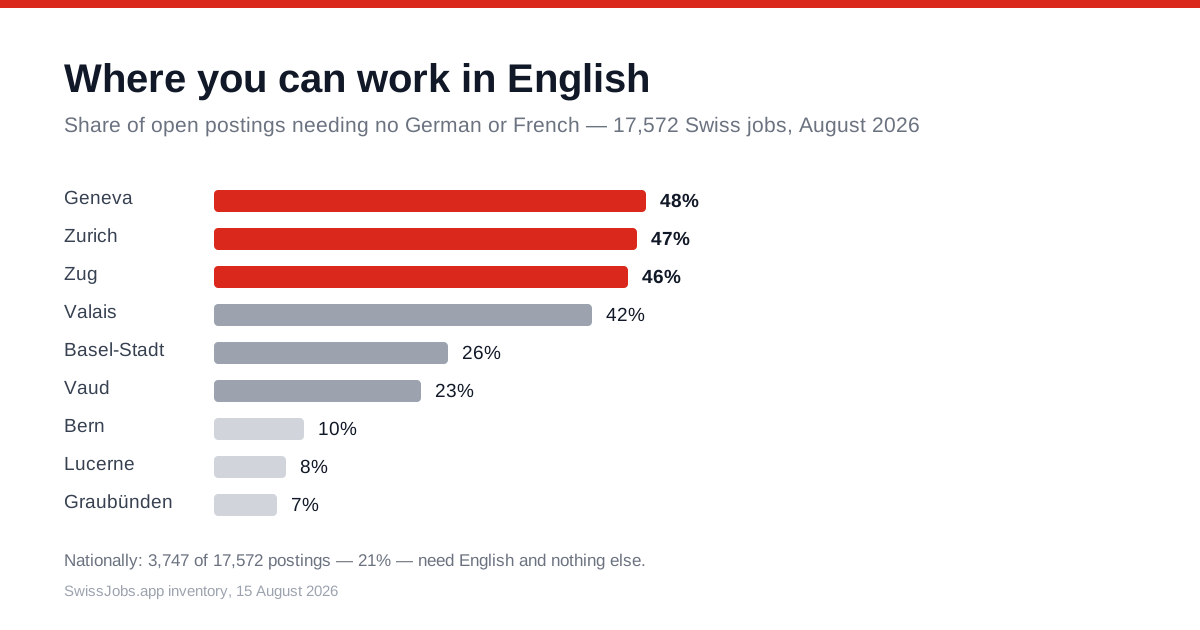
- That national share is misleading for your own search: English adverts are 49.9% of the total in the city of Zurich, 58.7% in Geneva and 52.3% in Zug, but 7.1% in Bern and 6.6% in Winterthur.
- 24.3% of English-language adverts still name German among the languages they ask for; 9.9% name French.
- When an advert names a language at all, 83.4% of those mentions ask for working proficiency, not a smattering — state levels as B2 or C1, not as "fluent".
- Among employers with at least three open vacancies, 33.0% advertise in more than one language.
- Applying in English is normal in the international sector and unusual outside it: in IT in Zurich 62.3% of adverts are in English, in retail across eastern Switzerland 97.8% are in German.
The software does not settle this question
Almost every guide gives the same reason for tailoring: an applicant tracking system reads your CV before a human does, matches keywords and screens you out. For part of the Swiss market that is true. For about half it is not. Of the adverts we hold, 50.6% route to an address on the employer’s own domain, 34.5% into an applicant system, and 14.9% to a board or an agency.
That split is read from where the apply link points, which makes it a judgement call at the edges — count a staffing agency as a system and the shares move. It also does not mean the employer half runs no software: larger employers commonly run bought software behind their own domain, so the system share is better read as a floor than as a ceiling.
Even so, the conclusion holds. A large part of this market is not machine-first, and a dossier built purely for a parser — keyword lists, stripped layout, no photo — is optimised for one part of the market and works against you in the rest. Which is why "software will read it" is not a good basis for deciding how many versions you need.
The real reason is language, and it is very local
Across the whole of the index, two adverts picked at random are in different languages 59.5% of the time, and five are all in one language only 5.3% of the time. Nobody applies nationally, though, so the national figure is not your figure. The interesting numbers are per place.
In the city of Zurich the split is almost exactly even: 49.9% English, 49.3% German. In Geneva, English is actually the larger share at 58.7% against 39.2% French — which surprises people who assume the Romandie is monolingual. In Lausanne it flips back: 65.8% French, 32.2% English. Basel sits at 71.5% German and 27.9% English. Bern is 81.5% German. Winterthur, in the same canton as Zurich, is 92.5% German.
To check that this is not one large employer skewing a city, we ran the same count at employer level: 53.4% of the employers advertising in Zurich post in German, 52.8% in English, and 7.9% do both. The picture survives counting each employer once.
If you are arriving from abroad, this is the number that matters
English is the second language of this market by volume, and it is concentrated. An English-only dossier reaches roughly a quarter of the national market — but close to half of the Zurich market and more than half of the Geneva market, which is why relocating to those two cities feels so different from relocating to Bern or St. Gallen.
The concentration is by sector as much as by city. In IT in Zurich 62.3% of adverts are in English; in finance and banking nationally 53.4% are. In retail 92.2% are in German, in nursing and care 88.6%. If your field is on the first list, one English CV is a workable starting position. If it is on the second, an English-only dossier is not a strategy, it is a ceiling.
And English adverts are not English-only jobs: 24.3% of them name German among the required languages and 9.9% name French. Federal statistics describe the same thing from the other side — the Federal Statistical Office reports that 41% of employed people in Switzerland use more than one language at work at least once a week.
What a Swiss dossier carries that a resume does not
Before deciding how many versions you need, it is worth knowing what a Swiss application contains, because several parts of it do not change between adverts at all. It is a CV, not a resume: two pages is normal rather than a failure of editing, a photo is conventional here where it is discouraged in Germany, the UK and the US, and the file travels with your Arbeitszeugnisse — the written employer references Swiss employers issue at the end of each job, and expect to see.
Non-Swiss applicants should also state their permit — the Bewilligung, B, C, G or L — as a line in the CV rather than leaving it to be asked about. Language skills are given as CEFR levels, B2 or C1, not as "fluent" or "native-level". Workload is stated as a Pensum in per cent: 90.8% of the adverts we hold are full-time and 6.2% part-time, so if you want anything other than 100% you have to say so.
None of that changes per advert. Dates, employers, job titles, education, references and the photo are fixed. What actually changes is short and sits at the top of the page.
So how many versions, and what changes in them
The rule that follows from the numbers is simple: count the languages your search area is written in, not the adverts. If one language covers nine adverts in ten, one version is enough. If two languages split your market roughly evenly — Zurich, Geneva, Zug — you need two, and two real ones rather than one run through a translation. Job titles, task descriptions and qualifications have to read the way they would read in an advert written in that language.
Within a language version, what changes per advert is the headline job title under your name, the three to five lines of profile beneath it, the language line with its levels, and the permit line if you need one. That is the tailoring, and it takes minutes rather than an evening.
One thing nobody can honestly offer you is a guarantee that a CV will "pass" an applicant system. The mechanism is real — a CV using the advert’s own vocabulary matches a keyword-based filter better than a generic one — but the outcome is not visible from outside, to us or to anyone selling you a score.
If you want to see how far your current dossier sits from a specific advert, check it against that advert rather than against a general checklist. The open Swiss adverts are already here, so you do not have to paste the posting in yourself, which is what tools built around a paste box ask you to do.
All shares come from our own analysis of the open Swiss adverts we hold, as at 28 August 2026. Advert language is detected from the text, not declared by the employer; roughly three in ten adverts carry no detected language and are excluded from every language share. Language requirements are read from the advert text — where an advert says nothing, it is not counted, so "more than one language" refers only to adverts that state language requirements at all. The classification of the apply link into employer address, applicant system, or board and agency is made from the destination address and is a matter of where you draw the line; large employers run bought software behind their own domain, so the applicant-system share is better read as a floor. Places come from the location field and occupations from keyword groups over advert titles, not from official regions or occupational classifications; small groups are an order of magnitude rather than a precise measure. The probabilities for two and for five adverts sharing a language are calculated from each place’s language mix and assume random selection. We publish shares, never counts.
Check how your CV fits a job — and the Swiss market
Free checker: languages, work permit, skills and more — scored against a specific posting.
ATS CV checker: against a specific advert, freeSources
Related questions
What our job index says about the Swiss market
Computed live from our own index, not quoted from a study. Shares only, as of today.
Language the advert is written in
- Deutsch
- 60%
- English
- 23%
- Français
- 13%
- Italiano
- 3%
Of adverts that state a language requirement, the share asking for
- Deutsch
- 70%
- English
- 43%
- Français
- 21%
- Italiano
- 3%
19% posted in the last 7 days · Largest markets: Zürich 18% · Bern 10% · Genève 5% · Basel 5%