Job portals in Switzerland: reputation, coverage and who owns them
Updated:
Three questions people keep asking — answered with figures from our own daily-updated job index rather than with opinions.
- Which job portals in Switzerland have the best reputation?
- What are the top job portals for Zurich?
- Which job site is the best in Switzerland — and how would you measure that?
- Where do I find current job openings in Switzerland — and how current is “current”?
- Where do I find federal or cantonal jobs in Switzerland — and can a foreigner apply for them?
Which job portals in Switzerland have the best reputation?
In short
By recognition, jobs.ch leads in German-speaking Switzerland and jobup.ch in Romandie; LinkedIn has the strongest reputation for English-speaking and international roles, Indeed for sheer volume. More useful than reputation, though, is a fact none of them advertises: jobs.ch, jobup.ch and JobScout24 all belong to JobCloud AG. Searching all three for more choice means searching three front doors to one business.
The Swiss job portals at a glance
Click an image for the full-size view. What each portal actually is stands beside it.
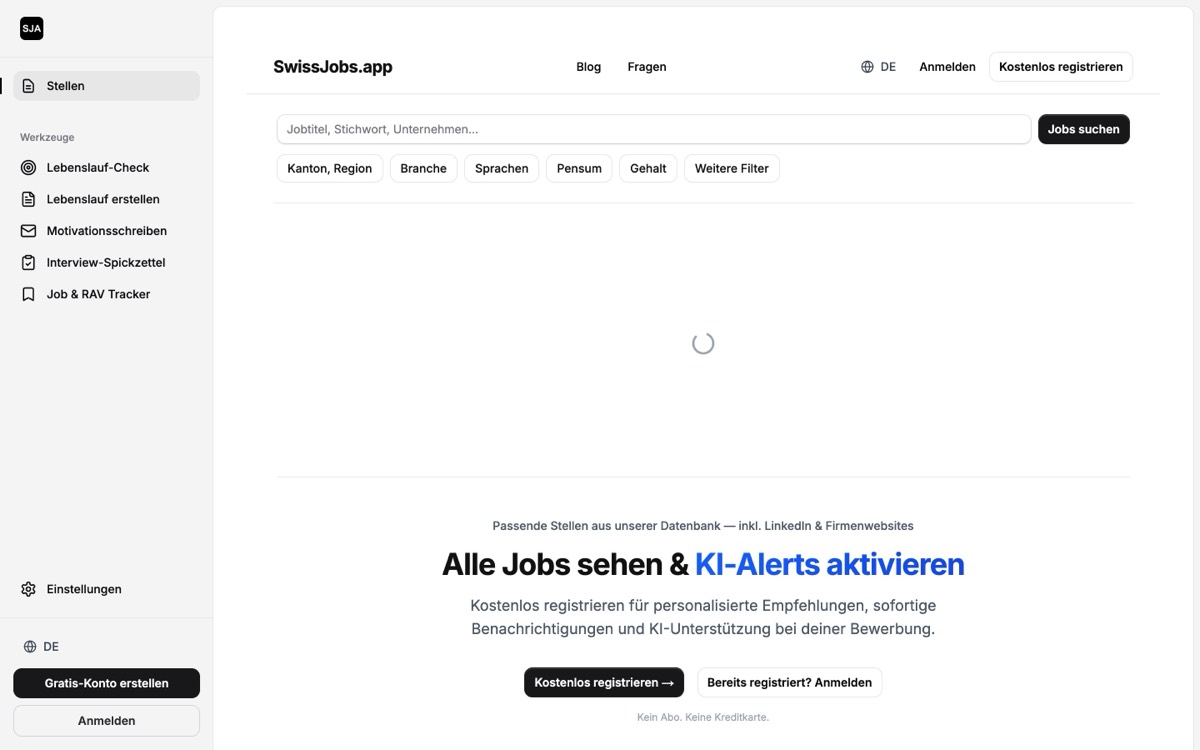
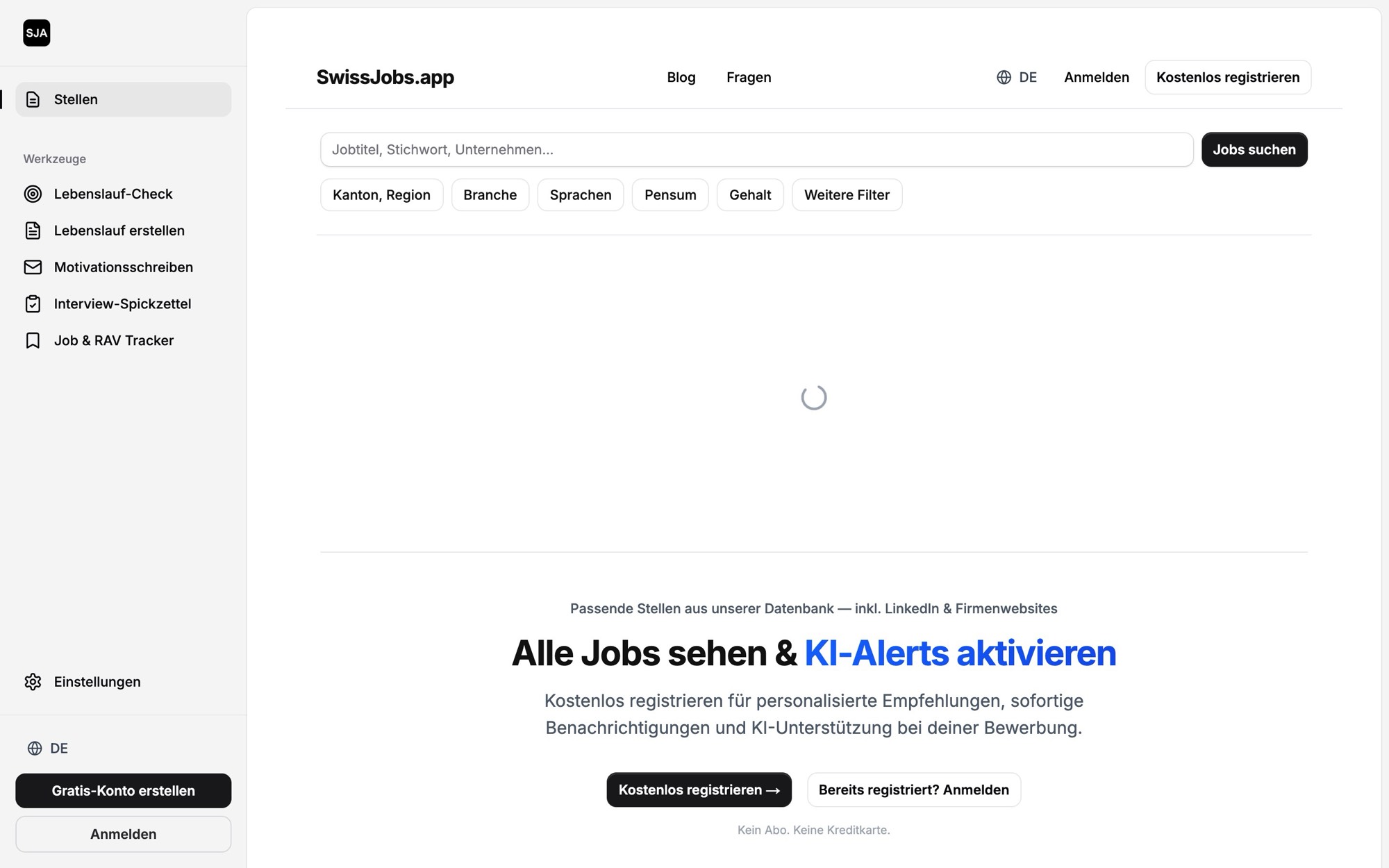
1. SwissJobs.appOur app
Over 21,000 open Swiss roles from ATS systems, company sites and LinkedIn in one place — and from any advert, straight into a CV, a motivation letter, a CV check and interview prep. The RAV job-search-efforts form fills itself from your application tracker. Free to use; the account is asked for at save.
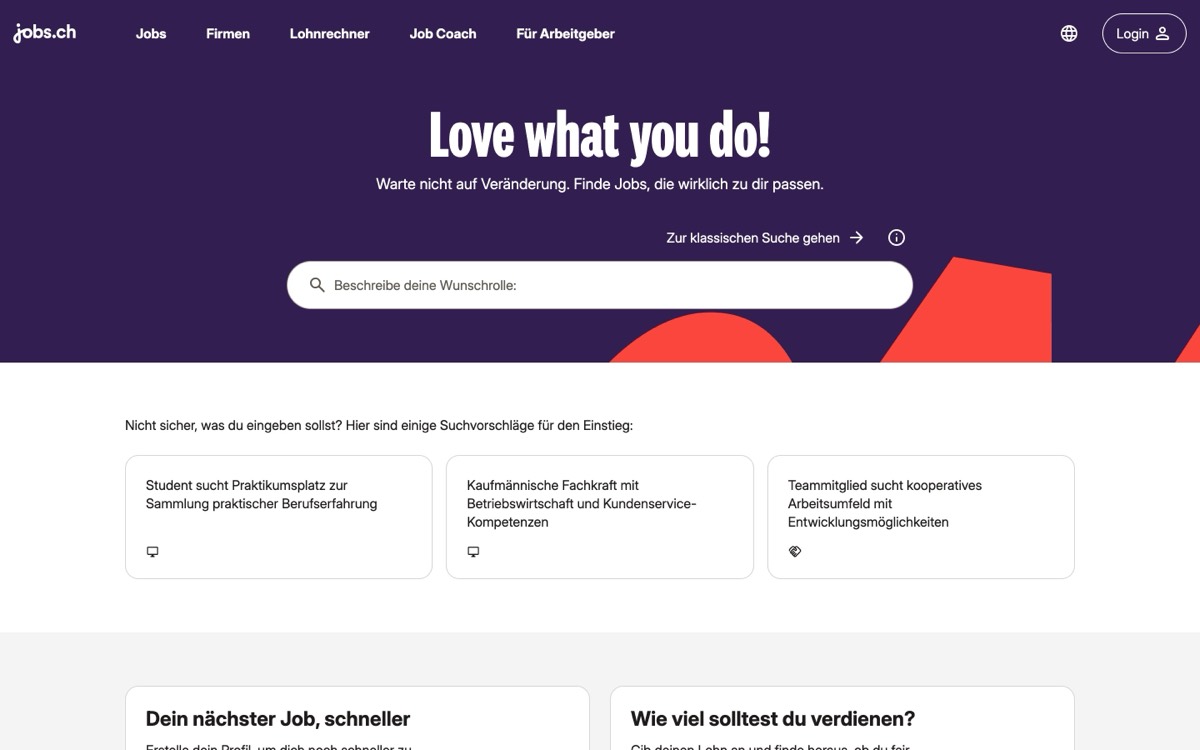
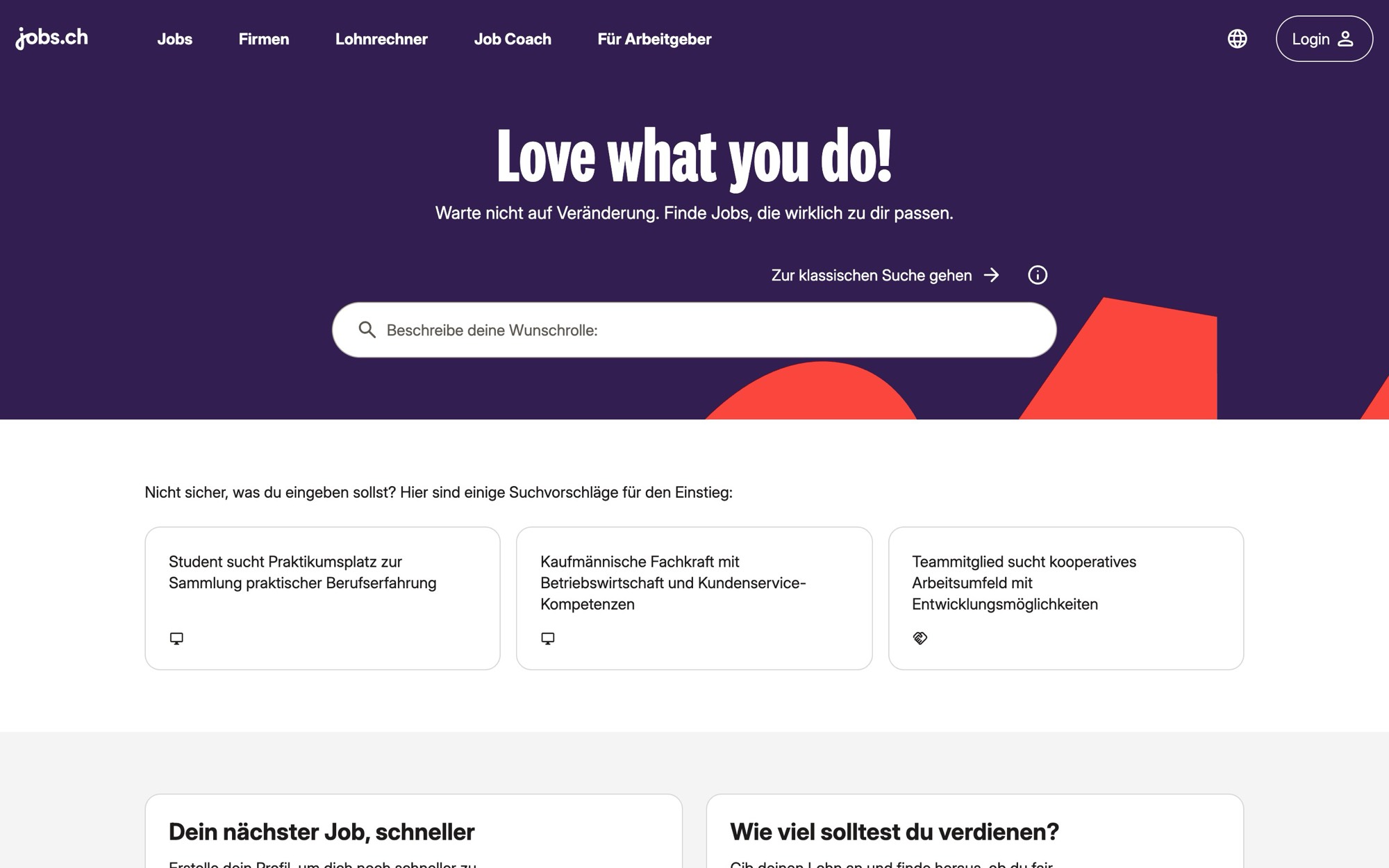
The best-known board in German-speaking Switzerland and the largest index in the country. Owned by JobCloud AG — as are jobup.ch and JobScout24.
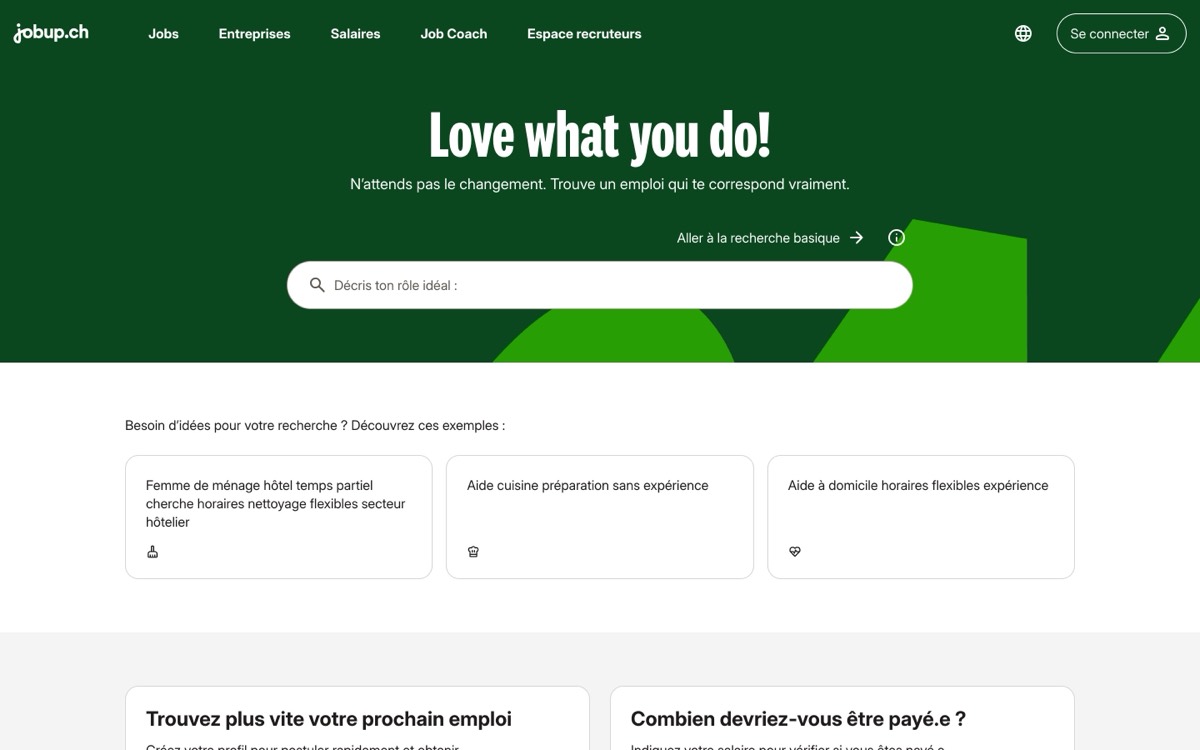
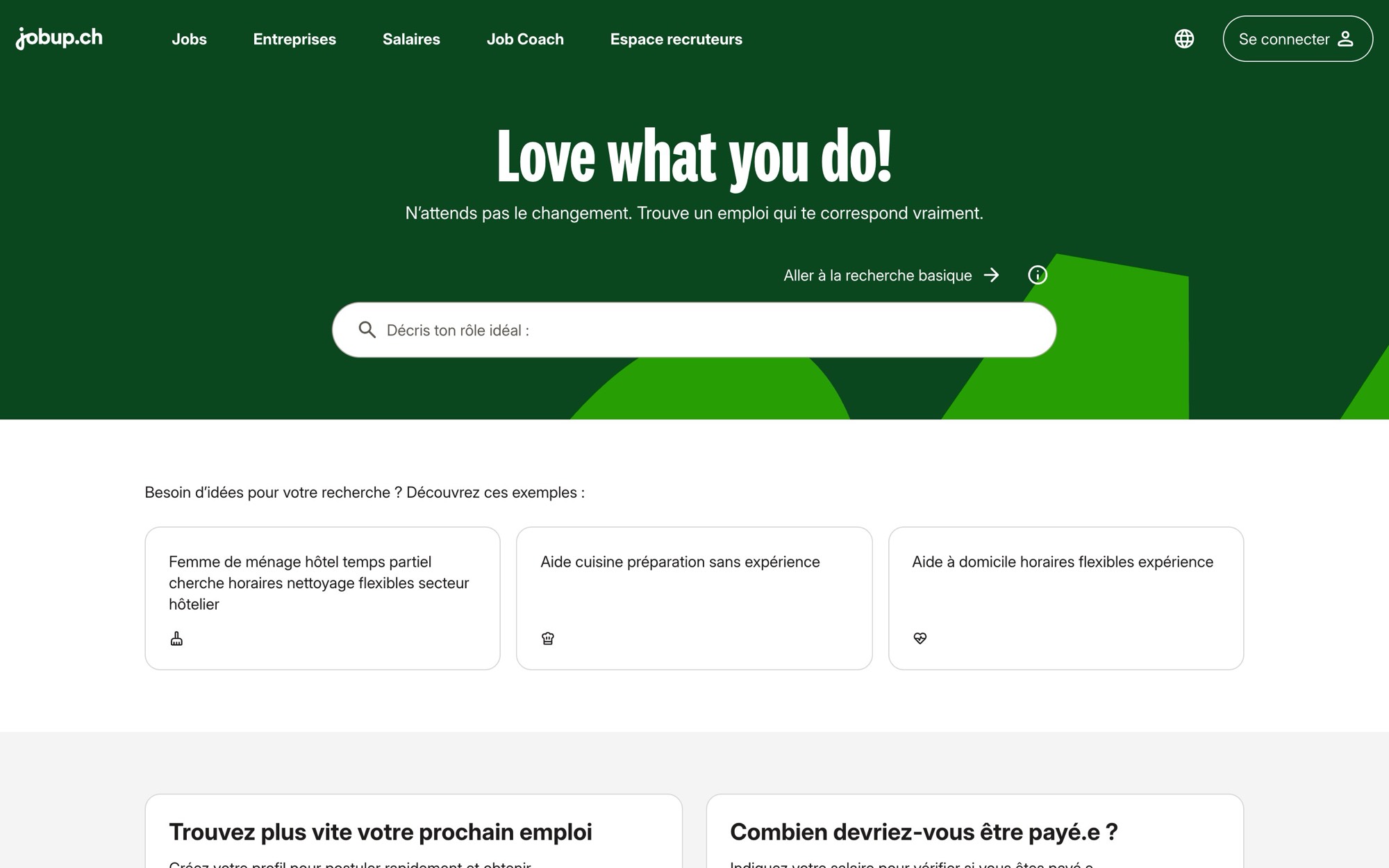
The standard in French-speaking Switzerland and the first place to look for the Romandie — but the same JobCloud AG as jobs.ch.
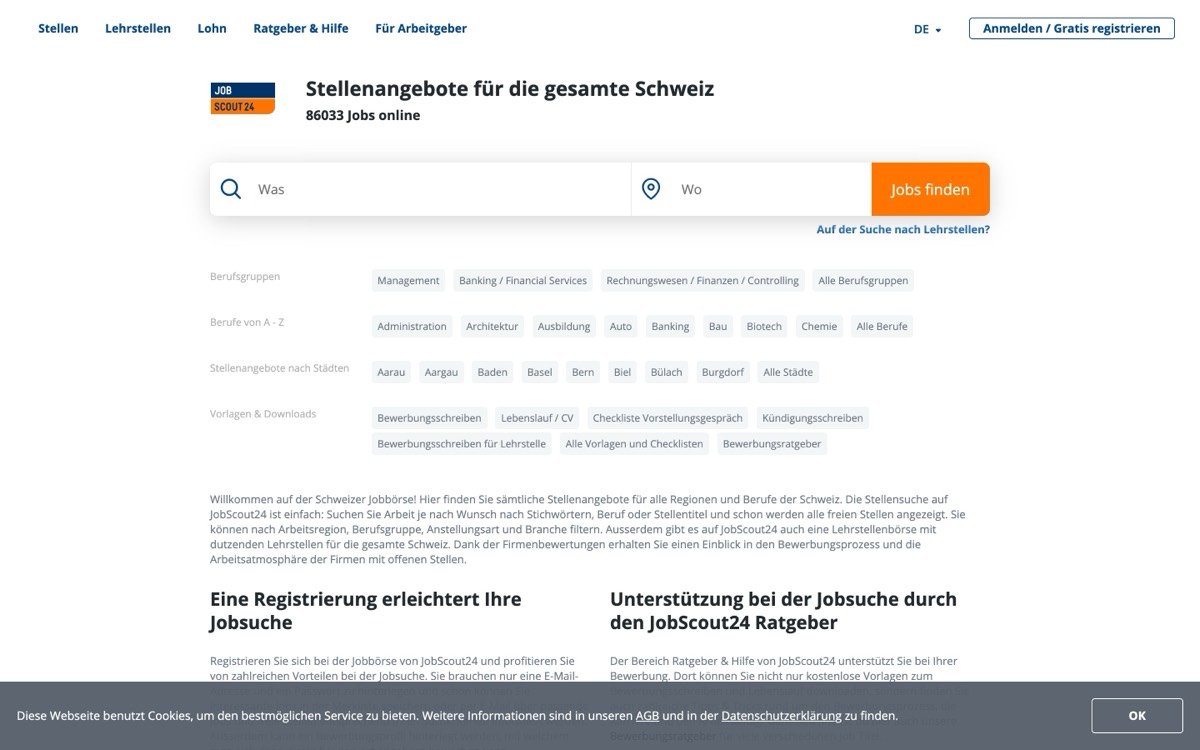
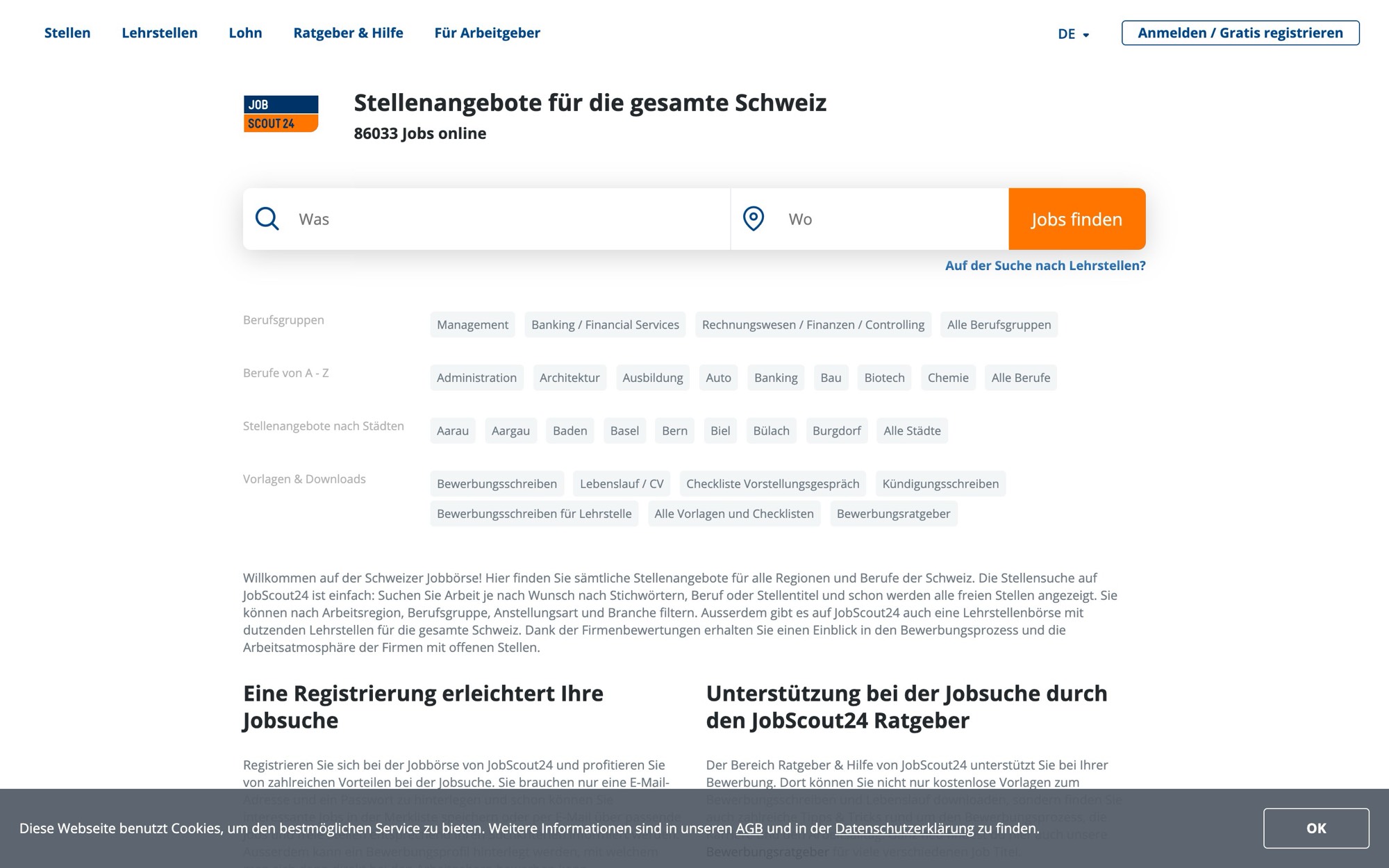
A third brand from the same company. Searching all three to widen your search means searching one provider three times.
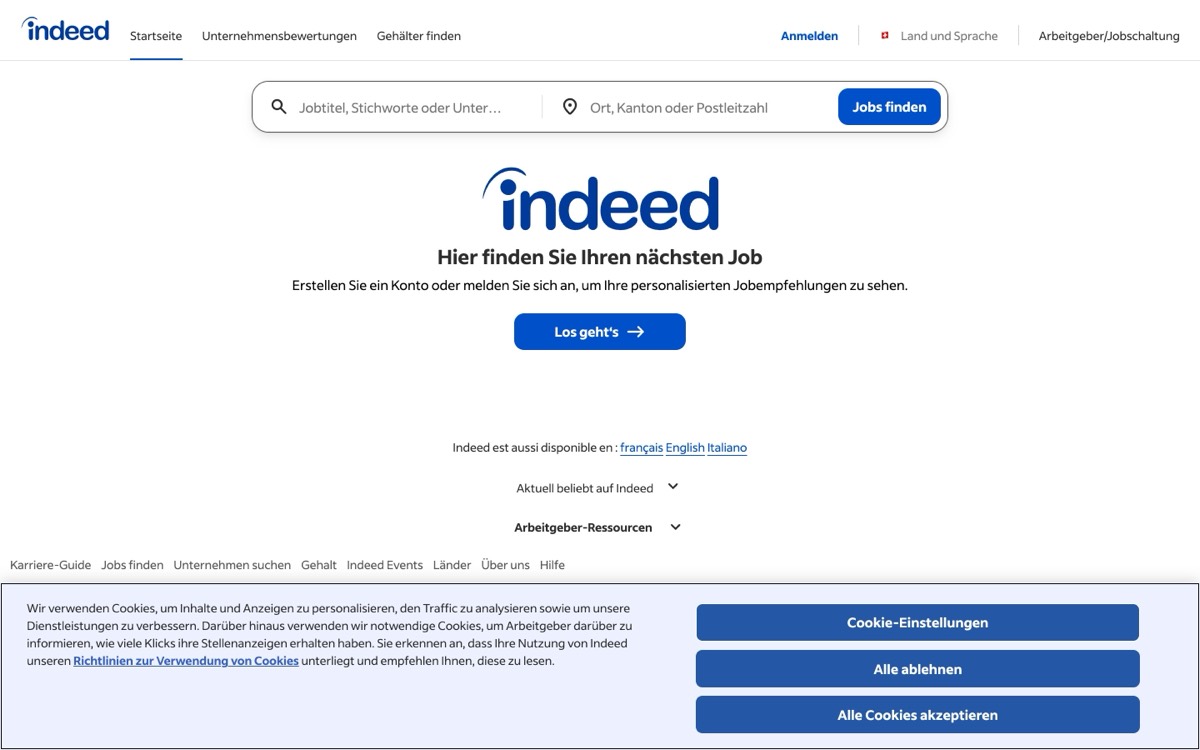
The broadest aggregation, because Indeed also collects from other boards — at the cost of many duplicates of the same advert.
The best reputation for English-speaking and international roles in Switzerland. Considerably thinner for trades, care and commercial roles.
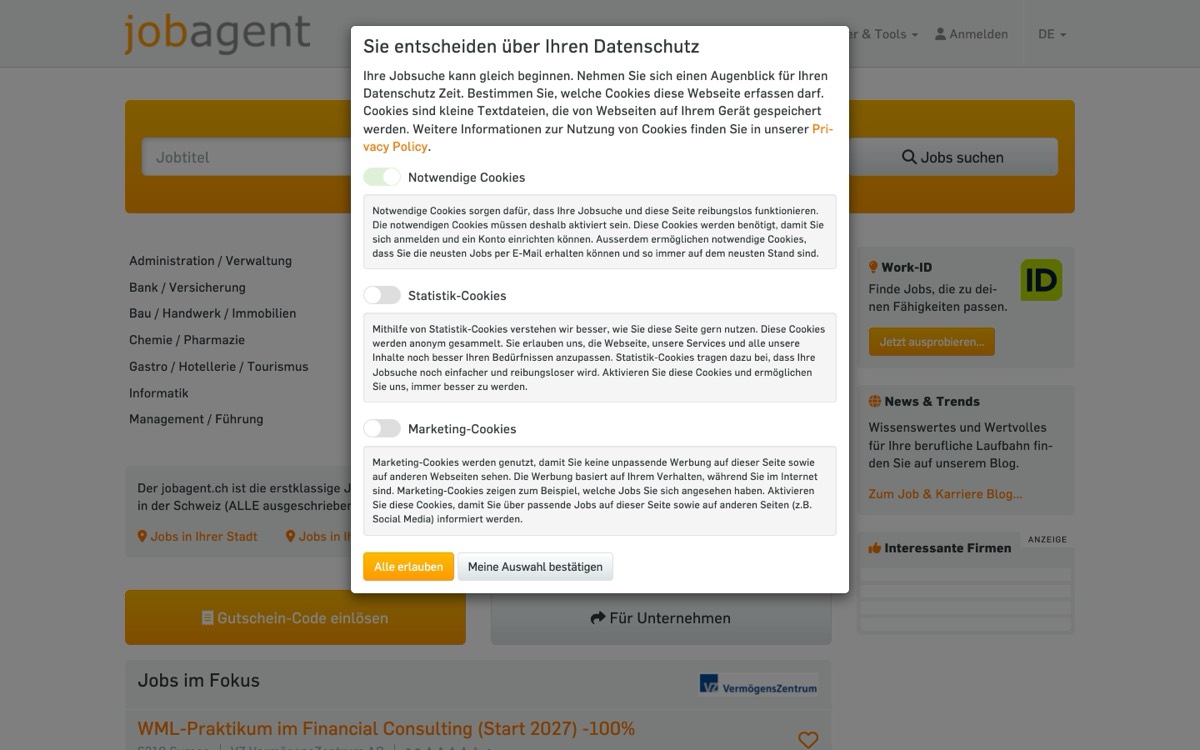
A meta-search across the Swiss job boards, "every job in Switzerland at a glance". Its strength is the Job-Abo: a saved search that mails you new adverts from every portal it covers. Salary calculator and application guides alongside.
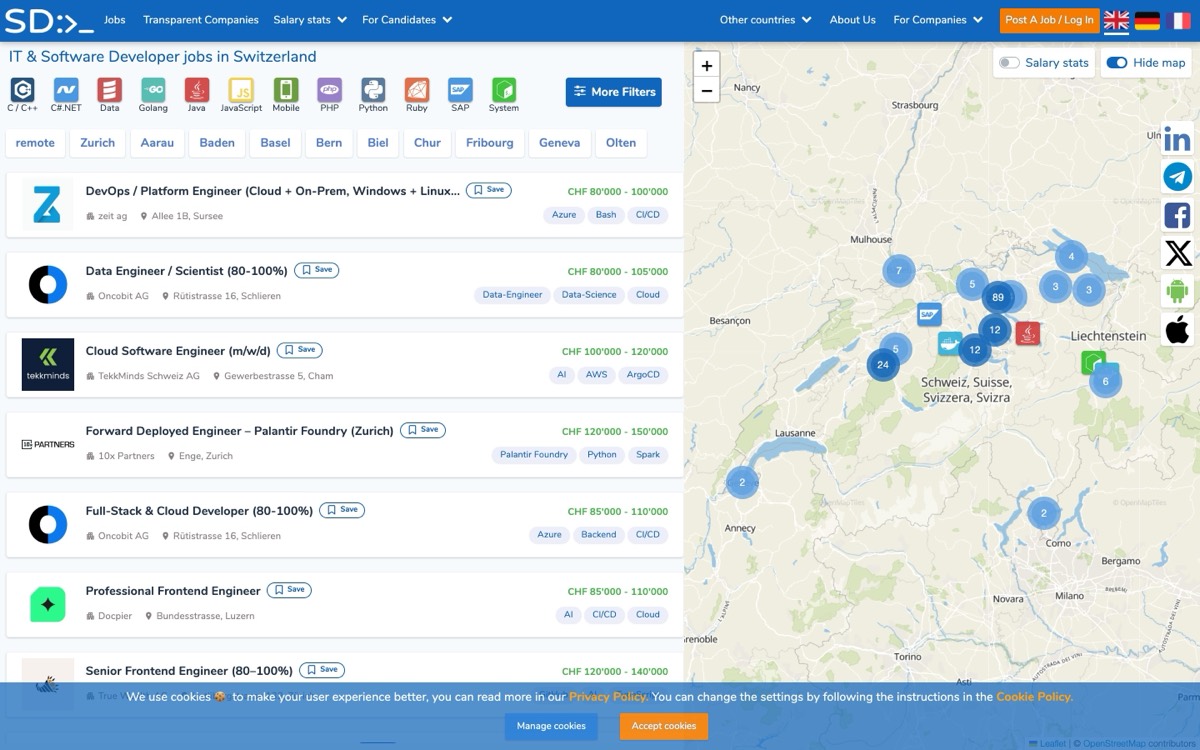
IT and software only, and thorough about it: "183 IT & Software developer jobs in Switzerland", filtered by technology (C#, Java, Python, DevOps, ML) rather than by industry. Publishes salary statistics and lists the companies that disclose their ranges. The site itself is in English.
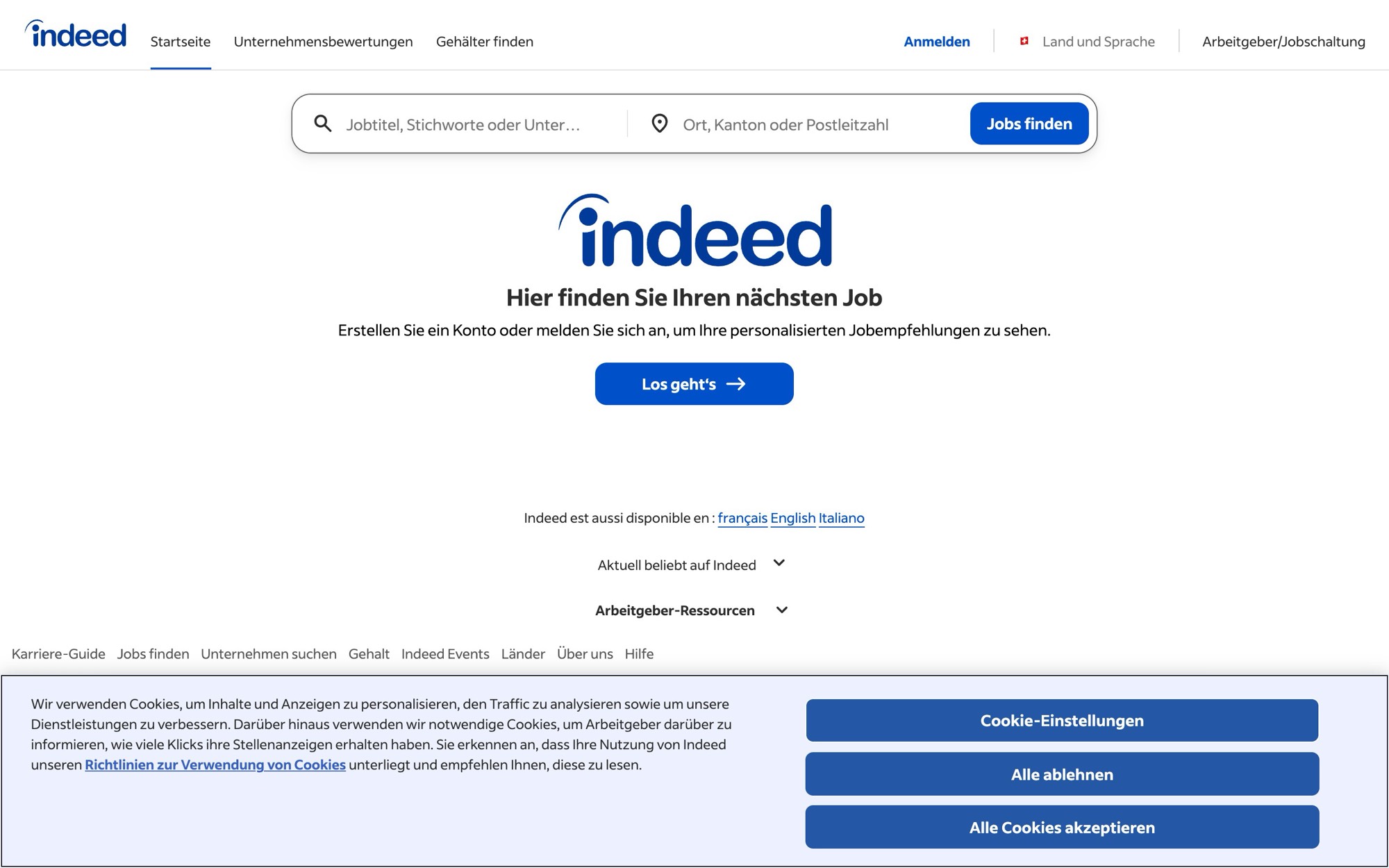
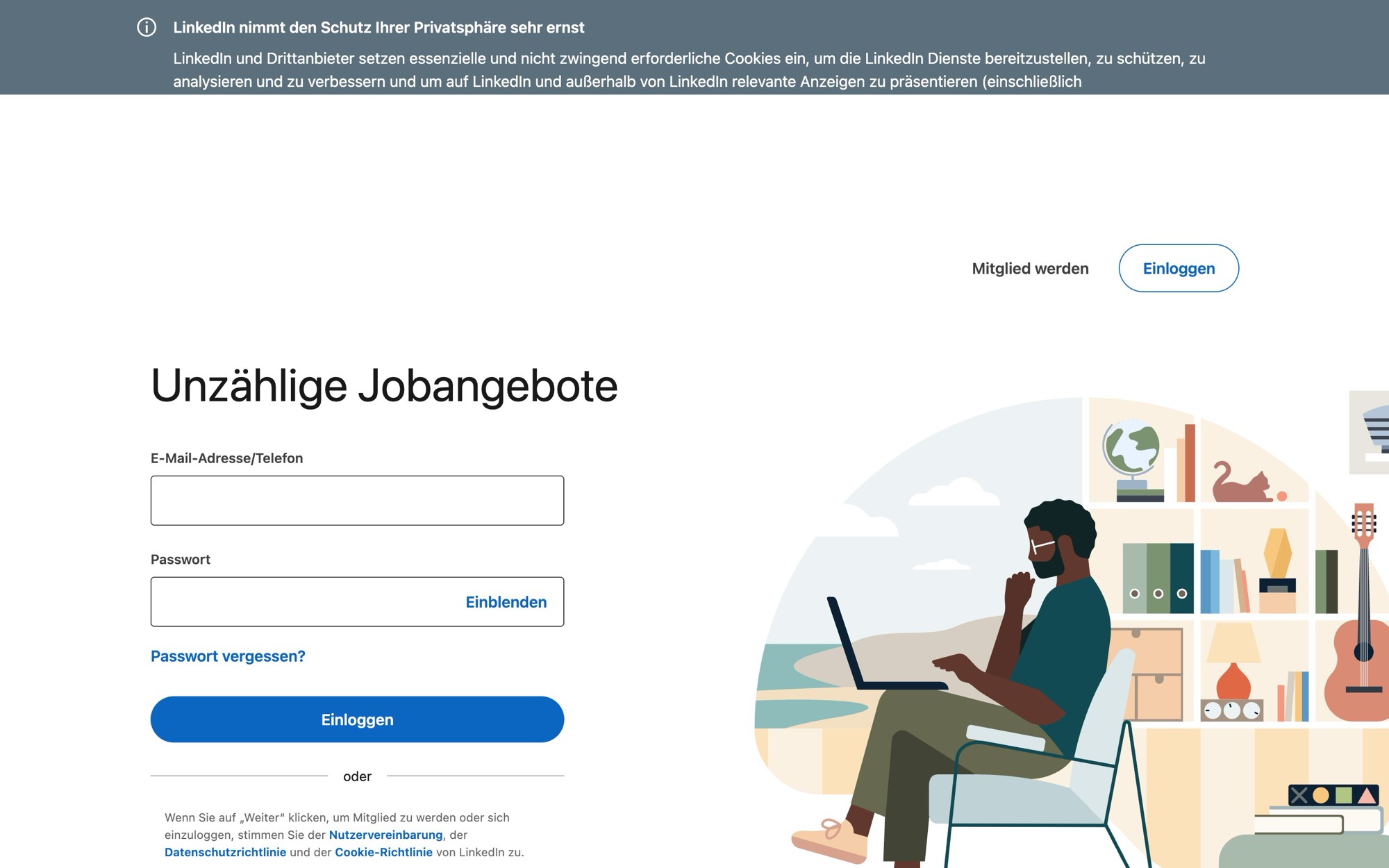
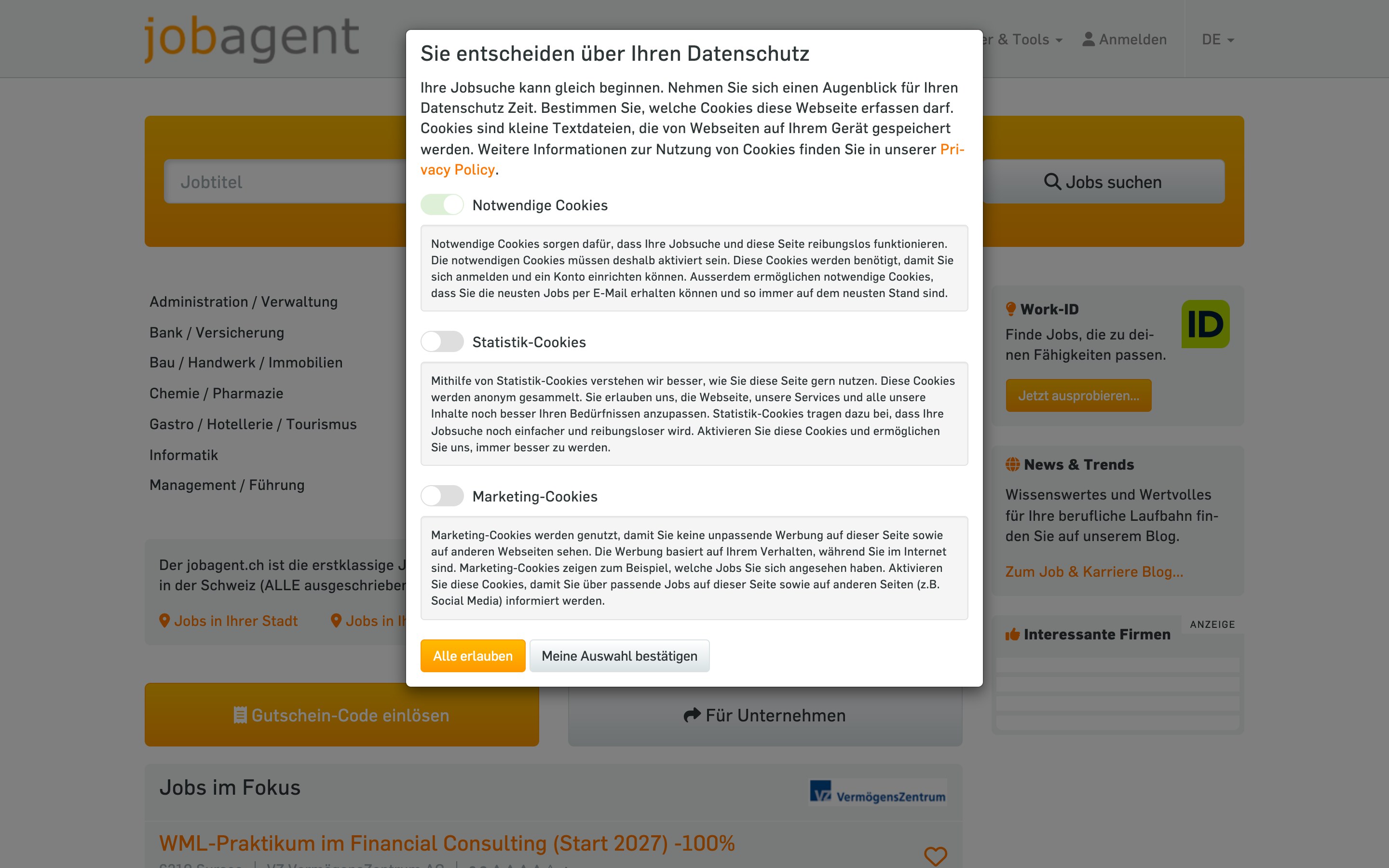
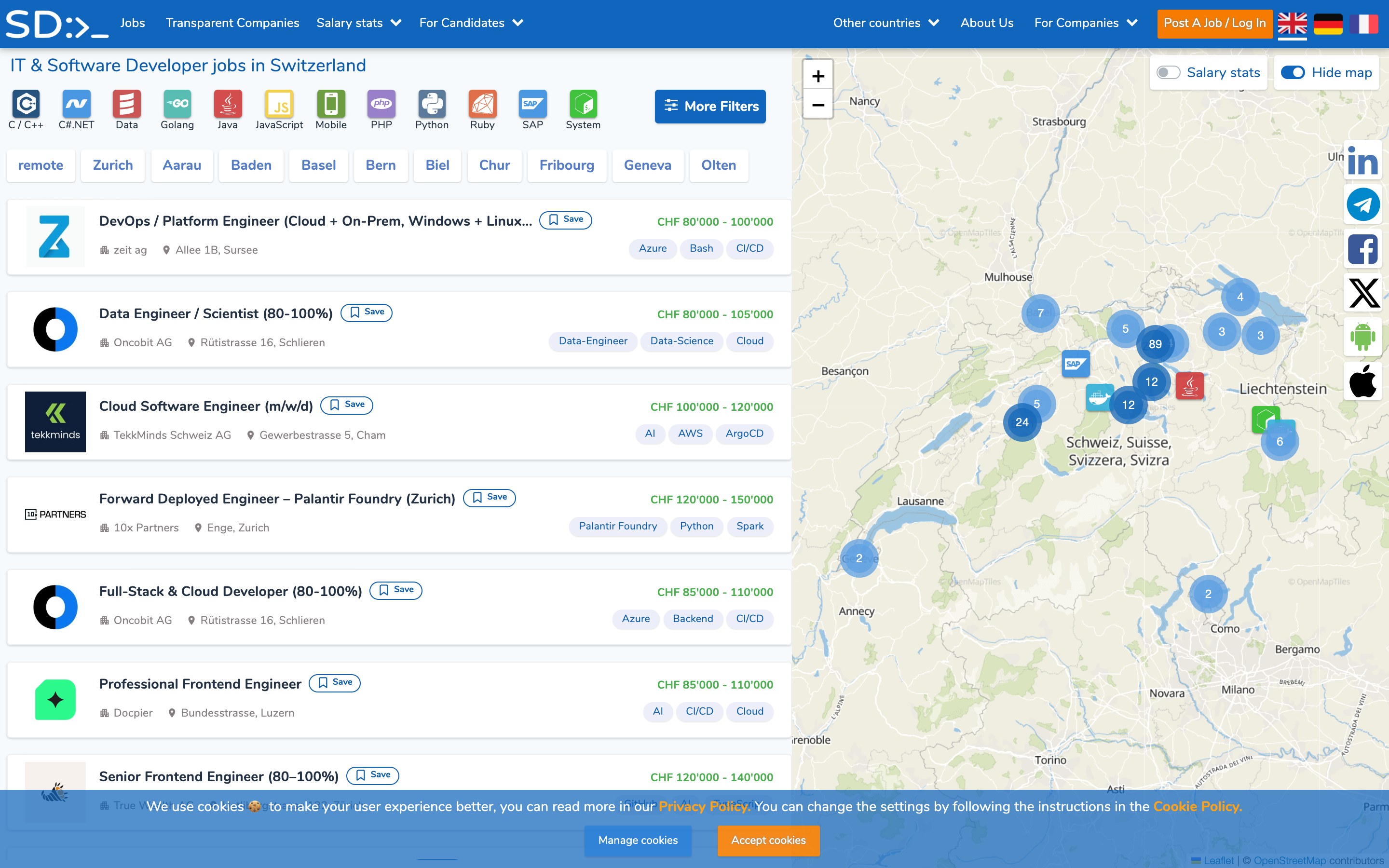
Jobs by profession, city or language
Type a profession, a city or a language, the page shows the adverts currently open for it.
By profession
- Consultant
- Project Manager
- Retail Sales
- Nurse
- Nursing & Care
- Administrative Assistant
- Account Manager
- Software Engineer
- Public Administration
- Architect
- Insurance
- Chef
71 more — narrow the search
By work type
In practice: two genuinely independent sources beat three brands from one provider.
- jobs.ch — best known in German-speaking Switzerland.
- jobup.ch — the standard in Romandie.
- JobScout24 — same company as the two above.
- Indeed — broadest aggregation, but many duplicates.
- LinkedIn — strongest reputation for English-speaking and international roles.
How to judge a job board
| Criterion | What to look at | Why it matters |
|---|---|---|
| Freshness | share of adverts from the last 7 days | ours is 21.9% — ask others for theirs |
| Expired adverts | removed, or left standing | dead adverts cost you applications |
| Duplicates | the same role listed repeatedly | it inflates the headline count |
| The job-registration duty | does the board mention it | 5 working days run through Job-Room first |
| Filters that matter | workload, language, canton | 23.0% of adverts state the workload in the title |
| Direct link to the employer | or a detour through a form | detours cost reply rates |
| Cost to applicants | there should not be one | — |
Reach cannot be checked from outside — every board claims the largest. Other things can be: how fresh, how clean, how honest about gaps. Hold us to the same points.
Ownership stated by JobCloud itself; assessments as of August 2026.
Check how your CV fits a job — and the Swiss market
Free checker: languages, work permit, skills and more — scored against a specific posting.
ATS CV checker: against a specific advert, freeWhat are the top job portals for Zurich?
In short
For Zurich, jobs.ch and Indeed cover the most volume, LinkedIn the English-speaking and international roles. What matters more is what happens next: in our index, roughly three quarters of postings lead to an application directly on the company's own site and another fifth into an applicant tracking system — only a small remainder stays on a job board. The board finds the posting; you apply to the employer.
Practically: use one big board for reach and one source that makes the application itself easier.
- Roughly three quarters of postings lead to a company site.
- About a fifth go into an applicant tracking system.
- Only a small share stays on a job board.
- Zurich is the largest single market in Switzerland.
How to judge a job board
| Criterion | What to look at | Why it matters |
|---|---|---|
| Freshness | share of adverts from the last 7 days | ours is 21.9% — ask others for theirs |
| Expired adverts | removed, or left standing | dead adverts cost you applications |
| Duplicates | the same role listed repeatedly | it inflates the headline count |
| The job-registration duty | does the board mention it | 5 working days run through Job-Room first |
| Filters that matter | workload, language, canton | 23.0% of adverts state the workload in the title |
| Direct link to the employer | or a detour through a form | detours cost reply rates |
| Cost to applicants | there should not be one | — |
Reach cannot be checked from outside — every board claims the largest. Other things can be: how fresh, how clean, how honest about gaps. Hold us to the same points.
Analysed from the currently published postings in our index, August 2026.
Check how your CV fits a job — and the Swiss market
Free checker: languages, work permit, skills and more — scored against a specific posting.
ATS CV checker: against a specific advert, freeWhich job site is the best in Switzerland — and how would you measure that?
In short
No single site covers the Swiss market, and that is measurable rather than a matter of taste. The largest single application destination in our index carries about eleven percent of the adverts we track, and you need roughly fifty different destinations before you have seen half the market. The strongest setup is therefore a pair: one broad search site for volume, plus Job-Room for occupations under the job registration requirement, where jobseekers signed on with an RAV see vacancies five business days before anyone else.
Behind the question sit four properties you can actually test: coverage, freshness, language and reach into small employers. A reputation ranking tests none of them.
For anyone job-hunting in English the second criterion matters most. About a fifth of the adverts we track are written in English, but they cluster in particular cities and particular industries — and a site that indexes only one language shows you a different market than the one that exists.
Share of all tracked Swiss adverts covered by the largest application destinations combined. A destination is where the application actually lands — usually an employer's own careers site. Ongoing analysis, August 2026.
- It takes around fifty different application destinations to cover half the adverts we track, and 393 to cover four fifths.
- Almost half of all employers in our index have exactly one vacancy open.
- Only about one advert in seven is younger than a week; more than a quarter is older than two months.
- Roughly a fifth of adverts are written in English — and in the French-speaking cantons that share rises to almost three in ten.
- In occupations with at least five percent unemployment, registered jobseekers get a five-working-day head start no private site can match.
How to judge a job board
| Criterion | What to look at | Why it matters |
|---|---|---|
| Freshness | share of adverts from the last 7 days | ours is 21.9% — ask others for theirs |
| Expired adverts | removed, or left standing | dead adverts cost you applications |
| Duplicates | the same role listed repeatedly | it inflates the headline count |
| The job-registration duty | does the board mention it | 5 working days run through Job-Room first |
| Filters that matter | workload, language, canton | 23.0% of adverts state the workload in the title |
| Direct link to the employer | or a detour through a form | detours cost reply rates |
| Cost to applicants | there should not be one | — |
Reach cannot be checked from outside — every board claims the largest. Other things can be: how fresh, how clean, how honest about gaps. Hold us to the same points.
The market is far more fragmented than the brand names suggest
For every advert we track we also record where the application itself lands. That produces a map of the Swiss market no individual site can show you: the largest single destination accounts for about eleven percent of adverts. The ten largest together reach not quite a third. You need around fifty destinations to reach half the market, and 393 to reach four fifths.
The employer side is just as spread out. The ten biggest employers in our index account for a good fifth of adverts between them; the hundred biggest do not reach half. Whatever site you start on, the majority of Swiss vacancies sits with employers you have never heard of.
That reframes the question. "Which site is best" is a weaker question than "which two sites do not overlap". Two sources that draw their adverts from genuinely different channels give you more choice than three brands fed by the same channel.
In practice the answer is a pairing: a broad search site for volume, and a second channel that reaches small employers and their own careers pages. Which large site you pick changes your result list far less than whether you have that second channel at all.
Freshness is the criterion nobody advertises
Only about one in seven currently open adverts in our index was published within the last week. A good third is younger than two weeks, and more than a quarter is older than two months. Volume claims tell you nothing about that distribution, and it is the distribution you are actually competing in.
There is a useful signal buried in it. Among the 25 largest application destinations the median open advert is around 17 days old; across the long tail of smaller destinations it is around 25. Large employers cycle faster. A four-week-old advert at a small firm is very often still genuinely open — the same age at a large one usually is not.
You can test any site for this in under a minute: sort by date and count how many adverts carry today's or yesterday's date. If almost everything looks new, the site is showing you when it found the advert, not when the employer published it. That difference decides whether you are applying on day two or day forty.
The other half of freshness is removal. A site that never takes anything down looks larger and performs worse, because a share of your applications goes to roles that were filled weeks ago and you never learn which ones.
The one site with a legal head start
There is exactly one place in the Swiss market that holds vacancies which may not yet be published anywhere else. Since 1 July 2018 the job registration requirement has applied: employers must report vacancies in occupation types with high unemployment to the responsible regional employment centre (RAV) before advertising them publicly. SECO states this on arbeit.swiss.
The federal portal is explicit about what registration buys you: by registering, you can see vacancies subject to the registration requirement "five business days before they are published elsewhere". Five working days is a long time in a Swiss hiring cycle — it is the difference between being among the first applications a recruiter reads and being one of many.
Two limits matter. First, the head start only covers occupations on the annual list, and an occupation type only qualifies if its unemployment rate is at least five percent, calculated nationally as a twelve-month average under the Swiss occupational nomenclature CH-ISCO-19. The list is refreshed each fourth quarter and runs from 1 January to 31 December of the following year.
Second, access is conditional: arbeit.swiss states that the services tied to registration are available exclusively to people already signed on as jobseekers with an RAV. If you are not signed on — and many people arriving in Switzerland on a permit are not — this route is closed to you and the practical answer reverts to coverage, freshness and language.
English-language roles are a fifth of the market, and they sit in specific places
Roughly a fifth of the adverts we track are written in English. Just over four in ten are in German, close to one in ten in French, and well under two percent in Italian. For about a quarter we cannot determine the language reliably, and we would rather say so than round it into a claim.
The English-language share is not spread evenly. Zurich alone accounts for close to three in ten English adverts once its spelling variants are combined, with Geneva, Basel and Zug following. If you search only in English you are effectively searching a handful of cities and a handful of industries — pharma, finance, technology and research.
The counterintuitive finding is in the French-speaking cantons. They carry around fourteen percent of the adverts we track, but only about four in ten of those are written in French; almost three in ten are in English. An English speaker who writes off Romandie as a French-only market is skipping one of the more accessible parts of the country.
The practical move costs nothing: run every search twice, once with the English job title and once with the German or French one. "Accounting Specialist" and "Sachbearbeiter Buchhaltung" return two different lists in the same city, and no site merges them for you.
The employers with a single vacancy
Almost half of the employers in our index have exactly one open advert. Together they account for around seven percent of all adverts; widen it to employers with at most three vacancies and you reach about sixteen percent.
This is the part of the market that brand-led search covers worst and where an application counts for most. A firm with one open role has no recruiting team, no employer-branding budget and rarely more than a handful of applications in the inbox. It is also the part where a well-written speculative approach still works.
Reaching it takes a source that indexes small careers pages and a willingness to run the same search two ways — once through a site, once through the names of employers in your region. Trade associations, cantonal business registers and your current employer's customer list are more useful here than any ranking of portals.
If your time is limited, that suggests an order of operations: Job-Room first if you are signed on with an RAV, then one broad search site sorted by date, then five to ten careers pages of small employers you picked yourself.
A five-minute test for any job site
One: search your own job title and sort by date. How many adverts carry today's date? Two: open three adverts and follow the apply button. If it takes you to the employers themselves, the site is a search engine over the market; if you never leave one domain, it is a closed marketplace with whatever subset chose to pay for it.
Three: search the same title in two languages. If the list changes substantially, the site is matching keywords rather than roles, and you have to run both variants yourself. Four: check whether it understands a location smaller than a canton — most searches fail on geography rather than on job titles.
What you cannot test is reputation, and it is the one thing every ranking article measures. Being well known says nothing about whether your specific vacancy is on the site. The four checks above answer that in five minutes, and they are also why the honest answer to this question is a combination rather than a single name.
Market figures come from our ongoing analysis of the Swiss job adverts we track, as of August 2026. "Application destination" means the address where an application actually arrives, not the site where you find the advert. Language shares are derived from the advert text; a quarter remain undetermined. We publish shares, not absolute inventory figures. Statements about the job registration requirement come from SECO.
Where do I find current job openings in Switzerland — and how current is “current”?
In short
Three channels together cover the current openings, and none of them does it alone: Job-Room, the unemployment insurance portal, if you are registered as a jobseeker with an RAV — vacancies subject to the registration requirement sit there five working days before they may appear anywhere else; a broad search sorted by date; and the career pages of employers in your region. The catch is in the word current. About 19.5 percent of the open adverts we track were published in the last seven days, but that fresh week is a distorted sample: one staffing firm supplies nearly three in ten of it.
This answer can contain errors and is not official advice. What your RAV or unemployment fund says is binding.
People searching for current openings usually mean two different things at once: recently published, and still genuinely open. Only the first can be sorted. The second is nowhere in the data, and the two are connected much more loosely than a date stamp suggests.
So date sorting is an excellent first move and a poor only move. It reliably shows you who advertises fast and often. It does not show you where a role is opening up for you — and on the first page those two things look identical.
Share of the adverts published in the last seven days, by occupational field, matched on the job title. Across the whole set of open adverts the same fields hold 10.6 percent (IT), 8.2 percent (engineering), 7.2 percent (sales and retail), 4.7 percent (office and admin), 4.2 percent (hospitality), 4.4 percent (healthcare) and 4.8 percent (construction and trades). Rolling analysis of the open Swiss adverts we track, August 2026.
- About 19.5 percent of open adverts were published in the last seven days; just over half of everything online was published this calendar month, and only 0.3 percent is older than six months.
- One staffing firm accounts for 28.7 percent of that fresh week but only 10.6 percent of the whole set of open adverts.
- 28 posters fill half of the last seven days. Across the whole set it takes 140.
- Employers with more than 50 open adverts supply 51.8 percent of the fresh week against 37.2 percent of the whole set; employers with a single opening drop from 7.0 to 5.4 percent.
- Only about 2.6 percent of open adverts sit in an occupation subject to the 2026 registration requirement — the only place where the five-working-day head start on Job-Room applies at all.
- Almost 43 percent of those adverts are kitchen and cleaning roles, which joined the list only on 1 January 2026.
“Current” is a sort order, not a state
In a job list, current means exactly one thing: the publication date is recent. Across the open Swiss adverts we track, 19.5 percent were published in the last seven days. Just over half of everything standing online was published this calendar month, a fifth the month before, and only 0.3 percent is more than six months old. The stock turns over continuously — most of what you are looking at is a few weeks old at most.
What the date does not tell you is the state of the role. In most Swiss companies an advert stays up until a contract is signed, which is routinely weeks after the first interview. Yesterday's advert may already have a shortlist; a six-week-old advert may be wide open because nobody suitable applied. Reading recency as quality means sorting on the wrong variable.
The date is still worth having, but for a different question: it measures the poster, not the vacancy. An employer whose adverts are consistently maintained usually has a real HR function and answers faster. An advert with no visible date is the worst signal of the lot — that page is showing you when it noticed the job, not when the job appeared.
The practical rule is dull but decisive: sort by date, always with an occupation filter and a location filter switched on at the same time. Without those two, you are not seeing the newest roles in your market, you are seeing the newest roles in the country — and those, as the next sections show, belong to a very small circle of posters.
The one channel with a legal head start — and who may use it
Switzerland has exactly one place where vacancies sit that are not yet allowed to appear anywhere else: the protected area of Job-Room. The job registration requirement has been in force since 1 July 2018, and in its present form since 1 January 2020. Employers must register vacancies in occupation types whose national unemployment rate is at least 5 percent with the regional employment centre. SECO states it plainly: the vacancy has to sit in the protected area of Job-Room for five working days before it may be advertised elsewhere. That is a blocking period, not a courtesy.
The list of occupation types is republished each fourth quarter and applies from 1 January to 31 December of the following year. The only criterion is the unemployment rate, calculated for the whole of Switzerland as a twelve-month average by occupation under the Federal Statistical Office's CH-ISCO-19 classification. New for 2026 are cleaning staff and auxiliary staff in offices and hotels, and chefs, both at 5.3 percent. On arbeit.swiss's own figures, 10.8 percent of the workforce now works in an occupation subject to the requirement, against 6.5 percent the year before.
On the advertising side, though, that head start is far narrower than 10.8 percent of the workforce suggests. We matched the official 2026 job titles against the titles of the open adverts we track: about 2.6 percent of them sit in a registration-requirement occupation, and almost 43 percent of those are the two occupation types added in January — kitchens and cleaning. The five-day advantage is real, but it touches roughly one advert in forty, not the market.
There are also exemptions worth knowing before you count on it. A vacancy need not be registered if it is filled by someone already registered with the public employment service, if it goes to an internal candidate employed in the company or group for at least six months without interruption, if the engagement lasts at most 14 calendar days, or if the hire is a close relative of an authorised signatory. Apprenticeships and internships that form a compulsory part of a course of study are exempt too. Even inside a covered occupation, Job-Room gives you a lead, not a complete list.
And access has a hard condition. arbeit.swiss states that the services attached to registration are available exclusively to people registered as jobseekers with an RAV. Registering runs through an AGOV login and requires your AHV number plus the eight-digit personal number your RAV issues. If you have just arrived in Switzerland and are not registered as a jobseeker, this channel is closed to you, and the fastest route to it is the RAV itself. If you are registered, do it on day one: it unlocks the five-day information advantage, a job alert and saved-vacancy lists.
Who actually fills the fresh week
Here is the part no search page displays. The adverts published in the last seven days are not the market in miniature — they are a heavily skewed sample of it. A single staffing firm supplies 28.7 percent of them while accounting for 10.6 percent of the whole set. Twenty-eight posters are enough to fill half of the fresh week; across the whole set it takes 140. And the ten largest application destinations cover 50.4 percent of the fresh week against 32 percent of everything open.
The same skew shows up by employer size. Employers with more than 50 open adverts supply 51.8 percent of the fresh week but 37.2 percent of the whole set, while employers with exactly one opening fall from 7.0 to 5.4 percent. The mechanism is arithmetic rather than mysterious: among the largest posters the median advert is about 15 days old and 27.1 percent of their roles are less than a week old; among single-opening employers it is about 22 days and 15.3 percent. High-volume posters live permanently at the top of a date-sorted list.
It skews geographically too. German-speaking Switzerland holds 81.0 percent of the open adverts but 86.3 percent of the fresh week; French-speaking Switzerland drops from 17.7 to 12.9 percent and Ticino from 1.2 to 0.8 percent. By field, IT roles are 10.6 percent of everything open but 17.4 percent of the last seven days, while construction and trades fall from 4.8 to 4.0 percent — and make up 7.4 percent of the adverts older than three months.
That this comes from the mix of posters rather than from the market itself is easy to demonstrate. Remove that one staffing firm from the fresh week and the proportions snap back almost to normal: French-speaking Switzerland to exactly its 17.7 percent, the largest employers to 32.4 percent, and filling half the week suddenly takes 100 posters instead of 28. One account is bending the picture of a whole country.
None of this makes date sorting bad. It makes the first page of a date-sorted list a statement about advertising volume. If the same two or three names keep coming back at you, that is not a sign of a lively market — it is the signature of a recruiter topping up its listings.
Three searches instead of one
First, if you are registered with an RAV, register on Job-Room the same day. It is the only structural head start available in the Swiss job market, it is free, and it costs twenty minutes once. Set up the job alert while you are there; in a covered occupation that five-day window is the entire advantage.
Second, the broad search — with three filters set instead of one: occupation, canton or region, and date. Only that combination turns date sorting into a view of your market. If you are searching around Zurich, Zug or Basel, run the same role in English and in German; the two result lists are not the same list, and in tech and pharma the English one is often larger.
Third, career pages. The employers that vanish under a date filter — one to three openings, no recruiting team — are exactly the ones where your application lands in the smallest pile. Ten to twenty names from your region, clicked through once a week, cover a slice of the market that no sort order will hand you. The commercial register, industry associations and your current employer's customer list are better sources for those names than any ranking of portals.
On frequency: if roughly a fifth of the stock renews every week, checking twice a week is enough and checking daily is mostly nerves. What matters more than frequency is separating searching from applying. Scanning new adverts costs minutes; a tailored application costs half an hour. Mixing the two makes both worse.
Which route fits which occupation
Not every occupation becomes visible through the same channel. In IT and engineering, date sorting genuinely is the main route: those fields are over-represented in the fresh week and are filled fastest, so looking two days later means you actually missed something. They are also where English-language adverts concentrate, which makes the date-sorted list unusually useful if German is not your working language.
In healthcare, retail and office roles, date sorting adds less than you would expect, because the stock is large and turnover is spread evenly across the month. Here it pays more to watch the career pages of the big regional employers — hospitals, care homes, cantonal administrations, retail chains — which publish continuously but not always where you look first.
In construction and the trades, the fresh week is the worst possible guide. These adverts are under-represented in the last seven days and over-represented among the adverts older than three months, which is a sign that the roles stay open. A two-month-old trades advert is usually not a dead listing; it is a job nobody has taken yet, and that is the most favourable ratio of vacancies to applicants in the country.
And in kitchen, service, cleaning and construction-labour roles, the first stop is the RAV, because those are precisely the occupation types on the 2026 list. There your head start is not decided by which search page you use but by whether you are registered. If you are not, you will see the same vacancies — five working days later, at the same time as everyone else.
Market figures come from our rolling analysis of the open Swiss adverts we track, August 2026. “Fresh week” means adverts whose publication date is at most seven days before the analysis date. An “application destination” is the address where the application actually arrives, not the site where you found the advert. The share of adverts subject to the registration requirement is an approximation: we matched the official 2026 job titles against advert titles and excluded apprenticeships and internships; only the competent RAV can decide a case bindingly. We publish shares, never absolute stock figures. Everything about the registration requirement and about registering as a jobseeker comes from SECO and arbeit.swiss.
Where do I find federal or cantonal jobs in Switzerland — and can a foreigner apply for them?
In short
Federal vacancies are published in the Confederation's electronic job bulletin at stelle.admin.ch, which the Federal Office of Personnel runs and which exists in German, French, Italian and English. Cantonal vacancies have no shared national address: every canton runs its own portal, from Zurich and Bern to Lucerne's stellen.lu.ch, Aargau, the bilingual canton of Fribourg at jobs.fr.ch, Vaud, Geneva and Ticino's concorsi.ti.ch. There is no single public-sector job board for Switzerland, and searching as if there were is the usual mistake.
The federal portal is not a marketing choice but an obligation. The Federal Personnel Act states that vacant posts are advertised publicly and leaves the exceptions to the implementing ordinance; that ordinance says vacancies are advertised at least in the Confederation's electronic job bulletin on the internet. A private firm may fill a role through a contact and never write an advert at all. A federal administrative unit may do so only in the cases the ordinance itself lists.
For anyone applying from abroad, the decisive question is usually citizenship, and the rule is narrower than the rumour. Access to a post may be limited to Swiss citizens only where the exercise of public authority requires it: by the Federal Department of Justice and Police for staff in international crime-fighting, policing and criminal prosecution, by the defence department for national defence and the intelligence service, by the foreign ministry for staff representing Switzerland abroad, by the finance department for members of the border guard, and by departments for staff representing Switzerland in international negotiations. Outside those areas, nationality is not a general bar — and the ordinance requires any such restriction to be flagged in the advert itself.
What is expected instead is a second national language. The Language Ordinance requires federal employees to have the oral and written knowledge of a second official language their function needs, middle management to have good active knowledge of at least a second official language and, if possible, passive knowledge of a third, and senior management to have both. Note the word official: for the Confederation the second language is German, French or Italian. English is a useful extra, not the requirement.
Share of adverts requiring a language at working level, calculated on the adverts that state any language requirement at all. Communal, cantonal and private employers in our collection of open Swiss adverts, August 2026. An advert can require more than one language, so the bars do not sum to a hundred.
- English is less of a passport in the public sector than in the private one. Among adverts that state a language requirement at all, 38.0 per cent of private ones ask for English at working level, against 23.8 per cent of federal adverts and 7.3 per cent of cantonal ones. French runs the other way: 50.7 per cent of cantonal adverts and 34.6 per cent of federal ones ask for French at working level, against 15.2 per cent of private adverts.
- The ETH domain is the exception written into the law. The Language Ordinance sets target ranges for the language communities across federal administrative units — German 66.5 to 68.5 per cent, French 22.5 to 24.5, Italian 7.5 to 8.5, Romansh 0.5 to 1.0 — and explicitly excludes the ETH domain from them. That is the corner of the federal world that recruits internationally: ETH Zurich, EPFL, the Paul Scherrer Institute, Empa, Eawag and WSL.
- The Federal Personnel Act reaches further than the ministries. It covers staff of the federal administration, the Parliamentary Services, the Swiss Federal Railways, decentralised administrative units, the Federal Administrative Court, the Federal Criminal Court, the Federal Patent Court, the Federal Supreme Court and the Office of the Attorney General. Working "for the Confederation" therefore includes courts and the railway, and several of those bodies also run their own career pages.
- The public sector is small in a general search and highly concentrated. Roughly ten per cent of the adverts we hold come from the Confederation, federally linked companies, cantons, communes, public hospitals, the ETH domain and public transport together; the core administration alone accounts for 4.6 per cent, of which the federal administration is 1.6 per cent. That block sits behind 112 employer names, of which the ten largest carry 54.8 per cent — against just under three thousand names on the private side, where the ten largest carry 23.4 per cent.
- Most of what looks like a public job in a general search is a hospital job. Cantonal hospitals, hospital centres, university hospitals and psychiatric services account for 3.8 per cent of the adverts we hold — nearly as much as the entire core administration of Confederation, cantons and communes combined. They run their own career pages and do not appear on the canton's portal.
- Part-time work is genuinely more available. Among adverts with a recorded employment type, 18.1 per cent of communal adverts, 16.8 per cent of public-hospital adverts and 12.4 per cent of cantonal ones are part-time, against 5.2 per cent of private ones. If a reduced workload is the constraint, the public sector is roughly three times denser in matches than the private market.
Federal and cantonal vacancies — and why they appear elsewhere first
| Point | What applies | Where |
|---|---|---|
| Federal administration | its own portal | stelle.admin.ch |
| Cantons | each canton runs its own | the canton's website |
| Municipalities and cities | own pages, rarely aggregated | the municipality's website |
| Occupations under the duty | 5 working days exclusive to RAV registrants | Job-Room, protected area |
| In force since | 1 January 2020 | AVIG art. 21a |
| Threshold | 5% unemployment in that occupation type | set annually |
| What it means for you | being registered with the RAV is a genuine head start | — |
The reason you see some vacancies late is the job-registration duty: since 1 January 2020, openings in occupation types with at least 5% national unemployment must be reported to the RAV first, and registered jobseekers get a five-working-day head start. Source: arbeit.swiss, FAQ on the Stellenmeldepflicht.
One federal bulletin, twenty-six cantonal ones
The single federal address exists because the ordinance assigns it. The Federal Office of Personnel is named as the specialist body for personnel policy, and its listed duties include responsibility for the central public advertisement of vacancies. That is why there is one bulletin rather than one per department, and why it carries separate entrances for apprenticeships in the federal administration and for university internships — the ordinance also obliges the departments to create both.
The cantons have no equivalent federal rule, so there is no equivalent single search. Each canton decides how it advertises, which in practice means one portal per canton — and often a second, separate market for teaching posts, as the canton of Bern runs. A cantonal portal usually covers more than the administration in the narrow sense: in Aargau, the administration, the state schools, the courts and the cantonal police all sit behind the same entrance.
Communes are a third layer again, and the thinnest one in any general listing. Switzerland has over two thousand communes; our collection holds adverts from twenty-one municipal administrations, and fourteen of the twenty-six cantons appear at all under a cantonal-administration name. That is not a picture of the public labour market. It is evidence that the body's own site remains the main channel.
The exceptions — what never reaches the bulletin
The ordinance exempts five categories from the duty to advertise publicly, and the first has the largest everyday effect: posts limited to a period of no more than one year. Short assignments, cover for absences and project engagements can be filled without an advert ever existing. If you want a first foothold, that route is reached by writing to the administrative unit you care about, not by refreshing a search page.
The second exemption covers posts filled internally within an administrative unit, and internal job rotation. It is an explicit rule rather than a loophole, and it has a plain consequence for outsiders: a share of the movement inside the federal workforce is never visible from outside. It also means the first federal job is the hard one, and the second is markedly easier.
Two further exemptions should not be read as barriers at all. Posts filled as part of the occupational reintegration of employees who have been ill or had an accident, and as part of the integration of people with disabilities, are exempt; so are posts filled by employees affected by a restructuring or reorganisation. These vacancies are missing from the bulletin because they are meant for someone who already has the employer.
The week before publication
One channel runs ahead of the federal bulletin, and it is written into the ordinance rather than granted as a courtesy. Vacancies that are not exempt from the duty to advertise publicly are reported to the regional employment centres at the latest one week before they are published in the Confederation's electronic job bulletin. The public employment service therefore sees a federal vacancy before the general public does.
A second paragraph of the same article adds a further duty: vacancies in occupations with above-average unemployment, as defined by the employment services ordinance, must be reported to the public employment service. The Confederation does not exempt itself from the reporting obligation it imposes on private employers — it is subject to it in the same way, and additionally to the week-ahead rule that applies to it alone.
For a jobseeker the practical reading is simple. If you are registered with a regional employment centre, the public employment service portal is where a federal vacancy appears first. If you are not registered, the federal bulletin is the earliest point at which you can see it, and there is no third channel that beats either of them.
The same post, several official languages
The Confederation does not publish one multilingual advert. It publishes the same vacancy several times, once per official language, each with its own title and its own application route. In our collection the same day and the same location carry Leiter/-in Armeeküche, Responsable de la cuisine militaire and Responsabile della cucina dell'esercito — three entries, one job. Searching in German alone therefore hides part of what is open, even though it describes the same function.
The Language Ordinance is the reason. Beyond the target ranges it sets for the language communities, it adds a procedural rule that is rarely quoted: when filling posts, employers must ensure that candidates from all language communities are retained after the pre-selection and invited to interview, provided they meet the objective selection criteria. At equal qualification, candidates from a language community under-represented in the unit concerned are engaged in priority, particularly for management posts.
It is worth knowing which language communities the ordinance means. The ranges cover German, French, Italian and Romansh — the national languages, not English. The same text explicitly allows the representation of the Latin language communities to exceed the upper end of their ranges. A candidate whose Swiss language is French or Italian is therefore reading a rule written in their favour, which is unusual in this labour market.
Where the federal jobs actually are
Bern is the largest federal location but nowhere near the whole picture. The federal-administration adverts in our collection are spread across thirty-two distinct locations: Bern carries 30.1 per cent, Neuchâtel 26.9, Zollikofen 9.2, Fribourg 4.6 and Dübendorf 2.9 per cent. Many of these are logistics, workshop and training sites of the armed forces and their support organisations rather than offices in the capital.
The mix of work is different too. Legal and judicial job titles make up 7.9 per cent of cantonal adverts against 0.1 per cent of private ones — a ratio that exists nowhere else in the market. Administrative and clerical titles account for 15.3 per cent of cantonal adverts against 4.0 per cent private, and IT for 11.8 per cent of federal adverts against 6.3 per cent private. If you are a lawyer, an administrator or an IT specialist, the public sector is not a side channel.
And the search can be mechanised in a way the private market does not allow. Nearly every cantonal portal offers a subscription to new postings, and because ten employer names carry more than half of the public adverts we hold, a handful of those subscriptions covers the channel. The public sector rewards fewer searches set up properly, not more searches repeated daily.
Legal statements come from the Federal Personnel Act (Art. 2, 7 and 8), the Federal Personnel Ordinance (Art. 13, 18, 22 and 23) and the Language Ordinance (Art. 7 and 8), in the versions in force on 23 August 2026, read on fedlex.admin.ch in German, French and Italian; the official English translation of these texts is not authoritative. Every portal named was opened individually on 23 August 2026. All advert shares come from our own continuing analysis of the open Swiss adverts we hold, August 2026. Employers are assigned by employer name; "federal administration" here means offices, state secretariats, the Federal Chancellery, the armed forces and the federal courts, excluding federally linked companies such as RUAG, Suva or Skyguide, which we count in the wider public sector. Language shares refer to adverts that state a language requirement at all. We publish shares, never absolute stock figures. What we hold is a sample of what is publicly advertised: administrations that publish only on their own portal are under-represented in it.
Sources
- arbeit.swiss — Registration for jobseekers
- arbeit.swiss — Job registration requirement
- arbeit.swiss — Job registration requirement and Check-Up for 2026
- Job-Room — portal of the public employment service
- Federal Statistical Office — Work and income
- arbeit.swiss — FAQ on the job registration requirement (five-working-day blocking period)
- Federal Personnel Act (BPG), SR 172.220.1 — Art. 2, 7 and 8
- Federal Personnel Ordinance (BPV), SR 172.220.111.3 — Art. 22 advertisement of posts, Art. 23 restrictions on access
- Language Ordinance (SpV), SR 441.11 — Art. 7 representation of the language communities
- Federal job portal — the Confederation's electronic job bulletin (English)
- Canton of Zurich — working for the canton
- Canton of Bern — jobs and careers
- Canton of Lucerne — open positions
- Canton of Aargau — open positions
- State of Fribourg — job offers (bilingual)
- State of Geneva — job offers
Related questions
What our job index says about the Swiss market
Computed live from our own index, not quoted from a study. Shares only, as of today.
Language the advert is written in
- Deutsch
- 60%
- English
- 23%
- Français
- 13%
- Italiano
- 3%
Of adverts that state a language requirement, the share asking for
- Deutsch
- 70%
- English
- 43%
- Français
- 21%
- Italiano
- 3%
19% posted in the last 7 days · Largest markets: Zürich 18% · Bern 10% · Genève 5% · Basel 5%