How do I make my CV machine-readable?
Updated:
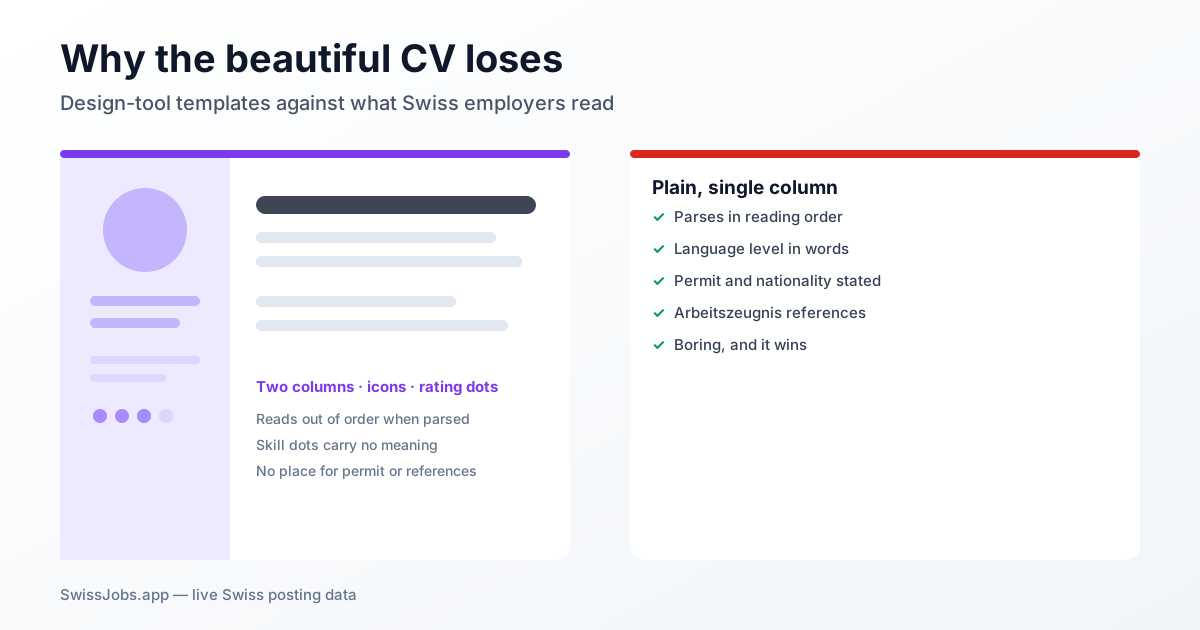
In short
Machine-readable means your file contains real text rather than a picture of text, and that the text can be pulled out in the right order. Export the CV straight to PDF from Word, Pages or Docs instead of printing, scanning or photographing it. Keep every important detail in the body text rather than in headers, text boxes or graphics, and avoid a two-column layout. You can verify it in ten seconds: open the PDF and use the search function to look for your own surname. If the viewer cannot find it, nothing else will either.
The second half has nothing to do with file format and everything to do with characters. Any match between an advert and a CV is literal, and Swiss place names are not written consistently. Among the adverts in our index that mention Zurich at all, roughly four in five spell it with the umlaut. In English-language adverts alone, the two spellings appear almost equally often — so an English CV written for Switzerland has to deal with both forms rather than pick one and hope.
The third part is restraint. Slashes, gender suffixes, workload percentages and shouty abbreviations are advert packaging, not CV content. A CV becomes readable through clean structure and correct spelling, not by imitating someone else's formatting.
Share of the adverts that mention the place at all and use exactly this form. A small number use both forms, so the values for one place do not add up to a hundred. Rolling analysis of the Swiss adverts we index, August 2026.
- About four in ten of the adverts we index carry an umlaut or an accent in the job title, the work location or the employer name — if your export drops those characters, the spelling no longer lines up.
- Among English-language adverts, roughly three in ten have an accented character in the location field, while barely one in a hundred has one in the job title.
- Around the Zürich area, some four in ten adverts are written in German and about three and a half in ten in English — the job is the same, the wording is not.
- In adverts for locations in Ticino, six in ten are written in Italian and close to two in ten in English, so an English CV is genuinely in play there.
- Half of all advert titles contain a slash and close to a third contain a digit — decoration that has no place in your own CV.
What machine-readable actually means
A PDF can hold two very different things. Either text stored as a sequence of characters, which any program can read out letter by letter. Or an image that looks identical to the eye but is technically a field of pixels. A human reads both without noticing the difference. Any automated reading gets the first one only, and it gets it completely or not at all.
Above the text sits a second layer almost nobody thinks about: structure. A well-built PDF marks what is a heading, what is a list, what is a table cell, and in which order the whole thing should be read. Those markings are the difference between a document that can be parsed and a pile of characters that happens to be in the file.
There is a recognised standard for this, which the CV advice industry rarely mentions. The Swiss accessibility standard published by the eCH association requires published documents to be accessible and explicitly recommends the ISO standard PDF/UA for PDF files. That standard describes how structure, reading order and alternative text should be stored inside the file.
That requirement is aimed at the administration and its publications, not at you and your job application — you are obliged to do nothing. It is still useful, because it names the properties that make a document readable by software. Once you know them, you stop arguing about font sizes and start looking at the text layer, the structure and the reading order.
The export route decides the outcome
Most unreadable CVs are not created while writing but while saving. 'Export as PDF' or 'Save as PDF' keeps the text. Going via a printer, a scanner or a phone camera produces an image, and without character recognition an image never turns back into text. The most common version of this is well meant: sign it, print it, scan it, send it.
Design tools produce images too. Templates from graphics software look immaculate and sometimes export the letters as outlines so the typeface renders identically everywhere. The proof is the same as before: search the finished PDF for your own name. Nothing found means the file is a picture.
If you use a typeface that is not installed everywhere, it has to be embedded — mainstream programs do this on export, while the detour via a preview or an image print does not. Stick to a common typeface and the question never arises.
One more rule for the file you send: one file, one document. Merging CV, cover letter and scanned reference letters into a single file leaves you with a document whose first pages are readable and whose remainder is a stack of images. Separate files with clear names cause less trouble.
Where the text disappears even though it is there
Headers and footers are the classic place to lose information. Put your address, phone number and email in the header and you have them visually on every page and technically outside the body text. The same goes for text boxes, which can be dragged anywhere on the page: they look like text in a specific spot, but in the reading order they sit wherever they happen to sit.
The two-column layout is the second trap, and the nastier one, because nothing is missing. The text arrives complete, just scrambled: the sidebar with your languages pushes itself into the middle of a job description, a date ends up next to the wrong employer. A human untangles that instantly. A parser does not untangle it at all.
The third loss is information carried by pictures. Dots, bars or stars for language skills contain no text and therefore no statement; an icon in front of your phone number does not say that a phone number follows. Write 'German: mother tongue', 'French: good working knowledge (B2)' and 'Phone: …' in words and the information is actually on the page.
Tables sit in between. A plain two-column table for dates and positions is usually read cleanly. Nested tables, merged cells and tables used purely as a layout scaffold are not. When in doubt, the copy test tells you in seconds whether your table arrives row by row.
The English CV and the accented place name
Roughly a fifth of the adverts we index are written in English, and that share is not evenly spread. Around the Zürich area, some four in ten adverts are in German and about three and a half in ten in English. In the Romandie, about four in ten are in French and roughly three in ten in English. For locations in Ticino, six in ten are in Italian and close to two in ten in English.
The interesting part is what those English adverts do with place names. Barely one per cent of English-language advert titles carry an accented character, but about three in ten have one in the location field — the job title is anglicised, the address is not. Employer names keep their accents too, in a smaller share of cases.
Zurich is the clearest example. Across the whole index, the umlaut form dominates by roughly four to one. Within English-language adverts, though, the two forms appear at almost the same rate: 'Zürich' slightly ahead of 'Zurich', with no sensible way to predict which one a given employer picked. Both spellings are normal, both are in circulation, and neither is a mistake.
The practical answer is not to hedge everywhere but to write it once in each form where it costs nothing. An address line reading 'Zürich (Zurich)', or a sentence in your profile mentioning the region as the advert spells it, covers both without looking odd. What you must not do is let your export strip the umlaut for you — that leaves you on the smaller side of a four-to-one split by accident.
Characters that look the same and are not
The apostrophe is the invisible one. Word processors silently convert the straight apostrophe into the typographic one. In the adverts we index, the straight form is overwhelmingly the common one and the curly form is a rarity. Copy 'l'équipe' out of a word processor and you have carried the other character into your document — visually identical, technically a different string.
Dashes behave the same way. A hyphen, an en dash and a non-breaking hyphen all look roughly like a short line and are three different characters. Workload ranges in Swiss adverts are written both ways. That is why it is better to write date ranges and workload figures consistently in your own hand rather than pasting them in from several sources.
German spelling adds a Swiss quirk. Swiss usage has no eszett; it writes ss everywhere. Even so, about seven per cent of the German-language adverts we index use the eszett, mostly in words like regelmässig, einschliesslich or fliessend, where the German spelling replaces the ss with an eszett. For a literal comparison, those are simply different words.
None of this means you should collect variants. For a Swiss CV, ss is correct and stays correct. It does mean that when a search for your own phrasing returns less than you expected, the cause is often a single character rather than the substance of what you wrote.
What not to copy from the advert
A common mistake follows logically from everything above: if software reads the text, surely I should reproduce the advert's text as closely as possible. But advert titles are largely packaging. Half of them contain a slash, a third contain a hyphen, close to a third contain a digit, a quarter contain an abbreviation in capitals, and among the German-language titles more than four in ten carry a gender suffix in brackets.
None of that belongs in your CV. A gender suffix after your own past position is meaningless, a workload figure in the title of a job you already left is confusing, and a colon in the middle of a job title makes the line harder to read rather than easier. An advert title is a piece of marketing. Your job title is a fact.
The median advert title runs to about five words and forty characters; everything beyond that is usually an add-on. The useful length in a CV is the same: function, field, qualification where it matters. 'Accounts Receivable Clerk', 'Electrician EFZ', 'Site Manager, Construction'. Short, spelled out, built the same way every time.
Finish with the same routine before every application: export from the program, search the PDF for your surname, paste the text once into a plain text field and read the first ten lines, then save the file under a name without special characters or spaces — surname, first name, CV. Two minutes, and the file arrives the way you intended.
All shares come from our rolling analysis of the Swiss job adverts we index, as at August 2026. Spelling figures are measured directly on the advert title, the location field, the employer name and our condensed advert text; an advert that uses both spellings of a place is counted in both, which is why the values for one place do not add up to a hundred per cent. The eszett figures are measured on German-language adverts only. We publish shares, never absolute index sizes.
Check how your CV fits a job — and the Swiss market
Free checker: languages, work permit, skills and more — scored against a specific posting.
ATS CV checker: against a specific advert, freeSources
Related questions
What our job index says about the Swiss market
Computed live from our own index, not quoted from a study. Shares only, as of today.
Language the advert is written in
- Deutsch
- 60%
- English
- 23%
- Français
- 13%
- Italiano
- 3%
Of adverts that state a language requirement, the share asking for
- Deutsch
- 70%
- English
- 43%
- Français
- 21%
- Italiano
- 3%
19% posted in the last 7 days · Largest markets: Zürich 18% · Bern 10% · Genève 5% · Basel 5%