How do I spot bad CV advice?
Updated:
In short
Weak advice gives itself away by its grammar long before you can judge its content. It arrives without a condition attached, names no market, no date and no measurement, and there is no observation that could make it wrong. So ask one question of every rule you read: what share of the currently open Swiss vacancies does this sentence get wrong? For "put Senior or Junior in your headline", the answer is roughly nine in ten — only 9.8 per cent of open adverts carry a level word in the title at all.
That single question works because almost every popular CV rule started life with a condition that fell off in retelling. "Part-time will hurt you" comes from occupations where part-time is barely advertised at all: in construction trades 0.9 per cent of the adverts that state a working pattern are part-time. In nursing and care it is 20.7 per cent. The same sentence is a fair warning in one field and simply untrue in another, and only the missing condition tells you which one you are in.
Bad advice is rarely a lie. It is usually a true observation that has lost its scope — one employer, one industry, one country, one decade ago. Restoring the scope is the whole job, and it takes no expertise: a job board, twenty adverts and five minutes are enough to find out whether a rule describes the market you are actually applying into.
Share of open adverts whose title contains Senior, Junior, Lead or Principal. Rolling analysis of the vacancies open on SwissJobs.app, 23 August 2026; only fields with enough adverts to report. Across all open adverts the figure is 9.8 per cent.
- "State your seniority in the title." Across all open adverts, 9.8 per cent carry a level word. In IT titles it is 24.7 per cent, in finance roles 22.3, in marketing 17.9, in engineering 17.3 — against 0.1 in nursing and care and 0.8 in hospitality. Highest field to lowest is a factor of 247. No sentence that varies that much can be true without a condition.
- "Part-time ruins a CV." Of the open adverts, 91.2 per cent state a working pattern, and 6.1 per cent of those are part-time. In nursing and care the figure is 20.7 per cent, in retail 10.8, in office and admin roles 8.1 — against 0.9 in construction trades and 1.1 in engineering. The rule describes two fields well and two others not at all.
- "Apply within 48 hours or the job is gone." The median open advert is 20 days old. 63.2 per cent have been open longer than a fortnight, 38.6 per cent longer than 30 days and 16.2 per cent longer than 90. Construction trades run a median of 44 days, IT a median of 12. Speed helps; it does not replace a dossier that fits.
- "Without German you may as well not apply." 72.9 per cent of open adverts state a language requirement explicitly, and 36.4 per cent of those do not ask for German at working or native level. In marketing that share is 50.7 per cent and in finance 47.8 — against 10.9 in retail and 12.3 in nursing and care. Depending on the field, the same rule is nearly a law of nature or nearly an exception.
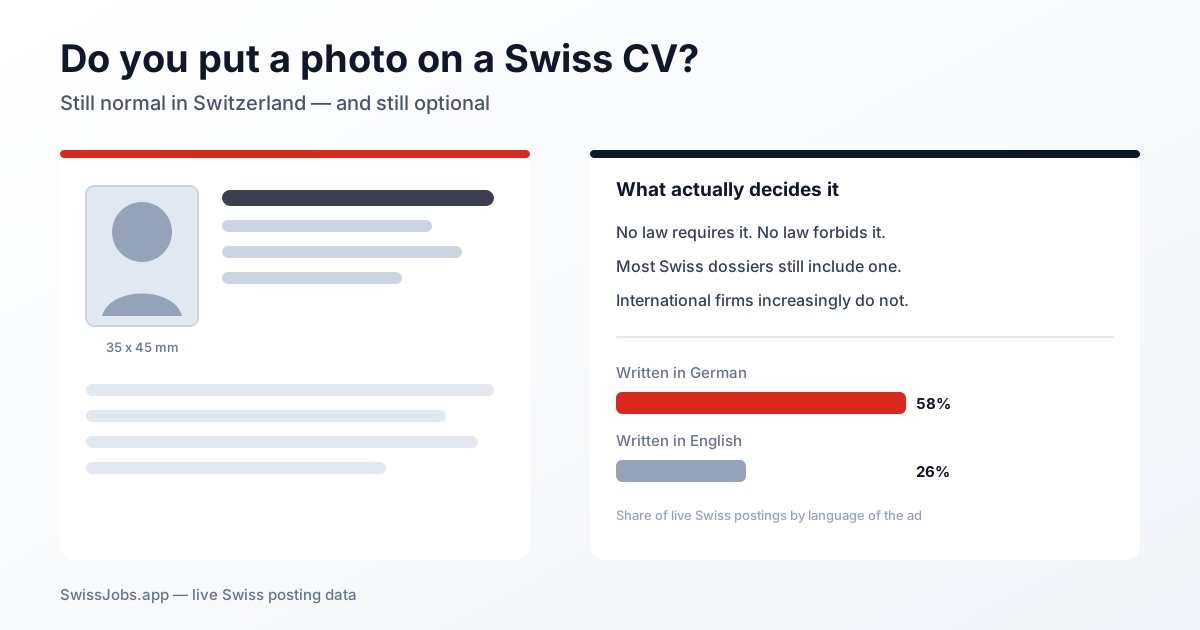
- "Write the CV in German." Of the adverts whose language of publication is recorded, 57.9 per cent are written in German, 26.1 per cent in English, 13.8 per cent in French and 2.3 per cent in Italian. In French-speaking Switzerland, which accounts for 19.0 per cent of open adverts, 57.6 per cent are in French, 35.5 per cent in English and 4.3 per cent in German. For a fifth of the market the advice points the wrong way.
- "A CV belongs on one page." The Swiss official answer says otherwise. arbeit.swiss, the SECO portal, states plainly: "A CV should be no longer than three pages." Whoever insists on one page is contradicting the body that runs Swiss public employment services — and usually omits which country their number came from.
- "A photo is compulsory" and "a photo is fatal". The same official page exists in four language versions and they do not agree on this point: the German one lists "Persönliche Daten, gegebenenfalls mit Bewerbungsfoto" — personal data, with a photo where appropriate — while the English says "personal details, including photograph", the French "données personnelles avec photo vous mettant en valeur" and the Italian "dati personali, inclusa la vostra fotografia". When one source wavers across its own editions, "always" and "never" are both unsupported.
The tell is grammatical, not factual
You do not need to know whether a piece of advice is true in order to see that it has not been written in a checkable way. Four things are missing, and all four show up in the sentence itself rather than in the subject matter.
The scope is missing. "Recruiters want X" — which recruiters, in which country, in which occupation, in which year? A sentence without those qualifiers is quietly claiming to hold for every employer at once. Not one of the values we measure across the open Swiss market behaves that way.
The measurement is missing. "Most CVs fail because of Y" — measured how, across how many dossiers, counted by whom? A number with no counter behind it is rhetoric wearing the clothes of evidence. That applies to ours as well: a figure of 9.8 per cent is only worth something alongside what was counted and when.
The date is missing. Swiss vacancies have been published in a wider mix of languages over recent years, so guidance written earlier can be out of date without anyone having been dishonest about it.
And the possibility of being wrong is missing. If you cannot imagine an observation that would refute a sentence, the sentence is not telling you anything. "Be authentic" is the archetype: nothing could contradict it, which is exactly why it cannot guide a decision.
The counter-check: five minutes on a job board
The check is a single move. Translate the advice into a claim about adverts, then go and see whether adverts behave that way. Nearly every CV rule can be rewritten like this, because each one carries an unspoken assumption about what employers publish.
"State your seniority" becomes "adverts state seniority". Search your occupation and count, across the first twenty hits, how many titles contain Senior or Junior. In an IT search roughly one in four will; in a care search almost none will.
"Nothing moves without German" becomes "adverts require German". Filter to your field and read which languages are asked for at which level. "Part-time does not exist" becomes "adverts are advertised full-time", which is equally visible — usually as a percentage-of-full-time figure in the headline itself.
Two rules keep the check honest. Take twenty adverts from twenty different employers rather than one page of results from a single one, and count inside your own field and language region rather than "in Switzerland". The figures above show why: on almost every one of these questions the national average is a number that describes no individual occupation.
Why one sentence can be true and false at the same time
The spread between occupational fields is neither small nor random. On level words in titles, IT to nursing is a factor of 247. On part-time share, nursing to construction is a factor of 23. On the share of adverts that do not require German, marketing to retail is a factor of 4.7. On median advert age, construction to IT is a factor of 3.7.
So anyone who states one of these rules in general terms is describing one field at best and missing on the others. And because advice is written disproportionately by people in the fields that publish a lot online — technology, marketing, consulting — it is those fields' local rules that travel furthest as though they were universal.
That makes the most useful follow-up question not "is this true?" but "who was this written for?". Advice formed in marketing, where 17.9 per cent of adverts carry a level word and 50.7 per cent of those stating a language requirement do without German, describes a different world from care work, where the same two figures are 0.1 and 12.3 per cent.
The same discipline applies to our own numbers. They describe the vacancies open on SwissJobs.app rather than the whole labour market, and they describe what employers write rather than whom they eventually hire. Advice that names its own limits is not automatically good advice — but advice with no limits at all is certainly not checkable advice.
Good sources hedge, and that is the point
The clearest difference between Swiss official guidance and the listicles is not what they say but how firmly they say it. Official texts qualify themselves, audibly and on purpose.
arbeit.swiss introduces the application file with "It generally comprises the following elements" and the CV with "A CV should usually contain the following information". Those are formulations that leave room for exceptions. The one hard number on the page is the length: "A CV should be no longer than three pages."
berufsberatung.ch and its French and Italian editions, run by the cantonal careers guidance services, tie their advice to the individual application rather than to CVs in general: prepare a separate dossier for each application, and read up on the company before the interview. That, too, is a condition — per vacancy, not per candidate.
When a source manages without any qualification at all, that is not a sign of confidence but of an unchecked claim. Guidance that tells you what matters, under which circumstances, and where its own statement stops being reliable is the more usable kind, even though it reads less decisively.
When one source disagrees with itself: the photo
The photo question is where all of this compresses into a single paragraph, and it is also the question that attracts the largest number of "always" and "never" sentences.
arbeit.swiss publishes the same page in four languages. The German edition lists personal data "gegebenenfalls mit Bewerbungsfoto" — where appropriate, with a photo — and so attaches a condition. The English edition lists "personal details, including photograph", the French "données personnelles avec photo vous mettant en valeur", the Italian "dati personali, inclusa la vostra fotografia". Those three attach none.
This is not a scandal; it is what four editions of the same guidance look like in a country with four language versions of everything. What follows for you is narrow and useful: if a single official source moves between "where appropriate" and "including", then a listicle that says "always" or "never" has not settled the question either.
Treat the photo as a decision with conditions — industry, where the employer is headquartered, which language region you are applying into — rather than as a rule. And when someone sells you one of the two absolutes, ask which market it came from.
Where bad advice usually comes from
First, the imported norm. A great deal of CV guidance online describes the Anglo-American market: one page, no photo, no date of birth, no employer references. For that market it is correct. Transplanted onto a Swiss dossier it contradicts the official Swiss description in several places at once, the page count among them.
Second, the sample of one. Someone who has hired has genuinely screened dossiers — at one employer, in one field, through one process. That feedback is valuable and narrow at the same time. The productive question is not "how does my CV come across?" but "what did you screen out on, the last time you did this?".
Third, advice that arrives attached to a sale. Anyone selling a template, a subscription or a rewrite describes the problem in the shape their product solves. That need not be dishonest, but it explains why so many rules concern form — layout, typeface, a score out of a hundred — and so few concern fit. Form can be packaged; the match between your CV and one particular advert cannot.
Between them, these three origins account for most of what you will read. None of them is malicious. All three produce the same defect: a true observation with its scope stripped off.
The small residue that really is universal
The counter-check is not a licence to discard everything. A few things survive it, precisely because they make no claim about employers' taste and instead describe conditions that hold for any dossier at all.
The file has to open on someone else's device and look there the way it looks on yours; mail it to yourself and view it on a phone. The filename has to carry your name, because it is the first thing visible in the employer's inbox. The dates must not contradict each other. Your contact details have to be reachable. A spelling mistake is a spelling mistake in every occupational field there is.
arbeit.swiss lists exactly this class of item: before sending, check for "spelling and formatting errors", "completeness of documents" and "clear and correct file names", and save everything as PDF. Those are inspections rather than opinions, which is why they pass the counter-check.
Everything else — length, photo, ordering, level words, language, working pattern — is a decision with conditions attached. And the conditions are not in a guide. They are in the advert you are answering.
What to do with advice that survives
Advice that survives the counter-check does not become a rule. It becomes a condition with a name on it. "Put your seniority in the title" turns into "in IT and finance roles somewhere between a fifth and a quarter of adverts name the level, so it is worth stating there, and not in care work".
Phrased that way you can act on it without believing it: you check the advert to see whether the condition holds, and then you decide. That is the same movement any comparison between a CV and a vacancy requires anyway — except that here you are applying it to the advice rather than to your document.
If you are still unsure after all this, the order is simple. Run the checks that always apply, then compare against the specific advert, and only then reach for general rules from the internet. In that order, a bad piece of advice costs you a few minutes of reading rather than an application.
Market figures come from the rolling analysis of the vacancies open on SwissJobs.app, 23 August 2026. A "level word" means the advert title contains Senior, Junior, Lead or Principal. The part-time share refers to the 91.2 per cent of adverts that state a working pattern. Language requirements are counted only where the advert states them explicitly, and "working level" covers the professional and native levels. Age is counted from the publication date given in the advert. Occupational fields are assigned from the advert title and are only reported where enough adverts fall into them; every figure is a share, never an absolute size of the index.
Check how your CV fits a job — and the Swiss market
Free checker: languages, work permit, skills and more — scored against a specific posting.
ATS CV checker: against a specific advert, freeSources
- arbeit.swiss (SECO) — Tips on applying for jobs: the application file "generally comprises", a CV "should be no longer than three pages", personal details "including photograph", checks before sending
- arbeit.swiss (SECO) — German edition of the same page: personal data "gegebenenfalls mit Bewerbungsfoto"
- arbeit.swiss (SECO) — French edition of the same page: "données personnelles avec photo vous mettant en valeur"
- berufsberatung.ch (SDBB, portal of the cantonal careers guidance services) — "Eine Stelle suchen": a separate dossier for each application (German)
Related questions
What our job index says about the Swiss market
Computed live from our own index, not quoted from a study. Shares only, as of today.
Language the advert is written in
- Deutsch
- 60%
- English
- 23%
- Français
- 13%
- Italiano
- 3%
Of adverts that state a language requirement, the share asking for
- Deutsch
- 70%
- English
- 43%
- Français
- 21%
- Italiano
- 3%
19% posted in the last 7 days · Largest markets: Zürich 18% · Bern 10% · Genève 5% · Basel 5%