Time abroad and foreign qualifications on a Swiss CV
Updated:
Anyone arriving with years spent outside Switzerland brings a file that has to be re-ordered before it can be read here — not translated, re-ordered: entry, employer, title, diploma, availability. This page collects those questions and answers them with what Swiss adverts actually ask for and what the federal offices actually write.
In short
Write the time abroad as an ordinary entry: dates, role or purpose, city and country, plus one line saying what that employer or institution actually is. What most returners brace for barely exists in the adverts. Of the postings on SwissJobs.app carrying a short description, 0.5 per cent explicitly ask for experience of the Swiss market, while 1.5 per cent advertise an international environment of their own accord — three times as many. The years abroad are rarely the part that needs explaining. The lines underneath are: language, qualification, availability.
The fear of being unemployable without Swiss experience can be counted, and counting shrinks it. 78 of the adverts examined ask for it in so many words, and they are not where people expect. French-language adverts are more than twice as frequent among them as in the file as a whole and Italian-language ones roughly five times as frequent; Geneva supplies the single largest cluster. By field they gather in marketing, sales, care and hospitality — the work where customers, authorities or patients are served directly.
What costs a returner is almost never the stay itself but the language line beneath it. Among adverts that state a language requirement, 68.1 per cent name German, and 88.9 per cent of those name it at professional level. At the same time roughly one in five of those adverts is satisfied with English alone. Where you apply, and in which field, moves your hit rate far more than any sentence you write about the years away.
- One entry, same shape as a job, with the country attached. «Quality Project Lead, hospital group in São Paulo (BR), 03/2022 – 06/2025» sits in the same column and the same typeface as everything else. The moment time abroad slides into an «Other» or «Personal» heading, it reads as something outside the career rather than part of it. The country code is not decoration: without it, a foreign place name is a question a Swiss reader has to stop and ask.
- One line explaining what the employer is. Just 0.6 per cent of Swiss adverts with a short description name any foreign country at all — this market talks almost exclusively about itself. Assume zero prior knowledge: «second-largest private hospital operator in the country, around four thousand staff» makes an entry legible, whereas a bare company name asks the reader to run a search that nobody runs.
- Do not translate a foreign title into a Swiss one. For recognised health qualifications the Swiss Red Cross is explicit that the protected title «dipl. HF» may not be used; what is allowed is the occupational designation used in Switzerland — for example «Pflegefachfrau» — or the title exactly as issued in the country of origin, with that origin stated. That is the safest formula for any foreign qualification: original title, country, year, and the local occupational designation in brackets where it genuinely applies.
- In most occupations you need no paperwork at all before applying. The State Secretariat for Education, Research and Innovation puts it plainly: «If the profession you wish to practise is not regulated, you have access to the labour market and can apply directly for a job.» A recognition procedure still running is therefore not a reason to wait. It is a line on the CV with a submission date, not a gate in front of it.
- Give languages a level and a proof, not a biography. «Portuguese C1 (CAPLE, 2024)» is information. «Fluent from three years on the ground» is a claim with a follow-up question built into it. The same applies in reverse: if your German has rusted while you were away, the language line carries the level that is true today, plus the course currently running if there is one — not the level you had when you left.
- Non-working time abroad needs an output, not a mood. Language stays, travel, volunteering: the market has no slot for them — volunteering appears in 0.2 per cent of adverts with a short description, a sabbatical in almost none. That is exactly why the entry has to carry itself: dates, place, country and the one checkable result — a certificate, a licence, a delivered project, a caring responsibility.
- Put availability at the top. If you are still abroad, four words answer the reader's first silent question: when you are in Switzerland, on what residence status, and how you can be reached for interviews. Without that line, a foreign address in the header becomes the reason an interview slot is never offered in the first place.
The adverts that really do want Swiss experience, and where they sit
The 78 adverts that ask outright for experience of the Swiss market are a small pile, but a very talkative one. Their language mix departs sharply from the file as a whole: around 30 per cent of them are written in French against a shade over 13 per cent overall, and around 12 per cent in Italian against a little over 2 per cent. German-language adverts, the largest group everywhere else, are markedly under-represented in this pile.
The places are no accident either. Geneva supplies the largest single cluster, Zurich the second; Lausanne, Bern, Lugano and Martigny follow with a handful each. By field the demand concentrates in marketing, sales, care, finance and hospitality — work where knowing the market means knowing the local clientele, the local approvals, the local price structure or the local insurance logic. In engineering and IT the requirement barely surfaces at all.
For a CV that is a map, not a verdict. Someone returning into one of those fields does not write more lines about the years away; they write one line about the local connection — the customer segment that is the same here, the product sold here too, the regulation that exists in both countries. That is the difference between «five years in sales in Portugal» and «five years in sales in the same market segment, two of them serving Swiss corporate clients».
It is also an argument about ordering. If you have any earlier Swiss entry at all — short, or very old — leave it visible instead of trimming it to make room for the recent foreign ones. It answers the only question these 78 adverts are asking, and it answers it without a single explanatory sentence.
How much the market talks about abroad in the first place
Before working out how to explain time abroad, it is worth seeing how often the other side raises the subject unprompted. Among adverts with a short description, 1.5 per cent name an international environment or an international team as a feature of the job, 1.3 per cent talk about global projects, clients or assignments, and 0.9 per cent offer relocation support. Experience abroad is explicitly required in 0.3 per cent, experience of the Swiss market in 0.5 per cent.
The ratio is the real message: for every advert demanding Swiss market experience there are about three advertising an international environment. Both groups are tiny — and that is the point. In the overwhelming majority of postings, abroad is simply not a topic. It is neither required nor excluded, and a CV that spends a paragraph defending the stay is answering a question nobody asked.
Where the international environment does appear, it is a property of the employer rather than a description of the ideal candidate. Those adverts cluster in Zurich and Basel and in marketing, engineering, hospitality and sales. With some employers it is almost a signature: roughly one advert in five at Roche carries the phrase, more than half of them at Accelleron. Apply there and a foreign entry needs no defending; it will be read as the norm.
The practical consequence is a question of weighting inside the document. The stay gets as much room as its tasks deserve and no more. A bullet reading «international experience» among your strengths repeats what the entries already show, and spends lines that results should be using.
The paperwork you do not need before you apply
The most expensive misunderstanding among returners is the belief that a foreign qualification has to be recognised before an application is even allowed. The State Secretariat for Education, Research and Innovation says the opposite in as many words: «If the profession you wish to practise is not regulated, you have access to the labour market and can apply directly for a job.» Whether your profession is regulated can be checked in advance; the federal look-up for that is recognition.swiss.
For professions that are not regulated, what exists instead of a recognition is a level statement. It costs CHF 350 and does exactly one thing: it «indicates the level and duration of your foreign training in the Swiss education system». It also states its own limits — «this examination does not take into account the content of the foreign training and does not refer to a specific Swiss qualification». A recognition, for a regulated profession, costs CHF 550.
That settles what such a document can do on a CV. It places the duration and the level, and nothing more. Anyone expecting the level statement to certify the substance of their training will be disappointed — and anyone waiting for it before applying loses months, because SERI itself allows up to ten months to issue one. The workable order is therefore: apply, start the procedure in parallel, and record its status on the CV with a date.
The line that does both jobs looks like this: «Licenciatura em Enfermagem, Universidade de Lisboa (PT), 2019 — recognition application filed 07/2026». Rewriting the same qualification as «BSc FH» or «dipl. HF», a Swiss form you do not hold, risks an accusation of claiming a protected title and guarantees the most awkward question of the interview.
Nursing and the health professions: the one field where the paper comes first
There is one field where recognition genuinely does precede the application, and the adverts show it. Among care and health postings, 11 per cent mention recognition, equivalence or the Red Cross. Across every other field together the figure is 0.9 per cent. That is more than a tenfold difference — nowhere else is the paperwork question this visible in the postings themselves.
The competent body is the Swiss Red Cross, for a closed list of qualifications: biomedical analysis, dental hygiene, occupational therapy, dietetics, healthcare assistant (FaGe), midwifery, medical massage, radiologic technology, naturopathy, operating theatre technique, optometry, orthoptics, osteopathy, nursing, physiotherapy, podiatry, and emergency and transport paramedicine. Every procedure opens with a PreCheck that is both free and compulsory, for which the Red Cross allows up to four weeks; for a first decision in the procedure proper it allows a maximum of four months.
The fees are published too: CHF 550 where the qualification appears on the EU list, CHF 930 where no compensatory measures are needed and up to CHF 1000 where they are, plus CHF 130 for entry in the national register of healthcare professions, NAREG. None of this is trivia for a CV. It is precisely why a line stating where your procedure stands is worth more than any adjective: «PreCheck positive, recognition application filed 05/2026» answers the first question a nursing director has.
On titles the Red Cross is unambiguous, and the rule is a good model well beyond healthcare. With a recognised foreign qualification the protected title «dipl. HF» may not be used. What may be used is the occupational designation used in Switzerland — «Pflegefachfrau» or «Pflegefachmann» in the example the Red Cross itself gives — or the title as issued in the country of origin, with the origin stated. And the separately available title attestation, in its own words, is a supplementary sheet to the diploma and does not replace the original diploma.
The language line is the real border
Among adverts stating an explicit language requirement, 68.1 per cent name German, 41.5 per cent English, 20.3 per cent French and 3.9 per cent Italian. What matters is not how often a language is named but at what level: for German, 88.9 per cent of those requirements are at professional level and only 8.2 per cent settle for conversational. German is rarely «desirable» in this market. It is assumed.
The counter-calculation is just as clear. Roughly 19 per cent of all adverts with a language requirement name English as the only language — but the regional spread is enormous: 47 per cent in Geneva, 38.2 in Zug, 32.8 in Zurich and Winterthur, 25.5 in Basel, 18.4 around Lausanne, 12.3 in Ticino, 6 in Lucerne and 4.7 in Bern. The same application sent into two regions meets two different labour markets.
By occupation the split is just as sharp. In marketing around 30 per cent of roles can be done in English alone, in IT 28, in hospitality 8.9, in HR 8.5, in logistics 7.5, in finance 6.4 — against 1.9 per cent in care, 0.3 in sales and 0.2 each in construction and engineering. Coming back after years away without German therefore means a wide market in two fields and a very narrow one everywhere else.
On the CV this makes the language line the most important line of the whole return, and it belongs near the top rather than at the end: level on the European reference scale, plus the certificate and its year where one exists. The honest version of today's level beats the optimistic one every time. German pitched too high collapses in the first two minutes of the phone screen, and at that point it is not only the language that is in doubt.
The employer nobody here has heard of
A Swiss file runs on recognition: employer, place, sector, order of magnitude. That recognition is exactly what a foreign entry lacks, and the job market does not supply it — only 0.6 per cent of adverts with a short description mention any other country by name. The reader has no way of telling whether your previous employer had ten thousand staff or twelve.
The fix is half a line, directly under the company name, carrying three things: sector, size, market position. The tasks then follow as they would for any other entry. It costs one line per foreign employer and replaces a silent assumption with a fact. If several entries share a country, place the description once at its first appearance and drop it thereafter.
The second difference is the attachments. A Swiss file carries employer reference letters; foreign employers generally issue none, because no comparable obligation binds them. Rather than leaving the hole uncommented, name it: letters of recommendation, confirmation of the employment period, a copy of the contract, or a named referee with function and contact details. A line reading «references on request; employer certificates are not issued under local law» is not a blemish, it is an explanation nobody else supplies.
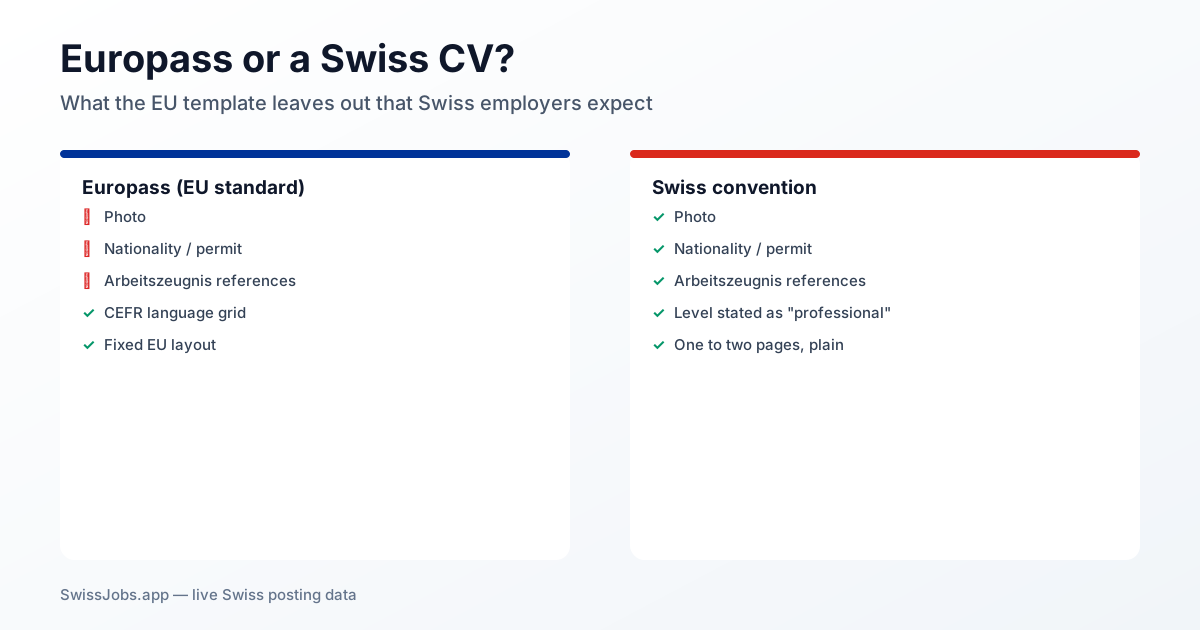
Finally the format itself. People returning from the EU often arrive with a Europass CV — a form that is neither expected nor read particularly well here, because it emphasises fields Swiss readers skip and omits the ones they look for. Move the content into the local shape: short profile, work history in reverse chronological order with workload and place, education, languages with levels, attachments. The time abroad loses nothing in the move. It simply lands in the column where it gets read.
The market figures were counted on 22 August 2026 from the adverts live on SwissJobs.app at that moment. Job titles and short descriptions were searched; the share figures use the adverts that carry a short description at all, roughly three quarters of the file. Language figures use a second base: the just under three quarters of adverts that state an explicit language requirement. Occupational fields are assigned by word patterns in the job title and should be read as orders of magnitude, not as industry statistics. The statements on recognition, level statements and the use of titles are quoted from the SERI and Swiss Red Cross pages linked below; fees and deadlines change, so check them there before you file anything.
Write a custom CV for every job you apply to
Most people send the same CV everywhere. The editor rewrites yours against the posting — Swiss format, the right language, in about a minute.
CV maker & resume builder: for a specific advertSources
- SERI — FAQ on the recognition procedure for professional qualifications: «If the profession you wish to practise is not regulated, you have access to the labour market and can apply directly for a job.»
- recognition.swiss — the federal look-up for whether your profession is regulated in Switzerland and which body is competent
- Swiss Red Cross — recognition of foreign qualifications in the healthcare professions: list of professions, PreCheck, fees and deadlines
- Swiss Red Cross — title and diploma attestation: which occupational designation a recognised foreign qualification allows you to use
Related questions
What our job index says about the Swiss market
Computed live from our own index, not quoted from a study. Shares only, as of today.
Language the advert is written in
- Deutsch
- 60%
- English
- 23%
- Français
- 13%
- Italiano
- 3%
Of adverts that state a language requirement, the share asking for
- Deutsch
- 70%
- English
- 43%
- Français
- 21%
- Italiano
- 3%
19% posted in the last 7 days · Largest markets: Zürich 18% · Bern 10% · Genève 5% · Basel 5%