Which language should your Swiss CV be in?
Updated:
The language of your dossier is decided by the advert, not by how well you speak. In Switzerland it also tracks the canton, the occupation and the seniority of the role. This page collects the language questions around the CV. The official parts come from SECO's application tips and from SERI's English designations for Swiss qualifications; the market figures are counted from the adverts on SwissJobs.app.
In short
Write the CV in the language of the advert. Of the adverts on SwissJobs.app whose language can be identified, 23.9 per cent are written in English — 49.5 per cent in Geneva, 38.9 in Zug, 36.2 in the canton of Zurich, but 6.2 in Lucerne and 6.1 in Graubünden. So an English CV answers a particular advert rather than being a default. And English on the page does not mean English alone at work: 29.1 per cent of English adverts still state a national-language requirement.
The stronger predictor is not where the job is but what it is and how senior it is. Among adverts with an identifiable language, 75 per cent in pharma and life sciences are English, 71.8 per cent in banking and insurance, 49.9 per cent in IT and engineering — against 3.9 per cent in hospitality, 3.1 per cent in health and care, and none at all in construction and the trades. Seniority moves it the same way: adverts with Head of, Director or Chief in the title are 88.2 per cent English, Senior 62.6, Junior, Graduate or Trainee 34.6, and apprenticeships 0.5 per cent.
Translating the document is the easy half. The structure survives: the English version of SECO's application tips lists the same eight components as the German one — title CV, personal details, professional experience to date, education and training, language skills, special knowledge or activities, personal interests or hobbies, references — with the same three-page ceiling. What does not survive is the vocabulary of the Swiss education system. Only 0.4 per cent of English adverts name a Swiss vocational qualification, against 15.2 per cent of German ones, so the reader of your English CV has most likely never seen the words EFZ or Fachausweis.
- Match the advert, not the employer. 18.8 per cent of employers who publish at least one English advert also advertise in a national language, and those employers account for 17.9 per cent of all adverts; inside them, the median share of their own adverts written in English is about half. The same company can therefore be right to read a German dossier for one role and an English one for the next.
- Keep the job title exactly as the employer writes it. 18.6 per cent of German-language adverts already carry an English-shaped title such as Manager, Engineer or Specialist. Translating such a title back into German on your CV only makes the match harder to see. The same rule works in reverse: in an English CV, keep the title that appears on your Swiss reference letter, and add one explanatory line beside it.
- Your Swiss qualifications have official English names — do not invent your own. SERI calls the EFZ a Federal VET Diploma, the EBA a Federal VET Certificate and the Berufsmaturität a Federal Vocational Baccalaureate. For professional education SERI names the examinations rather than the certificates: the Berufsprüfung behind an eidgenössischer Fachausweis is the Federal Professional Examination (FPE), the höhere Fachprüfung behind an eidgenössisches Diplom the Advanced Federal Professional Examination (AFPE), and a höhere Fachschule is a professional education institution (PEI). Write the English name, the Swiss title in brackets, and the year.
- There is a free official English document that explains your qualification for you. Certificate supplements for upper-secondary qualifications and diploma supplements for tertiary professional ones exist in German, French, Italian and English, follow the EU Europass template, and are described by SERI as enabling employers in Switzerland and abroad to assess the professional skills of qualification holders. Diploma supplements are personalised; certificate supplements are not. SERI issues a diploma supplement retrospectively for CHF 80.
- The word for Arbeitszeugnis is reference. The Confederation's own English version of the Code of Obligations puts it in Art. 330a: the employee may at any time request from the employer a reference concerning the nature and the duration of the employment relationship, the quality of his work and his conduct. That page also states that English is not an official language of the Confederation and the translation has no legal force — but as a terminology choice for your dossier it beats any free rendering.
- Do not turn a Swiss CV into an American résumé. 9.5 per cent of English adverts state the workload as a percentage, most often 80–100%, so keep the percentage rather than converting to full-time equivalents; keep day-month-year dates, and keep the place and year on every qualification. What you should not copy across is the m/f/d tag in titles: it appears in 40.9 per cent of German adverts but only 12.1 per cent of English ones, and it belongs to the advert, not to your CV.
Where English is the market language
Measured on adverts whose language can be identified, the English share is 49.5 per cent in Geneva, 38.9 in Zug and 36.2 in the canton of Zurich. Vaud sits at 28.9 per cent, Basel-Stadt at 25.6, Ticino at 21.6, Valais at 20.3 and Neuchâtel at 18.6. Then the curve falls steeply: St. Gallen 9.1, Bern 7.0, Lucerne 6.2, Graubünden 6.1, Thurgau 3.0. A job search that spans two of these cantons is often a search that needs two dossiers.
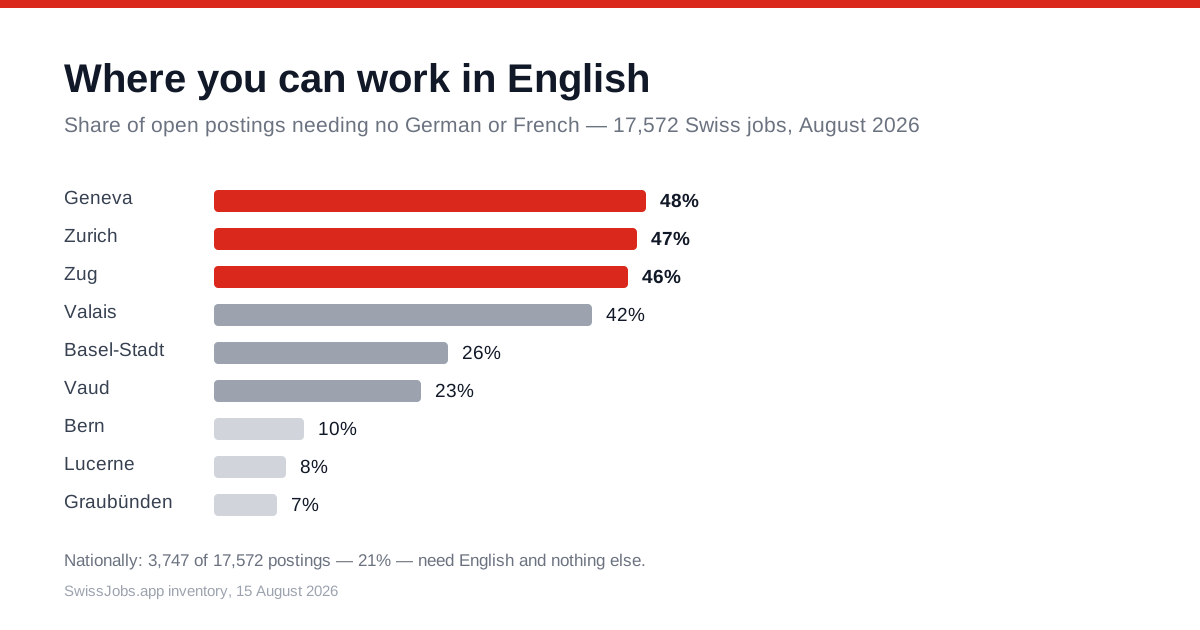
A second measure separates the regions even more sharply, because it asks what the job needs rather than what the advert is written in. Among adverts that state a language requirement at all — 72.8 per cent of the stock — 19.6 per cent nationally ask for English and no national language whatsoever. In Geneva that is 45 per cent, in Zug 42.8, in Zurich 41.3 and in Valais 41.2; in Bern 7.9, in Lucerne 5.9 and in Graubünden 4.3 per cent. The chart above shows the same measure in a slightly earlier count.
Within one region, the occupation decides. Three in four adverts in pharma and life sciences are English, seven in ten in banking and insurance, one in two in IT and engineering. In construction and the trades, none of the adverts with an identifiable language was written in English; in health and care it is 3.1 per cent, in hospitality 3.9. The same person can be right both ways: an English CV for the laboratory in Basel, a German one for a ward in the same hospital campus.
An English advert is not an English-only job
This is where most English dossiers are built on a wrong assumption. Of the English-language adverts that state a language requirement, 29.1 per cent also require a national language: German in 24.2 per cent, French in 9.5, Italian in 1.2. And it is rarely a courtesy request — 61.4 per cent of those requirements are at professional level, 31.1 per cent at conversational level. Your English CV therefore has to carry the German or French line as carefully as a German CV would.
The reverse case is bigger and is usually missed. Of all adverts that require English, 33.9 per cent are not written in English at all. Among German-language adverts, 18.5 per cent require English — 66.5 per cent of them at professional level, 30.3 at conversational. For that advert the right answer is a German dossier with a precise English line in the language block, not an English dossier that ignores the language the employer chose to publish in.
One number should calm anyone hesitating over their own English: native-level English is required in 1.4 per cent of English adverts. Within English adverts, 97.7 per cent of the English requirements are for professional level. Nobody is scoring your prose style. What is being read is whether the document holds together — the same tense throughout, one date format, one name for each employer and each qualification, and no sentence that a reader has to parse twice.
The Swiss things an English CV still has to carry
Start from the official English wording rather than from a template found abroad. SECO's own English page names the components — title CV, personal details, professional experience to date, education and training, language skills, special knowledge or activities, personal interests or hobbies, references — and adds three rules that many international templates break: the CV should be no longer than three pages, references are noted as available on request, and all supporting documents are gathered into one PDF file. Those are the headings a Swiss reader expects to find in English.
Then supply the part that English cannot infer. A Swiss reader of a German advert knows what an EFZ is; the reader of an English advert usually does not, and the adverts prove it — Swiss vocational qualifications are named in 15.2 per cent of German adverts and 0.4 per cent of English ones. Use SERI's designations, add the Swiss title in brackets, and where the qualification carries real weight in your application, attach the certificate or diploma supplement: it is the official English explanation of exactly that qualification, written by the authority that awards it.
Your reference letters stay in their original language. They are legal documents under Art. 330a, not marketing material, and translating them yourself would strip them of their value as evidence. Keep them in the single PDF, most recent first, exactly as SECO describes for a German dossier — and add one English line in your CV explaining what a Swiss reference letter is: a document the employer is obliged to issue, covering the nature and duration of the employment, the quality of the work and the conduct of the employee.
Register: what to keep, what to drop
The English of Swiss adverts is not the English of American job boards, and the difference is measurable. Words like global, international or headquarters appear in 24 per cent of English adverts and in 1.1 per cent of German ones — that is a signal about the audience, not an instruction for your document. Meanwhile the Swiss conventions stay in place inside English adverts: the workload appears as a percentage in 9.5 per cent of them, most commonly written as 80–100%.
On spelling there is no Swiss rule, but there is a measurable habit. In English-language adverts, American verb forms dominate: organiz over organis in 93.3 per cent of occurrences, optimiz in 97.9, analyz in 92.6. Nouns are more mixed — centre holds 18.1 per cent against center, programme 13.4 against program, licence 12.9 against license. Across the nine word pairs checked, only 7.7 per cent of occurrences are British. The practical rule is not to pick the winning variant but to keep one variant throughout a single document.
Finally, plan for two versions rather than one perfect file. Employers that advertise in both English and a national language stand behind 17.9 per cent of all adverts, and inside those employers roughly half of the adverts are English. Two maintained versions of the same CV — each with the section headings, qualification names and job titles that match the language of the advert — cost less than they look, because the content is identical. Only the vocabulary changes, and that is precisely the part this page gives you.
The market figures were counted on 22 August 2026 from the adverts then active on SwissJobs.app. The shares of adverts written in English, nationally and per canton, were recounted on 27 September 2026, when the language of the text could be identified for 97.4 per cent of adverts; every language share here uses that base, and the cantonal figures additionally only cover adverts with a canton assigned. An explicit language requirement is stated in 72.8 per cent of adverts, and levels are counted as the advert words them. Occupational fields are assigned from keywords in the job title and should be read as orders of magnitude, not as official industry statistics. The spelling figures compare nine British and American word pairs in the title and short description. The components, page limit and attachment rules for a CV come from SECO's application tips in both their German and English versions; the English designations of Swiss qualifications and the details on certificate and diploma supplements come from SERI; the wording of Art. 330a is quoted from the English version of the Code of Obligations published on Fedlex, which states that it has no legal force.
Write a custom CV for every job you apply to
Most people send the same CV everywhere. The editor rewrites yours against the posting — Swiss format, the right language, in about a minute.
CV maker & resume builder: for a specific advertSources
- arbeit.swiss (SECO) — Tips on applying for jobs: CV components, three-page limit, one PDF for attachments
- arbeit.swiss (SECO) — Bewerbungstipps: the same list in German, for the parallel wording
- SERI — Vocational Education and Training: Federal VET Certificate, Federal VET Diploma, Federal Vocational Baccalaureate
- SERI — Professional Education: Federal Professional Examination and Advanced Federal Professional Examination
- SERI — National Qualifications Framework: certificate and diploma supplements in four languages, for employers in Switzerland and abroad
- SERI — Diploma supplements for professional qualifications: retrospective issue for CHF 80
- Fedlex — Code of Obligations, English version, Art. 330a (reference); translation has no legal force
Related questions
What our job index says about the Swiss market
Computed live from our own index, not quoted from a study. Shares only, as of today.
Language the advert is written in
- Deutsch
- 60%
- English
- 23%
- Français
- 13%
- Italiano
- 3%
Of adverts that state a language requirement, the share asking for
- Deutsch
- 70%
- English
- 43%
- Français
- 21%
- Italiano
- 3%
19% posted in the last 7 days · Largest markets: Zürich 18% · Bern 10% · Genève 5% · Basel 5%