English speaking jobs Switzerland: and what level of German the rest of the adverts want
Swiss job adverts are unusually direct about language. Four in five name at least one, and when they do they attach a level to it, which makes “how good does my German actually have to be” a question with an answer rather than an opinion.
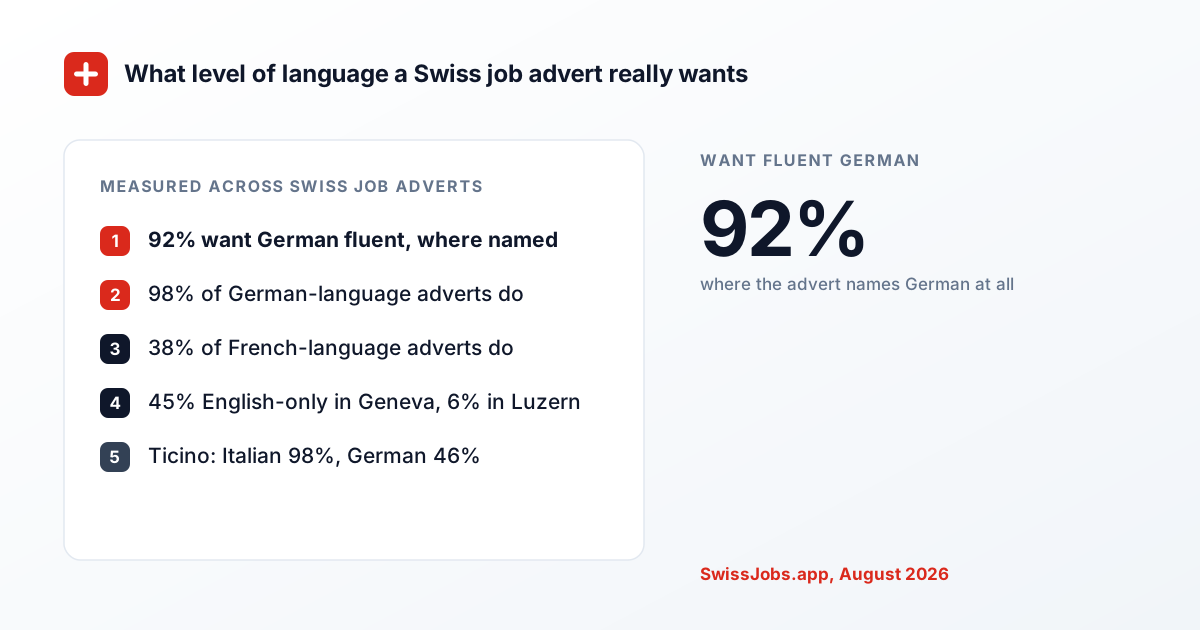
The answer in one line: where a Swiss advert names German, 92% of the time it wants a working or native level. A conversational level clears about 8%, and a basic one is close to nonexistent.
Read on its own, that number is a wall. It is not quite a wall, and the rest of this is about where the exceptions actually sit — because they sit in particular cantons, particular occupations, and above all in adverts written in a language other than the one they are asking for.
Short version
- What level of German do Swiss employers ask for?
- Where German is named at all, 92% of adverts want a working or native level — C1, or the wording “verhandlungssicher”. Roughly 8% accept a conversational level and a basic level is almost never enough on its own.
- Does “Deutschkenntnisse von Vorteil” mean I can apply with B1?
- Usually yes, and you can tell from the advert. In adverts written in German, 98% of German requirements are fluent-level. In adverts written in French only 38% are, and in English-language adverts 66% — there German is the second language and a conversational level is what is meant.
- Where in Switzerland can I work in English alone?
- Geneva leads at about 45% of language-stating adverts naming English and no national language, then Zug at 42%, Zürich and Valais at 41%, Basel-Stadt 25%, Vaud 21%. Bern, Lucerne and St. Gallen sit between 6% and 8%.
- Is a second language judged as strictly as the first?
- No. In Romandie, French is wanted fluent in 92% of the adverts that name it, German in 59%. In Ticino, Italian is wanted fluent in 98% of adverts naming it and German in fewer than half.
- What should I write in the language section of my CV?
- One CEFR level per language (A1–C2), near the top rather than on page two, using the same name for the language that the advert used. Add a certificate if you have one. Write the level you can hold on a phone call, because that is where it is checked.
Working on your CV right now? ATS CV checker: free, against a real Swiss job ad
See what a Swiss recruiter checks first
Upload your CV and get a score against a specific job ad in about 30 seconds — language levels, work permit, photo, how your achievements are phrased.
ATS CV checker, freeDo Swiss job ads say what language level they want?
Four in five Swiss adverts name at least one language, and three quarters of those name exactly one.
That one language is almost always the language the work is done in. Two languages appear in a fifth of them and three or more in 7% — the reception desks, the sales roles that cross the Röstigraben, the hospital jobs in Fribourg and Valais where the shift changes language halfway through.
The fifth of adverts that name nothing are not language-neutral. They are written in the language they expect. An advert in German that never mentions German is not being generous, it is assuming. If you cannot read the advert comfortably, you have most of your answer about the job.
This matters before you filter a job search by language. Filtering on stated requirements alone hides a slice of the market, and most of what it hides is German-speaking.
Measured across Swiss job adverts on SwissJobs.app, August 2026
Write a custom CV for every job you apply to
Most people send the same CV everywhere. The AI editor rewrites yours per application — Swiss format, the right language, in about a minute.
CV maker & resume builder: tailor it to this jobWhat does “good German” actually mean in a Swiss job ad?
Where German is named, 92% of adverts want it at a working or native level. The conversational band is about 8%.
In advert wording, a working level reads as “verhandlungssicher”, “stilsicher”, “fliessend” or plainly “sehr gute Deutschkenntnisse”. That is C1 in CEFR terms. “Deutschkenntnisse von Vorteil” is the conversational band, and it is the minority case rather than the standard one.
What surprised me is how little the level moves between occupations. Where German is named, the share wanting it fluent runs 95% in care roles, 96% in sales, 93% in the building trades and 94% in software. Cleaning and facility work is the one group where a conversational level turns up regularly, on a much smaller set of adverts.
So the occupation does not decide the level. It decides whether German is named at all: nine in ten care adverts that state a language name German, against six in ten in software. That is the lever a job seeker without German actually holds — choose the part of the market that does not ask, rather than hope for a softer version of the ask.
English is graded almost as strictly at 88%. French sits at 78% and Italian at 67%, and that gap is not about the languages being easier. It is about which of them is the working language of the job.
Measured across Swiss job adverts on SwissJobs.app, August 2026
See what a Swiss recruiter checks first
Upload your CV and get a score against a specific job ad in about 30 seconds — language levels, work permit, photo, how your achievements are phrased.
ATS CV checker, freeWhy does one advert say “von Vorteil” and the next “verhandlungssicher”?
Because of the language the advert itself is written in: 98% of German requirements in German-language adverts are fluent-level, against 38% in French-language ones.
This is the most useful split in the whole set. When the advert is written in German, German is the working language of the job and the level is not negotiable. When the advert is written in French, German is a second language somebody would like you to have, and roughly two thirds of the time a conversational level is what is meant.
English-language adverts sit between the two at 66%. Italian-language adverts that ask for German want it fluent about a quarter of the time.
The practical version: if your German is B1 or B2 and you have been reading “verhandlungssicher” as a closed door, start with adverts written in English and in French. Same country, same language named in the requirement, an entirely different bar.
And when you apply, write the level you have. An advert asking for conversational German will accept B2 and gains nothing from a claimed C2 — which is checked, informally, in the first ten seconds of the first phone call.
Measured across Swiss job adverts on SwissJobs.app, August 2026
Where in Switzerland can I work in English alone?
Adverts naming English and no national language beside it run at about 45% in Geneva and 6% in Lucerne.
Zug at 42%, Zürich at 41% and Valais at 41% sit just behind Geneva. Then Basel-Stadt at 25%, Vaud at 21%, Fribourg at 13%, and Bern, St. Gallen and Lucerne between 6% and 8%. Counted across the adverts where the canton is known, among those that state a language at all.
What drives this is the employer mix, not the canton’s own language. Geneva has the international organisations, Zug the holding companies, Zürich the banks and the software floors, Valais the research and industrial employers around Sion and Visp. A canton is not English-friendly; some of its employers are, and they cluster.
Occupation compounds geography. Among adverts that state a language, 37% of software roles ask for English alone, 22% in consulting and finance, and effectively none in care. If you are looking for the English-speaking part of the Swiss market, it is those two occupation groups in those four cantons, and the rest is a much longer route.
Measured across Swiss job adverts on SwissJobs.app, August 2026
Is a second language judged as strictly as the first?
No. In Romandie, French is wanted fluent in 92% of the adverts naming it and German in 59%.
Ticino is starker still. Italian is named in 79% of Ticino adverts that state a language, and 98% of those want it fluent. German is named in 22% of them and fewer than half of those want it fluent. English appears in 29%.
The pattern holds across the country: the language the work happens in is graded strictly, the second one is graded on usefulness. Nobody in Lugano expects your German to be the German of a Zürich law firm. They expect you to handle a supplier call without switching to English halfway.
Which is the argument for putting the second language on the CV even when it is not strong. B2 French on an application in Bern is a real advantage, and leaving it off because it is not perfect throws away the line that separates two otherwise identical applications.
Measured across Swiss job adverts on SwissJobs.app, August 2026
What should the language section of my CV say?
One CEFR level per language, placed where it is read in the first pass, in the same words the advert used.
Levels first. A1 to C2, one per language, near the top or in a right-hand column rather than under the hobbies on page two. “Deutsch: gut” is not a level: a screener reads it as a hedge, and it gives a search nothing to match.
Certificates if you have them — Goethe, telc, DELF, CELI, or a fide certificate, which is the one both Swiss employers and the migration authorities recognise. If you have none, state the level plainly and say where you use it. “C1, daily working language for three years” carries more than a certificate nobody asked for.
Two very different readers check this line. The software matches the language named in the advert against the language named in your CV, and it matches words rather than ability — so if the advert says Deutsch, the CV should say Deutsch, not German. The person who opens the file afterwards is reading your previous employers, what you delivered there and whether the skills fit, and on the first call they will place your level inside a minute. Write the level you can hold in that call.
Mother tongue is written as such. Swiss German is rarely required outright, and where it is, what is meant is understanding it rather than speaking it — “German C1, understands Swiss German” is a useful line when it is true and an expensive one when it is not.
What I would use
Two of these are ours and one is not. The order is the order I would use them in.
- SwissJobs job searchour tool
Ours. Swiss openings from across the market in one place, filterable by canton and by language — which is where every figure in this article was counted.
SwissJobs job search SwissJobs CV Check our tool
Ours, free. Run your CV against one specific advert and see what a Swiss screener notices first: permit line, language levels and where they sit on the page, the last two jobs.
Try it free- fide
Neutral and official. The Swiss language certificate system for German, French and Italian — the one that carries weight with employers and with the authorities, unlike a self-declared level.
Visit site
The short version: the level is a smaller obstacle than it looks, and the advert tells you which kind of demand you are reading. Fluent German is genuinely required in most adverts that name German — and most of those are adverts written in German, for jobs done in German all day.
Outside that, in adverts written in English or French, in Geneva, Zug, Zürich and Valais, and in software, consulting and research, a conversational level is what is actually meant. There an honest B2 is worth more than an inflated C1, because the inflated one ends on the first phone call.
All figures measured across Swiss job adverts on SwissJobs.app, August 2026. They drift from month to month. The shape of them does not.
The tools compared
We checked 16 Swiss and international application tools on their own pages — prices, free tiers, and what is actually included.