What do Swiss recruiters look at first on a CV?
Swiss recruiters are receiving hundreds of applications per job right now — from Switzerland and from across the EU — and in the industries hit hardest by the AI hiring slowdown it is worse than that. Standing out is genuinely difficult.
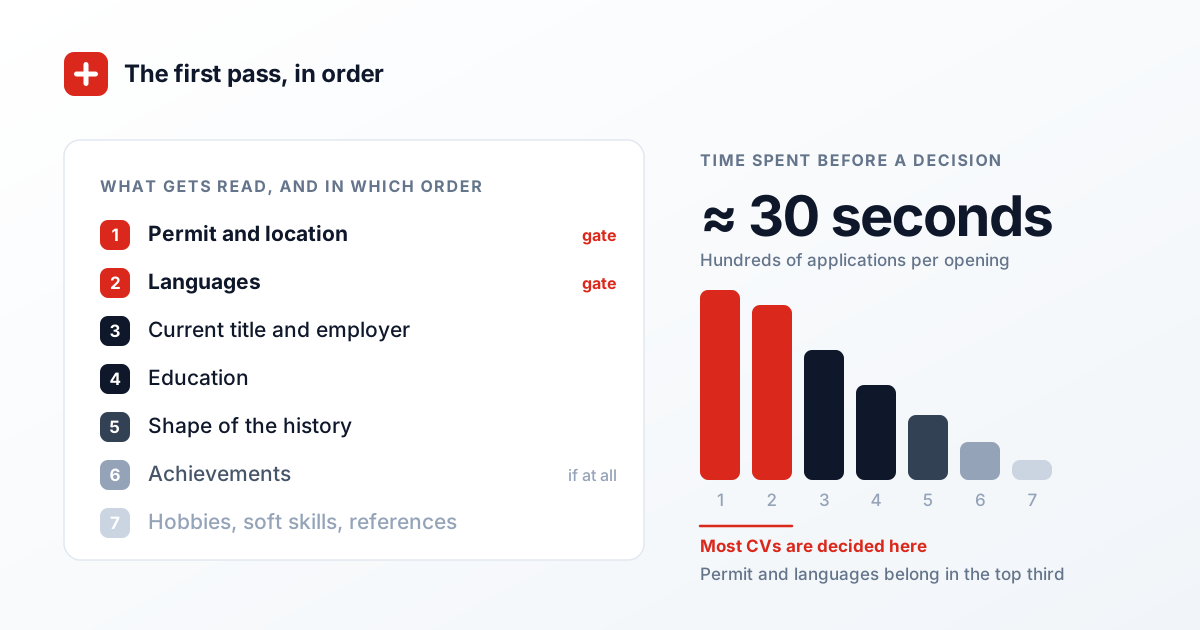
A lot of those applications come from outside Switzerland, which changes what gets checked first. These are the priorities I noticed. The first CV pass is fast — maybe 30 seconds — and it seems to run in a fixed order.
Short version
- What do Swiss recruiters check first on a CV?
- Permit and location. Before anything else gets considered, the question is whether you can be hired without a work-permit process and whether you are already in the country. It functions as a yes/no gate, and "unclear" gets treated as no.
- How important are languages on a Swiss CV?
- They are the second gate, and in Switzerland they are a hard filter rather than a soft preference. If you do not hit the language line stated in the ad, that alone eliminates more candidates than anything else on the page.
- Does your current job title matter in Switzerland?
- Yes, a lot. The third check is whether you are already doing roughly this job, at roughly this kind of company. "Has done this at our scale" carries more weight in Switzerland than a strong but differently-shaped background.
- Does job-hopping hurt in Switzerland?
- Yes. Progression, tenure and gaps are read as a pattern, and short tenures are judged more harshly in Switzerland than in the US or UK. Longer stays are the norm and the CV is read against that norm.
- Where do achievements come in when a Swiss recruiter reads a CV?
- Sixth, if at all. Achievements only get read once the CV has already cleared permit, language, title, education and career-shape checks — which is exactly why they need to be scannable numbers, not buried in a paragraph.
- What should go in the top third of a Swiss CV?
- Permit status and languages. They are the first two things checked, so they belong on page one, in the top third — not on page two and not left to the motivation letter.
Working on your CV right now? ATS CV checker: free, against a real Swiss job ad
See what a Swiss recruiter checks first
Upload your CV and get a score against a specific job ad in about 30 seconds — language levels, work permit, photo, how your achievements are phrased.
ATS CV checker, freeWhat does a Swiss recruiter check first on a CV?
Permit and location. It comes before anything else, and it works as a gate.
The first question is not whether you are good. It is whether you can be hired without a work-permit process, and whether you are already here.
It felt like a yes/no gate that ran before anything else on the page got considered. And crucially, unclear got treated as no — nobody emails to ask. If it takes more than a second to establish, you are out of the fast lane.
Location matters partly because the market is concentrated. Zurich alone carries 2,344 of the 21,407 open postings we track, more than Bern and Geneva combined, and a recruiter in a smaller canton is reading your address as a question about commuting and relocation rather than as a formality.
21,407 published postings. SwissJobs.app inventory, 15 August 2026.
Write a custom CV for every job you apply to
Most people send the same CV everywhere. The AI editor rewrites yours per application — Swiss format, the right language, in about a minute.
CV maker & resume builder: tailor it to this jobHow much do languages matter on a Swiss CV?
Second, immediately after the permit — and it is a hard filter, not a preference.
Do you hit the language line stated in the ad? In this market that is not a nice-to-have that a strong profile can overcome.
From what I saw, it eliminates more people than anything else on the page. If the ad says C1 German and your CV says "German: good", you have created exactly the kind of ambiguity that item one already showed gets resolved against you.
The distribution is what makes this a hard filter rather than a preference. Of the 11,106 postings that require German, 10,797 want it at professional level and only 926 accept conversational — so there is almost no band where “good German” is good enough. Write the CEFR level you can defend and let the ad decide.
Across 11,106 postings requiring German. SwissJobs.app inventory, 15 August 2026.
See what a Swiss recruiter checks first
Upload your CV and get a score against a specific job ad in about 30 seconds — language levels, work permit, photo, how your achievements are phrased.
ATS CV checker, freeDoes your current job title and employer matter in Switzerland?
Third check: are you doing roughly this job already, at roughly this kind of company?
"Has done this at our scale" carries a lot of weight here. A scale-up and a corporate are not treated as interchangeable experience, and neither are adjacent job titles that involved the same work.
This is the point where a strong but differently-shaped background quietly loses to a duller, closer-matching one.
It also helps to know who is actually posting. Outside the staffing agencies, the biggest direct employers on our platform are Coop with 725 open roles, Luzerner Kantonsspital with 268 and On Running with 253 — retail, hospitals and a handful of internationals, which is a different mix from the one most job-search advice assumes.
Direct employers, staffing agencies excluded. SwissJobs.app inventory, 15 August 2026.
Does your degree matter for Swiss jobs?
Fourth: is the degree the right type for the role, not just the right level?
Engineering role, engineering school. Switzerland has a dedicated education path for almost everything, and the CV gets read against that path.
It is less about prestige than about type. The reader has a template in their head of what the correct background for this job looks like, and they are checking yours against it.
Does job-hopping hurt on a Swiss CV?
Fifth: the shape of the history — progression, tenure, gaps.
Nobody reads the detail yet at this stage. They read the outline: is this going somewhere, how long did each stay last, is there anything unexplained.
Job-hopping seems to be judged more harshly here than in the US or UK. Two-year stints that read as normal ambition elsewhere read as restlessness in Switzerland.
The shape of the market explains why this check is unforgiving. Titles containing senior, lead or head of outnumber junior, graduate and apprentice titles by nearly four to one — 2,410 against 631 — so the default Swiss opening is written for somebody already doing the job, and a CV that reads as a step up needs the achievements to carry it.
Title keywords across 21,407 postings. SwissJobs.app inventory, 15 August 2026.
When do Swiss recruiters actually read your achievements?
Sixth. Only if you made it this far — and often not at all.
This is the one that surprised me most. The work I was proudest of, the part I spent the most time writing, got read sixth.
Which is exactly why the numbers have to be scannable rather than buried in a paragraph. By the time anyone reaches them, the reader is skimming, not studying. A result that needs three lines of setup to land will not land.
Worth knowing what you are competing against: outside the staffing agencies, the largest single employers on the platform post hundreds of roles each, and a recruiter working through that volume is reading for evidence rather than for effort. Two lines with a number in them beat six lines describing a responsibility.
Do hobbies and soft skills matter on a Swiss CV?
Seventh, and honestly that is where they belong.
Hobbies, soft skills, references. They matter for fit, and they can come up later in a conversation.
They are not what got me the call. Give them the space that reflects that.
What should you change on your CV because of this order?
Move permit and languages to page one, top third. That is the whole takeaway.
Not page two. Not the motivation letter, which at this stage nobody has opened. One line each, above the fold: "Based in Zürich, B permit, no sponsorship required" and an explicit language line with levels.
The uncomfortable part of this list is that most rejections get decided on items one to four — none of which are about how good your achievements were. That is not a reason to write worse achievements. It is a reason to stop letting items one and two be ambiguous.
One more thing worth knowing before you rewrite anything: this market moves faster than it looks. 5,614 of the 21,407 postings we track were published in the last seven days — roughly one in four. A CV that is nearly right today is worth fixing this week rather than perfecting next month, because the openings you are aiming at will have turned over by then.
How to check your CV against those first seconds
If you want to see how your CV holds up in the first pass rather than guessing, a few Swiss tools worth knowing:
SwissJobs.app CV Check our tool
Ours, and free. Scores your CV against a specific job ad and against Swiss criteria — permit clarity, language line, title match — then generates a tailored CV with AI for each job.
Try it free
None of this is scientific. It is what I noticed applying in Switzerland, and what kept coming up in conversations with people going through the same thing.
Curious whether it matches your experience — or whether you read CVs in a completely different order.
The tools compared
We checked 16 Swiss and international application tools on their own pages — prices, free tiers, and what is actually included.